
Educational science board games can teach through strategy, trivia, puzzles, or playful exploration, and the right choice depends on how your family likes to learn. I rank Cytosis as the best overall for its focused cell-biology theme and strategic play, while Ecosystem stands out for habitat building and Periodic for making chemistry feel like a family strategy game. The main tradeoff is depth versus accessibility: science-heavy games can reward repeat play but may need adult guidance, while lighter trivia and guessing games are easier to start but teach less through sustained play. Age range, reading load, play time, and whether players prefer competition or collaboration also shape the fit. Read on for the full breakdown and a guide to matching a game with your players.

Prime made for students and young adults
- Fast, free delivery for dorm and study essentials
- Prime Video and Amazon Music included
- Member-only deals
Key Takeaways
- Cytosis and Genotype connect game actions to specific biology concepts, making them stronger choices for learners who want more than science-themed questions.
- Ecosystem gives players a way to think about habitats and relationships between species, while Guess in 10: National Geographic Animals suits quick animal-focused rounds.
- Periodic and Ion make chemistry the center of play, but they suit different interests: broad periodic-table strategy versus building compounds.
- Somebody and Organ Attack both focus on anatomy, yet their tones differ sharply: approachable body learning versus comic, irreverent card play.
- Science Trivia Challenge, the space trivia game, and Dr. Eureka favor quick questions or puzzles over building a deeper model of a scientific system.




| educational science board game | Age range | Players | Manufacturer |
|---|---|---|---|
| Genius Games Ion: A Compound B | 8 years and up | — | Genius Games |
| Ecosystem | 12 years and up | 2–6 | Genius Games |
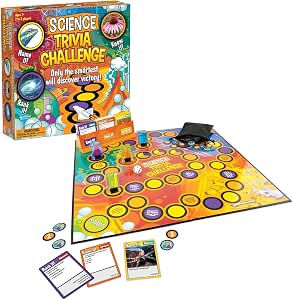
| MindWare Science Trivia Challe | 7 years and up | 4 | — |
| Cytosis: A Cell Biology Board | 10 years and up | 2, 3, 4, or 10+ | FLAHC |
| Somebody Human Anatomy Game | — | 2–4 | — |
| Genotype: Mensa Award-Winning | 8 years and up | — | Genius Games |
| The Awkward Yeti Organ Attack | 8 years and up | 2–6 | — |
| Periodic: A Game of the Elemen | 10 years and up | 2–6 | — |
| Skillmatics Guess in 10 Game | 6 years and up | 2 or more | Grasper Global Inc. |
| Space Board Game for Kids Ages | 8 years and up | 2–6 | — |
| Blue Orange Dr. Eureka Speed L | 8+ | 1–4 | Blue Orange |
More Details on Our Top Picks
Genius Games Ion: A Compound Building Game (2nd Edition)
Ion turns ionic bonding into a quick card-drafting challenge: players match positive and negative ions to make neutral compounds. That gives chemistry practice a direct role in play, rather than asking players to recall facts as in MindWare Science Trivia Challenge. Its 20–30-minute format is easier to fit into a class period or family game night than Cytosis, which is built around a longer cell-biology strategy game. The included science booklet supports discussion beyond the cards, and the radioactive-decay mode adds material for players ready for a harder challenge. The tradeoff is a narrower subject focus: buyers looking for broad science coverage or an especially gentle first game may prefer MindWare’s adjustable trivia or the younger-child-friendly Somebody. Ion is best when the goal is to practice chemistry concepts through repeated decisions.
Pros:- Players practice balancing positive and negative ions as part of the core game.
- Science booklet provides material for follow-up learning and discussion.
- Radioactive-decay mode offers an additional challenge for experienced players.
- Short 20–30-minute play time fits classroom sessions and family game nights.
Cons:- The chemistry focus may feel narrow compared with ecology, anatomy, or general science games.
- Younger players may find the concepts and rules demanding.
- The advanced radioactive-decay mode can be difficult for players new to the subject.
Best for: High-school science teachers and families with older children who want a focused, replayable introduction to ionic compounds and related chemistry concepts.
Not ideal for: Younger children who need very simple rules, solo players, or groups seeking broad science topics rather than chemistry practice.
- Age range:8 years and up
- Game type:Card game
- Edition:2nd Edition
- Model year:2022
- Included component:Science Behind Booklet
- Manufacturer:Genius Games
Our verdict“Choose Ion for short, chemistry-centered play that asks learners to apply ionic-bonding ideas, not just answer science questions.”
Ecosystem – A Family Card Game about Building Habitats
Ecosystem suits players who learn best by seeing how organisms and habitats relate. Building a habitat tableau makes ecological balance the organizing idea, setting it apart from Ion, which teaches a more tightly defined chemistry concept through compound construction. Its 15–20-minute play time also makes it a lighter commitment than Cytosis, whose cell-building strategy can run about 90 minutes. The draft-and-place approach offers more strategic choices than a simple fact quiz, while keeping the subject anchored in biodiversity and relationships among living things. The tradeoff is that it rewards interest in ecology more than broad science knowledge, and its listed age range starts at 12. With two to six players, it works for small groups but is not a solution for a large classroom playing together.
Pros:- Habitat-building makes ecological relationships and biodiversity central to play.
- Short 15–20-minute sessions are easier to schedule than Cytosis’s longer game.
- Offers strategic decisions rather than relying only on question-and-answer recall.
- Supports play with two to six people.
Cons:- The ecology subject may be less engaging for players without an interest in nature.
- The stated age range begins at 12, limiting its fit for younger children.
- A two-to-six-player limit makes it less practical for large-group classroom play.
Best for: Families, ecology educators, and small groups with players aged 12 and up who want a short strategy game about habitats and biodiversity.
Not ideal for: Buyers seeking broad science trivia, a game for younger children, or an activity for a group larger than six.
- Age range:12 years and up
- Players:2–6
- Play time:15–20 minutes
- Material:Cardboard
- Game type:Card game
- Manufacturer:Genius Games
- Model number:6050
Our verdict“Pick Ecosystem for a compact, strategy-led ecology game for small groups, rather than a general science quiz or a game for younger kids.”
MindWare Science Trivia Challenge Game – Educational & Fun for Families & Kids Ages 7 and Up
MindWare Science Trivia Challenge is the broadest-recall pick here: challenge cards let players encounter science topics through questions rather than building a model or system. That makes it a more flexible review activity than Ion, which concentrates on chemistry, or Ecosystem, which centers on ecology. Different difficulty levels can help mixed-knowledge groups stay involved, and observation tokens, dice, and pawns add a game structure to the questions. The listed age range begins at seven, younger than the stated ages for Ecosystem and Cytosis. The tradeoff is that trivia tests what players know more directly than it teaches how scientific systems work, so it offers less hands-on conceptual modeling than those strategy games. The product data lists four players, and repeated use may feel familiar once the card pool has been seen.
Pros:- Challenge cards cover science through a quiz-based format.
- Different difficulty levels can accommodate varying knowledge levels.
- Includes 216 cards, dice, tokens, and pawns for structured group play.
- The stated age range starts at seven, younger than Ecosystem or Cytosis.
Cons:- Trivia emphasizes recall more than the system-building play of Ion or Cytosis.
- The product data lists four players, limiting flexibility for other group sizes.
- Repeated sessions may feel repetitive after players have encountered many of the cards.
- Paper-based cards may wear with frequent use.
Best for: Families or educators looking for a broad science-question game with adjustable challenge levels for a group of four.
Not ideal for: Players who prefer strategic simulation over answering questions, or buyers seeking a solo game or a large-group format.
- Age range:7 years and up
- Players:4
- Number of cards:216
- Style:Trivia
- Language:English
- Educational objectives:Observation skills and social skills
- Container type:Box
Our verdict“Choose MindWare for varied science-question practice with a four-person group, but pick a simulation-style game for deeper subject modeling.”
Cytosis: A Cell Biology Board Game
Cytosis is the most substantial strategy choice in this group for learners focused on biology: worker placement has players build proteins, enzymes, hormones, and organelles within a human cell. Compared with the quick card play of Ion or the 15–20-minute sessions of Ecosystem, its estimated 90-minute play time gives the subject more room but asks for a larger time commitment. A fact booklet reviewed by PhDs supports the biology theme, while the mechanics give cell components a practical role instead of reducing the topic to trivia like MindWare Science Trivia Challenge. The tradeoff is complexity: younger players and casual groups may find the rules or session length hard to manage. Its educational value is strongest for players willing to learn a longer strategy game, not for a quick classroom warm-up.
Pros:- Worker placement ties cell components and biological products to player decisions.
- Covers proteins, enzymes, hormones, and organelles within a human-cell theme.
- Includes a fact-based booklet reviewed by PhDs.
- Offers a deeper strategy format than MindWare’s question-led trivia.
Cons:- Estimated play time of 90 minutes is longer than Ion or Ecosystem.
- Rules and strategy may be challenging for younger or casual players.
- The product data gives an unusual player-count listing of 2, 3, 4, or 10+.
Best for: Biology-minded families, older students, and educators planning a long, strategy-focused session on human cell functions.
Not ideal for: Groups needing a quick game, younger children who are new to strategy rules, or players who prefer light trivia and short rounds.
- Age range:10 years and up
- Players:2, 3, 4, or 10+
- Estimated playing time:90 minutes
- Genre:Educational, Family
- Included component:Cytosis: A Cell Biology Game
- Manufacturer:FLAHC
- Model number:GOT1006
Our verdict“Choose Cytosis when a group wants a long, strategic cell-biology session and has more time than Ion or Ecosystem requires.”
Somebody Human Anatomy Game – Educational Science Board Game for Kids Ages 6+ | Learn The Human Body, Organs & Systems | Talicor
Somebody Human Anatomy Game is the age-accessible anatomy pick: its stated minimum age of six is lower than Cytosis at 10 and Ecosystem at 12. Five different games give families more than one activity around organs and body systems, making this a better fit for younger children than Cytosis’s longer worker-placement strategy. It supports two to four players and needs no batteries, so it is suited to simple tabletop play rather than an electronic lesson. The tradeoff is depth: the product data describes anatomy learning and multiple games but does not specify the same kind of detailed strategic mechanics found in Cytosis, or a play time to help plan sessions. Small parts also call for care around young children. Choose it for an early introduction, not advanced biology study.
Pros:- Stated minimum age of six makes it a younger-child option than Cytosis or Ecosystem.
- Five different games provide variety within a human-anatomy theme.
- Focuses on organs and body systems through hands-on tabletop play.
- Requires no batteries and supports two to four players.
Cons:- The product details do not specify a play time or the depth of each of the five games.
- Small parts present a choking hazard for younger children.
- Its anatomy focus and simpler age positioning may not satisfy older learners seeking deeper strategy.
Best for: Families with children aged six and up who want several anatomy-themed tabletop activities for two to four players.
Not ideal for: Older learners looking for detailed biology strategy, large classrooms, or households where small game parts are unsuitable.
- Minimum age:6 years
- Players:2–4
- Included activities:Five different games
- Educational objective:STEM
- Operation mode:Manual
- Batteries:No batteries required
- Item weight:1.3 pounds
- Item dimensions:14.75 x 1.75 x 10.75 inches
Our verdict“Pick Somebody for a young child’s first anatomy game and choose Cytosis instead for longer, more involved cell-biology strategy.”
Genotype: Mensa Award-Winning Genetics Board Game about Mendel’s Pea Plants
Genotype is the strongest fit here for players who want to explore a specific scientific process, not just answer science questions. Its worker-placement and dice-drafting play models Mendel’s pea-plant experiments, giving genetics ideas a strategic context. Compared with Periodic, which makes chemistry its focus, Genotype narrows in on inheritance and rewards players for planning around experimental outcomes. Solo and multiplayer modes also make it more flexible for individual learning or a family game. That depth comes with a real cost: the mechanics may be demanding for younger players, even though the listed age starts at eight, and sessions can run as long as 75 minutes. I’d choose it for science-curious groups ready to spend time learning the rules, not for a quick introduction to science games.
Pros:- Models Mendel’s genetics experiments through strategic play
- Worker placement and dice drafting give scientific concepts a practical game context
- Supports both solo and multiplayer play
- Listed for ages 8 and up
Cons:- The mechanics may challenge younger or less experienced players
- A session can last up to 75 minutes
Best for: Families, educators, and science-minded players who want a strategic introduction to Mendelian genetics and value a solo option.
Not ideal for: Younger children or groups seeking a short, simple game; its layered mechanics and sessions of up to 75 minutes may be a poor fit.
- Age range:8 years and up
- Game modes:Solo and multiplayer
- Core mechanics:Worker placement and dice drafting
- Science topic:Mendelian genetics and pea-plant experiments
- Maximum play time:Up to 75 minutes
- Manufacturer:Genius Games
- Material:Cardboard
- Edition:Standard Edition
Our verdict“Choose Genotype for a focused, strategy-rich genetics lesson, but pick a simpler science game if your group needs a shorter or gentler start.”
The Awkward Yeti Organ Attack Card Game – Funny Anatomy Game, Medical Gift
Organ Attack makes anatomy the punchline and the lesson: players use afflictions and immunity cards to target or protect organs. That playful approach may help a mixed-age group stay engaged with human-body concepts, while the listed age of eight and up keeps it accessible to families. Compared with Somebody Human Anatomy Game, this pick leans harder on humor and card conflict rather than presenting itself as a straightforward anatomy-learning experience. The tradeoff is that the rules and science may feel light to players looking for strategic depth or a structured lesson. It supports two to six players, so it won’t serve a large gathering, and paper cards may show wear with frequent play. Its compact case makes it easier to pack than a full board game, but not a substitute for more detailed biology content.
Pros:- Uses organ-themed attacks and immunity cards to bring anatomy into play
- Humorous style can suit mixed-age family groups
- Supports two to six players
- Hardcover case is described as compact for storage and travel
Cons:- The simple, humorous format may not satisfy players seeking strategic depth
- Paper cards may wear with repeated handling
- Limited to six players
Best for: Families with children ages eight and up who want a humorous, card-based way to introduce organ names and anatomy.
Not ideal for: Older players seeking substantial strategy, a detailed anatomy curriculum, or a game for more than six participants.
- Age range:8 years and up
- Players:2–6
- Play time:30–90 minutes
- Components:Cards; set includes Organ Attack, Malady Madness, and Free Radical packs
- Material:Paper
- Dimensions:8 × 6 inches
- Theme:Humor and education
- Science topic:Human anatomy
Our verdict“Pick Organ Attack for a light, funny anatomy game, not for players who want the deeper scientific strategy of Genotype or Periodic.”
Periodic: A Game of the Elements | Periodic Table Strategy Board & Card Game for Kids & Family
Periodic is the chemistry pick for players who want the periodic table to shape their decisions, rather than serve as decoration for a trivia quiz. Strategic movement and set collection connect the elements to the way players pursue goals, giving the game a more involved feel than Organ Attack’s humorous anatomy card battles. Its two-to-six-player range suits families and small groups, and the listed age of ten and up signals that it is aimed at players ready for a more demanding science game. That focus also narrows its audience: younger children may find the rules difficult, and basic chemistry familiarity is listed as helpful. Compared with Genotype, Periodic covers chemistry rather than inheritance, so the better choice depends on which science topic your group wants to explore.
Pros:- Connects element knowledge and chemistry concepts to strategic movement
- Set collection gives the periodic table a role in gameplay
- Supports two to six players
- Designed for family or classroom play
Cons:- The rules may be challenging for younger players
- Basic chemistry familiarity may help players get more from the game
- The player limit makes it unsuitable for larger groups
Best for: Families, classrooms, and older children who want a strategic chemistry game tied to the periodic table.
Not ideal for: Younger players or groups without interest in chemistry; the rules may take learning time and the subject can be less approachable without basic familiarity.
- Age range:10 years and up
- Players:2–6
- Genre:Strategy
- Core mechanics:Strategic movement and set collection
- Science topic:Periodic table, elements, and chemistry
- Brand:Genius Games
- Edition:Standard Edition
- Set name:Periodic: A Game of the Elements
Our verdict“Choose Periodic for strategic, periodic-table-centered play, while Genotype is the better fit for groups more interested in genetics.”
Skillmatics Guess in 10 Game – National Geographic Animals
Guess in 10: National Geographic Animals turns animal facts into a question-and-guessing challenge. Players use yes-or-no questions and clues to narrow down an animal, making it a more portable, conversation-led option than the board-based strategy of Periodic. At ages six and up, it also reaches younger children than Genotype or Periodic, which can make it a practical first step toward thinking about animal traits and habitats. Its National Geographic facts add an educational hook, though the format is centered on identifying animals rather than exploring biology in depth. The game needs at least two players, and short rounds may not fill a longer game night on their own. Paper cards are easy to pack but may wear with frequent travel use.
Pros:- Questioning and clue use encourage logical deduction
- Includes National Geographic animal facts
- Age range starts at six, younger than Genotype and Periodic
- Travel box and card holder support portable play
Cons:- Requires at least two players
- Rounds may feel brief for players seeking a longer game
- Paper components may wear with frequent use
Best for: Families with children six and up who want a portable animal-facts game that encourages asking questions and narrowing possibilities.
Not ideal for: Solo players or buyers seeking a deep science lesson, a longer strategic session, or durable components for frequent rough handling.
- Age range:6 years and up
- Players:2 or more
- Game cards:50
- Clue cards:6
- Other components:1 card holder, instruction manual, and travel box
- Material:Paper
- Science topic:Animals and animal facts
- Manufacturer:Grasper Global Inc.
Our verdict“Choose Guess in 10 for quick, portable animal-fact play with younger children, rather than a deeper science strategy game like Periodic.”
Space Board Game for Kids Ages 8-12 – Educational Family Trivia Game
Space Board Game for Kids Ages 8–12 is a straightforward way to bring planets, moons, and other space facts into a family or classroom session. Its 20-minute estimated play time makes it a lighter commitment than Genotype, which can run up to 75 minutes and asks players to learn more involved strategy. The board, astronaut tokens, and 50 fact-filled cards give the trivia a space-exploration frame, while multiple difficulty levels can help adjust the challenge. This is a better match for children who enjoy reading and recalling facts than for players who want science concepts embedded in complex decisions, as in Periodic. The listed player limit is two to six, and the simple trivia format may leave older children or adults wanting more depth.
Pros:- Focuses on planets, moons, and other space objects
- Estimated 20-minute play time suits shorter activities
- Includes multiple difficulty levels
- Board, cards, and astronaut tokens create a clear space-exploration theme
Cons:- Trivia play may feel too simple for older children and adults
- Requires players to read and understand space facts
- Limited to two to six players
Best for: Families and educators looking for a short, space-themed trivia activity for children ages eight and up.
Not ideal for: Older or strategy-focused players, large groups, and children who find reading fact cards difficult.
- Age range:8 years and up
- Players:2–6
- Estimated play time:20 minutes
- Included components:50 cards, 6 astronaut tokens, and game board
- Educational objective:Learn about space and its objects
- Theme:Space travel
- Dimensions:8.66 × 8.66 × 0.04 inches
- Material:Cardboard
Our verdict“Pick this game for a short, accessible space-facts session; choose Genotype or Periodic if your group wants more involved scientific strategy.”
Blue Orange Dr. Eureka Speed Logic Puzzle Dexterity Game – 1-4 Players, Ages 8+
Dr. Eureka turns science-inspired play into a quick visual puzzle: players use challenge cards to arrange colored balls in test tubes, moving them without touching or dropping them. That combination makes it a more active, hands-on choice than Cytosis, which centers on cell biology, or the element-focused strategy of Periodic. Its main educational strength is practicing sequencing, focus, and spatial reasoning rather than teaching a detailed science topic. With solo play and a limit of four players, it can work for independent challenges or a small family group. The tradeoff is that quick dexterity tasks may frustrate players who prefer relaxed discussion, and the small pieces call for supervision around younger children. I’d choose it for energetic puzzle rounds, not as a stand-alone science lesson.
Pros:- Combines visual logic puzzles with hands-on dexterity practice.
- Solo and group modes give one game flexible use.
- Challenge cards provide a clear task for each round.
- Compact player range suits individual play and small family groups.
Cons:- Teaches general reasoning more directly than specific science facts.
- Small balls and tubes require careful handling and supervision around young children.
- A maximum of four players excludes larger groups.
Best for: Families with children aged 8 and up who want short, hands-on logic challenges that can be played solo or in a small group.
Not ideal for: Buyers seeking detailed instruction in biology, chemistry, or other science content, or families with children too young to handle small game pieces safely.
- Brand:Blue Orange
- Genre:Strategy
- Players:1–4
- Age range:8+
- Edition:Standard Edition
- Included components:12 test tubes, 24 balls, 54 challenge cards, illustrated rules
- Model number:03300
- Manufacturer:Blue Orange
Our verdict“Choose Dr. Eureka for lively, tactile logic practice; pick Cytosis or Periodic instead if learning a specific science subject is the priority.”

How We Picked
I compared each game by how directly its main mechanic supports its science topic, how approachable it appears for its intended age group, and how well it can hold attention beyond a single lesson. I also considered the kind of learning each format encourages: strategy and systems thinking, recall and discussion, or hands-on logic. A game can be educational without being a strong fit for every family, so I weighed reading demands, subject specificity, and the likely need for adult explanation as part of usability.
The ranking favors games that combine a clear science connection with meaningful play, rather than games that rely mainly on a science label or a stream of questions. Cytosis leads because its cell-biology theme is closely tied to the play experience; Ecosystem and Periodic follow as compelling system-building options in ecology and chemistry. More specialized, lighter, or puzzle-led picks rank lower for broad appeal, but may be the better choice for a particular age, subject, or play style.
| educational science board game | Manufacturer |
|---|---|
| Genius Games Ion: A Compound B | Genius Games |
| Ecosystem | Genius Games |
| MindWare Science Trivia Challe | — |
| Cytosis: A Cell Biology Board | FLAHC |
| Somebody Human Anatomy Game | — |
| Genotype: Mensa Award-Winning | Genius Games |
| The Awkward Yeti Organ Attack | — |
| Periodic: A Game of the Elemen | — |
| Skillmatics Guess in 10 Game | Grasper Global Inc. |
| Space Board Game for Kids Ages | — |
| Blue Orange Dr. Eureka Speed L | Blue Orange |
Factors to Consider When Choosing Educational Science Board Games
Choosing a science game is less about finding the most facts on the box and more about matching the learning style to the players. I would start with the subject they already ask about, then check how the game turns that subject into decisions, conversation, or practice. These broader factors can help prevent a game from feeling like homework—or from being too light for the learner.
Choose a Learning Mechanic, Not Just a Science Topic
Science games can teach through resource choices, visual matching, trivia, deduction, or timed puzzles, and those formats produce different kinds of engagement. Strategy mechanics can encourage players to connect cause and effect, while trivia mostly rewards recall and conversation. A child who likes solving problems may stay with a puzzle game longer than a question-and-answer format, even if both cover science. Avoid choosing only by a familiar subject name; a biology game can still feel like memorization if its play does not involve biological relationships. Match the mechanic to what players enjoy doing when the science content is not in front of them.
Check Age Fit Beyond the Box Label
Age guidance is a starting point, not a guarantee that a game will suit every player in that range. Reading fluency, comfort with abstract ideas, attention span, and familiarity with the subject can all change how accessible the rules feel. Younger players may manage a game with a clear visual board but struggle with dense card text or unfamiliar terminology. Older children can still enjoy simpler games when they want a quick family round, so difficulty alone is not a measure of value. If ages vary widely, look for ways adults can support younger players without taking over their decisions.
Decide How Much Science Depth You Want
Some games use science as the setting for entertaining play; others ask players to engage with scientific categories, processes, or systems. Neither approach is automatically better, but they serve different goals. If your aim is to reinforce a school topic, check whether the game repeatedly uses the concepts you want to practice rather than mentioning them once. For a relaxed family activity, lighter content may be easier to bring to the table. A common mistake is expecting a game to replace a lesson; it usually works better as a prompt for questions and follow-up discussion.
Consider Replayability and Group Size
A game that teaches a lot in one sitting may have limited appeal if the same questions or puzzle solution quickly become familiar. Variable setups, player choices, or changing combinations can help maintain interest, while trivia games may depend more on how much players enjoy repeating question rounds. Think about who will actually play: a game suited to a small group may not work as well at a large family gathering. Player count also affects waiting time and how often each person makes a decision. Before buying, compare the intended group size and expected session length with your household’s usual game-night habits.
Balance Hands-On Play With Setup and Rule Load
Pieces, cards, and physical puzzles can make abstract ideas easier to grasp, but they may also require sorting, careful handling, or more setup. A quick card game can be easier to bring out on a school night, while a more involved board game may suit a planned family session. Rule complexity matters too: if an adult must explain every turn, the game may not become an independent activity for younger players. On the other hand, a modest learning curve can be worthwhile when it supports strategic choices and repeat play. Look for a practical balance between tactile engagement and the time your group can give to setup and teaching.
Frequently Asked Questions
Which game is the best starting point for a child who is curious about science but new to strategy games?
I would start with a format the child already enjoys, rather than choosing the game with the most advanced subject matter. Science Trivia Challenge and Guess in 10: National Geographic Animals offer more direct question-based play, while Somebody introduces anatomy through a focused topic. If the child likes making choices and building a plan, a strategy-led game may hold attention better, though an adult may need to help with unfamiliar terms. Keep the first session relaxed and treat questions as conversation starters rather than a test.
Are science trivia games as educational as strategy games?
They can support learning, but they tend to emphasize different skills. Trivia games build recall and can expose players to facts they may want to explore further, while strategy games often ask players to apply relationships or make choices within a system. Neither format guarantees lasting understanding on its own. For a learner who enjoys facts and quick rounds, trivia may get more use; for someone who likes planning, a strategy game may sustain interest longer. A useful follow-up is to ask players why an answer or move makes sense.
How can I choose between the anatomy games in this roundup?
Start with the tone and the kind of body knowledge you want to encourage. Somebody is the more direct pick for introducing organs and body systems to younger children, while Organ Attack takes a comic card-game approach that may appeal to players who enjoy irreverent humor. Humor can help a topic feel approachable, but it may not suit every family or learning setting. If the game will be used for structured learning, check whether its style and terminology fit the players. If the goal is a casual family game, prioritize the tone the group will enjoy bringing back out.
Should I pick a game that matches a current school unit?
A matching topic can make a game feel relevant and give children another way to talk through what they are studying. Still, the mechanic matters: a game that asks players to use ideas may offer more reinforcement than one that only names the subject. Check whether the science content is central to turns and decisions, and whether the player’s current understanding fits the game’s vocabulary. A game outside the current curriculum can also spark curiosity and broaden interests. Use school alignment as one selection factor, not the sole reason to buy.
What should I choose for a mixed-age family that wants one game everyone can enjoy?
Look for rules that can be explained quickly and play that gives younger and older players ways to contribute. Trivia can work when players are happy to share knowledge, but gaps in age or experience may make competition feel uneven. Games built around visual choices or collaborative discussion can reduce that imbalance, depending on the group’s preferences. An adult can also read prompts aloud or help younger players understand a rule without choosing moves for them. If one game must serve several ages, a short trial round before committing to a longer session is a practical way to check the fit.
Conclusion
Best overall: I would choose Cytosis for families seeking science-led strategy with a clear biology focus. Best value for casual play: Science Trivia Challenge is a sensible match for families who want quick rounds and broad question-based play. Best premium-style pick: Genotype suits players looking for a more specialized genetics theme and a game built around its scientific subject. For beginners, I would start with Somebody for accessible anatomy or Guess in 10: National Geographic Animals for quick animal questions. Choose Ecosystem for habitat relationships, Periodic or Ion for chemistry, the space trivia game for astronomy interest, or Dr. Eureka when logic puzzles matter more than science facts. The best fit is the one whose play style your group will want to repeat.
Halloween Picks
halloween
As an affiliate, we earn on qualifying purchases.