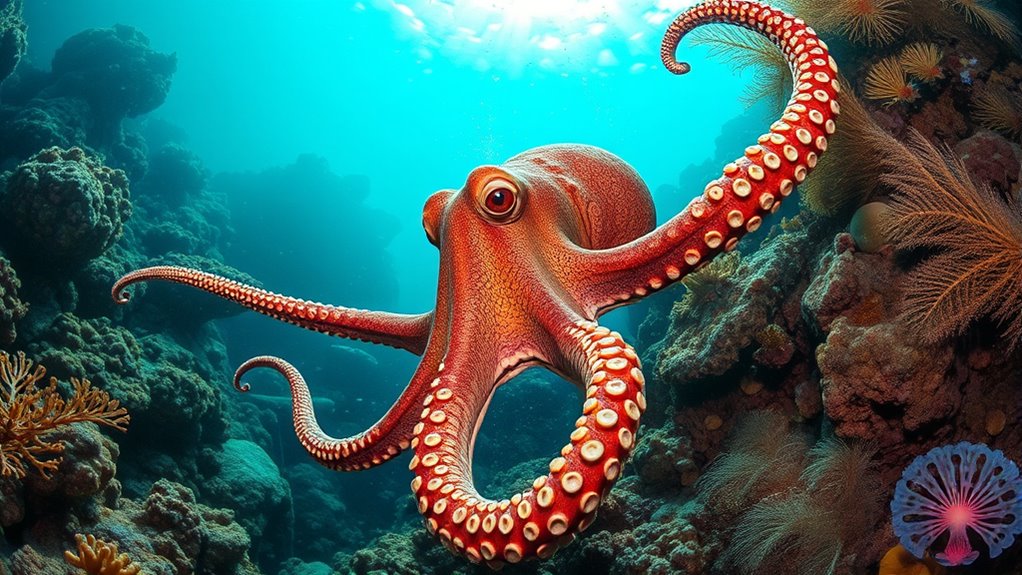

The Pacific giant octopus is a remarkable marine animal known for its impressive size, changing colors, and clever behaviors. It lives along North Pacific coasts, hiding in rocky reefs, kelp forests, and crevices, often staying close to its den. It hunts crabs, shrimp, and fish while avoiding predators with quick jets of water and camouflage. If you want to uncover more about this remarkable creature’s life and secrets, there’s much more to discover below the surface.

Prime made for students and young adults
- Fast, free delivery for dorm and study essentials
- Prime Video and Amazon Music included
- Member-only deals
Key Takeaways
- The Pacific giant octopus can grow up to 3 meters long and weighs over 270 kg, showcasing remarkable size and adaptability.
- It inhabits depths from shallow reefs to nearly 2,000 meters, preferring cool, nutrient-rich waters and complex habitats like kelp forests.
- This species exhibits rapid color and texture changes for camouflage, communication, and predator evasion, utilizing its soft body and unique markings.
- It creates and defends dens using debris and shells, stays mostly nocturnal, and relies on excellent vision and memory for navigation and survival.
- Reproduction involves females guarding eggs for weeks until death, while males die shortly after mating, highlighting their brief, intense life cycle.
As an affiliate, we earn on qualifying purchases.
The Impressive Size and Appearance of the Pacific Giant Octopus
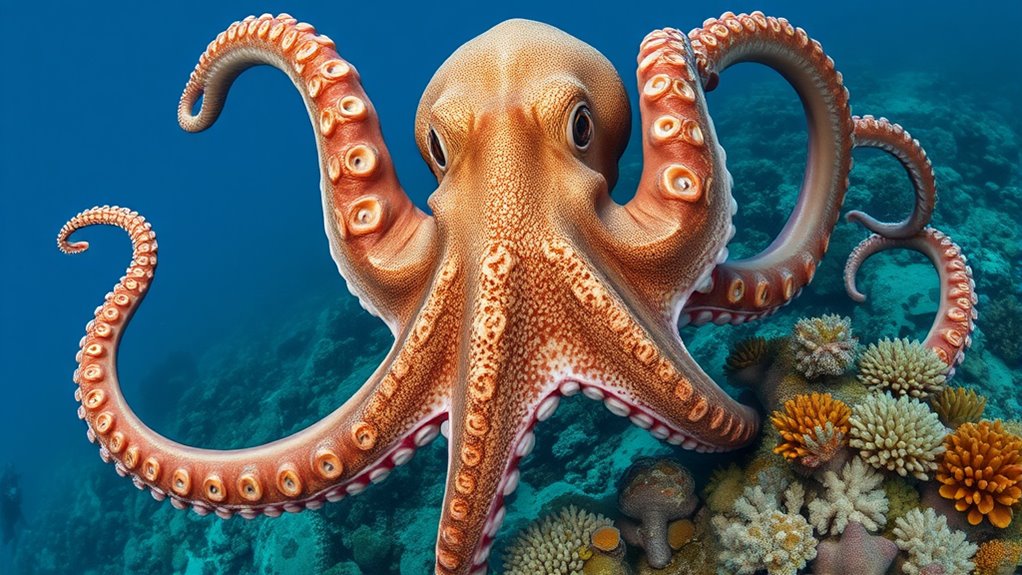
The Pacific giant octopus is truly a marvel of the ocean’s creatures, known for its enormous size and striking appearance. You’d be amazed to see one grow up to 300 centimeters long and weigh as much as 272 kilograms. Its body color varies from pale grey to dark red, thanks to chromatophores that change color rapidly for camouflage. You’ll notice its bumpy ridges, or “frills,” and distinctive markings, like white spots on the head in some regions. Its soft body features eight arms lined with two rows of suckers, perfect for grabbing prey and exploring its environment. When threatened, it can shoot water jets from its mantle cavity to escape quickly. This combination of size, color, and adaptability makes the Pacific giant octopus a true oceanic giant. Its remarkable abilities to change color and texture are crucial for survival in diverse habitats. Additionally, its camouflage techniques allow it to blend seamlessly into the surroundings, making it a master of concealment, aided by its color-changing capabilities, which are among the most advanced in the animal kingdom. The octopus’s intelligence and adaptability are further enhanced by its problem-solving skills, enabling it to navigate complex environments and avoid predators effectively.
Where and How It Lives in the North Pacific

You’ll find the Pacific giant octopus along the temperate coastlines of the North Pacific, from California to Japan, living in rocky reefs, kelp forests, and crevices. They prefer cooler waters between 7-12°C and occupy depths from shallow intertidal zones to nearly 2,000 meters deep. These octopuses move between dens, which they often defend and decorate, using landmarks and visual cues to navigate their surroundings.
Range and Distribution
Pacific giant octopuses inhabit the temperate coastal waters of the North Pacific, ranging from southern Baja California to the Aleutian Islands and across to Russia, Japan, and Korea. You’ll find them from shallow intertidal zones to depths of 2,000 meters, especially in cooler, nutrient-rich waters between 7-12°C. They prefer rocky reefs, kelp forests, and boulder areas, often denning in crevices or under debris. Some populations, like in Japan, migrate seasonally between inshore and offshore waters based on water temperature. Their distribution is patchy, with small home ranges less than 5 km². They tend to stay close to their dens, which they defend fiercely. Their range reflects adaptability to diverse habitats across the North Pacific, from coastal shallows to deep-sea environments. The presence of denning sites is crucial for their survival and reproductive success across different regions, demonstrating their behavioral adaptations to varying environmental conditions. Additionally, their ability to modify their surroundings and utilize available shelter areas showcases their environmental flexibility.
Preferred Habitats
Giant octopuses thrive in a variety of complex habitats across the North Pacific, choosing environments that offer ample shelter and abundant prey. You’ll find them in rocky reefs, boulder fields, and dense kelp forests, where they can easily hide from predators. They often make dens in crevices, under boulders, or within debris—sometimes including human artifacts—where they stay for weeks or months. These sites provide protection and access to food, like crabs, shrimp, and fish, which they hunt actively nearby. Cooler, nutrient-rich waters between 7-12°C suit them best. They prefer areas with good visibility and stable substrates, enabling them to remain concealed and efficiently ambush prey while avoiding threats. Their habitat choices are driven by safety, food availability, and ideal conditions for survival. Additionally, their complex habitats support their behavior of denning and hunting, ensuring their survival in the wild. The availability of shelter and prey directly influences their distribution and success in different regions. Moreover, the presence of ideal environmental conditions contributes to their ability to thrive and adapt to changing surroundings.
Denning and Movement
Have you ever wondered how the Pacific giant octopus navigates its environment and chooses where to settle? You’ll find that it relies on visual cues and landmarks to move between dens and feeding areas. They often settle in rocky crevices, under boulders, or among kelp forests, where they create secure dens using debris and shells. Movement is deliberate and mostly nocturnal, with most activity confined within a small home range of less than five square kilometers. These intelligent animals use their excellent eyesight and memory to locate dens and hunting grounds, avoiding predators and seeking prey. They rarely travel far from their chosen habitats, preferring stable, nutrient-rich environments that support their solitary lifestyle and complex denning behavior. Vertical storage solutions can also be used in their natural habitats to help manage space and resources effectively. Additionally, their ability to adapt to diverse environments reflects their behavioral flexibility and survival skills. They demonstrate a remarkable capacity for habitat selection, ensuring their survival across various conditions, and their adaptability is key to thriving in changing ocean landscapes.
The Unique Life Cycle and Reproductive Habits
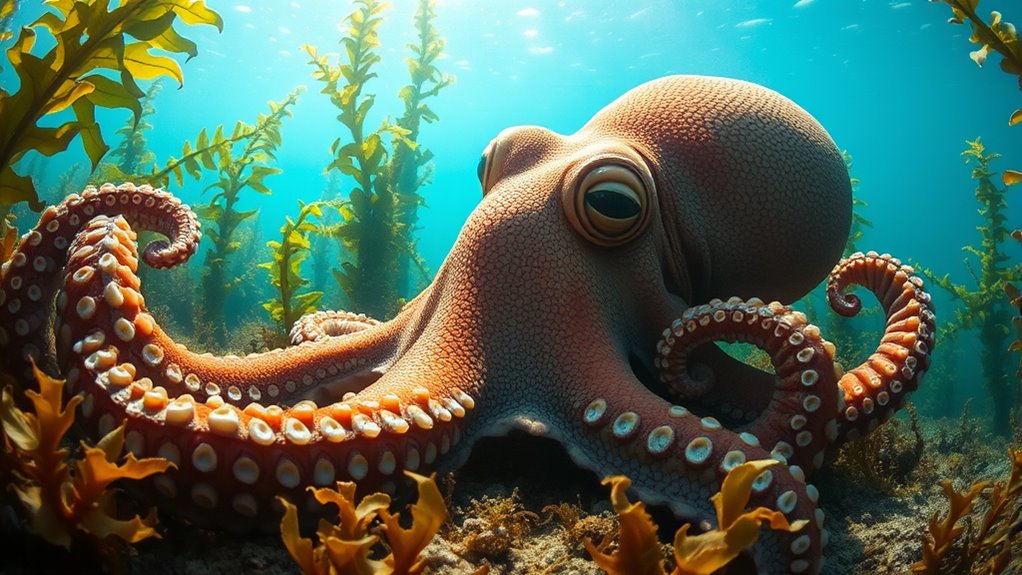
The life cycle of the Pacific giant octopus is marked by rapid growth, brief maturity, and a dramatic end. You’ll notice they grow quickly, reaching full size within a year, often living just 3 to 5 years. After hatching, tiny octopuses are miniature versions of adults, and they immediately start exploring their surroundings. Males seek out females during the breeding season; they transfer spermatophores to the female’s mantle cavity. Females lay up to 100,000 eggs, which they guard diligently for about 40 days without eating. During this time, they stay close to their eggs, often dying shortly after they hatch. Males generally die soon after mating. This short, intense life cycle emphasizes growth, reproduction, and a swift, natural end.
Behavior, Camouflage, and How It Navigates Its Environment
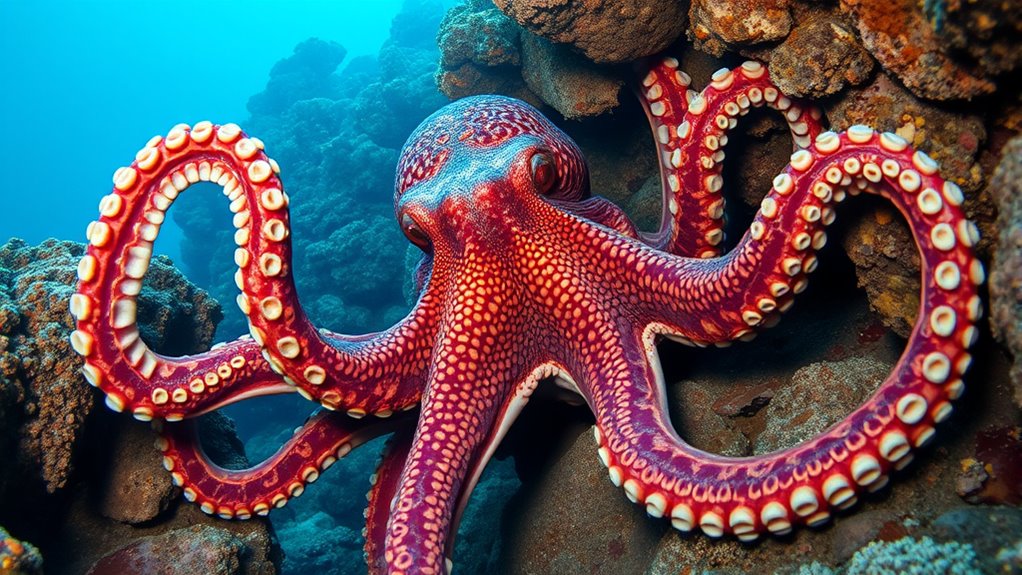
Despite their size, Pacific giant octopuses are remarkably shy and elusive, often spending most of their time concealed in dens or camouflaged among their surroundings. You might notice their ability to change color and texture instantly, blending seamlessly with rocks, kelp, or debris. They move cautiously, using landmarks and visual cues to navigate between dens and feeding areas. Their behavior is primarily nocturnal, staying still or hidden during the day, and becoming active at night. They create middens—piles of shells and prey remains—that help them mark territory and avoid predators. Their camouflage is so effective that you often only sense their presence through subtle movements or color shifts, evoking both admiration and awe for their mastery of survival. Additionally, their behavioral adaptations play a crucial role in their ability to avoid predators and thrive in the deep-sea environment. These adaptations include their ability to change color rapidly, which is essential for both camouflage and communication.
What It Eats and Who Predates on It
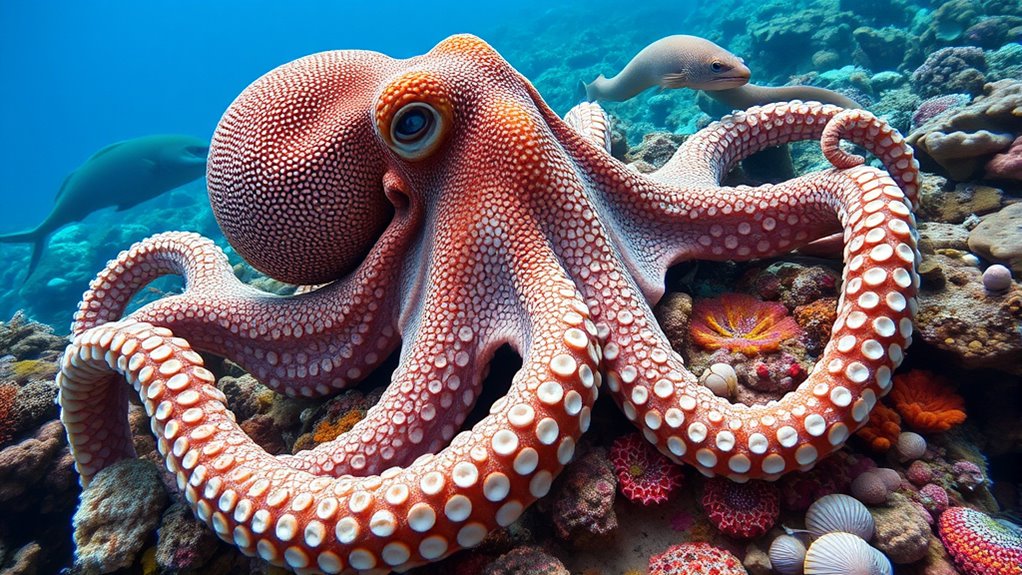
What does the Pacific giant octopus feed on? You’ll find it’s a skilled predator that hunts a variety of prey within its territory. Its diet includes:
- Shrimp and small crustaceans, caught with its arms and beak.
- Crabs, which it easily manipulates and cracks open.
- Bivalves like scallops and clams, using its strong beak to access the meat inside.
- Fish, which it ambushes or pursues in the water.
- It masterfully utilizes camouflage techniques such as coloration changes and quick jets of water to surprise prey. Its natural predators include sea lions, marine mammals, lingcod, and halibut. To defend itself, it employs camouflage, jet propulsion, and its den as a refuge. Additionally, it relies on its adaptive behaviors to evade detection and attack from predators.
Challenges to Its Survival and Conservation Efforts
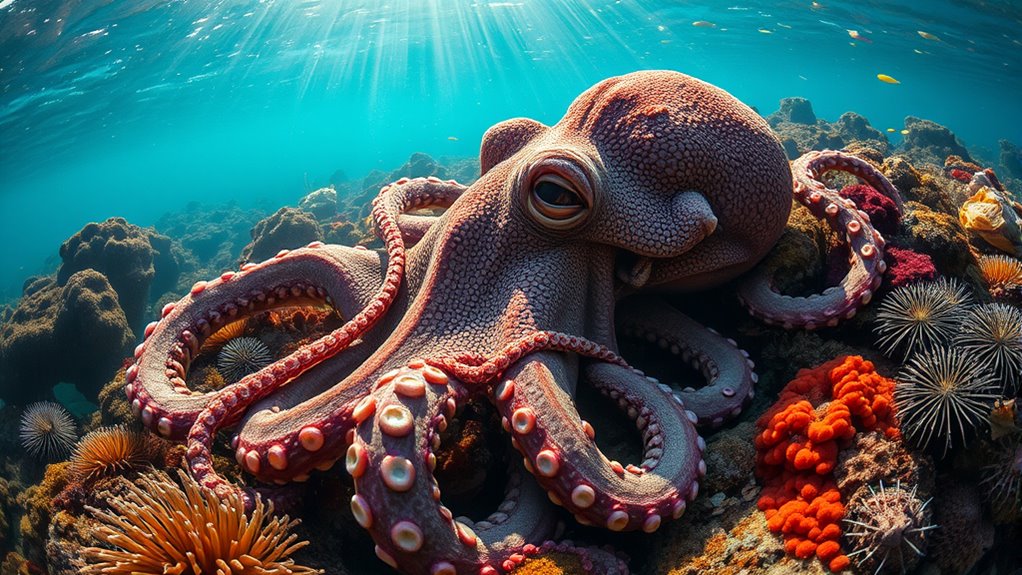
You should know that climate change is shifting the Pacific Giant Octopus’s habitat to deeper, cooler waters, making it harder for them to find suitable living spaces. Fisheries bycatch risks increase as they become accidental targets in commercial traps, threatening their numbers. Additionally, limited population data makes it difficult to assess their true status, complicating conservation efforts. Understanding their species-specific needs is crucial for developing effective protection strategies. Protecting their natural habitat is essential to ensure their survival amid these environmental changes.
Climate Impact on Habitat
How does climate change threaten the Pacific giant octopus’s habitat? Rising temperatures and ocean acidification disrupt the cooler, oxygen-rich waters they prefer. This forces them to seek deeper, less suitable habitats, risking population decline. Climate impacts include:
- Warmer waters pushing them into less favorable zones.
- Reduced oxygen levels impairing their respiration.
- Coral and kelp decline destroying dens and hunting grounds.
- Increased storm activity damaging rocky reefs and kelp forests.
- Vulnerabilities to AI-driven monitoring and conservation strategies that could help mitigate some of these impacts.
- Changes in drivetrain components may hinder their ability to adapt or escape threats effectively.
These changes threaten their ability to find shelter and prey, impacting survival. As their habitat shifts, they face greater competition and predation. Conservation efforts must address these climate effects to preserve their delicate ecosystems and ensure their future. If unmitigated, climate change could markedly reduce their populations.
Fisheries Bycatch Risks
Fisheries bycatch poses a significant threat to the Pacific giant octopus by unintentionally capturing it in commercial fishing gear, such as pots and trawls. When these octopuses get caught, they often suffer injuries or die, even if they aren’t the target species. Your fishing practices can directly impact their survival, especially since they inhabit areas heavily fished for other marine life. Bycatch can remove individuals before they reach reproductive age, disrupting local populations. Because the octopus’s secretive nature makes it hard to monitor, these accidental captures can go unnoticed, further threatening their stability. Reducing bycatch requires adopting more selective fishing methods, using gear modifications, and implementing protected areas, all of which can help safeguard this remarkable species from unintentional harm.
Limited Population Data
The true extent of the Pacific giant octopus’s population remains largely unknown due to limited data, posing a significant challenge for conservation efforts. This makes it difficult to assess their true numbers and health. Without precise information, implementing targeted protection measures is tough. Here are key issues:
- Their secretive, nocturnal behavior limits sightings, making surveys unreliable.
- Many populations inhabit remote or deep waters, reducing research opportunities.
- Seasonal migrations and habitat variability complicate tracking efforts.
- Bycatch and habitat changes further obscure population trends.
This data gap hampers understanding of their resilience and responses to environmental threats. As a result, conservation strategies often rely on assumptions rather than hard evidence, which could hinder effective protection for this elusive species.
Fascinating Facts and Ongoing Research Discoveries
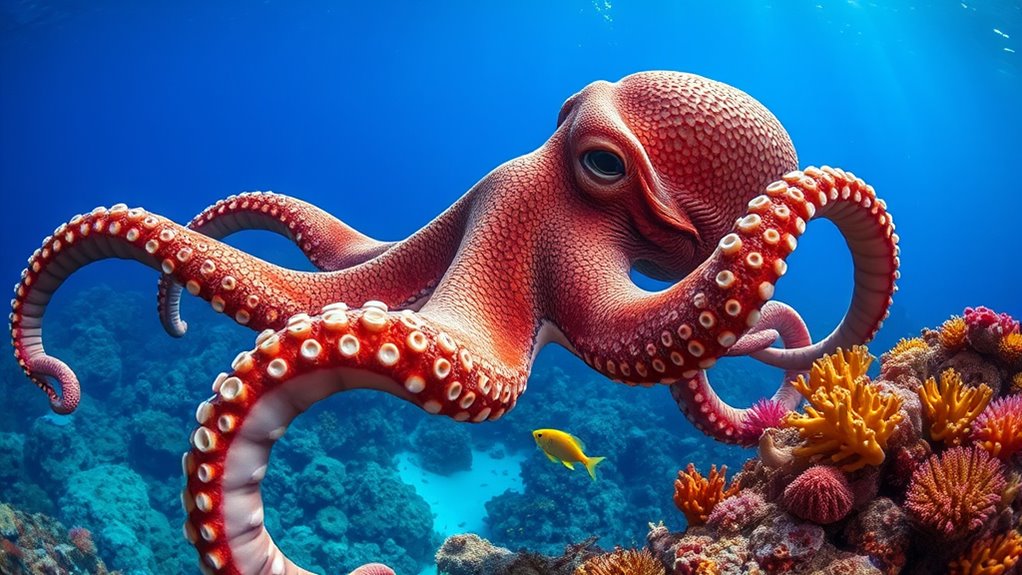
Recent research has uncovered astonishing facts about the Pacific giant octopus that deepen our understanding of its mysterious life. Did you know it can change color and texture in milliseconds, blending seamlessly with its surroundings? Scientists are also discovering its impressive problem-solving skills, like opening jars or orchestrating mazes. Researchers track their movements with advanced tagging, revealing surprisingly small home ranges and migration patterns tied to water temperature.
| Fascinating Fact | Research Discovery |
|---|---|
| Color-changing abilities | Rapid chromatophore control for camouflage |
| Complex problem-solving | Opening containers and escaping enclosures |
| Short lifespan and migration | Seasonal shifts between shallow and deep waters |
Frequently Asked Questions
How Do Pacific Giant Octopuses Communicate With Each Other?
You might be surprised to learn that Pacific giant octopuses communicate mainly through visual signals, like changing their color and skin texture rapidly to send messages. They also use body language, such as arm gestures and postures, to convey aggression, curiosity, or submission. Sometimes, they emit short, specialized sounds or release ink clouds to alert others or hide. These methods help them coordinate during mating or defend their territory effectively.
What Adaptations Help Them Survive in Deep-Sea Environments?
You might notice that Pacific giant octopuses adapt to deep-sea environments through their ability to change color and texture rapidly, helping them camouflage and avoid predators. Their soft bodies and flexible arms allow them to squeeze into tiny crevices for shelter. They also use jet propulsion for quick escapes and have a diet suited to deep waters, feeding on crustaceans and fish, which helps them thrive despite the pressure and darkness of the deep sea.
How Do They Choose and Modify Their Dens Over Time?
Think of their dens as personal fortresses, carefully chosen for safety and comfort. You see, they select rocky crevices, boulder shelters, or debris, then modify them by adding shells, rocks, and leftovers to reinforce or conceal their hideout. Over time, they enhance these sanctuaries by cleaning debris, making them more secure, and better suited for resting or hiding from predators, turning each den into a fortress tailored to their needs.
Can They Change Color to Express Emotions or Only for Camouflage?
You might think their color changes are just for camouflage, but they also express emotions. When you’re curious, you’ll notice the octopus can turn bright or mottled colors to show excitement, aggression, or distress. These rapid changes happen because of specialized skin cells called chromatophores, which respond to their mood, environment, or interactions. So, their color shifts serve both practical camouflage and social signaling.
What Impact Does Climate Change Have on Their Migration Patterns?
Climate change acts like a rising tide, washing over their world and shifting their migration patterns. You’ll find these giants moving deeper into cooler, oxygen-rich waters, chasing the chill to escape warming surface temperatures. As the ocean warms, their familiar haunts fade, forcing them into unfamiliar territory. This upheaval threatens their survival, disrupting their delicate balance and making their ancient, secretive journeys more unpredictable and perilous.
Conclusion
You’ve just learned that the Pacific giant octopus can grow up to 30 feet across and live up to five years in the wild. With its incredible size and clever camouflage, it’s a true marvel of the ocean. Despite facing threats like habitat loss, ongoing research helps safeguard this fascinating creature. Remember, every year, thousands of these octopuses are caught in traps, highlighting the importance of conservation efforts to ensure their amazing story continues underwater.
Fall Picks
fall essentials
As an affiliate, we earn on qualifying purchases.