
TL;DR
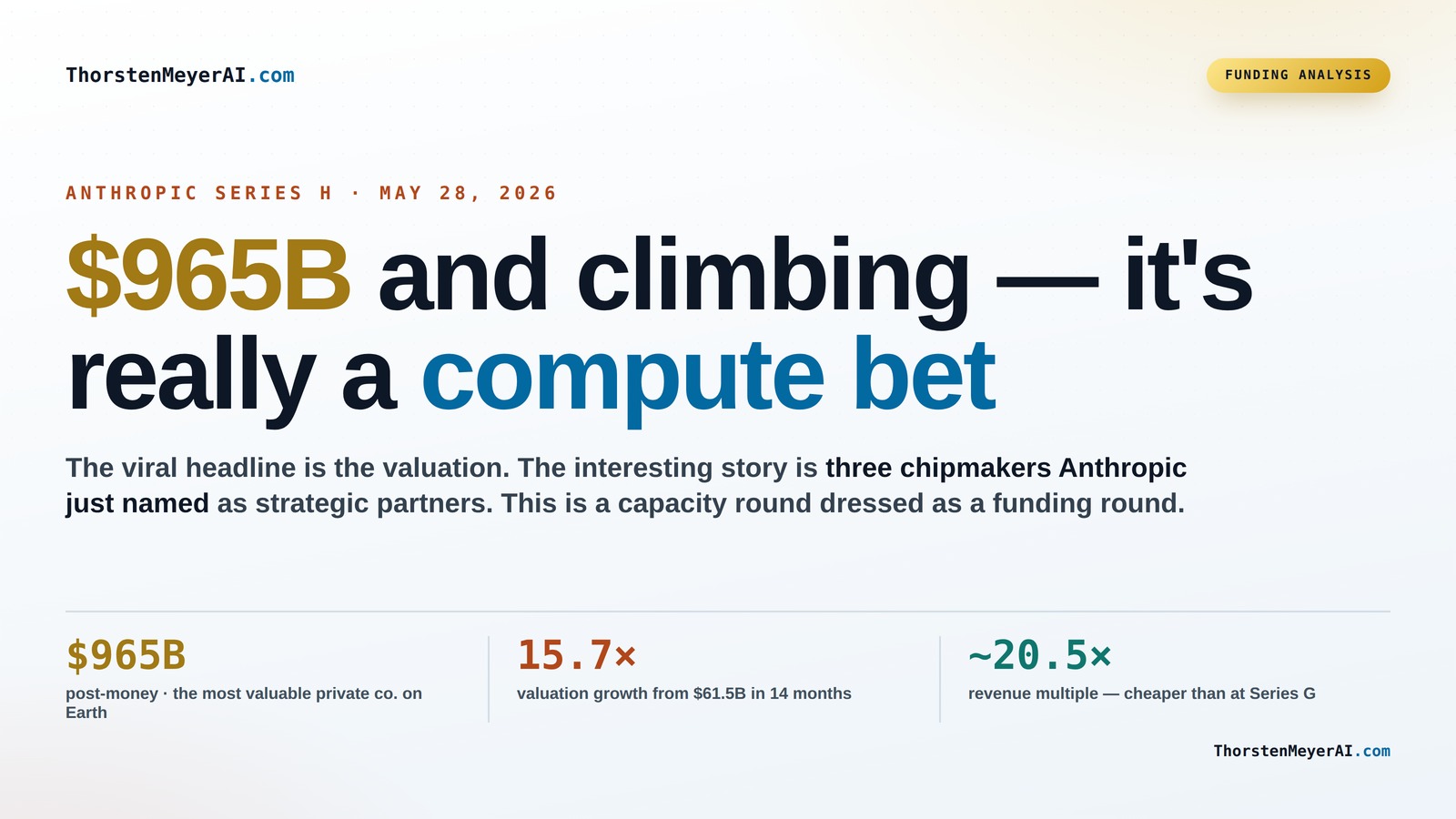
Anthropic raised $65 billion at a $965 billion valuation, but the real story is about securing compute capacity—chips, cloud power, and infrastructure—needed to fuel AI’s growth. Revenue growth and strategic hardware partnerships make this a capacity race, not just a valuation bubble.
$965B and climbing — it’s really a compute bet
The viral headline is the valuation. The interesting story is in the press release’s middle paragraphs — and in three chipmakers Anthropic just named as strategic partners. This is a capacity round dressed as a funding round.
The numbers nobody can quite parse in sequence
Read together they describe a trajectory with no precedent in enterprise software. Read individually, each looks like a typo.
From $61.5B to $965B in fourteen months
Salesforce took roughly two decades to reach revenue numbers Anthropic just blew past. The sequence below is the part most coverage skips — it’s not the size, it’s the shape.
Anthropic’s valuation ladder · Mar 2025 → May 2026
Five rounds, fourteen months. Bar height is the valuation; the climb itself is the story. Tap any milestone for context.
The multiple actually got cheaper
Bubbles look like multiples expanding while revenue lags. Anthropic’s pattern is the inverse — the valuation tripled, but revenue grew faster, and the multiple compressed.
Revenue-to-valuation multiple · Series G → Series H
Same company, three months apart. The denominator (revenue) is outrunning the numerator (valuation) — exactly the opposite of what a bubble narrative predicts.
10+ gigawatts and three chipmakers
When you name Micron, Samsung & SK hynix alongside your equity backers, you’re saying the binding constraint isn’t demand or model quality — it’s the physical supply of memory chips. The Series H is a capacity round.
Compute commitments backing Anthropic’s capacity bet
$200B+ in announced compute spend across multi-year contracts. The $65B Series H raise has to be read against that bill, not against operating losses.
A genuinely durable bet — or a structural exposure?
Both readings can be true at once. The answer arrives over the next 18–24 months as the gigawatts come online and either fill with paying demand or don’t.
Revenue growth has no precedent in B2B software ($1B → $47B in 17 months). The multiple is compressing, not expanding. Claude is the only frontier model on all 3 major clouds. Enterprise AI spend share went from ~10% to >65% in a year. Compute commitments are tied to specific contracts with capacity dates.
20× revenue is not cheap by any historical software-investing standard. Revenue is reported gross of cloud-reseller pass-throughs, which inflates the top line. Profitability is 2 years out. Amodei’s own warning: a 12-month delay in AI progress “would make him bankrupt” — the compute commitments are a structural exposure to demand persistence.
The valuation race — and the IPO context
Anthropic shipped Opus 4.8 the same morning as Series H — not a coincidence. One week after OpenAI filed confidentially for IPO. The late-2026 frame is set: two frontier AI companies racing to public markets, each pitching durability.
Key Takeaways
- Anthropic’s $965 billion valuation is driven mainly by its focus on securing massive compute infrastructure, not just market hype.
- The $65 billion Series H is a strategic investment in chips, cloud capacity, and hardware ecosystems, not just a corporate valuation boost.
- Rapid revenue growth—from $9 billion to over $47 billion in a few months—fuels the capacity arms race, requiring billions in hardware and power.
- Hardware partnerships with Micron, Samsung, and SK hynix highlight the importance of supply chain control for AI scaling.
- The real story behind the valuation is a global race for AI infrastructure, not just a valuation bubble.
As an affiliate, we earn on qualifying purchases.
Why a $965B valuation is just the surface — the real story is capacity
Anthropic’s valuation has skyrocketed to $965 billion, making it the most valuable private AI company. But that number masks a deeper truth: the company’s focus is on securing the compute power needed to train and run massive models.
Instead of spending on flashy product features, this round is about chips, cloud, and memory. It’s a bet that the bottleneck isn’t just talent or data, but the hardware that makes AI possible. Imagine trying to build a skyscraper, but the limiting factor is the crane. That’s what this raise is about.
The implications are significant: it highlights a shift in AI development priorities from solely algorithmic innovation to infrastructure readiness. This means that future AI capabilities will depend heavily on hardware scalability, which involves complex tradeoffs—such as balancing cost, performance, and supply chain reliability. Companies that succeed in this hardware race will have a competitive edge, but they also face risks like supply shortages or technological bottlenecks that could slow progress if not managed carefully.
For example, Anthropic’s recent partnerships with Micron, Samsung, and SK hynix point to a focus on memory chips — the backbone of AI data processing. Without enough GPUs and memory, even the smartest models can’t scale.

The real numbers behind Anthropic’s explosive growth — and what they mean
Anthropic’s revenue is surging. From roughly $9 billion at the end of 2025, it’s now over $47 billion in annualized run-rate. That’s a 5.4x jump in just a few months. Reports suggest they’re on track for over $10 billion in Q2 alone, a huge leap from previous estimates.
This rapid revenue growth signals a demand explosion for Claude, their flagship AI model. But it also underscores a simple fact: more compute is fueling more revenue. The company’s capacity to serve millions of queries depends on a steady supply of chips, power, and cloud resources.
In essence, revenue growth and capacity expansion are two sides of the same coin. If Anthropic wants to keep growing, it needs to buy more chips, build more data centers, and secure more power—fast. This means that revenue is no longer just a reflection of market share but a direct indicator of infrastructure scale. If infrastructure investments lag behind revenue growth, bottlenecks will emerge, slowing down AI deployment and innovation. Conversely, aggressive capacity expansion can open up new markets and applications, but at the risk of over-investment if demand doesn’t meet expectations. The balance between these factors will shape the company’s long-term trajectory and influence the broader AI industry’s development.
Furthermore, this capacity-driven growth emphasizes that future AI progress will be constrained or accelerated by hardware supply chains, making infrastructure a strategic asset rather than just a cost center.

How the $65 billion raise is a capacity purchase — not just cash in the bank
The $65 billion isn’t just for expanding the business; it’s a strategic purchase of compute capacity. About $15 billion of that is already committed by hyperscalers like Amazon, Microsoft, and Google.
Imagine ordering enough GPUs, memory chips, and cloud resources to run hundreds of thousands of AI models simultaneously. That’s the scale we’re talking about. The presence of chipmakers like Micron and Samsung confirms this focus on hardware supply chains.
For example, Samsung’s recent announcement of new memory chips tailored for AI workloads shows how hardware vendors are positioning themselves at the center of this race. The funds will likely go toward buying chips, building data centers, and ensuring enough power and cooling.
This focus on capacity underscores a crucial tradeoff: investing heavily in infrastructure can lead to rapid scaling, but it also introduces risks such as overcapacity if demand doesn’t materialize as expected. Companies must carefully forecast future needs to avoid costly excess while ensuring they can meet surging demand. The strategic allocation of funds toward hardware procurement reflects a recognition that without sufficient compute resources, even the most advanced models and algorithms will remain underutilized, limiting AI’s potential growth and competitive advantage.
Compare: How Anthropic’s valuation stacks up against OpenAI and others
| Company | Valuation | Revenue (2025) | Revenue Multiple |
|---|---|---|---|
| Anthropic | $965B | $47B | 20.5× |
| OpenAI | $852B | $13B | ~65× |
Despite its larger valuation, Anthropic’s multiple is lower than OpenAI’s. This suggests that the market sees Anthropic as more scalable, or at least less overhyped, than its rival. It’s a sign that the focus is shifting toward capacity and infrastructure, not just headline numbers. This comparison reveals that valuation alone doesn’t tell the full story; the multiples indicate how investors perceive the underlying growth potential and the importance of infrastructure investments that will underpin future expansion. A lower multiple for Anthropic suggests confidence that its infrastructure investments will translate into sustainable long-term growth, whereas higher multiples may reflect speculative hype or short-term expectations.

The hardware partnerships: who’s supplying the chips and why it matters
Anthropic’s partnerships with Micron, Samsung, and SK hynix aren’t just supplier relationships—they’re strategic alliances. These companies are investing in AI-optimized memory and storage chips, ensuring supply for Anthropic’s rapid growth.
Imagine having a steady pipeline of the fastest, most efficient chips. That’s the kind of ecosystem that can fuel AI models at scale, without running into supply shortages. It’s like ensuring your gas station always has enough fuel during a rush hour.
This approach helps Anthropic sidestep supply chain bottlenecks that have hampered AI scaling in the past. It’s a direct response to the huge compute demands of models like Claude. By securing long-term hardware supply agreements, Anthropic reduces the risk of delays that could stall development, giving it a competitive edge. Moreover, these partnerships allow for tailored hardware solutions optimized for AI workloads, which can significantly improve efficiency and reduce costs. This strategic hardware integration is a key enabler for scaling AI models effectively and sustainably, highlighting that hardware supply chains are not just supporting players but central to the AI race.
What does this mean for the future of AI and model capacity?
With billions invested in chips, data centers, and power, Anthropic is building the infrastructure to support far larger models. Think of it as laying the foundation for the next generation of AI — models that are smarter, faster, and more capable.
For users, this could mean more reliable, powerful AI tools. For the industry, it signals a shift: AI growth now depends heavily on hardware supply chains, not just algorithms or data. This hardware-centric approach indicates a recognition that advances in AI are increasingly bottlenecked by physical infrastructure rather than purely software innovations. The implications are profound: companies that can secure and scale hardware supply chains will have a strategic advantage, enabling them to deploy larger, more complex models that were previously infeasible. Conversely, those unable to secure sufficient hardware resources risk falling behind, making infrastructure a critical determinant of AI’s trajectory. In this context, the focus on capacity is not just about growth; it’s about survival in a highly competitive landscape where hardware availability can determine who leads and who lags.
In practice, this could accelerate AI adoption across industries, from healthcare to finance, as capacity constraints loosen. But it also raises questions about supply chain resilience, geopolitical risks, and the need for diversified sourcing to avoid bottlenecks that could stall AI progress at a critical juncture.