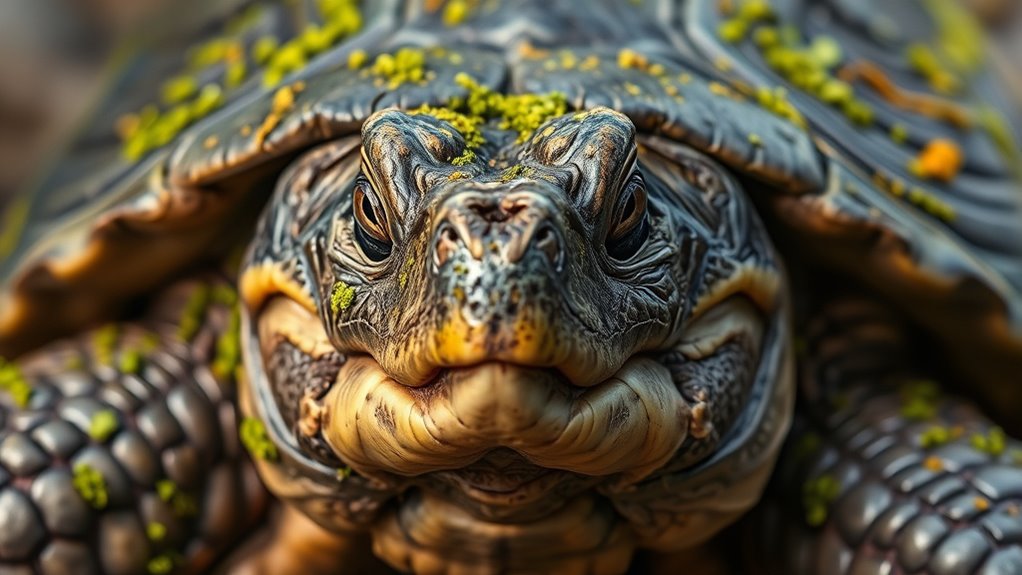

The alligator snapping turtle looks like a living dinosaur, with its massive size, rugged skin, and prehistoric features. It has a heavily armored shell with ridges, sharp jaws, and a tongue lure that tricks fish into biting. Its habitat includes deep, slow-moving waters with submerged logs and overhanging trees. Known for slow, deliberate movements and camouflage, these turtles are fascinating survivors. Discover more about their ancient appearance and survival secrets as you explore further.
Key Takeaways
- The alligator snapping turtle has a massive, prehistoric-looking shell with three prominent ridges resembling ancient reptiles.
- Its rugged, textured skin and powerful jaws give it a prehistoric, dinosaur-like appearance.
- The turtle’s side-positioned eyes and sensory organs enhance its ability to detect prey through vibrations and deception.
- Its ambush hunting strategy, including a worm-like tongue lure, mimics ancient predatory behaviors.
- As the largest freshwater turtle, it exemplifies a living dinosaur with primitive features and impressive size.

AENIMELY Alligator Snapping Turtle Figurine – Realistic Solid Turtle Model for Kids – Educational Reptile Animal Toy, Wildlife Learning Gift, Nature Diorama Decoration
Lifelike Alligator Snapping Turtle: Designed with rugged texture and powerful jaw details to reflect the distinctive freshwater predator.
As an affiliate, we earn on qualifying purchases.
As an affiliate, we earn on qualifying purchases.
Impressive Physical Features of the Alligator Snapping Turtle

The alligator snapping turtle boasts some of the most impressive physical features among freshwater turtles. Its massive size makes it the largest freshwater turtle in the world. Three prominent ridges run from front to back along its sturdy, domed carapace, giving it a prehistoric look. Its powerful jaws, paired with a large head and strongly hooked beak, allow it to crush prey effectively. Eyes are positioned on the sides of its head, a unique trait among snapping turtles, enhancing its peripheral vision. The turtle’s primitive appearance, with rough, textured skin and rugged features, resembles ancient reptiles from the prehistoric era. Additionally, its specialized tongue, which mimics a worm, serves as a lure for prey to attract fish close enough to catch. This adaptation is a remarkable example of evolutionary survival strategies that help it thrive in its aquatic habitat. Its strong, muscular limbs and webbed feet further aid in swimming and capturing prey, showcasing its well-adapted morphology. All these features combine to create a formidable, awe-inspiring creature that’s well-adapted to its aquatic habitat.

Tetra ReptoMin Floating Food Sticks Complete Food for Aquatic Turtles, Newts and Frogs, 2 LB (900 Grams)
FOR AQUATIC TURTLES, NEWTS AND FROGS: Specifically formulated for aquatic turtles, newts and frogs
As an affiliate, we earn on qualifying purchases.
As an affiliate, we earn on qualifying purchases.
Unique Characteristics That Resemble Prehistoric Reptiles
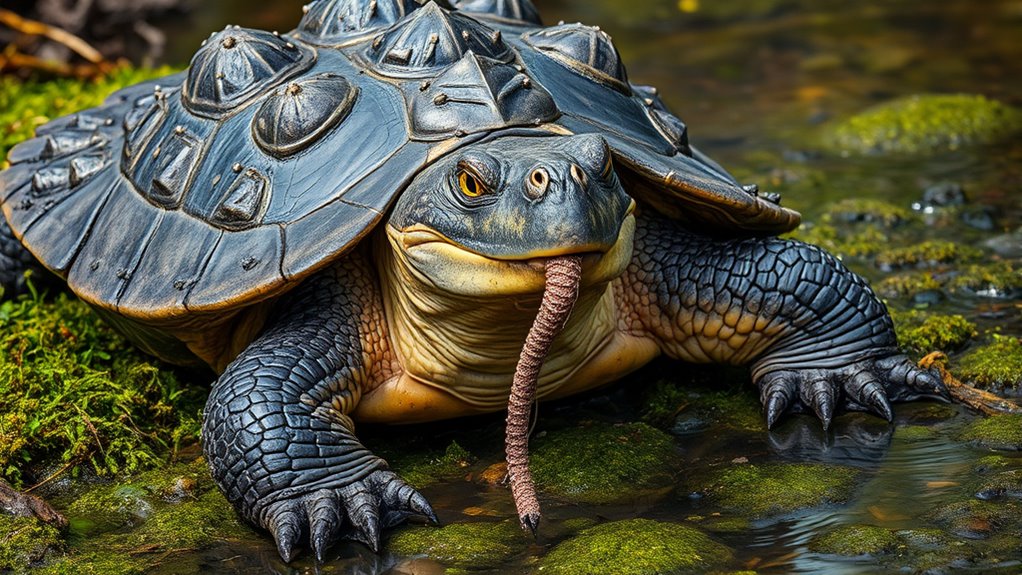
Because of its rugged, textured skin and prominent ridges, the living dinosaur’s appearance closely mirrors that of ancient prehistoric reptiles. Its large, heavily armored shell features three distinct ridges that run from front to back, emphasizing its primitive design. The powerful jaws and large, hooked beak resemble the formidable teeth of ancient predators. Unlike most modern turtles, its eyes are positioned on the sides of its head, giving it a more reptilian, predatory look. Its overall rugged, scaly appearance, combined with the primitive shape of its head and limbs, makes it seem as if it stepped straight out of the Mesozoic era. These features serve as a living reminder of the ancient reptiles that once roamed the Earth, preserved in modern form. Its classification as a reptile underscores its connection to prehistoric species still thriving today. The turtle’s primitive features highlight its evolutionary link to ancient reptiles and help explain its survival through millions of years. Additionally, its ability to adapt to diverse environments demonstrates the resilience of such ancient survivor species. A prehistoric lineage is evident in its genetic makeup, further emphasizing its status as a living fossil.

National Geographic Kids Ultimate Reptileopedia: The Most Complete Reptile Reference Ever (NGK Ultimate Pedias)
As an affiliate, we earn on qualifying purchases.
As an affiliate, we earn on qualifying purchases.
Distribution and Habitat Preferences in North America
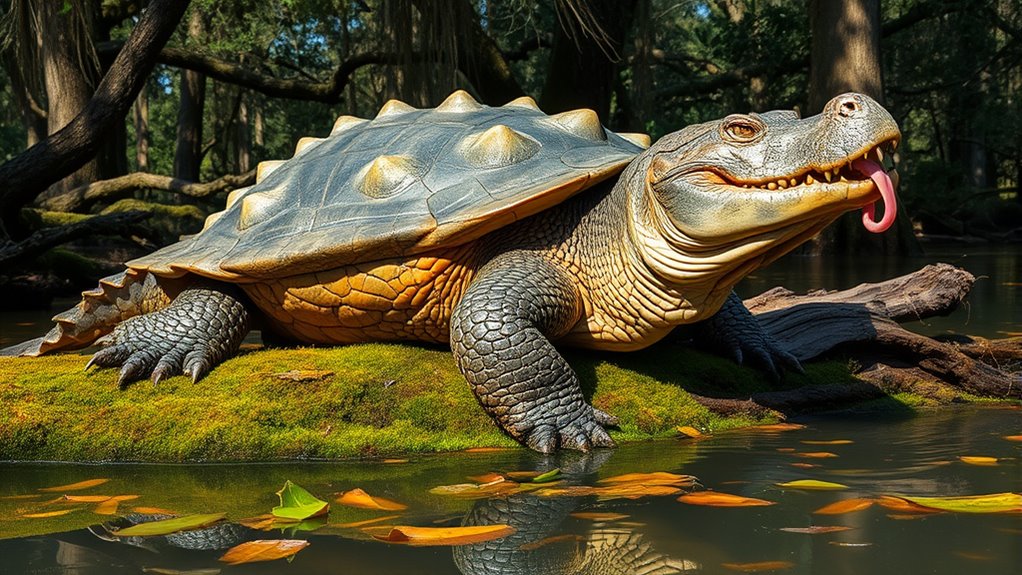
You’ll find these turtles mainly in the Gulf States, from northern Florida to Texas, with some populations stretching north to Illinois and Missouri. They prefer deep, slow-moving waters like oxbow lakes, deep pools, and sloughs, often near overhanging trees and submerged structures. Their range covers around 26,350 square kilometers, mostly around large rivers such as the Mississippi.
Range in Gulf States
Did you know that the living dinosaur known as the alligator snapping turtle primarily inhabits the freshwater rivers and lakes of the Gulf Coast region? You’ll find them mainly in southern Florida, southern Georgia, and along the coast into Texas. Their range extends northward to Illinois, Kansas, Iowa, and Missouri. These turtles prefer large river systems and floodplain habitats. Specifically, they inhabit:
- Lower Gulf coastal plain rivers
- Deep oxbow lakes and sloughs
- Canopy-covered areas with submerged trees
- Large water bodies with stable populations. Their distribution is closely tied to major water systems like the Mississippi River, which serve as critical habitat connectivity for their survival. You won’t see them far from these stable, freshwater environments, which provide the protection and resources they need to thrive. Maintaining aquatic habitat conservation is essential for supporting their populations.
Preferred Water Habitats
Living dinosaur residents of the Gulf Coast region thrive in a variety of freshwater habitats that offer ample cover and resources. You’ll find them mainly in deep sloughs, oxbow lakes, and the deep pools of large rivers, where they can hide and hunt effectively. They prefer areas with plenty of canopy cover, such as overhanging trees, shrubs, and submerged logs, which provide shade and concealment. These turtles typically stay close to larger bodies of water, with an average home range of about 750 meters, though females often have larger territories. They’re highly aquatic and rarely venture onto land, spending most of their time motionless on river bottoms, using their luring tongue to attract prey. Water depth and cover are critical to their survival and hunting success. Additionally, the presence of natural dune systems helps protect their habitats from erosion and maintains the stability of their environment. Maintaining a healthy ecosystem with diverse natural features is essential for supporting their populations. The availability of freshwater resources is also vital for their long-term survival and reproductive success. Preserving surrounding wetland habitats is crucial for ensuring they have access to feeding and breeding sites. Protecting aquatic ecosystems also supports the overall health of their habitats and promotes biodiversity.
Geographic Distribution Extent
Have you ever wondered how far the living dinosaur’s reach extends across North America? Its range covers a vast area, primarily along the southeastern U.S. and parts of the Midwest. Here’s what you should know:
- It spans from northern Florida and southern Georgia through Gulf states into Texas.
- Extends northward to Illinois, Kansas, Iowa, and southern Missouri.
- Mostly inhabits rivers of the lower Gulf coastal plain.
- Its entire range covers approximately 26,350 square kilometers, with populations clustered around large water bodies like the Mississippi River.
- Habitats and Ecosystems suitable for this species are characterized by deep, slow-moving waters with ample cover, which are essential for its survival.
You’ll find them in freshwater habitats with abundant cover, such as deep sloughs and oxbow lakes, mainly in areas with suitable water quality and stable ecosystems.

API TURTLE SLUDGE DESTROYER Aquarium Cleaner and Sludge Remover Treatment 8-Ounce Bottle
Beneficial bacterial
As an affiliate, we earn on qualifying purchases.
As an affiliate, we earn on qualifying purchases.
The Role of Deep Water Habitats in Their Lifestyle

Deep water habitats play a crucial role in the lifestyle of the alligator snapping turtle by providing essential environments for feeding, resting, and protection. These turtles prefer deep sloughs, oxbow lakes, and the deep pools of large rivers, which offer cover and abundant prey. They use submerged structures like fallen trees and overhanging vegetation to stay hidden. In these habitats, they remain motionless, camouflaging themselves while luring prey with their worm-like tongue. Their movement is slow and deliberate, often along river bottoms, rarely overland. The deep water environment helps regulate their temperature and reduces predation threats.
| Habitat Feature | Benefits |
|---|---|
| Deep pools and sloughs | Shelter and stable environment |
| Overhanging vegetation | Concealment and ambush points |
| Submerged structures | Resting sites and cover |
How These Turtles Hunt and Capture Prey
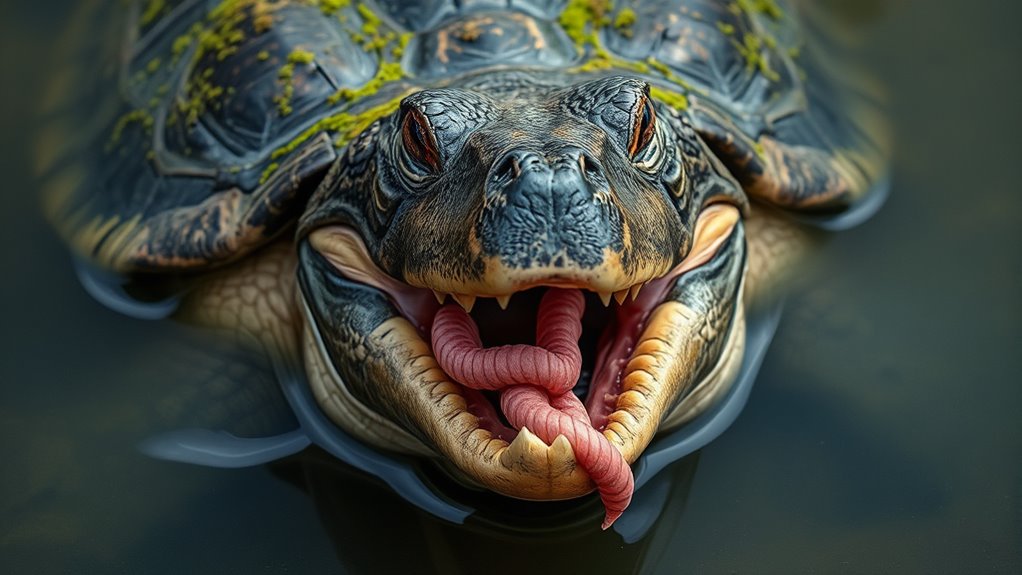
You’ll notice that these turtles use an ambush strategy to catch their prey, remaining motionless on the river bottom. They attract fish and small animals by wiggling a worm-like tongue appendage that acts as a lure. Once a curious prey approaches, the turtle quickly snaps its powerful jaws to capture it.
Ambush Hunting Strategy
Living dinosaur, the alligator snapping turtle, relies on an effective ambush strategy to catch its prey. You’ll find it perfectly camouflaged on the river bottom, waiting motionless for prey to come close. Its powerful jaws and hooked beak remain still, blending with the environment. When a fish or small animal ventures nearby, you can expect it to:
- Remain motionless for hours, conserving energy
- Use its worm-like tongue appendage to mimic a wriggling worm or fish
- Strike suddenly with lightning-fast jaws, capturing prey instantly
- Swallow prey whole, thanks to its large head and strong beak
This method makes the turtle an efficient predator, relying on patience and surprise rather than active pursuit. Its ability to stay hidden is key to its survival.
Luring With Tongue Appendage
The alligator snapping turtle’s hunting success hinges on its remarkable tongue appendage, which it uses to lure prey within striking range. This appendage resembles a worm, complete with ridges and movement that mimic real prey. When you observe one underwater, you’ll see it rest motionless on the riverbed, barely moving. As fish or small animals swim nearby, the turtle wiggles its tongue, attracting their attention. The prey mistakes the tongue for food and moves closer, giving the turtle the perfect moment to strike with its powerful jaws. This unique method allows the turtle to hunt effectively without chasing after prey, conserving energy. It’s a brilliant adaptation that combines patience and deception, making the alligator snapping turtle a true master of ambush predation. Additionally, specialized sensory organs help the turtle detect movement and vibrations in the water, further enhancing its hunting efficiency. Moreover, understanding adaptive hunting strategies reveals how these turtles have evolved to thrive in their environments. Recognizing the importance of camouflage further highlights their ability to remain concealed while waiting for the right moment to strike. In fact, their environmental adaptations are crucial for their survival in diverse aquatic habitats. Recent studies also show that their feeding behavior is highly specialized, enabling them to exploit a variety of prey types effectively.
The Use of a Luring Appendage to Attract Fish

Snapping turtles have evolved a remarkable adaptation: a worm-like appendage on the floor of their tongue that acts as a lure to attract prey. When you watch closely, you’ll see this appendage wiggle, mimicking the movement of small aquatic creatures. Here’s how it works:
- The appendage’s color and movement mimic prey, enticing fish to investigate.
- Fish interpret the movement as a food source, swimming closer.
- Once within striking distance, the turtle’s powerful jaws snap shut rapidly.
- This active deception minimizes the turtle’s need for chasing, conserving energy.
- The use of attracting appendages like this is a common strategy among hunting techniques, helping predators efficiently catch their prey.
- By employing such vibrational signals, these predators can effectively communicate and coordinate their hunting efforts.
- Additionally, the sensory adaptations of snapping turtles enhance their ability to detect movement and vibrations in their environment, making their hunting strategy even more effective. Recent studies also highlight the importance of environmental conditions in optimizing their prey detection and capture success.
Movement Patterns and Activity Cycles in Aquatic Environments
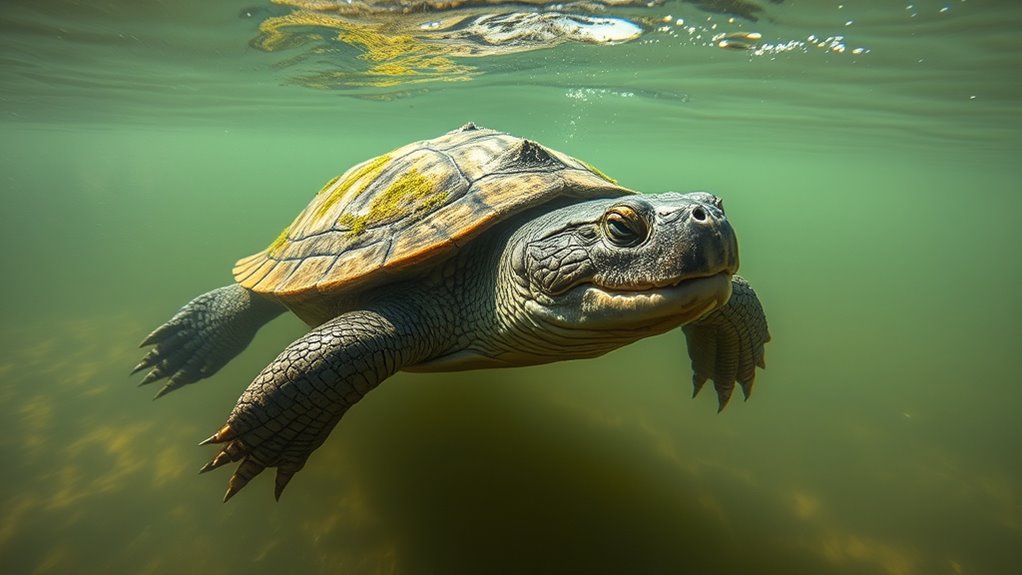
Despite their primarily aquatic nature, these turtles rarely move quickly or come ashore, preferring to stay submerged most of the time. You’ll notice they drift slowly along river bottoms, often inching over long distances—sometimes more than 15 miles over three years. They’re mostly active at night, hiding during daylight hours among submerged roots and vegetation. During warmer months, around 70°F water temperature, they can’t stay underwater longer than 50 minutes, so they surface frequently to breathe. Their movement is deliberate and slow, conserving energy while hunting or exploring. They rarely venture onto land, sticking close to stable water bodies like large rivers, oxbow lakes, and deep pools. This steady, low-energy movement pattern helps them blend into their environment and avoid predators.
Challenges Facing Alligator Snapping Turtle Populations

Alligator snapping turtle populations face significant threats that jeopardize their long-term survival. First, extensive commercial trapping over decades has drastically reduced their numbers. Second, habitat loss from urbanization, agriculture, and dam construction shrinks their suitable environments. Third, pollution from runoff contaminates water quality, impacting health and reproduction. Fourth, climate change causes rising sea levels and temperature shifts, disrupting nesting sites and skewing sex ratios—since temperature influences male and female offspring production. These combined pressures threaten the species’ stability, especially as their large home ranges and specific habitat needs limit their ability to adapt quickly. Without targeted conservation, these ancient creatures could face further declines, risking their status as living dinosaurs.
Conservation Efforts and Legal Protections in Place
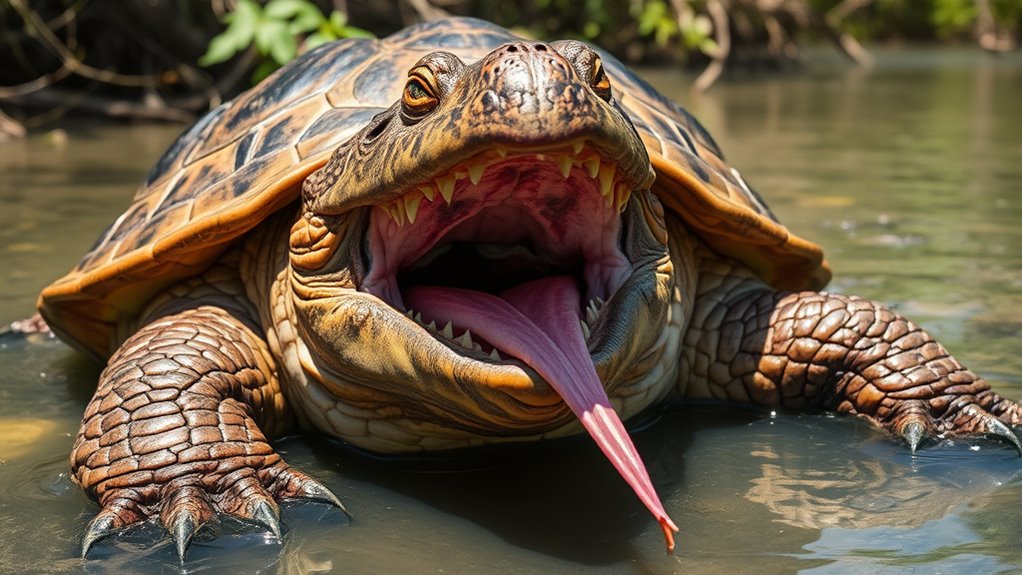
You can see that legal protections have been put into place to help the alligator snapping turtle, including laws that restrict trapping and collecting. Habitat preservation initiatives aim to safeguard essential river and wetland areas where these turtles live. By supporting these efforts, you contribute to ensuring the survival of this living dinosaur for future generations.
Legal Protections Implemented
Efforts to safeguard the living dinosaur have led to the implementation of various legal measures across its range. You’ll find these protections aim to curb illegal trapping and habitat destruction. Here are some key initiatives:
- States like Florida and Georgia have enacted laws banning commercial trapping and sale.
- Federal regulations restrict the collection of alligator snapping turtles from wild populations.
- Protected areas and wildlife refuges limit human activity that could harm their habitats.
- International agreements, such as CITES, regulate trade to prevent overexploitation.
These legal measures help ensure the species’ survival, reducing trapping pressures and safeguarding critical habitats. Enforcement varies by region but remains essential for maintaining existing populations and preventing further decline. Your awareness and support amplify these conservation efforts.
Habitat Preservation Initiatives
Legal protections have played an essential role in reducing trapping and habitat destruction for the living dinosaur. Conservation groups and government agencies have established protected areas that preserve vital habitats like deep rivers, oxbow lakes, and sloughs where these turtles thrive. Laws in states such as Florida, Illinois, and Missouri restrict habitat disturbance, construction, and illegal trapping. Restoration projects work to improve water quality and maintain natural flow regimes, supporting healthy ecosystems. Public awareness campaigns encourage local communities to protect waterways and avoid activities that harm turtle habitats. Additionally, partnerships between scientists, conservationists, and policymakers promote habitat connectivity and monitor populations. These initiatives aim to guarantee the alligator snapping turtle’s survival, maintaining the diverse ecosystems it calls home.
The Impact of Climate Change on Their Reproductive Success

Climate change poses a significant threat to the reproductive success of the living dinosaur species, primarily by disrupting the delicate environmental cues they rely on for breeding. As temperatures rise, sex ratios in hatchlings become skewed because temperature determines whether eggs develop into males or females. This imbalance can threaten population stability. Additionally, altered water levels and temperatures affect nesting sites and incubation periods. Specifically:
- Warmer nests produce more females, risking a shortage of males.
- Changes in water levels can flood nesting sites or reduce suitable areas.
- Increased temperature variability can delay or prevent successful hatching.
- Pollution from runoff worsens water quality, impacting egg viability.
These factors combine to put reproductive success at significant risk, endangering the species’ survival in the wild.
Frequently Asked Questions
How Long Can Alligator Snapping Turtles Stay Underwater During Activity?
You can expect an alligator snapping turtle to stay underwater for up to 50 minutes when it’s active, especially at 70°F water temperature. They rarely remain submerged longer due to their respiration needs. During activity, they often rest on the river bottom, ambushing prey with their distinctive lure. You’ll notice they’re highly aquatic, moving slowly and spending most daylight hours hidden beneath the water’s surface.
What Is the Average Size of an Alligator Snapping Turtle?
You’ll be amazed to learn that alligator snapping turtles can grow up to 26 inches in shell length, making them the largest freshwater turtles worldwide. On average, they measure around 18 to 20 inches. These giants weigh between 35 to 100 pounds, showcasing their impressive size. If you encounter one in the wild, you’re witnessing a true prehistoric marvel, a living relic from the age of dinosaurs.
Are Alligator Snapping Turtles Aggressive Toward Humans?
You probably won’t find the alligator snapping turtle aggressive toward humans if you keep your distance. They tend to be shy and prefer to stay hidden, only snapping defensively if they feel threatened or cornered. Avoid provoking or attempting to handle them, especially since their powerful jaws can cause serious injuries. Respect their space, observe quietly, and you’ll likely have a safe, fascinating encounter without any aggression from these impressive reptiles.
How Do Alligator Snapping Turtles Communicate With Each Other?
You might marvel at their muted, mysterious methods of communication. Alligator snapping turtles primarily communicate through subtle sounds, body language, and tactile interactions. You’ll notice head buffs, shell bumps, or gentle nudges during social encounters. These movements and murmurs help them establish dominance, define territory, or attract mates. Although they’re mostly solitary, understanding their signals reveals their silent social skills, showcasing nature’s nuanced, nonverbal language in their aquatic, age-old arena.
Can Alligator Snapping Turtles Live in Urban Waterways?
Yes, you can find alligator snapping turtles in urban waterways, especially if they connect to larger rivers or lakes. They thrive in deep, slow-moving waters with plenty of cover like submerged logs and overhanging trees. However, urban pollution, habitat disturbance, and human activity can threaten their survival. If you spot one, it’s important to protect its habitat and avoid disturbing it, ensuring they continue to thrive in those environments.
Conclusion
You’ve just glimpsed the incredible world of the alligator snapping turtle, a true living dinosaur. But their future hangs in the balance, threatened by unseen dangers and shifting climates. Will we act in time to protect these ancient giants, or will they vanish like whispers from the past? The choice is ours. The next move could determine whether this prehistoric marvel continues to roam our waters—or becomes just a memory.