

Owls dominate the night thanks to their incredible adaptations that make them silent hunters. Their large eyes and facial discs help them see and locate prey in darkness, while their asymmetrical ears detect even faint sounds with incredible precision. Their uniquely structured feathers reduce turbulence and noise during flight, allowing for stealthy approaches. Explore further to discover how these remarkable features work together to make owls the quiet rulers of the skies.
Key Takeaways
- Owls have specialized feather structures, like serrated edges and velvety surfaces, that reduce flight noise for silent hunting.
- Their large eyes and facial discs enhance low-light vision and sound localization, aiding nocturnal prey detection.
- Asymmetrical ears and facial discs enable precise sound triangulation in complete darkness.
- The microstructure of their feathers and wing shape minimize turbulence and noise during flight.
- These adaptations allow owls to hunt stealthily, making them the silent rulers of the night sky.
The Marvel of Night Vision

Owls have evolved extraordinary night vision that allows them to see clearly in near-total darkness. Their eyes contain thousands of photosensitive cells, thanks to high concentrations of rod opsin, or visual purple, which enhances low-light sensitivity. These eyes are exceptionally large relative to their heads, maximizing light intake to improve vision in darkness. Their binocular vision, with both eyes facing forward, helps them judge distances accurately—crucial for hunting prey. Although they can function in almost complete darkness, some ambient light still assists their vision. Additionally, owls have a third transparent eyelid called a nictitating membrane, which swiftly protects their eyes during high-speed pursuits and feeding. This combination of adaptations makes their night vision remarkably effective.
Auditory Mastery in Darkness
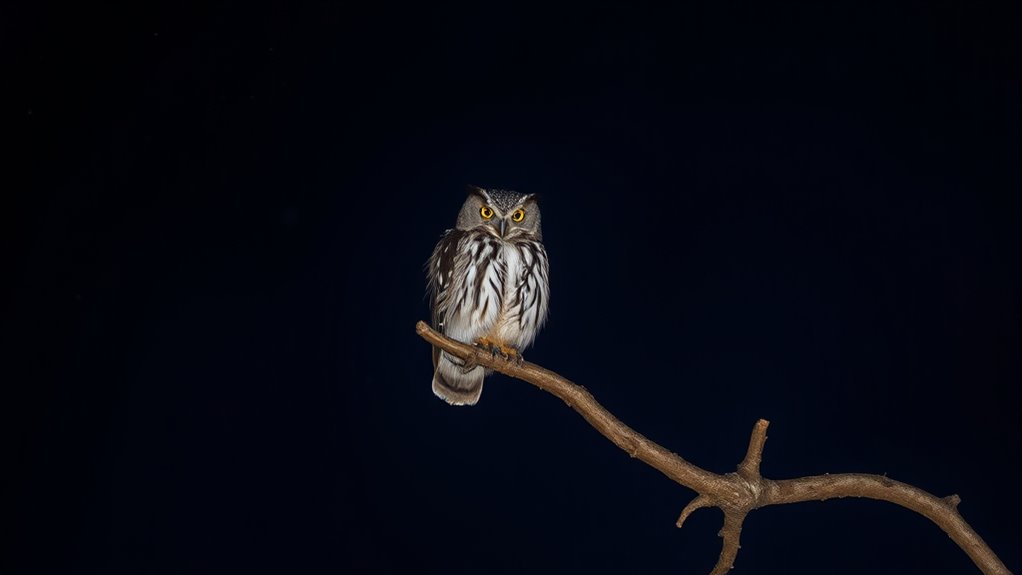
You might be amazed at how owls locate prey in complete darkness using their asymmetrical ear placement, which helps them pinpoint sound sources precisely. Their ability to perform sound triangulation allows them to determine the exact distance and direction of hidden animals. This exceptional hearing mastery makes owls some of the most effective nocturnal hunters alive today. Additionally, their incredible auditory abilities enable them to detect even the faintest sounds made by prey beneath thick foliage or snow. Their specialized ear anatomy significantly enhances their capacity to localize prey in complex environments. Furthermore, data privacy challenges in algorithms can impact the accuracy of their sound detection, highlighting the importance of technological safeguards.
Asymmetrical Ear Placement
Because their ears are positioned asymmetrically on each side of the head, you can leverage sound triangulation to pinpoint prey with incredible accuracy. This asymmetry creates a slight difference in the timing and intensity of sounds reaching each ear. As a result, you can interpret these subtle cues to determine the exact direction and distance of your target, even in complete darkness. Your brain processes these auditory signals rapidly, allowing you to react swiftly and precisely. This adaptation is vital for hunting in low-light conditions where vision alone isn’t enough. By utilizing asymmetrical ear placement, you gain a remarkable advantage—locating prey hidden under leaves, snow, or dense vegetation without relying on sight. It’s a sophisticated system that makes you a master of nocturnal hunting.
Sound Triangulation Precision
How do owls locate prey hidden in complete darkness with such astonishing accuracy? They rely on their exceptional sound triangulation skills. The flat facial disc acts like a satellite dish, funneling sound waves toward their ears. Many owls have asymmetrical ear placements, with one ear higher than the other, allowing them to detect minute differences in sound timing and intensity. This setup enables precise calculation of prey location, even when visual cues are absent. As the sound reaches each ear at slightly different times, your owl’s brain processes these cues to pinpoint the prey’s exact position. Their specialized auditory system enhances this ability, allowing owls to hunt effectively in complete darkness, giving them a significant advantage over their prey and solidifying their reputation as nocturnal predators. Additionally, their ear asymmetry is a remarkable adaptation that further refines their ability to accurately triangulate sounds in complex environments. The integration of these auditory adaptations exemplifies the importance of sound triangulation in nocturnal hunting success. Some species also utilize additional sensory cues, such as subtle air currents or vibrations, to improve their hunting accuracy in challenging conditions.
Hearing in Complete Darkness
Owls achieve extraordinary hearing in complete darkness by harnessing specialized anatomical adaptations. Their asymmetrical ears and facial discs function like advanced sound collectors, funneling sound waves efficiently. This setup allows them to pinpoint prey with remarkable accuracy, even beneath dense foliage or snow. You can see how their ear placement creates a triangulation system, giving them an edge in total darkness. Additionally, their ability to localize sound precisely provides a significant advantage in hunting in complete darkness. Their auditory system is so refined that they can detect the slightest rustle of prey moving underground or through thick vegetation.
The Secrets of Silent Flight

You can’t achieve silent flight without innovative feather structures that break up airflow. These feathers reduce turbulence and noise during flight, allowing owls to approach prey undetected. It’s this combination of feather design and turbulence control that makes their aerial movement so stealthy. Additionally, the unique feather structure of owls enhances their ability to glide quietly through the air, giving them an advantage over prey and predators alike. The aerodynamic shape of their wings further contributes to minimizing sound, making them masters of stealth in the night sky. Furthermore, their specialized wing feathers are adapted to further dampen sound, demonstrating the intricate evolution of silent flight.
Feather Structure Innovations
The secret to an owl’s silent flight lies in its uniquely specialized feather structure, which minimizes noise during aerial movements. You can see how each feather is adapted for stealth, with serrated edges and velvety surfaces that reduce turbulence. These features break up air currents, preventing sound from forming as wings move through the air. To visualize, consider this table:
| Feature | Function | Effect |
|---|---|---|
| Serrated leading edges | Disrupt airflow at the wing’s front | Diminishes noise from air turbulence |
| Velvety surface | Absorbs sound waves | Keeps flight silent |
| Fringe-like trailing edges | Smooths airflow behind wing | Further reduces noise |
| Soft, flexible feathers | Absorb vibrations from air movement | Ensures stealth during flight |
Additionally, the microstructure of owl feathers enhances their ability to dampen sound further. The biophysical adaptations of these feathers are highly specialized, allowing owls to hunt effectively at night without detection. These innovations, combined with their aerodynamic design, let owls glide silently, making them the ultimate night predators. Moreover, ongoing research into feather microstructures reveals potential applications in soundproofing technology, inspired by these natural silent mechanisms.
Turbulence Reduction Techniques
To achieve near-silent flight, owls employ turbulence reduction techniques that minimize air resistance and noise during their aerial movements. Their feathers play a vital role through specific adaptations. First, the leading edges of their wing feathers have comb-like serrations that break up airflow, reducing turbulence. Second, the trailing edges feature fringed, velvety edges that smooth airflow and dampen sound. Third, the soft, velvety surface of their feathers absorbs sound waves, preventing noise from air passing over their wings. These features work together to create a silent glide, allowing owls to approach prey undetected. Additionally, the lightweight materials of their feathers contribute to their ability to fly quietly and efficiently. These specialized feather structures also help in turbulence reduction, enhancing their stealth during flight. The biological design of their feathers exemplifies how structural adaptations can optimize performance in natural predators. Moreover, the feather microstructure of owls is uniquely arranged to further dampen sound and improve aerodynamics. Their specialized feather shapes further contribute to noise reduction by disrupting airflow patterns. By reducing turbulence and noise, they maximize stealth, ensuring their hunts are both efficient and silent, giving them a vital edge during nocturnal pursuits.
Stealth in Aerial Movement
Owls achieve remarkable silence during flight through a combination of specialized feather structures and aerodynamic adaptations. Their feathers have soft edges and fringes that break up airflow, reducing turbulence and noise. Their velvety surface of their wing feathers absorbs sound waves, preventing noise from air passing over them. Additionally, their wing shape and large surface area enable smooth, gliding movements that minimize wing-flap sounds. The leading edges of their feathers are serrated like a comb, dispersing air evenly. These modifications allow owls to fly silently, approaching prey undetected. Feather adaptations play a crucial role in their silent flight. Their aerodynamic features not only reduce noise but also enhance their overall flight efficiency. This stealthy movement is vital for successful hunting, giving them a significant advantage in the dark. Efficient aerodynamics also contribute to minimizing noise during flight, further enhancing their hunting success. Silent flight, combined with their keen senses, makes owls the ultimate nocturnal predators.
Hunting Strategies and Prey Choices
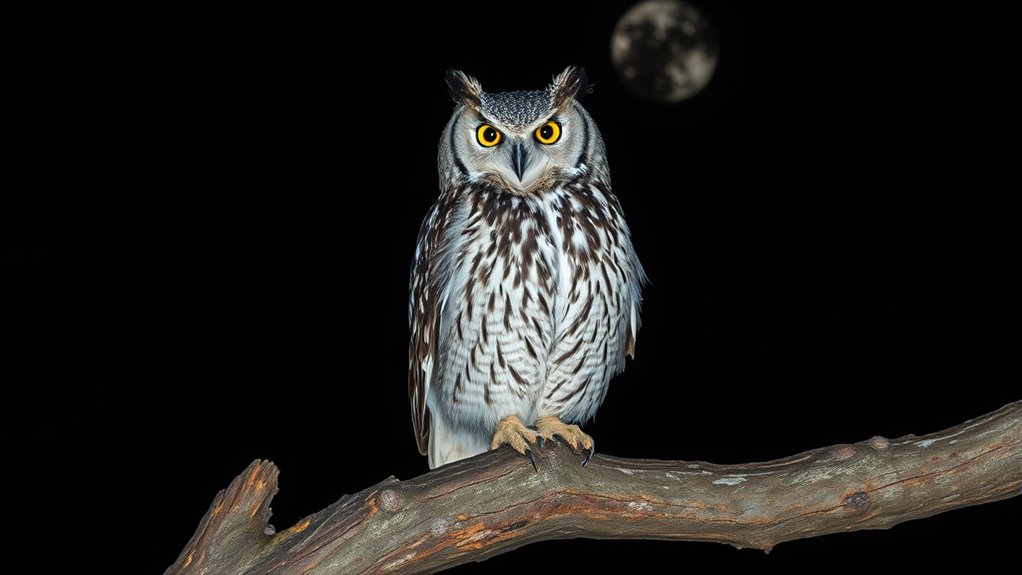
Hunting strategies among owls are highly specialized and vary depending on species, habitat, and prey availability. You might find a Barn Owl hunting alone in open fields, relying solely on hearing, or a Great Horned Owl stalking from a perch, then swooping down. Here are key tactics:
Owls employ diverse hunting tactics, from ambush to pursuit, tailored to their environment and prey.
- Ambush Hunting – Owls like the Great Horned wait quietly, watching for prey before striking.
- Pursuit Hunting – Some species chase prey in flight or on foot, especially in dense vegetation.
- Scavenging and Opportunism – Owls sometimes scavenge or take advantage of prey weakened by other predators.
Your preferred method depends on your environment and prey, but each strategy maximizes stealth and efficiency in the dark.
The Art of Lethal Capture

The art of lethal capture showcases owls’ remarkable ability to subdue prey with precision and efficiency. When you see an owl strike, you notice how its powerful talons extend instantly, gripping tightly to immobilize the target. These razor-sharp claws pierce flesh and bones, delivering swift, lethal blows. The owl’s hooked bill then tears flesh apart, ensuring quick consumption or safe transportation. Small prey, like mice or insects, are swallowed whole, often head-first to streamline swallowing. Larger animals, such as rabbits or birds, are killed outright with a single, forceful strike. This combination of lethal talons and tearing beak makes owls formidable predators. Their ability to quickly dispatch prey minimizes struggle, reduces risk of injury, and guarantees a swift, efficient feeding process.
Owls as Ecological Top Predators

As a top predator, an owl keeps prey populations in check, preventing any one species from overpopulating. Your presence helps maintain a delicate balance within the ecosystem, ensuring all species coexist sustainably. By controlling prey numbers, owls support the overall health and stability of their habitats.
Prey Population Control
Owls play a crucial role in maintaining balanced ecosystems by controlling prey populations. You can see their impact through their targeted hunting strategies. For example:
- They reduce overpopulation of small mammals like mice and voles, preventing crop damage.
- They keep bird populations in check, avoiding overgrazing of nests and feeding grounds.
- They regulate aquatic prey such as fish and amphibians, maintaining healthy water ecosystems.
Ecosystem Balance Maintained
By actively preying on a wide range of animals, owls serve as top predators that help maintain the balance within ecosystems. Their hunting keeps prey populations in check, preventing overgrazing and habitat destruction. Owls target species like rodents, small birds, and insects, which can rapidly multiply if left unchecked. This regulation supports plant health and biodiversity, ensuring no single species dominates. Additionally, owls often hunt larger prey, like young foxes or other birds of prey, reducing competition and maintaining species diversity. Their presence influences prey behavior, encouraging them to avoid risky areas and consequently distribute herbivory more evenly. As apex predators, owls contribute to a stable, resilient environment, underscoring their essential role in ecological health.
Unique Eye Adaptations for Night Hunting

The remarkable night vision of owls stems from their uniquely adapted eyes, which are specialized for low-light conditions. You can see how their eyes are exceptionally large relative to their heads, giving them a greater surface area to absorb available light. Their eyes contain thousands of rod cells, packed densely to enhance sensitivity in darkness. Additionally, their binocular vision, with both eyes facing forward, allows precise depth perception for accurate prey strikes. To paint a vivid picture:
- Enormous eyes maximize light collection.
- High rod cell density boosts low-light detection.
- Forward-facing eyes enable excellent depth judgment.
These adaptations work together, transforming owls into perfect night hunters. Their eyes are true masterpieces of evolution, making them the silent rulers of the night sky.
The Role of Facial Discs and Ear Asymmetry
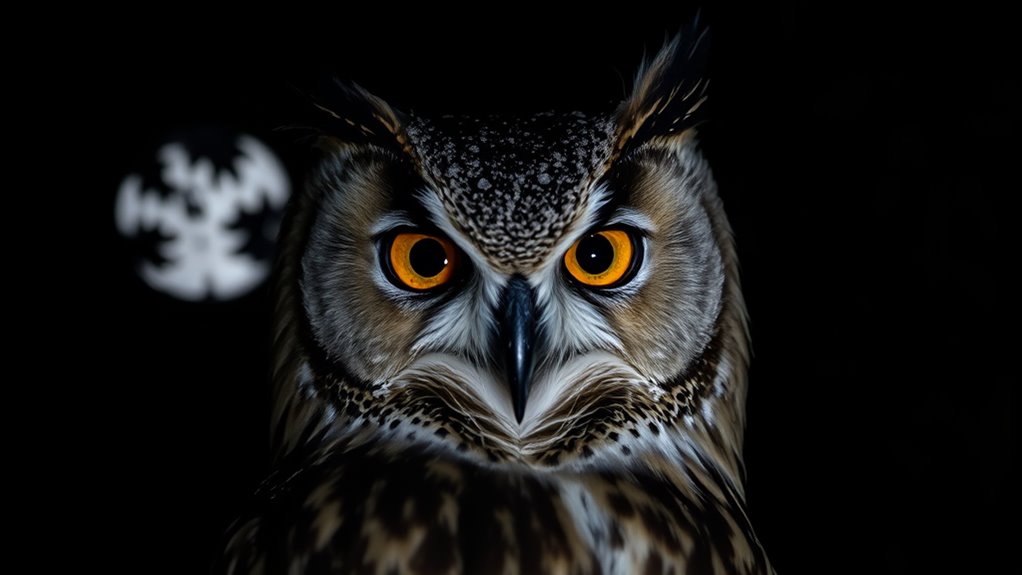
Facial discs and ear asymmetry work together to enhance an owl’s ability to locate prey with remarkable precision. The facial disc acts like a satellite dish, funneling sound toward the owl’s ears, which are positioned at different heights on the head. This asymmetry allows you to detect the direction and distance of sounds with incredible accuracy. When prey makes a noise, your facial disc captures it and directs it to your ears, where slight differences in timing and intensity help you pinpoint its location. This system enables you to hunt effectively even in complete darkness. By combining facial disc design with ear asymmetry, you gain a hunting edge that makes you a silent, precise predator in the night skies.
How Owls Survive and Thrive in Various Habitats
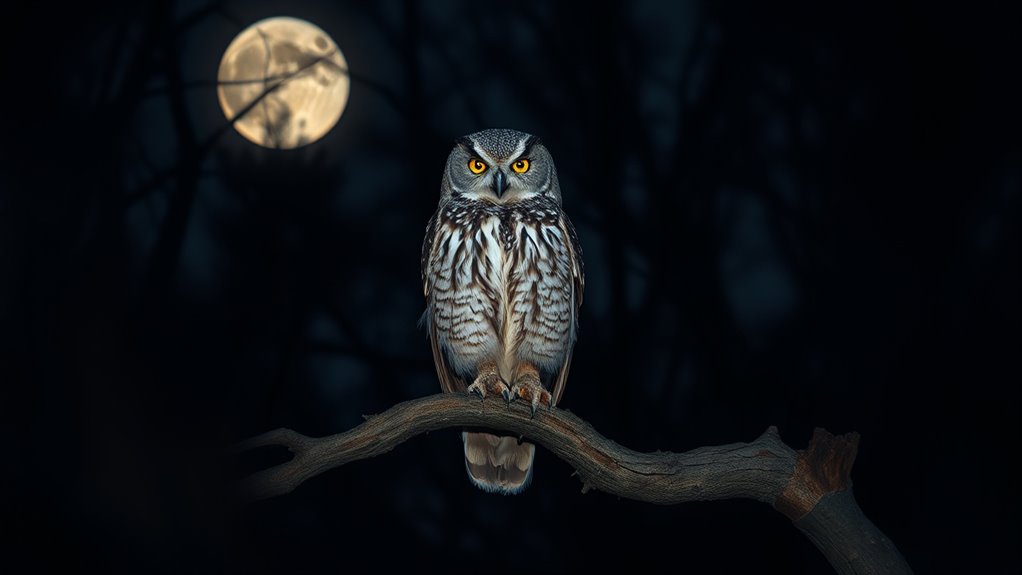
Owls have evolved remarkable adaptations that allow them to thrive across diverse habitats, from dense forests and open grasslands to urban environments. You’ll notice these adaptations in their ability to hunt, hide, and adapt to surroundings. For example:
- Camouflage: Their plumage blends seamlessly with the environment, making them nearly invisible during the day.
- Flexible hunting strategies: Some hunt from perches, others soar, and many wade into water or walk to catch prey, depending on habitat.
- Versatile roosting sites: They utilize tree cavities, abandoned buildings, or cliffs, adjusting to available shelter.
These traits enable owls to survive where conditions vary, ensuring they remain effective predators and elusive in their environments. Their adaptability is key to their success in multiple ecosystems.
The Impact of Owls on Ecosystem Balance

By controlling populations of various prey species, owls help maintain the delicate balance within their ecosystems. Their hunting keeps prey numbers in check, preventing overgrazing and habitat degradation. When owls hunt rodents, for example, they reduce crop damage and limit the spread of disease. Their predation on small mammals and insects influences plant regeneration and affects the populations of other predators, creating a balanced food web. Owls also target invasive species, helping to curb their spread and protect native wildlife. As top predators, they prevent any one prey species from dominating, fostering biodiversity. Without owls, prey populations could explode, leading to ecosystem instability. Their role as apex predators makes owls essential for sustaining healthy, resilient environments.
Frequently Asked Questions
How Do Owls’ Eyes Adapt to Different Night Environments?
Your owl’s eyes adapt to various night environments by adjusting the amount of light they absorb through their large size and high concentration of rod cells, which enhance sensitivity in darkness. Their binocular vision helps judge distances accurately, even in dim light. Additionally, the eyes can work with some ambient light, and their third eyelid protects them during rapid movements, ensuring clear vision across different low-light conditions.
Can Owls See in Complete Darkness Without Any Ambient Light?
Imagine you’re in a pitch-black forest, and a barn owl swoops silently, hunting with perfect precision. You might wonder if it can see in complete darkness. The truth is, owls can’t see in total darkness without any light. Their eyes need some ambient illumination to function. However, their incredible adaptation to low light makes them exceptional night hunters, capable of steering and hunting in almost darkness, but not absolute blackness.
How Do Owls’ Ear Placements Improve Their Prey Detection Accuracy?
You’ll notice that owls’ asymmetrical ear placements greatly improve their prey detection accuracy. By having ears at different heights, they can triangulate sound more precisely, pinpointing the exact location of prey even in complete darkness or dense vegetation. This adaptation allows you to detect subtle movements and sounds, giving you a hunting advantage by enabling quick, accurate strikes on hidden or well-camouflaged prey.
What Specific Feather Features Enable Owls’ Silent Flight?
You notice that owls’ feathers have specialized structures like soft fringes called fringed or velvety edges, which break up airflow and reduce noise. Their smooth, velvety surfaces also absorb sound vibrations, preventing turbulence during flight. These features work together to silence their wings, allowing you to approach prey stealthily. The feathers’ unique design ensures owls fly quietly, giving them the advantage of surprise during hunting, especially in darkness.
Do Owls’ Hunting Behaviors Change Across Different Seasons?
Like changing weather, owl hunting behaviors shift with the seasons. You’ll notice they adjust prey choices and hunting times—some hunt earlier in spring, while others focus on different prey types in winter. They adapt their strategies to seasonal prey availability and environmental conditions. This flexibility helps them stay effective year-round, ensuring they remain top predators in their habitats, no matter the season.
Conclusion
You might be surprised to learn that owls can rotate their heads up to 270 degrees, giving them incredible awareness of their surroundings. Their silent flight allows them to surprise prey in the dark, making them true rulers of the night skies. By mastering both sight and sound, owls control their ecosystems, helping keep prey populations in check. Next time you hear an owl’s call, remember you’re witnessing a marvel of evolution silently reigning over the night.