
The story of the passenger pigeon shows how human greed and habitat destruction wiped out a bird once numbering in the billions. Massive colonies made them easy targets, and relentless hunting sealed their fate. Their extinction highlights the importance of conservation and respecting nature’s balance. Understanding their tragic end reminds you that ignoring environmental impacts can lead to irreversible losses. If you’re curious about how this happened and what lessons remain, there’s more to uncover.
Key Takeaways
- The Passenger Pigeon’s rapid overhunting and habitat destruction led to its extinction, highlighting human impact on biodiversity.
- Its massive colonies and social behavior made it vulnerable to mass slaughter, illustrating risks of exploitative practices.
- The species’ decline underscores the importance of proactive conservation and early intervention to prevent irreversible losses.
- The story serves as a warning about assuming species abundance equates to resilience, urging sustainable resource management.
- Learning from this tragedy emphasizes the need for responsible stewardship to protect current threatened ecosystems.
Origins and Abundance of the Passenger Pigeon
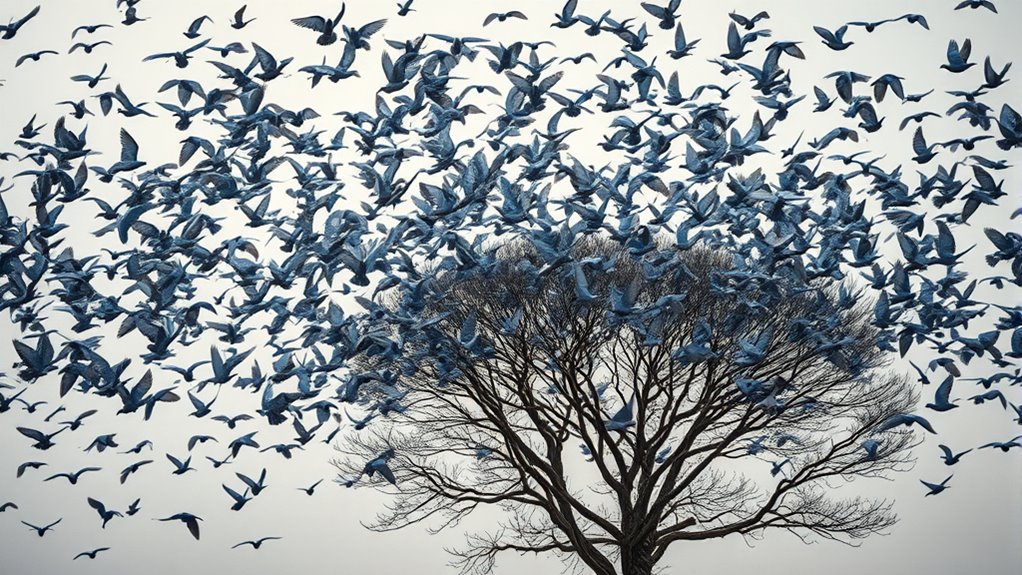
The Passenger Pigeon originated in North America, where it quickly became one of the most numerous bird species on the continent. By 1492, estimates suggest there were between 3 to 5 billion of these birds, making them a dominant presence in eastern forests and open woodlands. Their populations exploded due to their reliance on abundant mast, such as acorns and beechnuts, which provided ample food for nesting and feeding. These pigeons formed enormous colonies, sometimes spanning miles, where millions nested simultaneously. Their gregarious behavior and high reproductive capacity allowed their numbers to grow rapidly. When you consider their vast numbers, it’s clear they were once an integral part of North American ecosystems, shaping the landscape through their massive flocks and essential ecological roles.
The Peak of a Megafaunal Flock and Its Significance

At their peak, Passenger Pigeons formed flocks so enormous that millions of birds moved together as a single, unstoppable force. These massive flocks played a crucial role in shaping their ecosystems, influencing seed dispersal and forest growth. Understanding the scale and impact of these gatherings highlights their ecological significance and the consequences of their loss.
Enormous Flock Sizes
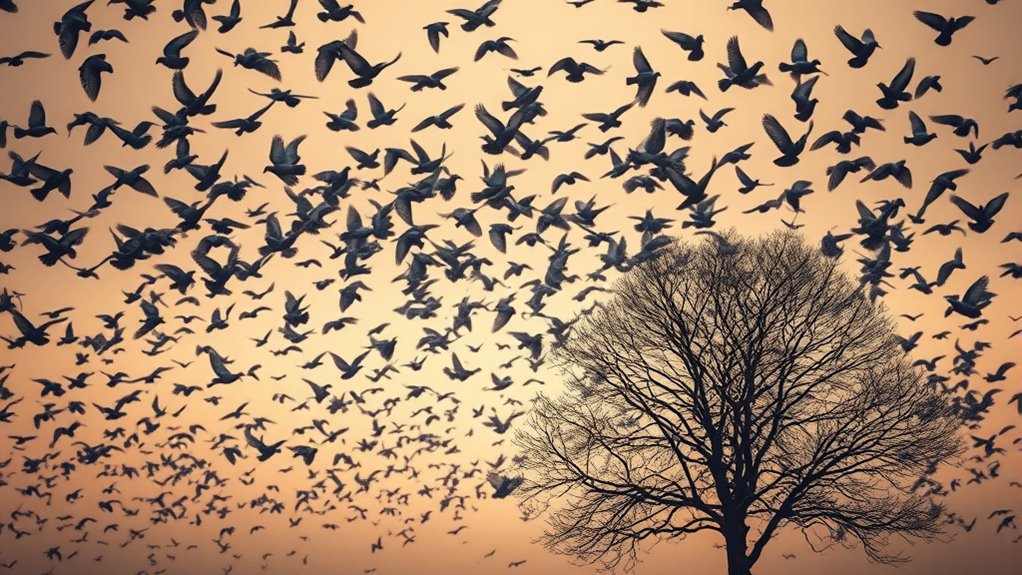
Passenger Pigeons once formed staggering flocks that numbered in the billions, a spectacle unmatched by most modern bird species. These immense gatherings could stretch across hundreds of miles, darkening the sky for hours or days. Such enormous flock sizes played a vital role in their survival, satiating predators and enabling rapid, long-distance migrations. The sheer density of these colonies made nesting and foraging highly efficient, supporting their massive populations. Their ability to coordinate in such vast numbers relied on their social behavior and colonial breeding strategies. Additionally, their large flock sizes facilitated efficient communication and collective decision-making, further strengthening their social bonds. The synchronized movement of these flocks exemplified complex social behaviors that allowed them to stay cohesive over great distances. However, this natural abundance also made them vulnerable. Hunters targeting these colossal flocks could harvest millions in a single season, accelerating their decline. The extraordinary size of their flocks once symbolized their dominance of North American skies. Colorful displays and social cohesion were key factors that allowed their colonies to thrive in such large numbers.
Ecological Importance
Have you ever considered how the massive flocks of Passenger Pigeons once shaped North American ecosystems? These colossal gatherings played a pivotal role in maintaining forest health and biodiversity. As they fed on mast like acorns and nuts, they helped control tree populations and disperse seeds across vast areas. Their droppings fertilized soil, promoting plant growth and supporting diverse habitats. During migration, their sheer numbers influenced predator populations, providing abundant food and preventing over-predation on other species. The destruction of these flocks didn’t just eliminate a bird — it disrupted ecological balances built over centuries. Their disappearance highlights how interconnected ecosystems are and reminds us that losing even a single species can ripple through entire environments, altering landscape dynamics and biodiversity for generations to come. Moreover, the decline of their populations underscores the importance of conservation efforts to preserve ecological integrity and prevent similar extinctions in the future. Understanding the ecological roles played by species like the Passenger Pigeon can help inform strategies to protect other vital biodiversity and maintain healthy ecosystems. Recognizing the importance of species interactions is essential for fostering resilient environments that can withstand environmental changes and human impacts. Protecting such species is crucial for maintaining ecosystem stability and ensuring thriving habitats for all living organisms.
The Slow Decline: Human Expansion and Habitat Changes

As humans expanded westward, your activities disturbed the Passenger Pigeon’s natural habitat, shrinking their nesting and foraging areas. Deforestation accelerated this loss, breaking up the large colonies they relied on for breeding. Changing land use further fragmented their environment, making it harder for the species to survive and reproduce. Additionally, the ongoing loss of suitable habitats underscores the importance of conservation efforts to prevent similar tragedies in the future. Recognizing the significance of measuring success in conservation initiatives can help ensure effective strategies are implemented to protect remaining species and ecosystems. Incorporating natural elements into conservation planning can also promote ecosystem resilience and recovery. Implementing monitoring technology can further aid in tracking habitat changes and species health, providing vital data to inform ongoing preservation strategies. Emphasizing creativity in problem-solving can lead to innovative solutions for habitat restoration and species protection, ensuring a sustainable coexistence with natural environments.
Westward Expansion Impacts
The westward expansion of European settlers in North America markedly contributed to the Passenger Pigeon’s gradual decline. As settlers moved west, they cleared forests for agriculture and settlements, reducing the pigeons’ natural habitats. This expansion fragmented large tracts of forest, limiting breeding and foraging areas. Increased land use disrupted the species’ reliance on mast-producing trees like oaks and acorns, essential for their survival. Settlers also introduced new hazards, such as hunting and trapping, which further decimated populations. Railroads and roads facilitated easier access to nesting sites, making it simpler for hunters to reach colonies. The combination of habitat loss, increased hunting, and infrastructure development accelerated the pigeons’ decline, pushing an already vulnerable species toward extinction. Your actions during westward expansion played a critical role in this devastating process.
Deforestation and Habitat Loss
During the westward expansion, settlers cleared vast forests to create farmland and settlements, steadily shrinking the Passenger Pigeon’s habitat. As you witness, these deforestation efforts reduced the large, continuous forests that once supported their nesting and foraging needs. Although massive flocks still nested in considerable woodlands early on, ongoing habitat destruction fragmented their environment, making it harder for colonies to thrive. As trees were cut down for agriculture, timber, and development, the pigeons lost critical breeding sites and food sources like acorns and mast. This habitat loss weakened their populations, making them more vulnerable to hunting and other threats. You see, human-driven landscape changes gradually undermined the species’ ability to sustain itself, setting the stage for their tragic decline.
Changing Land Use
Have you ever considered how human expansion gradually reshaped the land, quietly undermining the Passenger Pigeon’s survival? As settlers moved westward, they cleared vast forests for farms, towns, and industries. This transformation fragmented the pigeons’ natural habitats, reducing nesting sites and foraging areas. Large tracts of mature woodland, pivotal for mast production, shrank, forcing pigeons into smaller, isolated populations. Roads, railroads, and urban development also disrupted migration routes and nesting colonies. While early on, these changes seemed minor, their cumulative effect diminished the species’ ability to sustain large colonies. Over time, land use shifts chipped away at the pigeons’ essential resources, making their populations more vulnerable to hunting and environmental fluctuations. This gradual land transformation played a significant role in their tragic decline.
The Brutal Impact of Commercial Exploitation
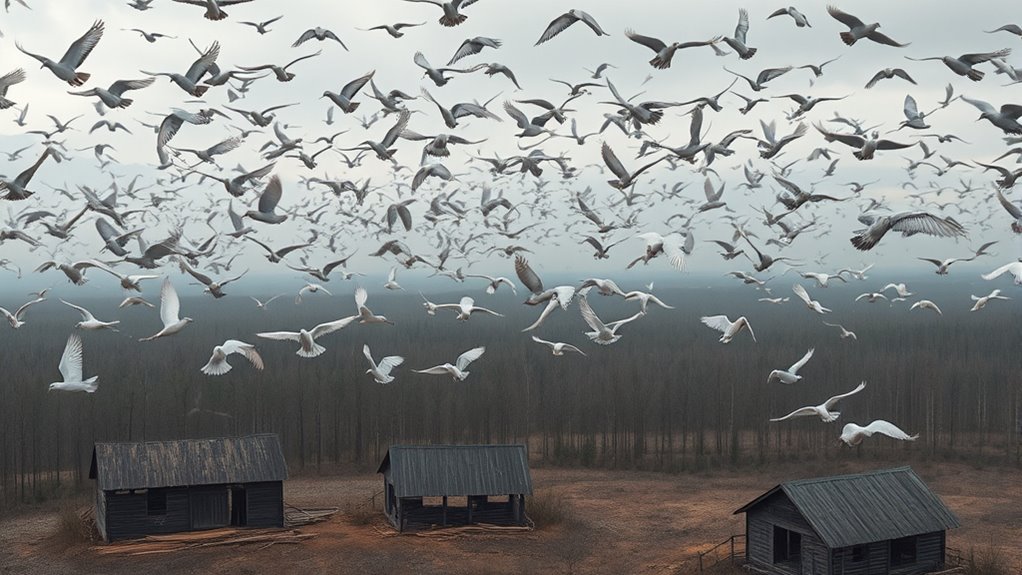
Commercial exploitation drove the Passenger Pigeon rapidly toward extinction by turning their abundance into a seemingly endless resource. Hunters targeted massive flocks during nesting seasons, killing millions with little regard for sustainability. Their large colonies made them easy targets, allowing for mass slaughter that drained populations quickly. As demand for pigeon meat grew in the late 19th century, hunting intensified, often destroying entire breeding colonies. Markets thrived on the bird’s perceived inexhaustibility, encouraging reckless harvesting. Weak laws and poor enforcement failed to curb the relentless slaughter. The birds’ social structure, which depended on large groups for reproduction, suffered as numbers plummeted. This relentless exploitation, driven by greed and ignorance, pushed the Passenger Pigeon toward extinction long before natural factors could take effect. Recognizing the importance of conservation efforts today is crucial to prevent similar tragedies in other species. Additionally, the lack of early intervention and awareness about the ecological consequences of overhunting intensified the decline and underscored the need for proactive species protection measures. Understanding the ecology of such social species could have helped inform better management strategies to prevent their collapse. The Passenger Pigeon’s story underscores the devastating effects of overexploitation, emphasizing the need for sustainable practices and regulatory oversight in wildlife management.
How Colonial Breeding Behavior Made Extinction Inevitable
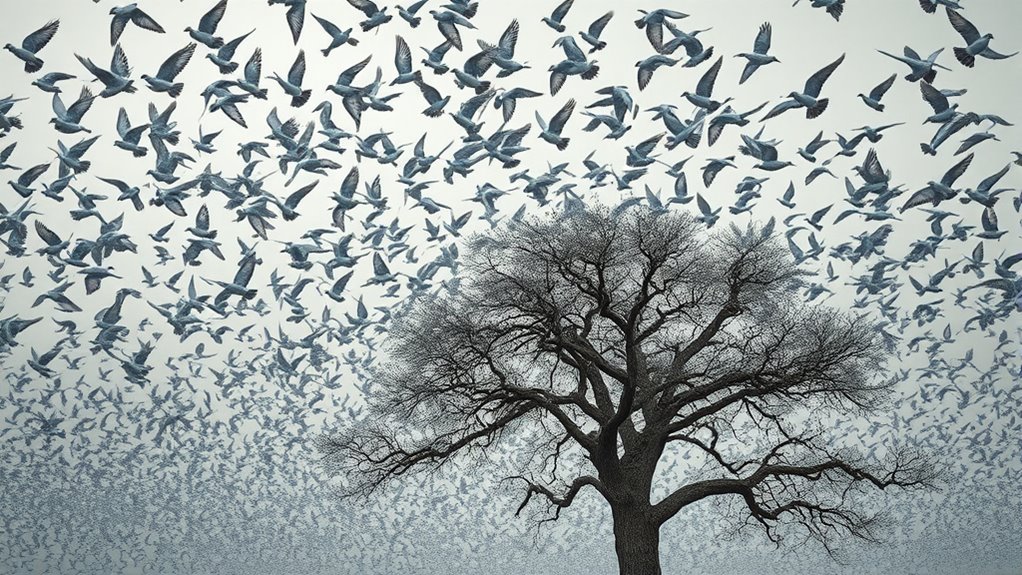
The colonial breeding behavior of Passenger Pigeons made their population particularly vulnerable to rapid decline and eventual extinction. They relied on massive colonies, sometimes numbering in the billions, to reproduce effectively. They depended heavily on social aggregation for successful breeding, which meant that once numbers fell below a critical threshold, reproductive success plummeted, accelerating their decline. Large nesting flocks attracted intense hunting because hunters targeted these gatherings for easy harvests. Disrupting nesting sites during breeding seasons reduced chick survival rates dramatically. Habitat loss further fragmented their breeding grounds, making it harder for colonies to regroup. As populations dwindled, social stimulation for breeding weakened, leading to a vicious cycle of reproductive failure. Their reliance on massive colonies turned out to be their greatest weakness, sealing their fate once numbers started slipping. Modern conservation efforts highlight the importance of understanding species vulnerability in preventing similar extinctions. Understanding their zodiac compatibility can offer insights into how social behaviors impact survival. Additionally, their colonial nesting behavior exemplifies how social dependence can be a double-edged sword in species survival.
The Failure of Early Conservation Efforts
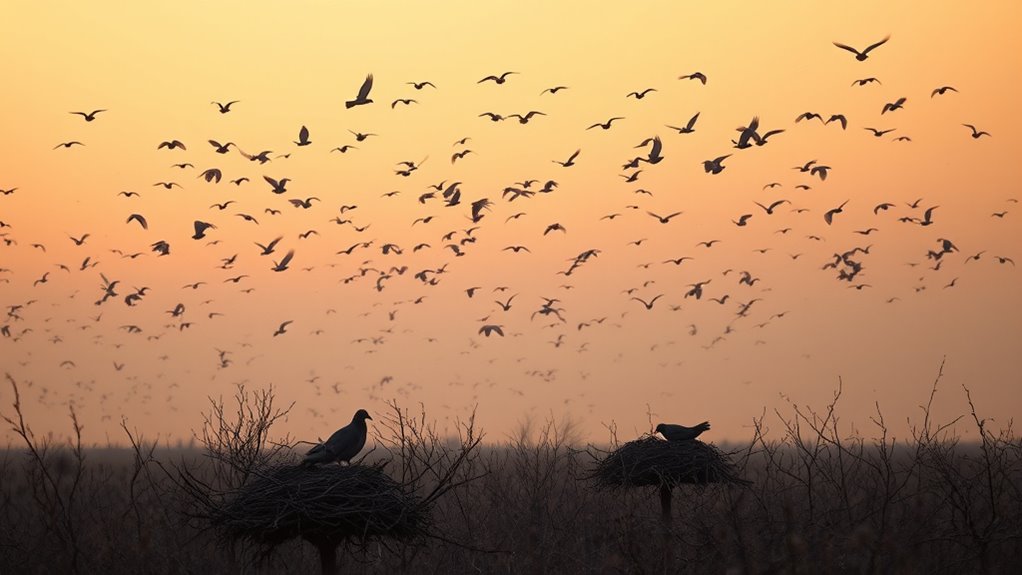
Early conservation efforts to save the Passenger Pigeon largely failed because they were too little, too late. Despite laws like Michigan’s 1897 hunting ban, enforcement was weak, and millions still fell prey to hunters. Laws restricting hunting near nesting sites came too late to prevent decline. You see, the species’ social nature made it vulnerable; once numbers dropped, reproduction faltered. The effort to breed pigeons in captivity failed because they relied on large social groups, which were impossible to recreate. Public awareness grew only when extinction was imminent, leading to limited, ineffective measures. Here’s a quick look at conservation attempts:
| Year | Effort | Result |
|---|---|---|
| 1897 | Hunting ban (Michigan) | Little impact, still hunted |
| 1880s | Restrictions on hunting | Enforced poorly |
| 1914 | No legal protection | Species already gone |
| 1900s | Captive breeding efforts | Failed due to social needs |
| 1890s | Public awareness rise | Too late for rescue |
Furthermore, the species’ social behavior made it particularly difficult to conserve once numbers declined. This social structure was a critical factor that amplified their vulnerability and hindered recovery efforts. The lessons from the Passenger Pigeon highlight the importance of preventive conservation and proactive measures before a species reaches the brink of extinction. Recognizing the importance of species’ social needs is essential for designing effective conservation strategies to prevent similar tragedies in the future.
The Final Days and the Last Known Individuals
As the Passenger Pigeon’s decline accelerated in the late 19th and early 20th centuries, the species slipped closer to extinction despite increasing awareness. You can imagine the last wild individuals, struggling to survive amid relentless hunting and habitat loss. By 1902, only a handful remained in the wild, each one more isolated. In captivity, Martha became famous as the last known Passenger Pigeon, dying in 1914. During those final years, you would have seen:
- Small, scattered flocks struggling to find mates
- Hunters capturing or killing remaining birds during nesting seasons
- Conservation laws that came too late to make a difference
- The heartbreaking death of Martha, symbolizing the species’ extinction
These moments encapsulate the species’ tragic final days.
Lessons Learned and Their Relevance Today

How often do we underestimate the impact of human activities on species that seem abundant and resilient? The Passenger Pigeon’s extinction shows that even billions of birds can vanish quickly if we aren’t careful. This lesson reminds you to take proactive conservation measures and enforce laws early, before species reach the brink. Waiting until it’s too late is a costly mistake. The story also highlights the importance of understanding social behaviors and population thresholds necessary for survival. Today, you can apply these lessons to combat biodiversity loss, protect habitats, and support sustainable practices. The Passenger Pigeon warns us that complacency and neglect can lead to irreversible losses—reminding us to act responsibly now to preserve our planet’s biological richness for future generations.
Frequently Asked Questions
Could Passenger Pigeons Have Survived With Better Conservation Efforts?
Yes, passenger pigeons could have survived with better conservation efforts. If you had implemented timely legal protections, enforced hunting bans, and preserved their habitats, their populations might have remained stable. Recognizing their social and colonial nature early on would’ve helped maintain breeding success. Active management, public awareness, and sustainable practices could have prevented their rapid decline, allowing these once-abundant birds to thrive rather than face extinction.
What Specific Ecological Role Did Passenger Pigeons Play in Their Habitat?
Imagine a vast, natural broom sweeping through forests—that’s what passenger pigeons did, shaping their habitat. Their massive flocks helped disperse seeds, fertilize soils, and control insect populations. For example, their droppings enriched the soil, supporting plant growth. With billions of these birds, their presence maintained a balanced ecosystem. Without them, the forest’s regeneration slowed, illustrating their essential role in sustaining a healthy, functioning environment.
Are There Ongoing De-Extinction Projects for Passenger Pigeons Today?
Yes, there are ongoing de-extinction projects for passenger pigeons today. Scientists use advanced genetic technologies, such as cloning and gene editing, to potentially bring the species back. These efforts aim to restore ecological roles and learn from past mistakes. You can follow organizations like Revive & Restore, which lead these initiatives. While still in experimental stages, these projects reflect hope and caution about manipulating nature.
How Did Their Social Behavior Influence Their Vulnerability to Extinction?
Your understanding of their social behavior reveals how it made Passenger Pigeons sitting ducks. Their massive colonies, like living clouds, relied on unity to breed and thrive. When hunters scattered these flocks or reduced their numbers, the social bonds shattered, and reproduction faltered. Their dependent social structure meant that once their population dropped below a critical point, survival became nearly impossible, sealing their tragic fate.
What Lessons From Their Decline Apply to Current Endangered Species?
You should recognize that even abundant species can vanish if humans exploit them unchecked or neglect conservation. The Passenger Pigeon’s decline warns you to act early with enforceable laws and habitat protection. Relying solely on natural abundance isn’t enough; proactive measures are essential. By learning from this, you can help prevent similar fates for endangered species today through timely intervention, sustainable practices, and respecting ecological needs.
Conclusion
Remember, history repeats itself if we don’t learn from it. The passenger pigeon’s tragic end teaches you that unchecked greed and neglect can wipe out even the most numerous species. If you ignore nature’s warnings, you risk losing more than you think—once gone, forever gone. So, let this story remind you: a bird in the hand is worth two in the bush, and safeguarding what we have today is the only way to ensure it’s here tomorrow.