
Among educational weather station kits for kids, I would put the Learning Resources Weather Center Kit first for a straightforward, hands-on introduction, while the Thames & Kosmos Weather & Climate Lab suits children ready for more involved experiments. The AcuRite 00777 stands apart for families who want a working indoor weather display rather than a project kit. The main choice is between guided activities that teach weather concepts and equipment that supports repeated observation; age, setup effort, and how much adult help a child needs also matter. Read on for the full comparison, buying advice, and recommendations by learner type.

Prime made for students and young adults
- Fast, free delivery for dorm and study essentials
- Prime Video and Amazon Music included
- Member-only deals
Key Takeaways
- The Learning Resources Weather Center Kit is the clearest all-around starting point for hands-on weather learning, while more elaborate experiment sets suit children who want a longer project.
- Thames & Kosmos and Science Can emphasize lab-style learning; they make more sense for kids who enjoy following experiments than for families seeking a simple display.
- The AcuRite 00777 fills a different role from the five activity kits: its alarm-clock format supports everyday weather awareness, but it is less focused on structured experiments.
- The DIY Weather Station kit and 4M Green Science kit lean toward building and making, so check the child’s tolerance for assembly and the adult’s willingness to help before choosing.
- The most useful kit depends on how a child will use it: repeated observation favors a display, while guided activities or construction favor an experiment set.
| Learning Resources Weather Center Kit |  | Best for Beginner Meteorology | Brand: Learning Resources | Recommended age: 5–10 years | Included instruments: 3-inch barometer, hygrometer, Celsius/Fahrenheit thermometer | VIEW LATEST PRICE | See Our Full Breakdown |
| Thames & Kosmos Weather & Climate Lab Earth Science Experiment Set |  | Best for Outdoor Weather Tracking | Brand: Thames & Kosmos | Age range: 6–12 years | Tools: Wind vane, compass, rain gauge, anemometer, thermometer | VIEW LATEST PRICE | See Our Full Breakdown |
| DIY Weather Station Science Kit for Kids Ages 7–14 |  | Best for Assembly and Hands-On Projects | Recommended age: 7–14 years | Included instruments: Wind vane, anemometer, thermometer, rain gauge, compass | Additional experiment: Bottle greenhouse-effect project | VIEW LATEST PRICE | See Our Full Breakdown |
| Science Can Interactive Meteorology Lab STEM Toy |  | Best for Indoor Weather Demonstrations | Brand: Science Can | Age range: 6 years and up | Weather modes: 8 | VIEW LATEST PRICE | See Our Full Breakdown |
| AcuRite 00777 What-to-Wear Weather Station with Alarm Clock |  | Best for Everyday Weather Habits | Power source: Battery powered | Display batteries: 3 AAA batteries required, not included | Outdoor sensor batteries: 2 AA batteries required, not included | VIEW LATEST PRICE | See Our Full Breakdown |
| 4M Green Science Weather Science Kit |  | Best for Early Weather Experiments | Brand: 4M | Set name: Green Science Weather Science Kit | Age range: 5+ | VIEW LATEST PRICE | See Our Full Breakdown |
| educational weather station kits for kid | Brand | Material | Model number | Age range |
|---|---|---|---|---|
| Learning Resources Weather Cen | Learning Resources | Plastic | LER2940 | — |
| Thames & Kosmos Weather & Clim | Thames & Kosmos | — | 550049 | 6–12 years |
| DIY Weather Station Science Ki | — | Plastic listed; product description contains inconsistent material claims | — | — |
| Science Can Interactive Meteor | Science Can | Plastic | — | 6 years and up |
| AcuRite 00777 What-to-Wear Wea | — | — | — | — |
| 4M Green Science Weather Scien | 4M | — | 00-00017 | 5+ |
More Details on Our Top Picks
Learning Resources Weather Center Kit
For younger children starting to connect weather readings with the world outside, the Learning Resources Weather Center Kit offers a simple set of three instruments: a barometer, hygrometer, and thermometer. That mix introduces air pressure, humidity, and temperature without asking kids to assemble a full outdoor station. The included stands, carrying case, and activity guide make it easier to set up and keep the pieces together than the Thames & Kosmos Weather & Climate Lab, which is geared more toward outdoor readings such as wind and rainfall. The tradeoff is narrower coverage: there is no wind vane, anemometer, or rain gauge, and the product data gives no thermometer accuracy details. I’d choose it for guided first lessons, not for families seeking a broad, ongoing outdoor weather project.
Pros:- Introduces three distinct measurements: pressure, humidity, and temperature
- Activity guide supports structured first lessons
- Individual stands and a carrying case help with setup and storage
- Thermometer displays both Celsius and Fahrenheit
Cons:- Does not measure wind direction, wind speed, or rainfall
- No thermometer accuracy details are provided
- Plastic construction may be less suited to rough outdoor use
Best for: Families with children ages 5–10 who want a portable, guided introduction to temperature, humidity, and air pressure.
Not ideal for: Kids ready to measure wind and rainfall outdoors, since this kit does not include those tools.
- Brand:Learning Resources
- Recommended age:5–10 years
- Included instruments:3-inch barometer, hygrometer, Celsius/Fahrenheit thermometer
- Included accessories:Carrying case, individual stands, activity guide
- Material:Plastic
- Item weight:1.1 pounds
- Item dimensions:13.3 x 7.8 x 3.2 inches
- Model number:LER2940
Our verdict“Choose this kit for younger beginners who benefit from clear, portable lessons, but pick Thames & Kosmos for broader outdoor observation.”
Thames & Kosmos Weather & Climate Lab Earth Science Experiment Set
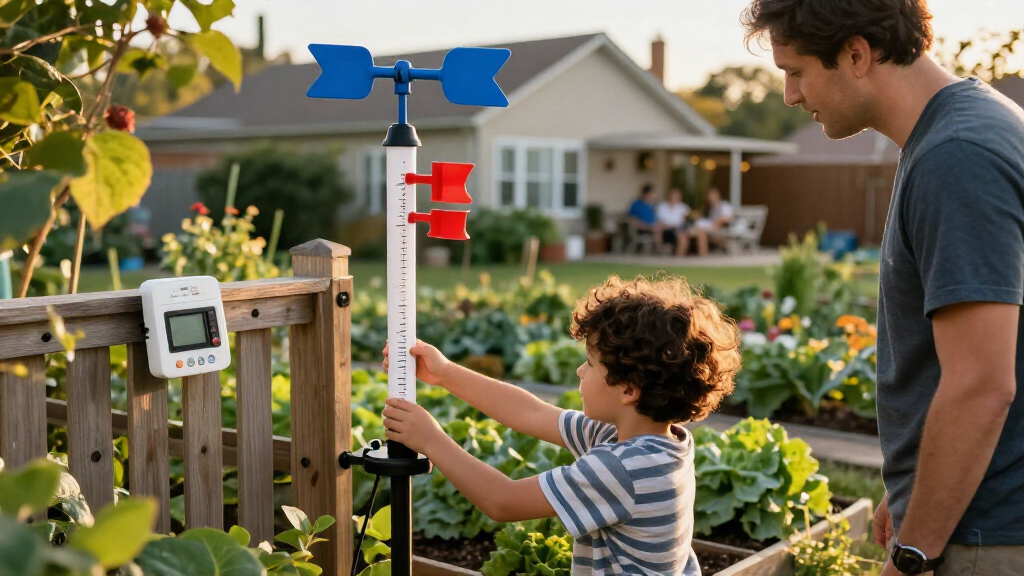
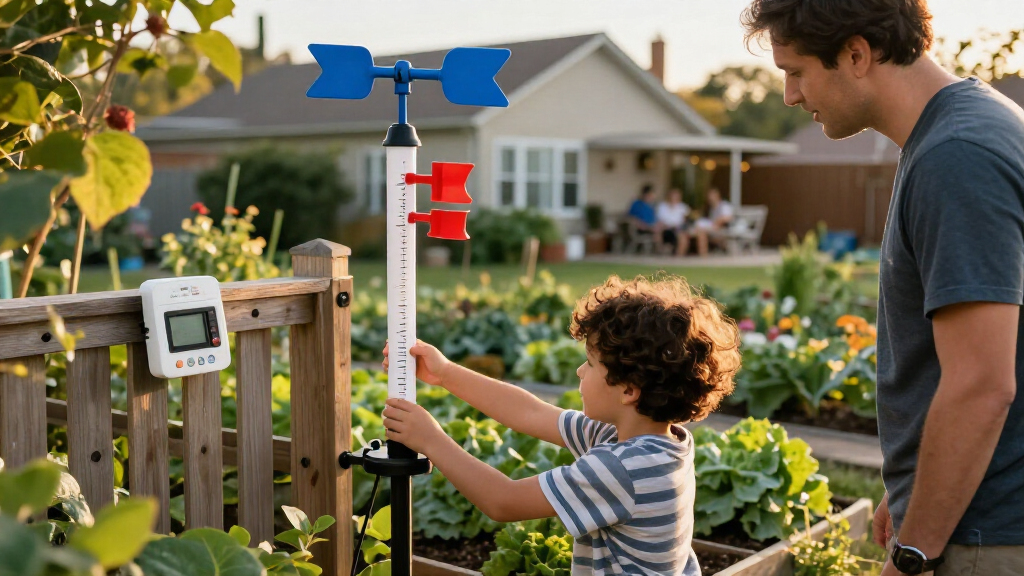
The Thames & Kosmos Weather & Climate Lab is the strongest fit here for children who want to gather observations outdoors rather than focus on indoor demonstrations. Its five tools cover wind direction, wind speed, rainfall, and temperature, while a compass supports orientation and the 32-page manual supplies eight experiments plus room to record findings. Compared with the Learning Resources Weather Center Kit, this set gives kids more ways to connect changing conditions with measurements; it also asks more of the family, since the station is designed for outdoor use and needs installation. The guided activities make the setup feel like a continuing science project, but it is less convenient for a quick tabletop lesson or a child who wants a ready-to-use interactive display. I’d rank it highest for sustained observation, with installation as its main hurdle.
Pros:- Combines a wind vane, anemometer, rain gauge, thermometer, and compass
- Eight experiments give children a reason to revisit their measurements
- 32-page full-color manual includes space for recording observations
- Supports hands-on study of both weather and climate
Cons:- Outdoor installation is required
- Less portable and immediate than the Learning Resources Weather Center Kit
- Product information does not specify measurement accuracy
Best for: Families with children ages 6–12 who can install an outdoor station and want guided experiments with recorded observations.
Not ideal for: Apartment households without a suitable outdoor mounting spot, or children who need a portable indoor activity.
- Brand:Thames & Kosmos
- Age range:6–12 years
- Tools:Wind vane, compass, rain gauge, anemometer, thermometer
- Manual:32-page, full-color manual
- Experiments:Eight hands-on experiments
- Included components:Compass, plastic parts, thermometer, zip ties
- Model number:550049
Our verdict“Pick this set for kids ready to install and track an outdoor station, rather than for families seeking a compact indoor lab.”
DIY Weather Station Science Kit for Kids Ages 7–14
Children who learn by building may get more from the DIY Weather Station Science Kit than from the ready-to-use Learning Resources Weather Center Kit. The assembly element gives kids a role in putting together tools for wind direction, wind speed, temperature, and rainfall, then applying them to outdoor observations. A separate bottle greenhouse-effect experiment adds a simple way to explore how conditions can change, broadening the project beyond taking readings. Its stated age range of 7–14 also reaches older children than the beginner-focused Learning Resources set. The tradeoff is that the product details provide less information about guided activities and construction than the Thames & Kosmos manual does, and the description includes inconsistent material claims. I’d favor it for a build-and-explore project, while families wanting a clearly documented lesson sequence may prefer Thames & Kosmos.
Pros:- Includes tools for wind direction, wind speed, temperature, and rainfall
- Assembly gives children a hands-on role before data collection
- Bottle greenhouse-effect project extends the weather activities
- Lightweight at approximately 120 g (4.2 oz)
Cons:- Contains small parts and is not suitable for children under 3
- Product description has inconsistent material claims
- Available details do not specify the same experiment and recording support as the Thames & Kosmos manual
Best for: Children ages 7–14 who enjoy assembling science projects and want to combine weather tracking with a greenhouse-effect activity.
Not ideal for: Families seeking detailed, clearly specified lesson materials or a kit for children under 3, due to small parts.
- Recommended age:7–14 years
- Included instruments:Wind vane, anemometer, thermometer, rain gauge, compass
- Additional experiment:Bottle greenhouse-effect project
- Material:Plastic listed; product description contains inconsistent material claims
- Weight:Approximately 120 g (4.2 oz)
- Small parts warning:Not suitable for children under 3 years
Our verdict“Choose this for school-age kids who want to build their station and try a related science project, not for buyers who need detailed kit specifications.”
Science Can Interactive Meteorology Lab STEM Toy
Where the Thames & Kosmos Weather & Climate Lab is built around collecting outdoor measurements, the Science Can Interactive Meteorology Lab focuses on indoor demonstrations. Its eight weather modes, mist humidifier, and illustrated manual give children a more immediate, visual way to explore weather ideas, without installing a vane or rain gauge outside. USB power or four AA batteries lets families choose a fixed spot or cordless operation, though batteries are not included. This is a different kind of learning tool from the Learning Resources Weather Center Kit: it offers interactive effects rather than a set of instruments for reading pressure, humidity, and temperature. That makes it appealing for demonstration-led learning, but less useful for logging real local weather. I’d choose it for indoor exploration and skip it if the goal is measurement practice.
Pros:- Eight weather modes provide varied indoor demonstrations
- Mist humidifier and white noise mode add interactive elements
- Illustrated manual explains the science behind demonstrations
- Can run by USB or with four AA batteries
Cons:- Does not provide the outdoor measurement tools found in Thames & Kosmos
- Four AA batteries are not included for cordless use
- Single included component offers less scope for instrument-based tracking
Best for: Families with children ages 6 and up who prefer visual indoor demonstrations over installing and maintaining outdoor measuring instruments.
Not ideal for: Children who want to record actual wind, rainfall, or temperature readings from an outdoor station.
- Brand:Science Can
- Age range:6 years and up
- Weather modes:8
- Power:USB cable or 4 AA batteries, not included
- Material:Plastic
- Dimensions:8.66 x 7.68 x 9.84 inches
- Included components:1
Our verdict“Choose this lab for interactive indoor demonstrations; choose Thames & Kosmos or the DIY kit for collecting outdoor weather data.”
AcuRite 00777 What-to-Wear Weather Station with Alarm Clock
The AcuRite What-to-Wear Weather Station turns a daily forecast into a practical clothing choice, making it the most routine-oriented option in this group. Its wireless outdoor sensor reports temperature and trends, while more than 40 clothing recommendations and virtual stars can prompt kids to connect the weather with what they wear. That everyday use differs from the Thames & Kosmos Weather & Climate Lab, which teaches through outdoor measurements and recorded experiments, and from the Science Can lab’s indoor demonstrations. The AcuRite is easier to fold into a morning routine, but it is not a full instrument kit: it does not measure wind speed, rainfall, or air pressure. The display and sensor also need separate batteries, which are not included, and the stated wireless range may not suit larger properties. I’d pick it for applied daily learning, not broad meteorology lessons.
Pros:- More than 40 clothing recommendations connect forecasts with a daily decision
- Wireless outdoor sensor provides temperature, trend arrows, and a freeze indicator
- Virtual stars encourage children to take part in dressing for the weather
- Alarm clock includes snooze, backlight, and battery backup
Cons:- Does not offer the wind, rainfall, and experiment tools found in Thames & Kosmos
- Requires three AAA batteries for the display and two AA batteries for the sensor; not included
- Wireless range is about 165 feet, which may not suit larger properties
Best for: Families who want children to practice matching outdoor temperature and forecast guidance to daily clothing choices.
Not ideal for: Young weather enthusiasts seeking experiments or a broad set of measuring tools, or households where the outdoor sensor must sit beyond its stated range.
- Power source:Battery powered
- Display batteries:3 AAA batteries required, not included
- Outdoor sensor batteries:2 AA batteries required, not included
- Connectivity:Radio frequency (433 MHz)
- Temperature accuracy:+/- 2°F
- Display type:LCD
- Additional features:Adjustable brightness, alarm, clock
- Wireless range:About 165 feet
Our verdict“Choose the AcuRite for practical, repeatable weather-and-clothing lessons, but select an experiment kit for broader measurement skills.”
4M Green Science Weather Science Kit
The 4M Green Science Weather Science Kit is a strong fit for younger children who learn by making and observing, rather than by tracking daily conditions with instruments. Its activities connect cloud formation, the water cycle, static electricity, the greenhouse effect, and acid rain, giving kids several entry points into weather and climate science. The included desktop water cycle model adds a visible demonstration that the AcuRite 00777, focused on displaying conditions and clothing guidance, does not offer. Compared with the more lab-oriented Thames & Kosmos Weather & Climate Lab, this kit is aimed at a younger stated age range and favors approachable activities over a broad experiment-set format. The tradeoff is that it is not a working weather station, and some experiments call for household materials such as baking soda and vinegar.
Pros:- Covers multiple weather and environmental topics, including the water cycle and greenhouse effect
- Hands-on activities give young learners concrete ways to explore scientific ideas
- Includes a desktop water cycle model
- Stated age range of 5+ makes it suitable for early science activities
Cons:- Some experiments require household supplies such as baking soda and vinegar
- Does not provide a set of instruments for ongoing weather observation
- The listed components describe a science kit without specifying the materials or quantity for each activity
Best for: Families with children aged 5 and up who want guided, hands-on introductions to weather and environmental science at home.
Not ideal for: Buyers seeking instruments to measure or record outdoor weather; this is an experiment kit, not a functional weather station.
- Brand:4M
- Set name:Green Science Weather Science Kit
- Age range:5+
- Educational objective:Creative skills
- Item type:DIY kit
- Included components:Science kit
- Number of items:1
- Model number:00-00017
Our verdict“Choose this kit for a child aged 5 or older who wants varied weather experiments, but pick an instrument-based option for regular weather tracking.”
How We Picked
I compared the six options by how directly they help children learn weather concepts through observation, experiments, or construction. I also weighed age fit, clarity of activities, likely adult involvement, opportunities to repeat or extend learning, and whether the product’s format suits regular use or a one-time project.
The ranking favors kits that offer an approachable, useful learning experience for a broad range of families, then distinguishes more specialized picks by their strengths. The Learning Resources Weather Center Kit leads as a balanced hands-on choice; experiment-heavy sets rank well for curious, self-directed learners, while the AcuRite 00777 earns a separate place for everyday display use. No single format is right for every child, so the order reflects versatility and fit—not a claim that one kit teaches every weather topic best.
| educational weather station kits for kid | Material |
|---|---|
| Learning Resources Weather Cen | Plastic |
| Thames & Kosmos Weather & Clim | — |
| DIY Weather Station Science Ki | Plastic listed; product description contains inconsistent material claims |
| Science Can Interactive Meteor | Plastic |
| AcuRite 00777 What-to-Wear Wea | — |
| 4M Green Science Weather Scien | — |
Factors to Consider When Choosing Educational Weather Station Kits For Kids
Before choosing a kit, decide what kind of learning you want to happen after the package is opened. A weather display, a set of guided experiments, and a build-it-yourself project can all teach useful ideas, but they call for different levels of attention, support, and space.
Choose Between Observing, Experimenting, and Building
Start with the activity your child is most likely to repeat. A display can prompt daily conversations about conditions, while experiments help connect causes and effects through guided tasks. Construction kits add the satisfaction of making something, but assembly can take time away from learning if the child mainly wants quick results. A common mistake is to choose the most activity-packed box without asking whether the child enjoys instructions and multi-step projects. For younger or easily distracted learners, a simple observation routine may be more rewarding than a long experiment sequence. If your child likes making and testing, a build-oriented kit can turn weather into a project they revisit.
Match the Learning Load to the Child
Age labels are a starting point, not a full measure of readiness. Consider reading comfort, ability to follow steps, patience with trial and error, and interest in recording results. Some children can manage complex ideas but still need help with setup or small components. Buying an advanced set too early can leave an adult doing most of the work; choosing a very simple one may lose an older child’s interest. Check the activity descriptions and expected supervision rather than relying on the age range alone. The best fit lets a child take an active role without making every session feel like a lesson.
Check What the Kit Lets a Child Learn
Weather covers several connected ideas, including temperature, wind, precipitation, and patterns over time. A kit may focus on only a subset, so choose based on the concepts your child wants to explore rather than the broad label on the box. Look for activities that encourage comparing observations or asking why conditions changed; these habits can make even simple equipment more educational. Avoid assuming that a product with many parts teaches more than one with fewer, well-explained activities. If your child is working on a school topic, match the kit’s actual activities to that subject. For broader learning, pair a focused kit with a notebook and regular outdoor observations.
Account for Adult Help and Setup
Hands-on learning kits vary in how much setup, explanation, and troubleshooting they ask of adults. Think about whether a caregiver can join the first session, help interpret results, or supervise assembly when needed. A kit that requires frequent assistance may be a good shared activity but a poor choice for independent play. Read the instructions and component details before buying, especially if the child is expected to complete experiments alone. Also consider where activities will happen: outdoor observation may require a suitable spot, while tabletop work needs room to spread out. Matching the kit to your household routine reduces the chance that it stays unused after the first session.
Think About Repeat Use and Long-Term Interest
Some kits are designed around a finite set of experiments; others invite ongoing observation. Neither format is automatically better: a completed project can still be worthwhile if it teaches a concept the child cares about. Ask whether your child prefers finishing a sequence or returning to the same activity as conditions change. If repeat use matters, favor formats that support recording, comparing, or displaying observations rather than relying only on novelty. A common buying mistake is to treat a large activity count as proof of lasting play value. Consider whether the kit can connect with books, school projects, or simple weather tracking at home.
Set Expectations for What a Kids’ Kit Can Do
Educational kits are learning tools, not necessarily substitutes for professional forecasting equipment or full-featured home weather stations. Decide whether you want a child-friendly demonstration, a project to build, or reliable information for household planning; those goals may point to different products. A toy or experiment set can make abstract ideas tangible without providing highly detailed measurements. Likewise, a digital display may be convenient but offer less guided instruction than a lab-style kit. Check the product information for what is included and what the child can actually measure or observe. Paying more only makes sense when the extra functions match a real learning goal.
Frequently Asked Questions
Which type of kit is best if my child wants to check the weather every day?
Choose a product designed for ongoing display or observation rather than one centered on a fixed sequence of experiments. In this lineup, the AcuRite 00777 is the most distinct fit for everyday weather awareness because it combines a weather display with an alarm-clock format. A display can build a routine, but it may offer less structured instruction than a science lab kit. If your child also wants to understand why weather changes, add a notebook or pair the display with guided activities. Check the product details to confirm which readings and functions matter to your household.
Should I choose a weather experiment set or a kit my child builds?
Pick an experiment set if your child likes following steps and seeing how a test connects to a weather concept. A build-oriented kit is a stronger match for a child who enjoys assembly and wants to make a project part of the learning. Construction can increase engagement, though it may also call for more patience and adult help. Neither format guarantees more learning; the better choice is the one your child will complete and revisit. If you are unsure, consider whether they usually prefer a guided activity or making something from parts.
Do these kits work for a child who needs an adult nearby?
Many children benefit from an adult joining the first activity, especially when a kit involves setup, instructions, or interpreting results. That does not make the kit unsuitable; it may turn weather learning into a useful shared project. Before buying, check the product’s age guidance, activity steps, and any notes about supervision. If you need a child to work independently, favor a simpler format and avoid assuming that a STEM label means little adult involvement. Plan for help with initial setup even when the child can handle later activities on their own.
Can one kit cover both school science projects and casual play?
It can, but the fit depends on the assignment and the child’s interests. Guided experiment kits may provide a clearer starting point for a project that asks a child to test an idea, while a display or observation routine can support tracking conditions over several days. Check the assignment requirements before choosing; a kit may not measure the specific factor the teacher expects. Casual play also matters, since a project used only for homework may not hold attention afterward. A simple observation log can extend many kits without requiring extra equipment.
Is a weather display or an experiment kit the better gift for a beginner?
For a beginner who wants to learn through doing, the Learning Resources Weather Center Kit is the most balanced starting point in this roundup. A display may feel more immediately useful to a child who already likes checking conditions, but it can be less instructional on its own. Experiment kits suit beginners who enjoy following a sequence and have the patience for a more structured activity. Think about whether the recipient prefers quick, everyday interaction or a focused project. If you cannot ask, favor the format that matches their usual play style rather than choosing by feature count.
Conclusion
For the broadest fit, I recommend the Learning Resources Weather Center Kit as best overall, while the DIY Weather Station Science Kit for Kids Ages 7–14 is the best value-style choice for families prioritizing a hands-on project format. The Thames & Kosmos Weather & Climate Lab is my best premium pick for children who want a deeper sequence of experiments, and the Learning Resources kit is also the strongest beginner-friendly option in this comparison. Choose the AcuRite 00777 for a child who wants a weather display as part of daily routine; choose the Science Can Interactive Meteorology Lab or 4M Green Science Weather Science Kit when their particular lab or making style is the draw. Match the format to the child’s habits first, then use the feature list to narrow the choice.