
TL;DR

Get school and study supplies delivered free — and shop member deals
- Fast, free delivery on millions of items
- Access to Prime Big Deal Days deals on October 6–7
- Prime Video, Amazon Music and more included
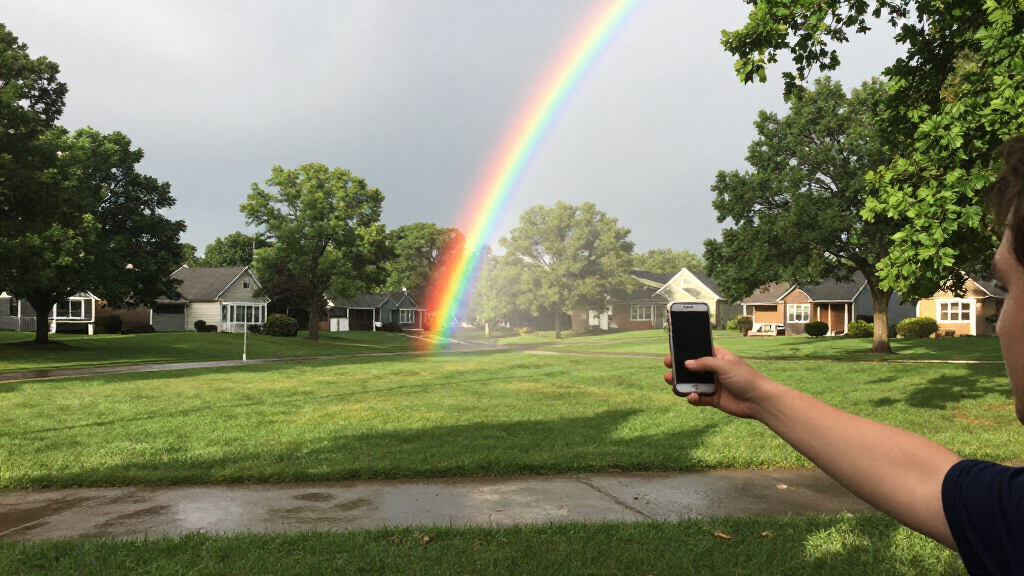
NASA’s Astronomy Picture of the Day for Oct. 4, 2026, features a photograph of at least five supernumerary rainbows over New Jersey’s Jersey Shore. The image was taken in 2018 after the remnants of Hurricane Florence passed through; the closely spaced bands form through wave interference in sunlight passing through similarly sized raindrops.
NASA’s Astronomy Picture of the Day for Oct. 4, 2026, features a photograph showing at least five supernumerary rainbows over the Jersey Shore in New Jersey. Photographer John Entwistle captured the scene in 2018 after the remnants of Hurricane Florence passed, recording a rare-looking display produced by sunlight interacting with raindrops.
The APOD account says the Sun appeared in one direction after the storm’s remnants passed, while a series of rainbows formed in the opposite direction. Over roughly the next half hour, the bands appeared and faded. Entwistle’s featured image captured at least five, according to the NASA explanation. The photographer was there with his daughter, who shared the experience.
These additional bands, called supernumerary rainbows, appear close to a primary rainbow. NASA says they form when falling water droplets are nearly the same size, typically less than a millimeter across. Sunlight passing through the droplets can both reflect inside them and interfere as waves, producing the extra colored bands.
The image is credited to John Entwistle. The APOD page lists Robert Nemiroff, Jerry Bonnell, Cecilia Chirenti and Keighley Rockcliffe as authors and editors. NASA describes APOD as a daily service that pairs an image or photograph with an explanation written by a professional astronomer.
A Rainbow Explained by Light Waves
The photograph offers a visible example of a phenomenon that depends on the wave behavior of light, rather than reflection alone. NASA’s explanation says the closely spaced bands arise from interference among light waves after sunlight passes through similarly sized raindrops. That makes the image useful beyond its striking appearance: it connects a familiar weather scene to a physical process that can be difficult to see directly.
NASA also places the phenomenon in the history of optics. It says supernumerary rainbows were noted in the early 1800s and were considered early evidence for light’s wave nature. The APOD feature therefore serves as both an image of a transient atmospheric display and a short account of how observation helped inform scientific understanding.
As an affiliate, we earn on qualifying purchases.
The 2018 Jersey Shore Display
The event depicted in the image happened in 2018, not on the APOD publication date. NASA’s caption links the display to the passage of the remnants of Hurricane Florence over the Jersey Shore. It describes a change in the local conditions: the Sun emerged on one side, and rainbows became visible in the opposite direction. The source does not give a more precise date or identify a specific location along the shore.
APOD republishes and explains astronomical and other science-related imagery on a daily schedule. In this case, the feature is an atmospheric-optics photograph rather than an image of a distant astronomical object. NASA’s caption uses it to explain how rainbow bands can arise from water droplets and the interference of light waves.
Limits of the Published Account
NASA’s page does not specify the exact date in 2018, the precise Jersey Shore location, or the camera and exposure details. It reports that at least five bands were captured in the featured image, but does not provide a separate measurement of the droplet sizes or a detailed meteorological record for the moment of the photograph.
The APOD feature is an explanation of an existing photograph, not a report of a new rainbow event in New Jersey. The source does not indicate that the image has been independently analyzed or that NASA conducted new observations for this publication. Its scientific description is presented in the APOD caption.
The Daily APOD Continues
NASA’s Astronomy Picture of the Day service publishes a different image or photograph each day with an accompanying explanation. The Oct. 4 feature points readers to the next scheduled picture, which the page labels “open space.” The source does not provide further details about that image in the material accompanying the New Jersey rainbow photograph.
For this story, the next step is the regular APOD publication rather than a developing investigation: the 2018 scene has already passed, and the Oct. 4 page presents the photograph and its explanation. NASA’s account gives no indication of additional reporting or follow-up measurements related to the rainbow display.
Key Questions
What did NASA feature on Oct. 4, 2026?
NASA’s Astronomy Picture of the Day featured a photograph of at least five supernumerary rainbows over New Jersey’s Jersey Shore.
When was the photograph taken?
The APOD caption says the image was taken in 2018, after the remnants of Hurricane Florence passed over the Jersey Shore. It does not provide an exact date.
What causes supernumerary rainbows?
According to NASA, they form when raindrops are nearly the same size, typically under a millimeter across. Sunlight passing through the droplets interferes as waves, creating additional bands near a rainbow.
Did the rainbow display last for half an hour?
NASA says the bands faded in and out over about half an hour. The caption does not say that every band remained continuously visible throughout that period.
Source: primary
Halloween Picks
halloween
As an affiliate, we earn on qualifying purchases.