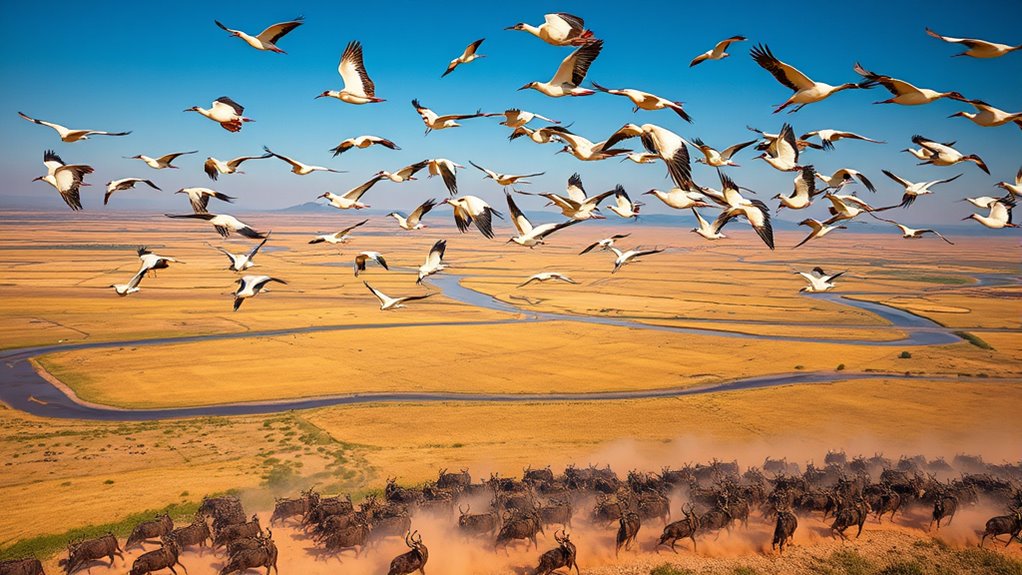

Animals travel epic distances driven by survival, breeding, and seasonal resource needs. They use cues like stars, the sun, landmarks, and social learning to navigate often thousands of kilometers. Adaptations such as fat storage, streamlined bodies, and environmental awareness help them succeed. However, climate change and habitat loss challenge their journeys. If you’re curious about the incredible ways animals overcome these obstacles and how they master navigation, there’s more to discover ahead.
Key Takeaways
- Animals migrate primarily to access seasonal resources, breeding sites, and avoid harsh environmental conditions.
- Migration strategies include physiological adaptations, energy conservation, and navigation using celestial cues and landmarks.
- Long-distance migrations are driven by survival needs, gene flow, and ecological balance.
- Navigational techniques involve innate spatial awareness, social learning, environmental landmarks, and environmental cues.
- Migration faces challenges from climate change, habitat loss, predators, and weather, requiring behavioral and physiological resilience.
The Driving Forces Behind Animal Migration

What prompts animals to undertake migration journeys? You might think it’s just instinct, but it’s more about survival. Seasonal changes are key drivers, signaling animals to move to access food and breeding sites. When winter approaches, many species head to warmer areas to avoid harsh conditions and find more hospitable habitats. Migration also boosts reproductive success by helping animals reach ideal breeding grounds. Environmental stressors like droughts, extreme weather, or predator pressures can trigger movement as well. Additionally, animals rely on social learning and collective memory, following routes learned from previous generations. These motivations work together, ensuring animals can survive, reproduce, and thrive despite changing environments. Migration isn’t random; it’s a strategic response to life’s challenges.
Record-Breaking Distances in the Animal Kingdom

Have you ever wondered which animals cover the longest distances during migration? The Arctic tern, for example, makes an incredible round-trip journey of about 70,900 km each year, setting a record for the longest migration. Meanwhile, caribou undertake extensive treks exceeding 1,200 km, demonstrating remarkable endurance across the animal kingdom. To better understand these impressive journeys, exploring the best anime movies can provide enriching storytelling and insights into perseverance and adventure. Cultivating a strong mindset can also inspire the endurance needed for such epic migrations, highlighting the importance of resilience in the animal kingdom. Additionally, understanding energy conservation strategies used by migrating animals can shed light on how they sustain themselves over long distances, emphasizing the significance of adaptive metabolic processes. These strategies often involve sophisticated energy management techniques that help animals maximize their endurance during migration.
Arctic Tern’s Global Journey
The Arctic tern holds the remarkable record for the longest migration distance of any animal, covering approximately 70,900 kilometers annually on its round-trip journey. You might be surprised to learn that this tiny bird travels from its Arctic breeding grounds to the Antarctic and back, following the sun’s path across the globe. Its navigation relies on a combination of celestial cues, magnetic sensing, and environmental signals, allowing it to undertake such immense journeys with incredible precision. During migration, it exploits wind currents and carefully chosen stopover sites to conserve energy. This epic trek enables the Arctic tern to access continuous food supplies and ideal breeding conditions year-round. Its migration exemplifies nature’s extraordinary ability to conquer vast distances, driven by survival instincts and evolutionary adaptations. Additionally, recent studies have shown that their ability to interpret magnetic signals plays a crucial role in maintaining their precise migratory routes over thousands of miles. This extraordinary navigation skill is supported by magnetic sensing, which helps the birds detect Earth’s magnetic field and orient themselves accurately during their extensive migrations. Moreover, understanding animal migration patterns can provide insights into environmental changes and the impacts of climate change on migratory species. Researchers continue to explore migration mechanisms to better understand how these remarkable journeys are possible despite challenging conditions.
Caribou’s Extensive Trekking
Caribou undertake some of the longest terrestrial migrations among land animals, often traveling over 1,200 kilometers round-trip to access seasonal resources. Their journeys are driven by the need for fresh grazing grounds and breeding sites. To understand their incredible trek, consider these points:
- They follow established migration corridors, often guided by traditional routes learned socially.
- Their movement can shift over 500 km due to climate change, altering wintering and calving grounds.
- Fat reserves build up beforehand to fuel long-distance travel without eating.
- Navigational cues include celestial signals, landscapes, and social cues from other herd members.
- Advances in tracking technology have allowed researchers to monitor and better understand these remarkable migrations.
- These migrations demonstrate remarkable endurance and environmental adaptation, highlighting their importance in ecosystem balance.
Navigational Tools and Techniques in Migration
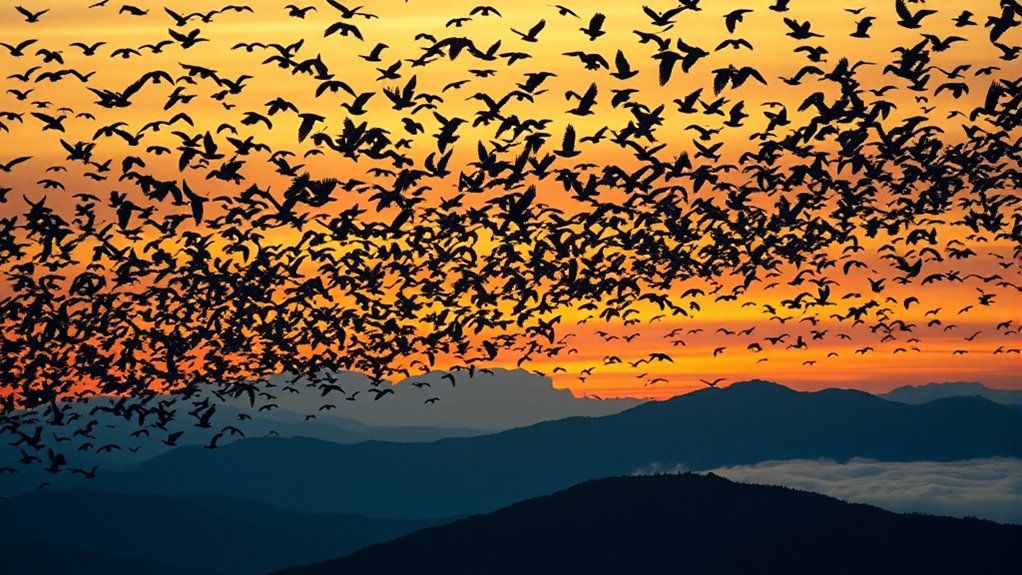
You can’t migrate successfully without reliable navigation, so animals rely on celestial cues like the sun and stars to chart their courses. They also use environmental landmarks such as rivers and mountains to stay on track during long journeys. Additionally, social learning helps many species improve their navigation, as they follow experienced individuals or groups to reach their destinations efficiently. Understanding emotional support can also be crucial for animals facing stressful migration conditions, helping them cope with the challenges of their journeys. Recent studies highlight how AI-powered tracking enhances our understanding of migratory routes, enabling conservation efforts to better protect these incredible journeys. Incorporating biodiversity hotspots into conservation strategies ensures the protection of critical migratory pathways for many species. Recognizing migration patterns aids researchers in identifying key stopover sites that are essential for the survival of migratory species. Moreover, advances in technology reveal how environmental cues are vital for guiding animals across vast distances, especially in changing climates.
Celestial Cues Utilized
Many migratory animals rely on celestial cues such as the sun, stars, and the moon to navigate vast distances accurately. You might not realize, but these natural signals guide animals across oceans and continents with remarkable precision. They interpret the position of the sun during the day, adjusting their course as it moves. At night, stars serve as a celestial map, with species like birds and insects aligning their flight paths using specific constellations. The moon also aids nocturnal travelers, helping them maintain direction. Local adaptations include the use of different celestial cues depending on species and environment. Here are four key techniques they use:
- Sun compass for daytime navigation
- Stellar navigation through star patterns
- Lunar cues for night-time orientation
- Magnetic field calibration combined with celestial cues
These tools enable animals to find their way through complex environments confidently, often relying on celestial navigation as a fundamental component of their migratory success.
Environmental Landmark Reliance
Animals often rely on prominent environmental landmarks such as rivers, mountain ranges, coastlines, and valleys to guide their migration routes. These features serve as consistent navigation cues, helping animals stay on course over long distances. For example, many birds follow coastlines or river valleys, which provide visual references and stable pathways. Mountain ranges can act as barriers or guides, directing movement along certain corridors. Valleys and coastlines offer recognizable landmarks that animals memorize during their migrations. These environmental features are especially useful when celestial cues are unavailable, such as during overcast weather or at night. Additionally, many species develop an innate spatial awareness that allows them to interpret and utilize these landmarks effectively. This innate ability is often honed through evolutionary adaptation, ensuring reliable navigation over generations. By using these landmarks, animals reduce navigation uncertainty, increase efficiency, and improve survival chances during their epic journeys. The development of such environmental landmark reliance is often reinforced through evolutionary adaptation, ensuring that animals can efficiently navigate complex terrains during migration. environmental landmarks serve as reliable visual cues that animals depend on to navigate complex terrains during migration.
Social Learning Strategies
Social learning strategies play an essential role in navigation during migration, as animals observe and imitate the successful routes of their peers. This collective knowledge helps them avoid hazards, optimize energy use, and reach breeding or feeding grounds efficiently. You might notice that young animals follow experienced individuals, learning crucial cues and landmarks along the way. Additionally, understanding essential oils for navigation reveals how sensory cues can facilitate orientation in some species. To deepen your understanding, consider these key points: 1. Many species rely on social cues to refine their migratory paths. 2. Experienced animals serve as leaders or guides for others. 3. Collective memory preserves successful routes over generations. 4. Social learning reduces individual trial-and-error, increasing migration success.
How Climate Change Is Reshaping Migration Patterns
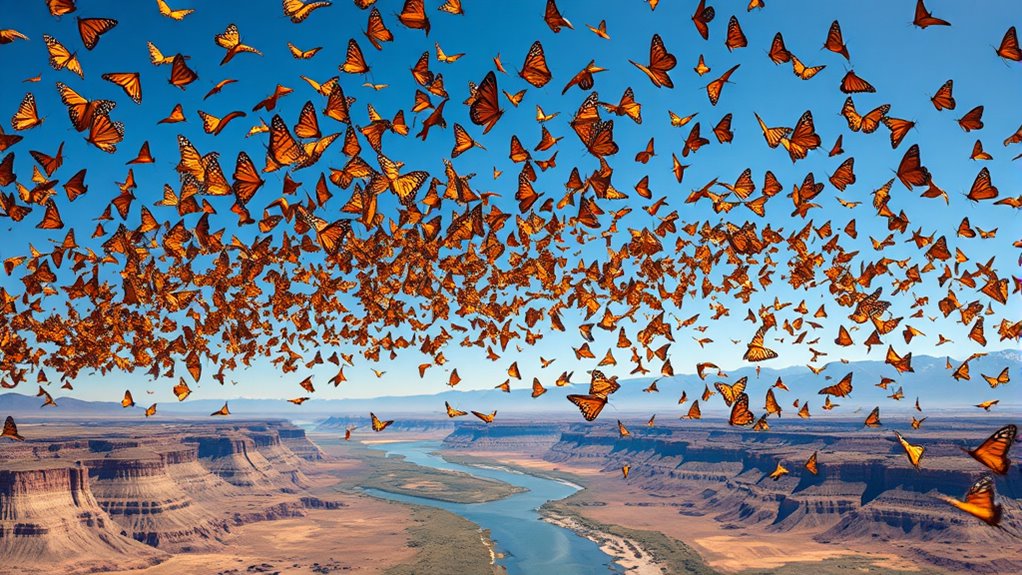
Climate change is actively reshaping migration patterns by altering the environmental cues and conditions that animals rely on. Warmer temperatures shift seasonal signals, causing animals to arrive too early or late at breeding or feeding sites. Changing weather patterns and extreme events disrupt traditional routes, forcing species to adapt or abandon familiar paths. For example, some birds delay their arrivals, while others travel further north to find suitable resources. Migration ranges are shifting, with species like caribou moving wintering grounds over hundreds of kilometers. These changes impact food availability and survival rates, often leading to population declines. As climate change continues, animals must adjust their timing, routes, and behaviors, highlighting the urgent need for conservation strategies that account for these rapid environmental transformations.
The Ecological Role and Evolutionary Benefits of Migration

Migration plays a crucial role in maintaining ecological balance by linking different habitats and enabling species to access essential resources across seasons. You benefit from this movement because it sustains biodiversity, promotes gene flow, and supports ecosystem health. Here are four key ecological and evolutionary benefits:
- It guarantees access to seasonal resources like food and breeding sites.
- It maintains genetic diversity through population mixing.
- It helps species adapt to environmental changes over generations.
- It reduces competition and predation pressure by spreading populations across habitats.
Adaptations That Enable Long-Distance Travel

Animals that undertake long-distance journeys have evolved remarkable adaptations to overcome the challenges of extended travel. You’ll notice they store large fat reserves, providing a crucial energy source for non-stop flights or extended marches. Their bodies are streamlined, reducing drag and conserving energy, while powerful muscles support sustained movement. Many species develop exceptional navigation skills, using celestial cues like stars and the sun, or environmental signals such as wind patterns. Social behaviors enhance route accuracy, with learned pathways and collective decisions guiding navigation. Physiological adjustments like adjusting metabolism or timing migrations to favorable conditions help them conserve resources. These adaptations work together, enabling animals to traverse thousands of kilometers, cross diverse terrains, and reach distant breeding or feeding sites efficiently and safely.
Challenges and Risks Faced During Migration Journeys

Long-distance journeys pose numerous dangers that can threaten an animal’s survival. You face unpredictable weather, which can bring storms, extreme heat, or freezing cold, disrupting your route and exhausting your energy reserves. Predators are always a threat, waiting during stopovers or along migration paths to catch the unwary. Navigational errors can lead you off course, increasing the risk of starvation or exhaustion. Additionally, human activities like habitat destruction, pollution, and road collisions pose significant risks. Here are some key challenges:
- Harsh weather conditions
- Predation and natural predators
- Navigational mistakes
- Human-induced threats
These hazards require incredible resilience, adaptation, and timing to complete your epic journey successfully.
Conservation Strategies for Migratory Species

Protecting migratory species requires coordinated efforts across countries and habitats to guarantee safe passage and suitable stopover sites. You need international agreements, like the Convention on Migratory Species, to promote shared conservation goals. Establishing protected areas along key migratory routes ensures animals have safe places to rest and refuel. Restoring critical habitats, such as wetlands and grasslands, supports food and breeding needs. You should also reduce threats like hunting, pollution, and habitat destruction, which directly impact migration success. Using tracking technology helps identify essential corridors and stopover sites. Public awareness campaigns can foster community support and responsible land use. Ultimately, collaboration across borders and sectors is fundamental to maintain the ecological connectivity that migratory species depend on for survival.
Frequently Asked Questions
How Do Animals Remember Their Migratory Routes Across Generations?
You can remember your migratory routes through a mix of innate instincts and social learning. Your ancestors pass down knowledge via collective memory, and experience helps refine your navigation skills. You rely on celestial cues, environmental landmarks, and environmental patterns learned over generations. This combination of inherited behaviors and learned cues enables you to follow established routes, adapt to changing conditions, and successfully reach your seasonal destinations year after year.
What Role Do Genetic Factors Play in Migration Behavior?
Genetic factors play a vital role in shaping your migration behavior by providing innate navigation skills and route tendencies. These inherited traits help you recognize environmental cues, like celestial patterns or landmarks, guiding your seasonal movements. Your genes influence timing, direction, and distance traveled, ensuring successful migration across generations. This genetic programming allows you to adapt to environmental changes and maintain effective migration strategies, enhancing your survival and reproductive success.
How Do Juvenile Animals Learn to Navigate During Migration?
You learn to navigate during migration mainly through social learning and environmental cues. Young animals observe and imitate experienced elders, picking up navigation skills over time. They also respond to natural signals like the sun, stars, and landmarks along the route. As you gain experience, your instincts and memories improve, helping you make better decisions about when and where to migrate, ensuring your survival and reproductive success.
Can Animals Adapt Their Migration Timing in Real-Time Due to Environmental Changes?
Your instincts act like a compass, guiding you to adapt your migration timing in real-time. When environmental changes occur, you can sense shifts in temperature, food availability, or weather patterns and adjust your departure or arrival accordingly. This flexibility helps you avoid dangers and optimize survival, turning your migration into a dynamic dance with nature’s ever-changing rhythm, rather than a fixed, rigid journey.
What Are the Long-Term Evolutionary Impacts of Migration on Species?
You see, migration shapes species over time by selecting traits that improve navigation, endurance, and adaptability. These evolutionary pressures lead to better physiological and behavioral skills, like fat storage or route learning. As climate and environments change, migration patterns evolve, influencing survival and reproductive success. This ongoing process drives genetic diversity and specialization, ensuring species can cope with shifting habitats, ultimately shaping their long-term evolution and resilience.
Conclusion
You’ve just learned how incredible animal migration really is. Did you know that over 2,000 species travel thousands of miles each year? That’s like crossing the entire United States twice! As climate change alters these patterns, it’s vital you support efforts to protect these amazing journeys. By understanding their challenges and adaptations, you can help guarantee future generations witness these epic migrations firsthand. Together, we can keep these natural marvels thriving for years to come.