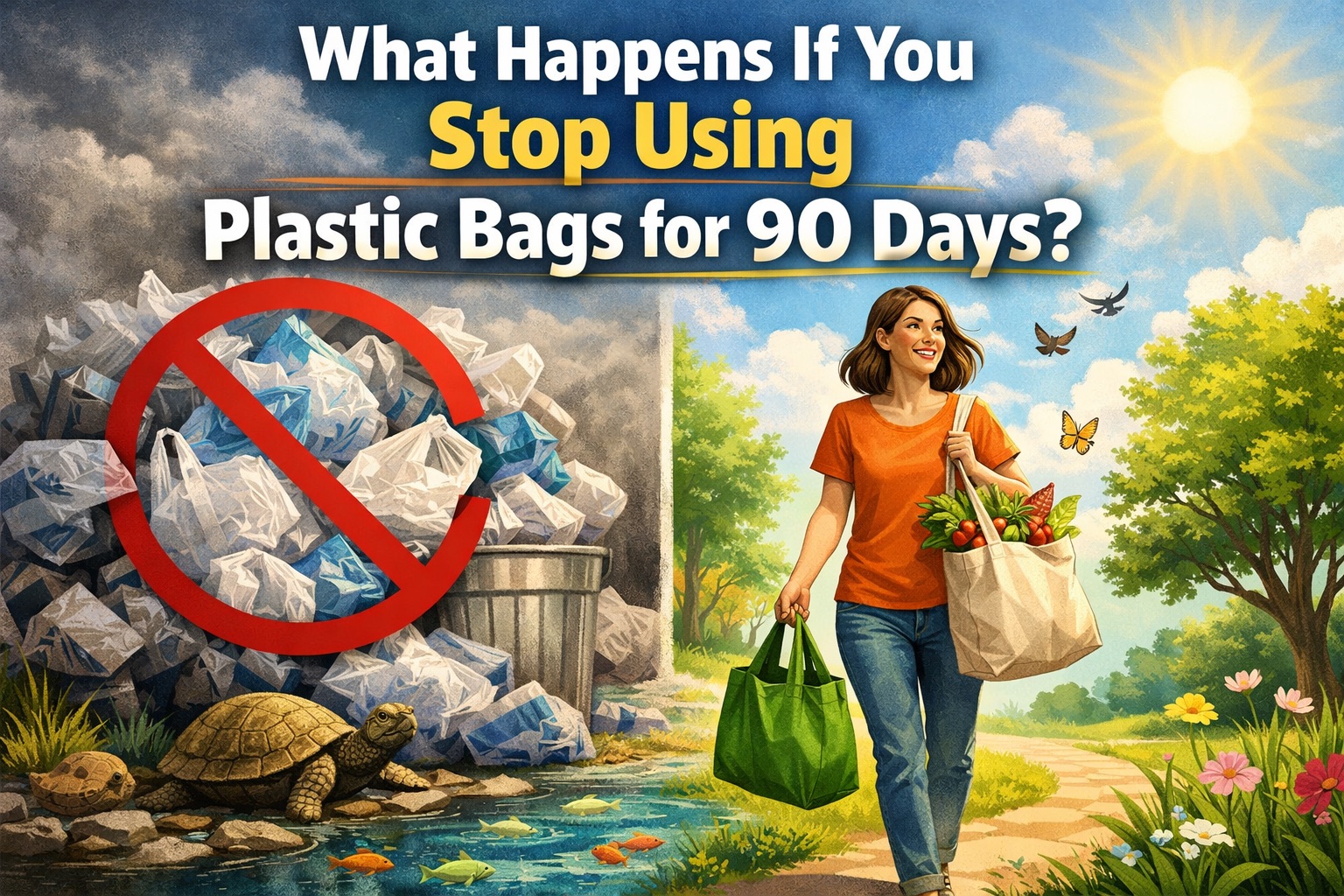

If I Stopped Today: No Plastic Bags for 90 Days
Picture this: it’s today. Not next Monday. Not after you run out of the stash under the sink.
Today you decide: for 90 days, you won’t take a plastic checkout bag—no “just this once,” no “it’s raining,” no “I’ll reuse it as a trash liner.”
This isn’t a purity test. It’s a stress test for one tiny behavior that quietly compounds into a big, sticky problem—because plastic doesn’t “decay” the way we want it to.
Plastic waste can take 20 to 500 years to break down, and even then, it doesn’t truly disappear—it gets smaller. United Nations
And many plastics fragment into microplastics, which are far harder to recover once released. European Parliament
So what actually happens when you stop for 90 days?
Let’s run the scenario.
Do I need plastic bags?
In most day‑to‑day situations, no.
You need a carrying system (something that gets items from point A to B). Plastic bags are just the default one because they’re handed to you automatically.
The 90‑day experiment is about replacing the default with a system you control.
Day 1–3: The “friction spike” (where most people quit)
What happens:
- You forget your reusable bags.
- You do the awkward hand‑carry to the car.
- You buy a random reusable bag you didn’t need.
- You feel like you’re “doing extra work” for something small.
What’s really happening:
You’re colliding with an old convenience loop: purchase → automatic bag → no decisions.
When you remove plastic bags, you’re forced to make decisions again. That’s uncomfortable—but it’s also where the change is.
Quick fix (keeps you from breaking the streak):
- Put 2–3 foldable bags in the places you already go: car, backpack, work bag.
- Add a “bag trigger”: keys = bags. (Clip a small bag to your keys if you can.)
- Give yourself a backup rule: “No plastic bag” doesn’t mean “carry nothing.” It means “choose a non‑plastic carry option.”
Day 4–14: The “systems week” (where the habit gets built)
What happens:
- You stop “trying” and start setting up.
- You create a routine: bags live in one spot, always reset after unloading.
- You notice which purchases were driving most bag use (takeout, convenience stops, small grocery runs).
This is also where the ‘decay’ lesson shows up:
Sustainable behaviors don’t break because they’re hard.
They break because they’re not automated yet.
If your bag system isn’t automatic by Week 2, your motivation will decay faster than your results.
Day 15–30: The “compounding win” phase (less decision fatigue)
By the end of the first month, the biggest change isn’t “you saved the planet.”
It’s this: you stop making the same choice over and over.
Every avoided plastic bag is one less unit of demand, one less item to manage, one less “maybe recyclable” headache.
And that matters because:
- Americans use about 100 billion plastic grocery bags a year, and they’re often used for about 12 minutes before being thrown away. Ocean Conservancy
- Recycling doesn’t reliably bail you out; the EPA’s data puts overall plastic recycling at 8.7% in 2018 (and bags/film are typically even harder to recycle curbside). US EPA+1
What “compounding” looks like in real life:
- You stop accumulating bag clutter at home.
- You stop running out of “good” bags at the worst moment.
- You stop having to decide at checkout—because you already decided.
Day 31–60: The “identity shift” (where it becomes normal)
Around Month 2, people often report something surprising:
Plastic bags start to feel weird.
Not morally. Logistically.
They tear. They’re flimsy. They’re not sized for your real needs. They’re “one more thing” that enters your house and must be dealt with.
That’s the hidden win:
you’ve moved from willpower to preference.
Day 61–90: The “lock‑in” window (where relapse risk changes)
At 90 days, you can usually predict whether this sticks long-term by one factor:
Do you have a recovery plan for when you mess up?
Because you will mess up. And this is where the “recovery difficulty” theme matters.
Recovery difficulty, two ways
1) Environmental recovery is slow.
Plastic can persist for decades to centuries, and the system doesn’t “bounce back” quickly once material is in landfills, waterways, or fragmented into microplastics. United Nations+1
2) Habit recovery can be instant—in the wrong direction.
If you go back to “just this once,” the old default returns fast because stores are built to make plastic effortless.
Your goal at Day 90 isn’t perfection. It’s resilience.
Is it necessary FAQ
Is it necessary to stop using plastic bags to make a difference?
If your baseline is “a few bags here and there,” the difference feels small—until you realize plastic doesn’t behave like a temporary mistake. It accumulates and fragments, and cleanup is hard once it escapes waste systems. United Nations+1
Do I need plastic bags for trash?
Most people don’t need new plastic grocery bags for trash. You need a liner strategy:
- Use purpose-made liners only where required (bathroom, kitchen), not everywhere.
- Reduce bin size where possible (smaller bin = less “need” for a liner).
- Reuse existing packaging (bread bags, mailer bags) when appropriate.
Is recycling plastic bags enough?
Often, no. Many communities don’t accept film plastic curbside, and plastic recycling rates overall are low. US EPA+1
Reduction and reuse beat “hope it gets recycled” almost every time.
Is switching to paper bags better than plastic?
Sometimes—but not always. Paper is easier to recycle in many places, but it can have higher weight/volume impacts. The better question is: Can you reduce single‑use bags entirely? Reusables + a backup plan tends to outperform swapping one disposable for another.
What if I forget my reusable bags?
That’s not failure; that’s reality. The key is a non-plastic backup you can tolerate:
- Keep foldable bags in the car/backpack.
- Choose a cardboard box (many stores have them).
- Carry by hand for small trips.
The streak survives when your backup is pre-decided.
The simple math (optional callout box)
If a person uses roughly 300 plastic bags/year, then 90 days is about a quarter of a year—around 75 bags avoided per person (more if you do lots of small trips). Environment America+1
For a small retailer handing out 200 bags/day, 90 days is 18,000 bags avoided.
The exact number varies—but the compounding logic doesn’t.