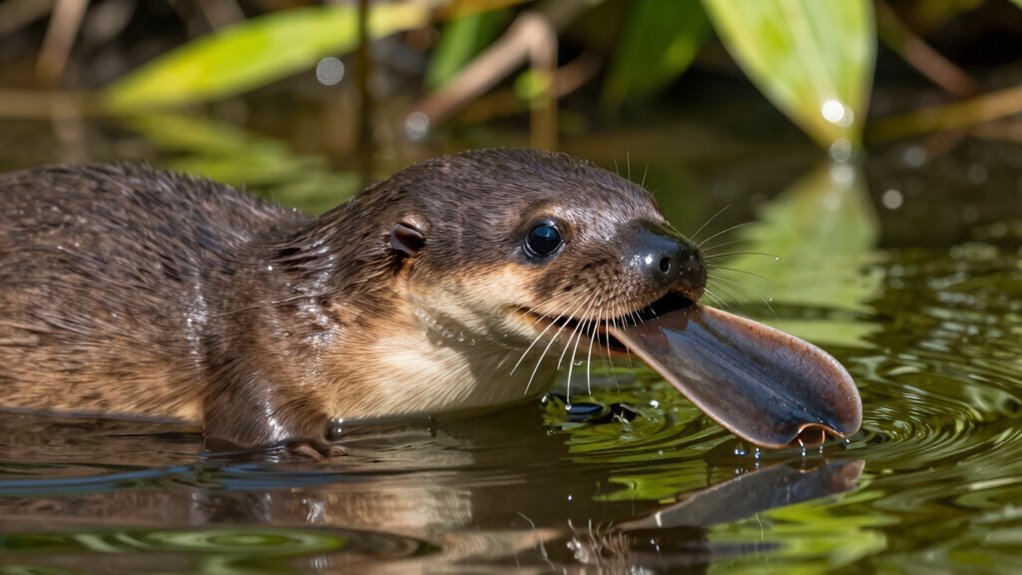

The platypus is the only mammal that lays eggs, which still surprises scientists because it retains primitive features from early vertebrates. Its unique reproductive strategy involves externally incubating leathery eggs in burrows, a trait more common in reptiles. This blend of primitive and specialized traits challenges what we understand about mammals. If you want to understand how this ancient trait shapes mammal evolution, there’s more to uncover below.
Key Takeaways
- The platypus’s egg-laying trait is a primitive characteristic retained from early vertebrate ancestors.
- Its reproductive strategy challenges traditional mammal classifications, highlighting deep evolutionary links to reptiles.
- Ongoing research reveals unexpected traits like venom production and electroreception, showcasing diverse mammalian adaptations.
- The platypus exemplifies how ancient traits persist, offering insights into mammalian evolution and environmental adaptation.
- Despite extensive study, the platypus continues to surprise scientists, emphasizing evolution’s complexity and ongoing discovery.

Some mammals stand out because they lay eggs instead of giving birth to live young. Among these rare exceptions is the platypus, a creature that defies many of the typical expectations we have about mammals. Its unique reproductive strategy is a clear example of evolutionary adaptations that set it apart from more common mammals like humans, dogs, or whales. While most mammals have evolved to give birth to live offspring, the platypus has retained an ancient trait—egg-laying—that offers insight into its evolutionary history. This reproductive strategy isn’t just a quirky feature; it’s a window into how species adapt over millions of years to their environments, selecting traits that enhance survival.
Some mammals, like the platypus, still lay eggs, revealing ancient evolutionary traits and adaptations.
The platypus’s egg-laying behavior is a fascinating example of how evolutionary adaptations shape reproductive strategies. Instead of investing energy in carrying young internally, the female deposits eggs into a specialized burrow. These eggs are small, leathery, and require a period of incubation outside the mother’s body. This method reduces the physical burden on the mother and allows her to focus on other crucial tasks, like foraging and protecting her nest. It’s a reproductive approach that has persisted through natural selection because it suits the platypus’s aquatic lifestyle and the environment of eastern Australia, where it resides. The ability to produce eggs instead of live young has allowed the platypus to efficiently reproduce in its niche, demonstrating how evolution can preserve ancestral traits that still serve a purpose. Additionally, the primitive nature of the eggs resembles those of reptiles, highlighting the deep evolutionary connections between different vertebrate groups.
What continues to surprise scientists is just how primitive and yet highly specialized the platypus’s reproductive system is. Its eggs resemble those of reptiles more than mammals, highlighting a deep evolutionary connection to earlier vertebrates. The platypus’s reproductive adaptations blur the lines between traditional mammalian traits and ancient reptilian features, challenging our understanding of mammal evolution. Its unique physiology, including the ability to produce venom and the electroreceptive bill, shows just how diverse mammalian adaptations can be. These features, combined with its egg-laying habit, remind us that evolution isn’t a straight line—it’s a complex web where some species retain ancient traits while others develop new ones. Furthermore, ongoing research into its reproductive biology continues to reveal surprising evolutionary links that challenge conventional classifications.
Despite centuries of scientific study, the platypus still surprises us. Its existence raises questions about the origins of mammals and the evolutionary pressures that led to its extraordinary reproductive strategy. The fact that such a creature exists today proves that nature’s evolutionary adaptations are often more intricate and surprising than we initially thought. The platypus reminds us that evolution isn’t just about progress but about persistence and adaptation, often in ways we least expect. Its continued study helps us understand the broader story of life’s diversity, emphasizing that some of the most fascinating biological traits are rooted in our ancient past. Exploring the evolutionary history of the platypus can provide deeper insights into how ancient traits are retained and adapted in modern species.

Safari Ltd. Platypus Figurine – Detailed 4.75" Plastic Model Figure – Fun Educational Play Toy for Boys, Girls & Kids Ages 3+
Authentically Detailed: The duck-billed platypus is one of the world's most unique mammals, and this hand-painted, scientifically accurate…
As an affiliate, we earn on qualifying purchases.
As an affiliate, we earn on qualifying purchases.
Frequently Asked Questions
How Do Platypuses Communicate With Each Other?
You’ll find that platypuses communicate through various vocalizations, especially during the breeding season, where their vocalizations become more frequent. They use a range of sounds, including grunts and growls, to relay messages to each other. In aquatic environments, platypus vocalizations serve as an essential form of aquatic communication, helping them establish territory, find mates, and stay connected despite the water’s noise and distance.
What Is the Lifespan of a Platypus in the Wild?
A platypus lives around 10 years in the wild, much like a fleeting shadow. You might find their lifespan influenced by their diet, mainly aquatic invertebrates, and their nesting habits, which keep them safe and warm. These unique mammals face threats from predators and habitat loss, which can shorten their lives. Understanding their natural lifespan helps you appreciate their delicate place in the ecosystem.
Are Platypuses Endangered or Threatened Species?
You might be concerned about the status of platypuses, but they’re considered near threatened due to habitat loss and pollution. To support platypus conservation, focus on habitat preservation, especially in freshwater systems where they thrive. Protecting rivers and wetlands helps guarantee their survival. Your efforts in advocating for habitat preservation can make a real difference in preventing these unique mammals from becoming more at risk.
How Do Platypuses’ Electroreceptors Work?
You might wonder how platypuses’ electroreceptors work. Their electroreceptor function allows them to detect electric fields generated by the muscle contractions of their prey. This sensory adaptation helps them hunt effectively underwater, even in murky conditions. When their bill touches water, these receptors pick up tiny electric signals, guiding their movements with impressive precision. This unique feature makes platypuses extraordinary mammals, blending sensory innovation with their semi-aquatic lifestyle.
Can Platypuses Be Kept as Pets?
You can’t keep a platypus as a pet because they have specific needs that are hard to meet outside their natural habitat. They require a diet rich in aquatic insects, larvae, and small fish, and thrive in freshwater habitats like rivers and streams. Plus, legal restrictions protect them, making it illegal to own one. Their specialized habitat and diet make them unsuitable for captivity, and they need the environment only found in the wild.

Mammal evolution: An illustrated guide
Used Book in Good Condition
As an affiliate, we earn on qualifying purchases.
As an affiliate, we earn on qualifying purchases.
Conclusion
Just like a hidden treasure waiting to be discovered, the platypus continues to surprise us with its odd blend of mammalian and reptilian traits. Its unique biology reminds you that nature isn’t always straightforward; it’s full of surprises, just like uncovering a secret in a familiar place. Keep exploring, because in the world of science, there’s always something new just beneath the surface, waiting to remind you that curiosity is the key to understanding life’s mysteries.

Pangea Hatch Premium Reptile Egg Incubation Substrate (1 lb)
Premium quality: This Clay incubation substrate is premium quality and can be used for all reptile eggs. It…
As an affiliate, we earn on qualifying purchases.
As an affiliate, we earn on qualifying purchases.

The Platypus Guardian
As an affiliate, we earn on qualifying purchases.
As an affiliate, we earn on qualifying purchases.