The ghost orchid is a stunning, rare plant that depends on specific trees, specialized pollinators, and a fragile habitat to survive. Its mesmerizing white flower and delicate structure make it unique, but environmental threats, habitat loss, and low reproductive rates threaten its future. Conservation efforts focus on protecting its habitat, preventing illegal collection, and supporting pollinator health. To discover how scientists and conservationists are working to save this ethereal beauty, keep exploring further.
Key Takeaways
- The ghost orchid is critically endangered due to habitat loss, limited flowering, and reliance on specific pollinators.
- Conservation efforts include habitat restoration, protected areas, and legal safeguards in Florida and Cuba.
- Its highly specialized pollination by nocturnal moths makes it vulnerable to environmental disruptions.
- Habitat destruction from wetland drainage and land development threatens its survival.
- Ongoing research and public engagement are crucial for ensuring the orchid’s future conservation.
Unique Features and Physical Traits of the Ghost Orchid

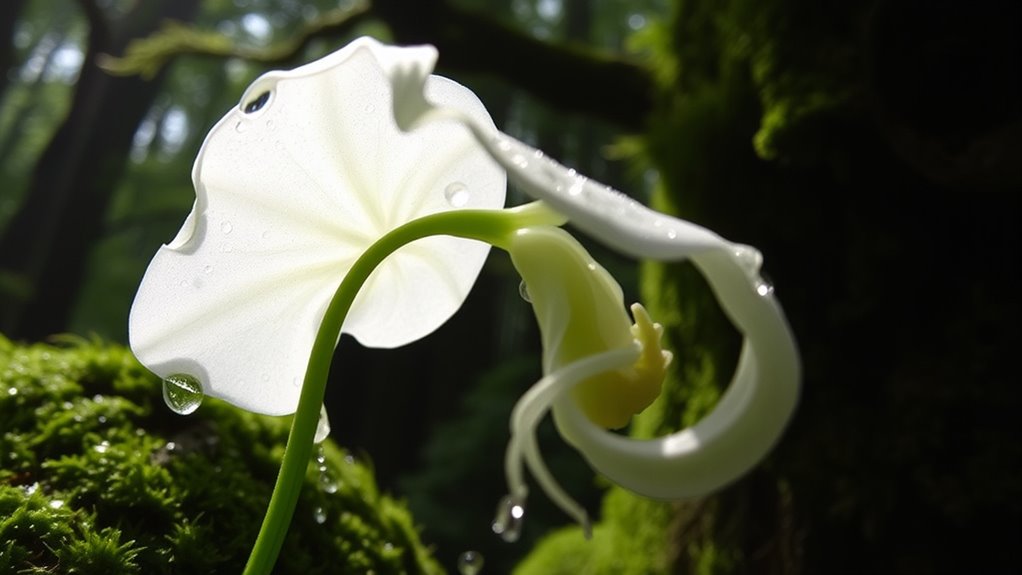
The ghost orchid (*Dendrophylax lindenii*) is remarkable for its leafless, almost transparent appearance, which helps it blend seamlessly into its environment. Its roots are the primary photosynthetic organs, displaying a gray-green hue with short white markings, stretching over 50 centimeters long. During its blooming period from May to August, you’ll notice a single white flower per plant, featuring a distinctive three-lobed labellum with a triangular center lobe flanked by two elongated, tapered lobes. This flower’s long, curved spur is designed to attract specific pollinators like sphinx moths. Its unique structure and ghostly white coloration contribute to its ethereal look, making it one of the most mesmerizing orchids in the world. Additionally, the ghost orchid’s specialized habitat requires precise environmental conditions, making it particularly vulnerable to habitat loss and conservation efforts. The delicate balance of its environment underscores the importance of ongoing conservation programs to ensure its survival. Recognizing its rare status emphasizes the need for targeted protection measures. Furthermore, conservationists are exploring innovative strategies, such as habitat restoration, to help safeguard this elusive species. Given the ongoing threats from habitat destruction, climate change poses an additional risk to the ghost orchid’s future.
Geographic Range and Distinct Habitat Types

Have you ever wondered how the ghost orchid’s range is split across different environments? You’ll find this rare plant mainly in southwestern Florida and specific regions of Cuba, separated by about 350-600 kilometers. In Florida, it thrives in cypress domes, sloughs, and hardwood swamps with standing water. In contrast, Cuban populations grow in tropical semi-deciduous forests on fractured reef limestone with little or no water. Despite proximity, these populations colonize different host trees and habitats.
Ghost orchids grow in Florida’s wetlands and Cuba’s limestone forests, separated by hundreds of kilometers and distinct habitats.
- Florida habitats include cypress swamps and strand swamps with standing water
- Cuban habitats are semi-deciduous hardwoods on limestone with minimal water
- Separate populations grow on distinct host tree species, despite geographic closeness
The Role of Host Trees and Symbiotic Relationships

Ghost orchids depend heavily on their host trees to survive and thrive in their respective habitats. You’ll notice they grow as epiphytes, attaching to trunks and branches of specific tree species. In Florida, they mainly cling to pond apple (*Annona glabra*) and pop ash (*Fraxinus caroliniana*), which support about 80% of the orchids. In Cuba, they utilize up to 18 different tree species, showing greater diversity. These trees provide more than just a surface for attachment; they create a microenvironment rich in humidity and protection from temperature extremes. The presence of healthy host trees also influences the growth of associated mycorrhizal fungi, which are essential for nutrient exchange. Symbiotic relationships with mycorrhizal fungi are crucial for nutrient exchange, especially since ghost orchids lack leaves and rely on their roots. Without these host trees and fungi, the ghost orchid cannot survive, reproduce, or maintain its fragile existence. Healthy host trees also contribute to the stability of the ecosystem, supporting a variety of other plant and animal species. Additionally, conserving native trees is vital for protecting these delicate orchids and their ecosystems. Understanding Symbiotic relationships can help conservation efforts by highlighting the importance of preserving both the orchids and their supporting ecosystems.
Intricate Pollination Strategies and Pollinator Species

You might think pollination is straightforward, but the ghost orchid’s strategies are surprisingly complex. It relies on specific moth species with long proboscises to access nectar deep within its spurred flowers, making successful pollination a delicate process. This intricate relationship presents challenges and risks that threaten the orchid’s reproduction and survival. Additionally, the orchid’s dependence on specialized pollinators makes it particularly vulnerable to environmental changes that affect these moth populations. The rarity of these interactions underscores the importance of preserving pollinator species critical to the orchid’s lifecycle. Protecting these pollination interactions is essential for the conservation of the ghost orchid and maintaining biodiversity. Understanding the pollination process can help conservation efforts by highlighting the need to protect both the orchid and its essential pollinators. Moreover, efforts to maintain healthy ecosystems support the sustainability of these fragile plant-pollinator relationships.
Moth Pollination Partners
How do moths serve as the primary pollinators for the ghost orchid? You might think only one moth species does the job, but recent studies reveal multiple moths contribute to pollination. These moths have long proboscises capable of reaching deep into the orchid’s nectar spur. When they insert their feeding tube, they brush against the flower’s reproductive structures, transferring pollinia.
- Moths like Eumorpha labruscae and *Protambulyx shigilis* are common pollinators, drawn by the flower’s white color and faint scent. Their specialized mouthparts enable them to access nectar deep within the orchid’s long spur.
- Some moths, including Dolba hyloeus and *Pachylia ficus*, carry pollinia on their heads, ensuring pollen transfer.
- These moths are active at night, coinciding with the ghost orchid’s blooming period, making their pollination essential for the plant’s reproduction.
- The moths’ adaptations for nocturnal activity enable them to navigate and pollinate in low-light conditions, supporting the ghost orchid’s specialized pollination strategy.
Long-Spurred Flower Adaptations
| Pollinator Species | Proboscis Length | Nectar Access | |
|---|---|---|---|
| *Eumorpha labruscae* | 12–15 cm | Easy | |
| *Protambulyx shigilis* | 13–16 cm | Efficient | The specialized pollination strategies of the ghost orchid highlight its reliance on specific pollinators. |
| *Dolba hyloeus* | 10–12 cm | Limited | This specialized adaptation guarantees effective pollination by matching flower and pollinator morphology, reducing competition and maximizing reproductive success. The co-evolution of the ghost orchid and its pollinators exemplifies a finely tuned ecological relationship, demonstrating the importance of pollinator specificity in maintaining these delicate interactions. |
Pollination Challenges and Risks
Despite the ghost orchid’s specialized pollination system designed to match long-tongued moths, it faces significant challenges that threaten its reproductive success. The orchid relies on a narrow range of pollinators, mainly specialized moths, making it vulnerable to environmental changes and declining moth populations. Its intricate flower structure, with a long spur, limits access to only certain moth species, reducing pollination opportunities. Additionally, pollinators must visit at the right time, aligning with the orchid’s brief flowering window. Disruptions in moth migration, habitat loss, or climate shifts can drastically cut pollination rates. Pollination strategies are crucial for understanding the orchid’s reproductive limitations and conservation needs. The delicate timing needed for successful pollination underscores the importance of pollinator activity, which can be affected by broader ecological disturbances. Limited pollinator species, mainly specialized moths, restrict reproductive chances. Habitat disturbances threaten both orchid and pollinator populations. Furthermore, the orchid’s reliance on specific vibrational cues for attracting pollinators can be disrupted by environmental noise and human activity, complicating conservation efforts. Recognizing the importance of specialized pollination mechanisms helps inform targeted conservation strategies to protect both the ghost orchid and its essential pollinators. Additionally, sound design techniques could potentially be used to study pollinator behavior and improve conservation awareness.
Challenges in Growth and Reproductive Cycles
The ghost orchid faces significant challenges in its growth and reproductive cycles due to its exceptionally slow development and limited flowering opportunities. It can take years for a plant to reach maturity, and many never produce flowers at all. When it does bloom, it typically offers just one flower per season, often only during May to August. This infrequent flowering reduces the chances of pollination and seed production, making population recovery difficult. Moreover, the orchid’s reliance on specific host trees and symbiotic fungi means that any habitat disturbance hampers its growth. Environmental factors, such as fluctuating humidity and water levels, further complicate its life cycle. Additionally, the orchid’s natural habitat is highly sensitive to environmental changes and human activities, which further threaten its survival. Together, these challenges create a fragile balance that makes the ghost orchid highly vulnerable and slow to recover from declines.
Legal Protections and Conservation Efforts

Efforts to protect the ghost orchid have led to its designation as an endangered species in Florida, where illegal collection and habitat destruction pose significant threats. You can find laws that prohibit removing or damaging these orchids, helping prevent further decline. Conservation organizations work with government agencies to safeguard critical habitats and enforce regulations. They also focus on habitat restoration and public education to reduce illegal collection.
- Establishment of protected areas like Big Cypress Preserve and Panther Refuge
- Enactment of legal bans on collecting or disturbing wild orchids
- Active monitoring and enforcement to prevent illegal harvesting and habitat destruction
Major Threats Facing Wild Populations

You need to understand that habitat loss and modification pose the biggest risks to wild ghost orchid populations. When wetlands are drained or altered, these plants lose the specific conditions they depend on for survival. Additionally, illegal collection and poaching continue to threaten their fragile existence, despite legal protections.
Habitat Loss and Habitat Modification
Habitat loss and modification pose significant threats to wild ghost orchid populations by disrupting the delicate environmental conditions they depend on. When wetlands are drained or altered for development, the orchids lose their essential habitat, including the high humidity and water levels they need. You might find that changes like water management practices or land conversion eliminate the specific trees and moist conditions crucial for their survival.
- Draining wetlands for agriculture or urban development, reducing available habitat
- Altering water flow through drainage projects, lowering humidity and water availability
- Removing or replacing host trees, disrupting the epiphytic environment indispensable for growth
These modifications break the fragile balance, making it harder for ghost orchids to thrive and reproduce naturally.
Illegal Collection and Poaching
Illegal collection and poaching pose one of the most immediate and severe threats to wild ghost orchid populations. Despite legal protections, many collectors seek these rare blooms for their uniqueness and beauty, often risking fines or arrest. Poachers target accessible or easily accessible plants, removing them from their natural habitats without regard for sustainable practices. This activity diminishes already fragile populations, especially since ghost orchids reproduce slowly and produce few flowers annually. Removing mature plants also disrupts pollination cycles and genetic diversity, making recovery difficult. The clandestine nature of illegal collecting means it often goes unnoticed until populations decline considerably. Protecting these orchids requires strict enforcement of laws, increased awareness, and addressing the demand for rare plants in illegal markets.
The Future of the Ghost Orchid: Conservation Challenges and Opportunities

What lies ahead for the ghost orchid amid ongoing conservation challenges? The future depends on overcoming habitat loss, illegal collection, and climate change impacts. You can help by supporting habitat protection efforts, such as preserving wetlands and managing water levels. Restoration projects offer opportunities to reconnect fragmented populations and restore native host trees. Advances in research on pollination and mycorrhizal relationships can improve recovery strategies and cultivate orchids in controlled environments for reintroduction. Public awareness campaigns can reduce illegal harvesting and foster community engagement. Additionally, strengthening legal protections and fostering collaboration among conservation groups are essential. While threats remain, proactive efforts and scientific innovation hold promise for securing the ghost orchid’s survival for generations to come.
Frequently Asked Questions
How Long Does It Take for a Ghost Orchid to Reach Maturity?
It takes a ghost orchid about 7 to 10 years to reach maturity. During this time, you’ll see slow growth, as the plant develops its leafless roots and eventually produces flowers. The process is quite gradual, and reproduction depends on favorable conditions, including proper habitat, humidity, and pollinator activity. Because of this slow development, you should understand that the species’ recovery and growth are inherently slow.
Are There Successful Methods for Cultivating Ghost Orchids Artificially?
Yes, you can cultivate ghost orchids artificially, but it’s like trying to tame a wild breeze—challenging yet possible. You need to mimic their delicate habitat with high humidity, consistent water levels, and specific host trees. Researchers have experimented with tissue culture and symbiotic fungi to grow these orchids outside their natural environment. Patience and precision are your allies in this delicate dance with nature’s most elusive, ghostly treasure.
What Specific Environmental Conditions Do Ghost Orchids Require to Thrive?
You need to provide ghost orchids with high humidity, consistent moisture, and stable water levels in their habitat. They thrive on host trees like pond apple or pop ash, with trunks overhanging water. Make certain the environment mimics their natural conditions: warm temperatures, filtered light, and minimal disturbance. Avoid habitat disruption and maintain healthy mycorrhizal fungi populations, as these are essential for their nutrient uptake and overall survival.
How Does Climate Change Impact the Ghost Orchid’s Habitat Over Time?
Climate change is like a rising tide that slowly erodes the ghost orchid’s delicate habitat. Over time, increasing temperatures, altered rainfall, and more frequent storms disrupt the high humidity and water levels these orchids depend on. You might notice their once stable environment shrinking or becoming unpredictable, making it harder for these plants to survive. Without action, their fragile ecosystems could vanish, taking these rare orchids with them.
Can Ghost Orchids Survive Outside Their Natural Wetland Environments?
You can’t successfully grow ghost orchids outside their natural wetland habitats because they rely heavily on specific environmental conditions like high humidity, water levels, and particular host trees. These orchids have evolved to thrive in these unique ecosystems, and any deviation can hinder their growth and survival. Attempting to cultivate them elsewhere often results in failure, as they depend on the delicate balance of their native wetland environment.
Conclusion
To save the ghost orchid, you must become its guardian—its silent sentinel in the shadows of nature’s delicate balance. Like a whisper of hope in a fading dream, your efforts can guarantee this elusive beauty endures. By understanding its plight and supporting conservation, you breathe life into a fragile wonder that, like a ghost, vanishes without our care. Will you stand as its protector before it becomes a ghost of the past?