
TL;DR

Prime made for students and young adults
- Fast, free delivery for dorm and study essentials
- Prime Video and Amazon Music included
- Member-only deals
IdeaClyst acts as a digital war room, giving founders a local-first, collaborative workspace to test, refine, and align on ideas using AI-driven analysis. It speeds up validation, reduces risk, and keeps your most valuable thoughts safe on your own machine.
Imagine having a dedicated space—your own war room—where every idea is alive, visible, and challenged from multiple angles. That’s what IdeaClyst offers: a high-tech, private battlefield for your next big concept. You can learn more about how creating a war room can boost innovation.
With startups losing over $150,000 on building ideas nobody wanted, speeding up validation is no longer optional. This is about turning the chaos of multiple ideas into clarity, confidence, and execution power. Let’s explore how this digital war room reshapes the way founders think and act on their ideas.
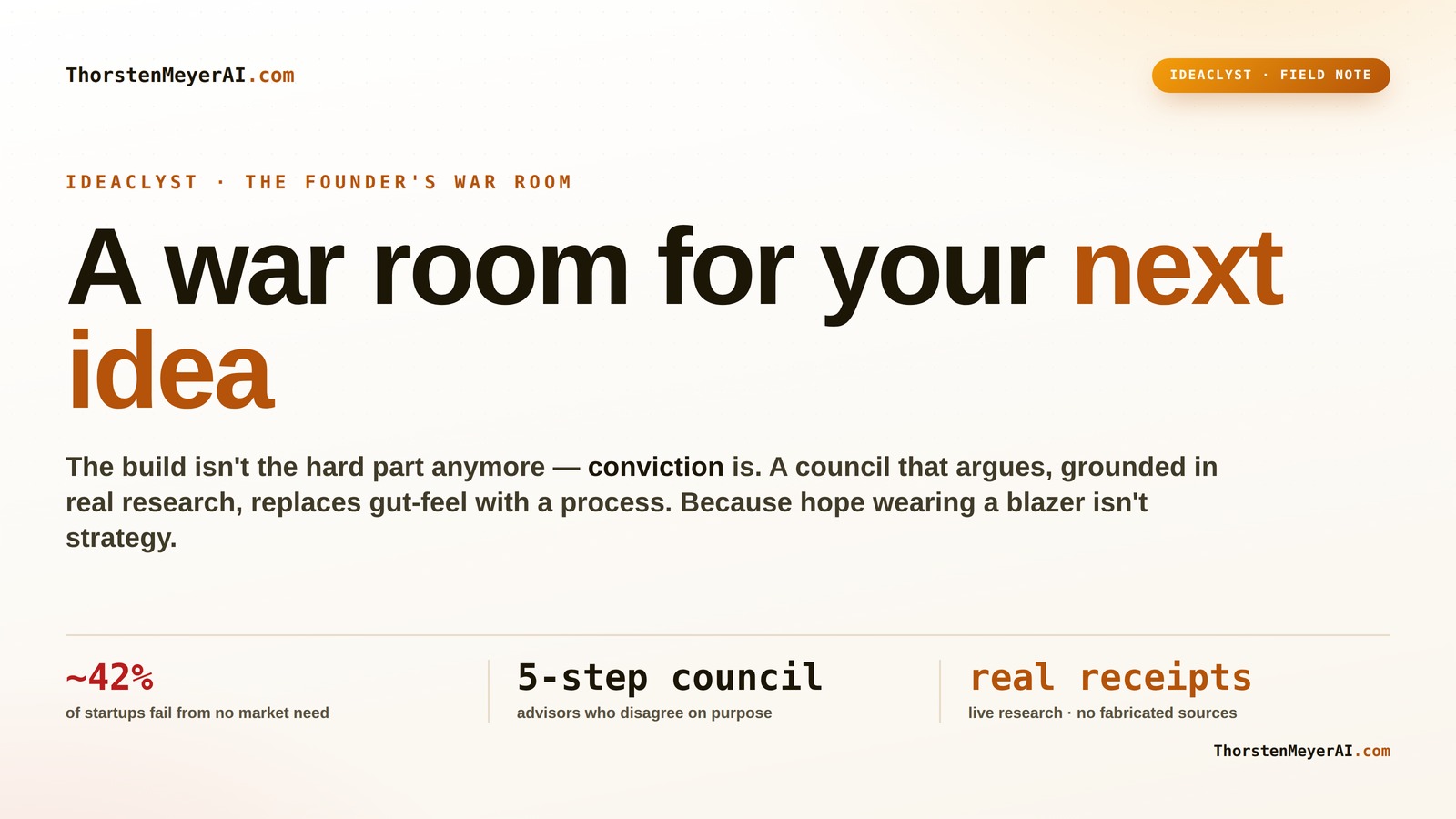
A war room for your next idea
The build isn’t the hard part anymore — conviction is. Knowing which idea deserves the next six months, and being able to defend it. Most founders answer with gut feel and optimistic math. That’s hope wearing a blazer. IdeaClyst replaces it with a process.
The most expensive decision is what to build
The single most valuable thing a tool can do is talk you out of the wrong six months. The numbers make the case better than any pitch.
Three tools in one — on your own machine
Strip away the framing and IdeaClyst is three things at once, all running locally with nothing leaving your laptop.
An AI council
Pressure-tests an idea you bring it — advisors who argue on purpose.
A discovery engine
Finds ideas you didn’t know to look for by hunting real demand signals.
A founder’s workspace
Carries winners from “interesting” all the way to “ready to build.”
Advisors who disagree on purpose
Not one confident, agreeable answer — a structured five-step deliberation where models play different roles and turn on their own work. The disagreement is the feature.
The five-step deliberation
A council that leads with the bad news surfaces the objections you’d otherwise find the expensive way, on month five.
Product strategy
Who’s it for, what’s the wedge, why now, what’s the business model.
Technical architecture
What would it actually take to build — and where’s the risk.
Critique pass
The council turns on its own work. Where’s the hand-waving? What kills this?
Second, independent critique
A different voice, a different angle — so blind spots don’t survive.
Final synthesis
Everything into one coherent founder packet: strategy, architecture, validation, plan.
When IdeaClyst cites a source, it actually fetched it
The hard departure from “ask an AI what it thinks of my startup.” It runs in a strict, real-data-only mode — if it can’t gather genuine evidence, it says so plainly rather than inventing a plausible paragraph.
Confidence with receipts
No fabricated statistics, no imaginary competitors, no made-up citations. The packet survives a skeptical co-founder or a sharp investor because the reasoning has receipts.
Market research first
Scouts the landscape before the council reasons about anything.
Competitor read
Real positioning, pricing signals, feature claims — differentiation vs. reality.
Validation with links
Not “talk to customers” — concrete signals & sources you can click.
From the blank page to build-ready
Evaluation is half the problem; the blank page is the other half. And a plan is worthless if it dies in a tab you never reopen.
Bring a space, not an idea
“AI for accountants,” “tools for indie game studios” — plus your goal and real capacity. It hunts demand signals across HN, Reddit, Product Hunt, GitHub, pricing pages.
- An honest market read — leads with the bad news when a space is hard
- An opportunity map — high pain, thin competition
- Ranked candidates — wedge, who pays, effort, risk, confidence
- each with KILL CRITERIA — when to walk away
A home and a forward path
Every promising idea gets carried forward, with every artifact in plain files on your disk.
- Validation tooling — sprint board, interview list, evidence browser
- Founder profile — a personal-fit lens; same discovery, different advice
- Build workspaces — funnel, personas, landing draft, version history
- “Build this idea” → a PRD + task queue, ready for a coding agent
Key Takeaways
- Use a structured AI council in IdeaClyst to identify flaws early—saving months and thousands of dollars.
- Build your war room as a local-first workspace—your ideas stay private, safe, and under your control.
- Keep your digital war room alive with regular reviews, updates, and cross-team input to maintain momentum.
- Choose setup options—digital, physical, or hybrid—that best fit your team’s remote or in-office needs.
- Treat your war room as an ongoing project hub, not just a one-time brainstorming dump.
As an affiliate, we earn on qualifying purchases.
Why a War Room Is a Game-Changer for Innovators
A war room isn’t just a fancy office corner. It’s a central hub where your team gathers to see progress, share insights, and make tough calls. Think of it as a command center for your ideas—visual, collaborative, and dynamic.
For example, a startup working on an AI-powered fitness app set up a digital war room. They uploaded sketches, user stories, and hypotheses. As discussions evolved, they spotted weak spots early—saving months of wasted effort and thousands of dollars.
Research shows that teams with a shared visual workspace accelerate decision-making by 30% and improve alignment. Discover how practical knowledge and systems thinking can support effective collaboration. That’s because everyone sees the same thing, at the same time, making insights tangible and actionable.
Understanding why this matters: a well-structured war room minimizes miscommunication, aligns team members around common goals, and provides a clear record of decision points. The tradeoff is that it requires discipline to keep the space updated and focused—without that, it can become cluttered or less effective. The key is to treat it as a living tool, continuously refined for maximum clarity and impact.
How IdeaClyst Turns Your Idea Brainstorm Into a Battle-Tested Strategy
IdeaClyst isn’t just a place to jot notes. It’s a structured, AI-powered council that debates your idea from five angles: strategy, tech risk, critique, independent review, and synthesis. Imagine five advisors arguing in your corner—each pointing out flaws, gaps, or opportunities.
This multi-layered critique isn’t just about spotting problems—it’s about understanding the implications of each flaw and how they affect your overall project. For example, if your idea’s market fit is weak, the council’s debate helps you see whether the issue is a misaligned target audience, an incomplete value proposition, or a flawed assumption. Addressing these specific issues early means you can pivot or refine with precision, saving time and resources.
This process pushes you to think beyond surface-level validation. It encourages a mindset of continuous improvement—where each critique is a chance to deepen your understanding and strengthen your approach. For more insights, see how to set up an effective war room. The tradeoff? It requires honest self-assessment and openness to critique, but the payoff is a significantly more robust, investment-ready idea.
Research indicates that structured disagreement accelerates flaw detection by up to three times compared to solo thinking, giving you a strategic advantage. Practical takeaway: incorporate AI-driven critique into your regular review cycles to systematically uncover and address hidden risks and weaknesses.
Digital, Physical, or Hybrid? Setting Up Your War Room for Maximum Impact
IdeaClyst’s digital war room is a portable, local-first workspace—no cloud, no subscriptions, just your own laptop and files. It’s like having a secret, locked bunker on your machine, where every idea stays private and safe.
But what if you prefer a physical space? Many teams combine a digital core with a physical board or whiteboard, displaying key metrics or sketches while keeping detailed reports in the app. Hybrid setups are perfect for remote teams who want the best of both worlds.
Practical advice: start by assessing your team’s working style. If your team is remote or frequently mobile, prioritize a robust digital setup with regular synchronization. Learn more about art education and care for creative teams. For co-located teams, supplement with physical boards to facilitate spontaneous collaboration and visualization. The decision hinges on balancing security, accessibility, and team dynamics. For instance, a remote team might use IdeaClyst on laptops for day-to-day work, then hold weekly physical meetings with whiteboards to review progress, ensuring everyone’s aligned without sacrificing privacy or speed.
Mastering the Art of Continuous Idea Refinement
A war room isn’t a one-and-done deal. It’s an ongoing process. Keeping ideas visible, revisiting them regularly, and leveraging the council to challenge assumptions helps your project adapt and improve over time.
For example, a health-tech startup maintains a dynamic idea board, updating it weekly based on user feedback and testing results. They use IdeaClyst’s structured critique to identify which features are most valuable, which to discard, and how to pivot their messaging. This continuous loop of feedback and refinement prevents stagnation and ensures their product evolves with market needs.
Practical steps: establish routine review cycles—weekly or bi-weekly—tag ideas with status updates (e.g., ‘Under review,’ ‘Ready for development’), and encourage team members to contribute insights daily. For document management tips, see organizing and managing files. This habit builds a culture of ongoing learning and agility, turning your war room into a living, breathing hub of innovation.
Implication? Your ideas become more resilient, aligned, and ready to adapt—key traits for navigating uncertain markets and fast-paced environments.
Avoiding the Common Pitfalls of War Rooms
Many teams treat their war room as a one-time brainstorm or a dumping ground for ideas. This kills momentum. The key is to keep it alive and structured, with clear routines and purpose.
For instance, a startup once piled their digital war room with ideas but neglected to revisit or organize them. Over time, it became cluttered, and valuable insights were buried. Regular cleaning, categorization, and scheduled reviews are essential to maintaining clarity and usefulness. Practical advice: set recurring review sessions—weekly or bi-weekly—to prune outdated ideas, highlight progress, and reset priorities.
Beware of echo chambers: the council should challenge ideas vigorously, not just agree. Structured disagreement uncovers flaws faster and leads to better solutions. Implement mechanisms like voting or anonymous feedback to ensure diverse perspectives are heard.
Finally, avoid siloing ideas or perspectives. For more on fostering open innovation, visit creating collaborative war rooms.ing the war room within one team. Make it accessible to cross-functional members, and encourage open participation. An inclusive environment fosters richer critique and broader buy-in, which accelerates decision-making and innovation.
Tradeoffs include the effort required to maintain discipline and openness. But the payoff is a dynamic, high-value space that continuously propels your project forward.
Your Questions About Digital War Rooms Answered
- What is a war room in a business or creative context? It’s a dedicated space where a team visualizes, discusses, and iterates on ideas, keeping everyone aligned and focused.
- How does a war room help generate better ideas? By making ideas visible, encouraging critical discussion, and fostering continuous refinement, teams spot flaws early and build stronger concepts.
- Can remote teams use a war room effectively? Absolutely. Digital tools like IdeaClyst are designed for remote collaboration, keeping ideas organized and accessible on personal devices.
- What tools or materials do you need to set one up? A computer, a shared workspace (digital or physical), and regular review routines are enough to start.
- What makes IdeaClyst different from a simple brainstorming board? It combines AI-driven critique, structured debate, and a local-first approach, making idea validation faster and more trustworthy.
Conclusion
Think of your idea war room as your secret weapon—an ever-evolving battlefield where clarity, critique, and confidence collide. The more you treat it as a living, breathing workspace, the faster you’ll turn bold concepts into real-world solutions.
With tools like IdeaClyst, you gain a private, high-powered environment that slices through guesswork and accelerates your path from idea to impact. Your next breakthrough starts here—are you ready to step into your war room?
Halloween Picks
halloween
As an affiliate, we earn on qualifying purchases.