

Scientists predict and prevent extinctions by using advanced machine learning and genomic tools that analyze species’ traits, genetic diversity, and environmental threats. These methods identify vulnerable species and prioritize conservation efforts effectively. While models face challenges like ecological changes and data gaps, ongoing improvements help refine predictions. If you want to understand how these technologies are shaping conservation strategies and the future of Earth’s biodiversity, there’s more to discover ahead.

Prime made for students and young adults
- Fast, free delivery for dorm and study essentials
- Prime Video and Amazon Music included
- Member-only deals
Key Takeaways
- Scientists use machine learning models analyzing species traits and genomic data to assess extinction risk accurately.
- Predictive tools identify vulnerable species and prioritize conservation efforts based on risk levels.
- Models consider environmental threats like climate change, habitat loss, and invasive species to forecast future extinctions.
- Genomic analysis reveals past population declines and genetic diversity, indicating species’ resilience or vulnerability.
- Conservation strategies focus on protecting hotspots, critical habitats, and connecting isolated populations to prevent extinctions.
machine learning conservation tools
As an affiliate, we earn on qualifying purchases.
As an affiliate, we earn on qualifying purchases.
Leveraging Machine Learning to Detect Extinction Risks

Machine learning has become a powerful tool for identifying species at risk of extinction by analyzing complex biological data. You can use algorithms like gradient-boosted trees to examine functional traits of extinct genera and determine what makes species vulnerable. Bayesian Additive Regression Trees (BART) models, trained on thousands of plant species, predict the extinction risk for all known flowering plants, giving you a broad view of potential threats. Genomic analysis allows you to assess extinction risk by exploring evolutionary history encoded in an animal’s genome, covering a significant portion of mammalian diversity. Additionally, artificial intelligence models analyze genetic diversity, demography, and mutations affecting fitness to distinguish threatened species from stable ones. Incorporating interior design principles can help create engaging educational displays and habitats that foster awareness and conservation efforts. These methods enable you to prioritize conservation efforts more effectively, focusing resources where they’re most needed, and understanding biological diversity is essential for implementing successful conservation strategies. For example, advancements in AI security can enhance data protection and ensure the integrity of conservation databases. Furthermore, leveraging retirement planning techniques such as risk assessment and strategic resource allocation can optimize conservation funding and ensure long-term sustainability of protected species.
Challenges in Predicting Mass Extinction Events

Predicting mass extinction events presents significant challenges because extinction selectivity varies widely across different periods, with different traits becoming critical indicators depending on the event. For example, during the End-Permian, mineralogy was a key factor, while skeletal physiology mattered more in the End-Cretaceous. This variability makes it difficult to develop universal models, as traits influential in one event may be irrelevant in another. Additionally, models based on past extinctions often fail to transfer accurately to future scenarios because ecological conditions, species interactions, and environmental factors have changed. Space-for-time substitution methods can produce misleading results, especially when predicting responses to climate change. Overall, the diversity of extinction drivers and traits complicates efforts to reliably forecast mass extinction timelines and impacts.
Future Extinction Timelines and Projections

Recent computational models project a grim outlook for global biodiversity, indicating that approximately 10 percent of all plant and animal species could vanish by 2050. You’ll see that projections for vertebrates estimate 27 percent could disappear by 2100, reducing overall animal diversity markedly. These models simulate future scenarios based on current threats like climate change, habitat loss, and invasive species. They consistently show that extinction rates are accelerating, not slowing, despite conservation efforts. Large-scale simulations, including virtual species and food webs, help refine these predictions. You should recognize that while models provide valuable insights, inherent uncertainties remain due to ecological complexity and data gaps. Still, these projections highlight the urgency for proactive measures to mitigate imminent biodiversity loss.
Assessing Data-Deficient Species With Genetics

You can use genetic indicators to identify high extinction risks in species with limited data, making assessments faster and more cost-effective. By analyzing genomes from just one individual, you gain valuable insights into a species’ vulnerability and prioritize conservation efforts accordingly. This approach allows you to act swiftly for species like killer whales and Javan chevrotains, where traditional data is scarce. Implementing efficient coding practices in genetic data analysis can further enhance the speed and accuracy of these assessments, especially as technological advances improve genomic data processing capabilities. Additionally, integrating bioinformatics tools can streamline data analysis workflows and facilitate rapid decision-making in conservation strategies, leveraging the increasing availability of genomic data to improve predictive models. Incorporating machine learning algorithms can also optimize the interpretation of genetic information, enabling more precise risk assessments in conservation efforts.
Genetic Indicators of Risk
Genetic indicators have become essential tools for evaluating extinction risk in species with limited biological data. By analyzing genetic information, you can uncover hidden vulnerabilities that traditional methods might miss. This approach allows you to prioritize conservation efforts effectively.
Consider these impactful insights:
- Genetic diversity acts as a buffer against environmental change, so low diversity signals higher risk.
- Genomic bottlenecks reveal past population declines, indicating ongoing vulnerability.
- Mutations affecting fitness can predispose species to collapse, even if population numbers seem stable.
Rapid Conservation Assessments
Rapid conservation assessments leverage genetic data to evaluate the extinction risk of species with limited or no biological information. By analyzing DNA from a single individual, you can quickly identify genetic diversity levels, population structure, and signs of inbreeding or genetic bottlenecks. These indicators help determine a species’ vulnerability, even if traditional data like population size or reproductive rates are unavailable. You can use genomic analysis to uncover evolutionary history, providing context for susceptibility to environmental changes. Artificial intelligence models trained on genetic datasets can assign risk scores, streamlining decision-making for conservation priorities. This approach enables you to rapidly identify high-risk, data-deficient species, guiding targeted efforts, optimizing resource allocation, and accelerating conservation actions essential for preventing imminent extinctions. Additionally, understanding genetic diversity is crucial for assessing a species’ capacity to adapt to changing environments and ensuring long-term survival. Incorporating legal and ethical considerations ensures that genetic data collection and intervention strategies respect local regulations and community interests.
Mapping Extinction Risks of Plant Species

You can use advanced predictive models, like Bayesian algorithms trained on thousands of assessed species, to estimate extinction risks for millions of plant species. These predictions are now accessible online, allowing both experts and the public to identify at-risk plants quickly. By focusing on conservation areas identified through these models, you can prioritize efforts that have the greatest impact on preventing species loss. Embracing a creative practice mindset can also foster innovative solutions to conservation challenges. Additionally, integrating insights from artistic and cultural perspectives can inspire novel approaches to engaging communities in preservation efforts. Leveraging machine learning techniques enhances the accuracy and efficiency of these predictive models, further supporting conservation strategies. Regular maintenance and troubleshooting of data collection methods can improve the reliability of these predictions over time. Incorporating biodiversity data from various sources helps refine these models and ensures they remain up-to-date and effective.
Predictive Modeling Techniques
Predictive modeling techniques play a crucial role in mapping the extinction risks of plant species by utilizing advanced statistical and computational tools to analyze a wide range of biological and environmental data. These models help you identify which species are most vulnerable and prioritize conservation efforts. Incorporating visualization techniques allows researchers to better interpret complex data and communicate risks effectively. Machine learning algorithms, like gradient-boosted trees, analyze traits to predict extinction trends, giving you insights into species’ vulnerabilities. Bayesian models trained on thousands of assessed species extend predictions to unassessed plants, allowing you to gauge risks broadly. Online accessible predictions enable you to check the extinction status of individual species, empowering both researchers and enthusiasts to take action. These predictive models can incorporate environmental and ecological data, making extinction risk mapping more robust. Understanding sensor technology can further enhance data collection accuracy for conservation efforts. Additionally, integrating geospatial analysis helps visualize habitat changes and risk hotspots more clearly. Employing data collection methods ensures that the information feeding into these models remains accurate and comprehensive. Together, these techniques make extinction risk mapping more precise, timely, and actionable, guiding effective conservation strategies.
Accessing Online Data
Have you ever wondered how conservationists and researchers access up-to-date information on the extinction risks of plant species? They rely on online databases and accessible prediction models that compile vast amounts of data. Researchers use publicly available tools that integrate assessments from global biodiversity repositories, enabling quick evaluation of individual species’ risk levels. These platforms often feature user-friendly interfaces, allowing scientists and even the general public to check extinction scores and confidence levels for thousands of flowering plants. Bayesian models, trained on assessments of tens of thousands of species, generate predictions for those not yet evaluated. This online access democratizes conservation efforts, making critical data readily available, fostering collaboration, and helping prioritize species and habitats most in need of protection. Additionally, sizing and load‑planning tools help conservationists allocate resources effectively for habitat preservation and recovery efforts. Accessible data enhances conservation outcomes by providing timely insights to guide decision-making. For example, the integration of predictive modeling allows for early detection of at-risk species before they become critically endangered. Pimple Patch technologies exemplify how targeted, accessible treatments can improve skin health, much like how accessible data enhances conservation outcomes.
Conservation Prioritization
How can conservationists efficiently identify which plant species require urgent protection? You can leverage advanced mapping and predictive models that analyze extinction risks across thousands of species. These tools help prioritize efforts where they’re needed most. Consider these key strategies:
- Risk Mapping: Using models trained on assessed plant data, you identify the 45% of flowering plants facing threats, focusing resources effectively.
- Site Identification: Researchers pinpoint 16,825 conservation sites covering 164 million hectares, which could prevent all predicted extinctions, guiding protected area design.
- Confidence Levels: Extinction predictions include reliability scores, allowing you to target species with the highest risk certainty for immediate action.
Identifying Key Conservation Areas

What makes a conservation area truly effective in safeguarding biodiversity? It’s about strategic placement, habitat diversity, and threat levels. By analyzing data on species richness, ecosystem types, and extinction risk, scientists identify sites that can maximize conservation impact. These areas should cover regions with high endemism or unique habitats, ensuring protection of the most vulnerable species. Prioritization models help determine which sites offer the greatest benefit for biodiversity preservation.
| Site Type | Key Features | Conservation Focus |
|---|---|---|
| Biodiversity Hotspots | High species richness, endemism | Protect unique ecosystems |
| Critical Habitats | Breeding grounds, migration corridors | Support reproductive success |
| Ecosystem Reserves | Diverse habitats, ecological functions | Maintain ecological balance |
| Threatened Areas | High human impact, habitat loss | Mitigate ongoing threats |
| Connectivity Corridors | Link isolated populations | Promote gene flow |
The Role of Functional Traits in Extinction Predictions
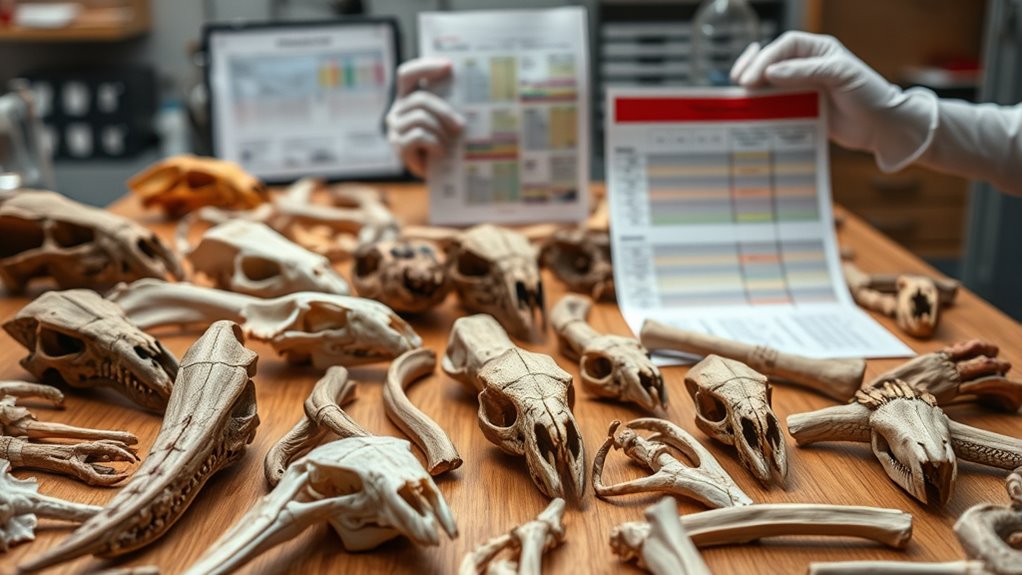
You need to understand how traits like mineralogy, skeletal physiology, or habitat tiering influence species’ vulnerability during mass extinctions. These traits vary in importance across different extinction events, making predictions complex. Recognizing how trait significance shifts helps improve our ability to forecast which species are most at risk.
Traits Influencing Vulnerability
Functional traits play a crucial role in determining species’ vulnerability to extinction, as they directly influence survival and reproductive success under changing environmental conditions. Your understanding of these traits helps scientists predict which species are most at risk. Consider:
- Reproductive strategies—species with limited breeding opportunities struggle to recover from population declines.
- Physiological tolerances—species unable to withstand temperature or moisture fluctuations are more susceptible to habitat changes.
- Dispersal ability—species with poor mobility can’t escape deteriorating environments or reach new habitats quickly.
Trait Variability Across Events
Different mass extinction events reveal that the traits influencing species’ vulnerability aren’t consistent across time. For example, during the end-Permian event, mineralogy was a key predictor of extinction risk, while later events like the end-Cretaceous prioritized skeletal physiology or ecological tiering. This variability indicates that what makes a species vulnerable depends on the specific environmental pressures and causes at each crisis. As a result, models based on traits from one extinction may not accurately predict another’s outcomes. You must recognize that trait importance shifts over time, requiring adaptable approaches. Understanding these differences helps refine predictions, emphasizing the need to contemplate multiple traits and their changing relevance across different extinction events for more effective conservation strategies.
How Genomic Data Enhances Conservation Strategies

Genomic data has become a powerful tool for enhancing conservation strategies by providing detailed insights into species’ evolutionary history, genetic diversity, and adaptive potential. With this information, you can identify vulnerable populations, prioritize species at highest risk, and design targeted interventions.
- You can assess genetic health and diversity with single-individual genomes, accelerating risk evaluations for data-deficient species.
- Conservation efforts become more effective as genomic insights reveal adaptive traits critical for species survival.
- You gain the ability to predict how species might respond to environmental changes, enabling proactive management strategies.
Limitations of Past Models and Transferability

Many models used to predict extinction risk in past studies face significant limitations when applied across different mass extinction events. You’ll find that traits influential in one event, like mineralogy during the Permian, may be irrelevant in another, such as skeletal physiology in the Cretaceous. This variability means models built on data from one extinction often don’t transfer well to others. You might assume that functional traits or environmental factors are universally predictive, but they’re not. Additionally, space-for-time substitution methods can give misleading results, especially when modern ecosystems differ from prehistoric ones. You’ll also encounter challenges when models don’t account for unique ecological contexts or evolutionary histories, limiting their ability to accurately forecast future extinctions across diverse events.
The Impact of Climate and Habitat Changes on Extinction Forecasts

While past models struggled to accurately predict extinctions across diverse mass events due to shifting traits and ecological contexts, current forecasts face a different set of challenges rooted in climate and habitat changes. You must understand that rapid environmental shifts directly threaten species survival.
Current extinction risks are driven by rapid climate and habitat changes, challenging prediction accuracy.
Consider these impacts:
- Rising temperatures disrupt ecosystems, forcing species to adapt or face extinction.
- Habitat loss from deforestation and urbanization reduces available living space.
- Altered migration patterns and breeding cycles hinder reproductive success.
These factors make predictions more complex, as ecosystems are constantly changing and species responses vary. Unlike past models, today’s forecasts must account for unprecedented rates of climate change and habitat fragmentation to accurately identify at-risk species.
Frequently Asked Questions
How Accurate Are Current Extinction Risk Models for Predicting Rare or Elusive Species?
You can’t rely entirely on current models for rare or elusive species, as their accuracy drops when data is limited. Many models depend on genetic, demographic, or trait data, which might be scarce or hard to gather for these species. While AI and genomic methods improve predictions, uncertainties remain high. To improve accuracy, you should combine multiple approaches, including field surveys and genetic analysis, for better conservation planning.
Can Artificial Intelligence Effectively Predict Extinction Risks Across Vastly Different Ecosystems?
Yes, AI can effectively predict extinction risks across diverse ecosystems. You leverage machine learning models trained on traits, genetics, and demographic data, which adapt to different environments. While predictions are more reliable within similar ecosystems, AI’s ability to analyze vast, varied data allows it to identify at-risk species even in unfamiliar habitats. Continuous refinement and ecosystem-specific training improve accuracy, making AI a valuable tool for global biodiversity conservation efforts.
What Ethical Considerations Arise From Using Genetic Data to Assess Extinction Threats?
Imagine you’re holding a fragile glass sculpture, knowing it can break at any moment. Using genetic data to assess extinction threats is similar—you’re wielding powerful information that can save species but also risks misusing sensitive details. You must consider privacy, consent, and potential misuse. Ethical use demands transparency, respect for indigenous knowledge, and safeguards against exploitation, ensuring your actions protect species without causing unintended harm or violating moral boundaries.
How Do Conservation Priorities Change When Models Indicate High Extinction Risk?
When models show high extinction risk, you should prioritize conserving those species or habitats immediately. Focus on protecting critical areas, funding urgent research, and implementing targeted recovery plans. These predictions guide you to allocate resources effectively, ensuring the most vulnerable species get attention first. By acting swiftly on high-risk assessments, you help prevent irreversible losses, safeguarding biodiversity for future generations and maintaining ecological balance.
Are There Emerging Technologies That Could Improve Extinction Predictions in the Future?
Think of emerging technologies as new tools in your survival kit. Advanced AI models, trained on genetic, demographic, and environmental data, will soon predict extinction risks more accurately. Genomic sequencing and machine learning will uncover hidden vulnerabilities, while supercomputers simulate future scenarios. These innovations will help you act before it’s too late, bridging gaps in current methods and giving species a fighting chance against the tide of extinction.
Conclusion
While machine learning helps predict extinction risks, it can’t replace the urgent need for habitat preservation. You might think technology alone can save species, but without protecting ecosystems and addressing climate change, predictions remain just numbers. The future isn’t set in stone—your actions can make a difference. By combining data-driven insights with real-world conservation, you hold the power to prevent the countdown from hitting zero.
Fall Picks
fall essentials
As an affiliate, we earn on qualifying purchases.