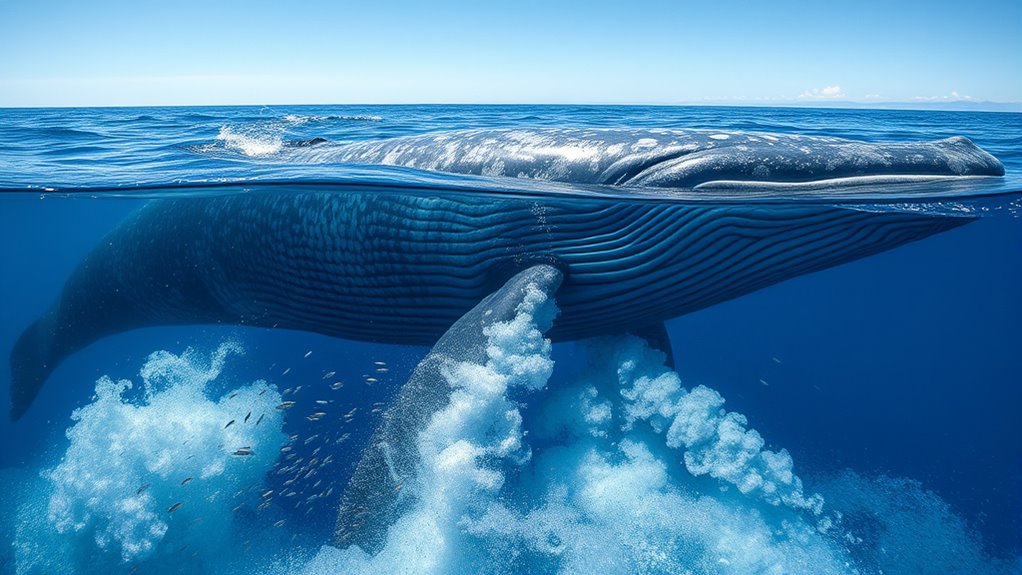

Giant whales fuel oceans and boost the food chain by recycling essential nutrients like nitrogen and iron through their fecal plumes. As they feed deep and swim upward, they release nutrient-rich waste near the surface, supporting the growth of phytoplankton—the foundation of marine life. This natural process enhances ocean productivity, helps sequester carbon, and sustains ecosystems. To understand how these magnificent creatures maintain ocean health and climate balance, keep exploring their incredible role.
Key Takeaways
- Whales release nutrient-rich fecal plumes that fertilize surface waters, promoting phytoplankton growth.
- Whale movements and deep dives help circulate nutrients and break ocean stratification.
- Nutrients from whales, like nitrogen and iron, enhance primary productivity at the base of the food chain.
- Increased phytoplankton supports marine food webs and aids in carbon sequestration.
- Protecting whales maintains this natural “whale pump,” vital for ocean health and climate regulation.

Vintage Alaska Whale Watching Retro Travel Poster Graphic T-Shirt
Vintage Alaska Whale Watching Retro Travel Poster Graphic
As an affiliate, we earn on qualifying purchases.
As an affiliate, we earn on qualifying purchases.
The Science Behind the Whale Pump Mechanism
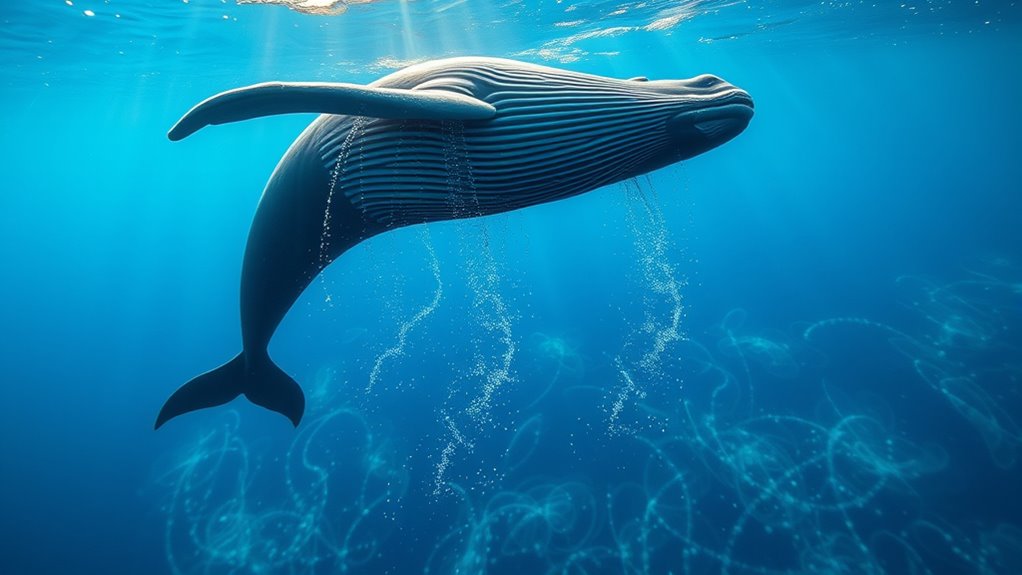
Have you ever wondered how whales help sustain ocean productivity? When they feed deep underwater, they accumulate nutrients like nitrogen and iron in their bodies. As they swim back toward the surface, they release nutrient-rich fecal plumes, creating a biological pump that moves nutrients from the deep to sunlit waters. This vertical mixing distributes essential elements, supporting phytoplankton growth. Whale excretions are especially rich in nutrients that limit productivity in many parts of the ocean. Their movement and feeding cycles enhance this process, extending the nutrient supply beyond natural mixing. In essence, whales act as natural nutrient redistributors, fueling primary production. This process boosts the entire marine food web and plays a crucial role in maintaining healthy, productive ocean ecosystems. Regular whale migrations also contribute to the health of marine populations, ensuring biodiversity and ecological resilience. Additionally, their nutrient redistribution helps sustain the complex balance of oceanic life, making whales vital to the overall health of marine environments. Recent research also suggests that whales significantly impact carbon cycling, which can influence global climate regulation. Interestingly, recent studies highlight that their role as biological vectors significantly amplifies nutrient cycling beyond what natural processes alone can achieve. Moreover, their activities can enhance oceanic carbon sequestration, helping mitigate climate change impacts.

Marine Biology Lite: The World of Sea Animals Explained: Accurate, Relatable, and Entertaining
As an affiliate, we earn on qualifying purchases.
As an affiliate, we earn on qualifying purchases.
Nutrients Delivered by Whales and Their Impact on Phytoplankton

Whales directly influence phytoplankton growth by delivering nutrient-rich waste to surface waters. Their fecal plumes contain high concentrations of nitrogen, iron, and phosphorus—key nutrients that often limit phytoplankton productivity. When whales excrete near the surface, these nutrients become available for photosynthesis, fueling phytoplankton blooms. This process is especially essential in nutrient-poor or stratified waters where natural mixing is limited. Whale feces boost phytoplankton growth, which forms the foundation of the ocean’s food web and considerably contributes to global carbon absorption. By providing a steady supply of essential nutrients, whales help maintain healthy, productive ecosystems and enhance the ocean’s capacity to sequester carbon, playing a pivotal role in climate regulation. Their nutrient cycling significantly supports marine biodiversity and the health of ocean environments. Additionally, their role in ecosystem health highlights the importance of conserving whale populations to sustain these vital processes. The nutrients supplied by whales can also influence biogeochemical cycles, further reinforcing their importance in maintaining oceanic balance. Recognizing the keystone role whales play in nutrient distribution underscores their critical contribution to the stability of marine ecosystems.

Protect The Sharks Save The Ocean Shirt – Respect The Locals Shark Ocean Conservation T-Shirt L Sand
AWESOME SHIRT: By wearing the "Protect The Sharks Save The Ocean Shirt," you become an advocate for the…
As an affiliate, we earn on qualifying purchases.
As an affiliate, we earn on qualifying purchases.
How Whale Movement Facilitates Ocean Mixing and Nutrient Distribution
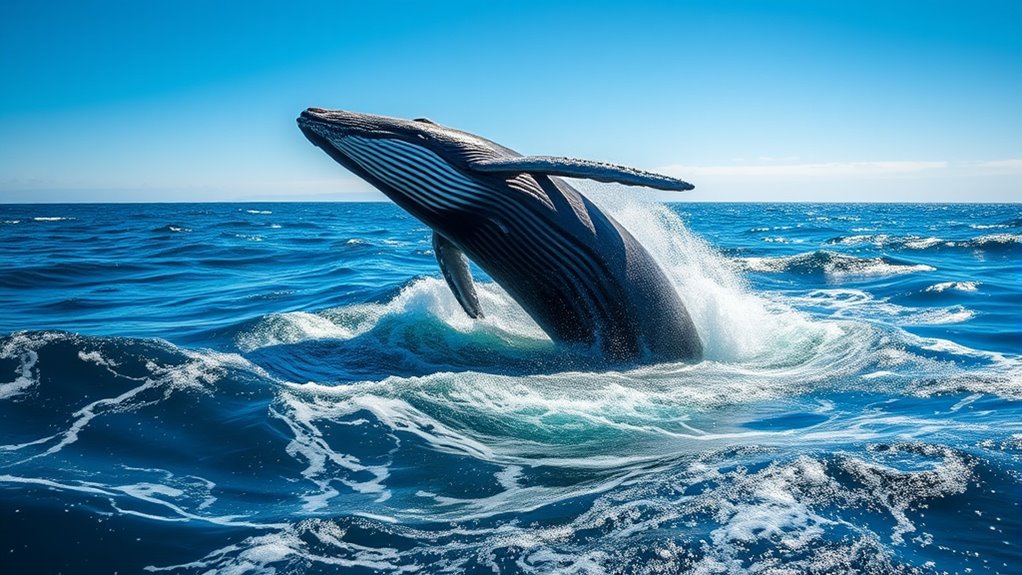
Did you know that whale movements play a crucial role in mixing ocean waters and redistributing nutrients? As whales swim vertically and horizontally, they create physical disturbances that promote water circulation. Their profound dives bring nutrient-rich waters from the ocean depths toward the surface, while their surface foraging and migration patterns help stir stratified layers. This vertical mixing breaks down barriers between nutrient-poor surface waters and nutrient-dense deep waters, enhancing the natural exchange of essential elements like nitrogen and iron. By moving through different water layers, whales act as biological mixers, supporting nutrient cycling and preventing stagnation. Additionally, their movement can influence ocean circulation patterns, which are vital for maintaining healthy marine ecosystems. Their role in marine nutrient cycling is thus essential for sustaining diverse and productive ocean habitats. Moreover, whale feces contribute significantly to nutrient enrichment, providing vital nutrients that stimulate phytoplankton growth at the ocean surface. The physical activity of whales also aids in dispersing microbial communities, which play a key role in breaking down organic matter and cycling nutrients within the ecosystem. Interestingly, this biological activity can also help mitigate ocean stratification, promoting a more dynamic and resilient marine environment.

Activation Products Oceans Alive Marine Phytoplankton – Pure Marine Phytoplankton Supplement Drops, Superfood with Antioxidants, Essential Fatty Acids, and Amino Acids, No Contaminants (30 ml)
CHLOROPHYLL LIQUID MINERALS: Activated your body with Oceans Alive. Our MARINE OMEGA 3 SOLUTION CONCENTRACE is a premium…
As an affiliate, we earn on qualifying purchases.
As an affiliate, we earn on qualifying purchases.
The Role of Whale-Derived Nutrients in Supporting Marine Food Webs

As whales move through different water layers, their nutrient-rich excretions directly feed the base of marine food webs. Their feces and urine supply essential nutrients like nitrogen, phosphorus, and iron, which are often limited in surface waters. These nutrients stimulate phytoplankton growth, forming the foundation of the ocean’s food chain. When phytoplankton bloom, they support a diverse array of marine life, from tiny zooplankton to larger fish and marine mammals. This process enhances local productivity and biodiversity, especially in nutrient-poor or stratified regions. By boosting phytoplankton populations, whale-derived nutrients help sustain healthier, more resilient ecosystems. Additionally, research indicates that these nutrient inputs can influence marine biogeochemical cycles, further supporting overall ocean health. The continuous recycling of nutrients by whales contributes to maintaining marine nutrient balance, which is vital for ecosystem stability. This nutrient recycling also plays a crucial role in mitigating ocean acidification by promoting healthy phytoplankton growth, which sequesters carbon dioxide. Ultimately, this nutrient recycling fosters a robust food web, ensuring the survival of numerous marine species and maintaining ocean health.
Contributions of Whale Activity to Global Carbon Sequestration

Whale activity boosts phytoplankton growth by delivering essential nutrients to nutrient-poor waters, which enhances carbon absorption. As phytoplankton die, their carbon-rich biomass sinks, sequestering carbon in the deep ocean for centuries. This natural process makes the whale pump a significant contributor to long-term carbon storage and climate regulation.
Enhanced Phytoplankton Growth
Enhanced phytoplankton growth is a crucial way that whale activity contributes to global carbon sequestration. When whales release nutrient-rich fecal plumes near the surface, they supply essential elements like nitrogen, phosphorus, and iron that limit phytoplankton growth in many ocean regions. Their vertical swimming behavior mixes nutrients from deep waters to sunlit layers, creating a natural boost for phytoplankton blooms. These microscopic plants thrive on the increased nutrients, photosynthesize more effectively, and produce significant amounts of organic carbon. As phytoplankton die, their biomass sinks, trapping carbon in the deep ocean for centuries. By stimulating this primary productivity, whales indirectly help remove CO2 from the atmosphere, supporting the planet’s climate regulation and enhancing oceanic carbon cycling.
Long-Term Carbon Storage
Long-term carbon storage resulting from whale activity plays a pivotal role in mitigating climate change by locking carbon in the deep ocean for centuries. When whales feed and excrete nutrients, they stimulate phytoplankton growth, which absorbs CO2 through photosynthesis. As these microscopic plants die, their carbon-rich biomass sinks into the ocean’s depths. This process, known as the biological carbon pump, effectively sequesters carbon away from the atmosphere. Additionally, whale carcasses, or “whale falls,” provide substantial carbon storage, sinking to the seafloor and decomposing slowly over decades or centuries. Overall, whale-driven nutrient cycling enhances this natural sequestration, with estimates suggesting whales contribute to capturing around 200,000 metric tons of CO2 annually. Their activity therefore supports the ocean’s capacity to act as a long-term carbon sink.
Geographic Regions Where the Whale Pump Is Most Effective
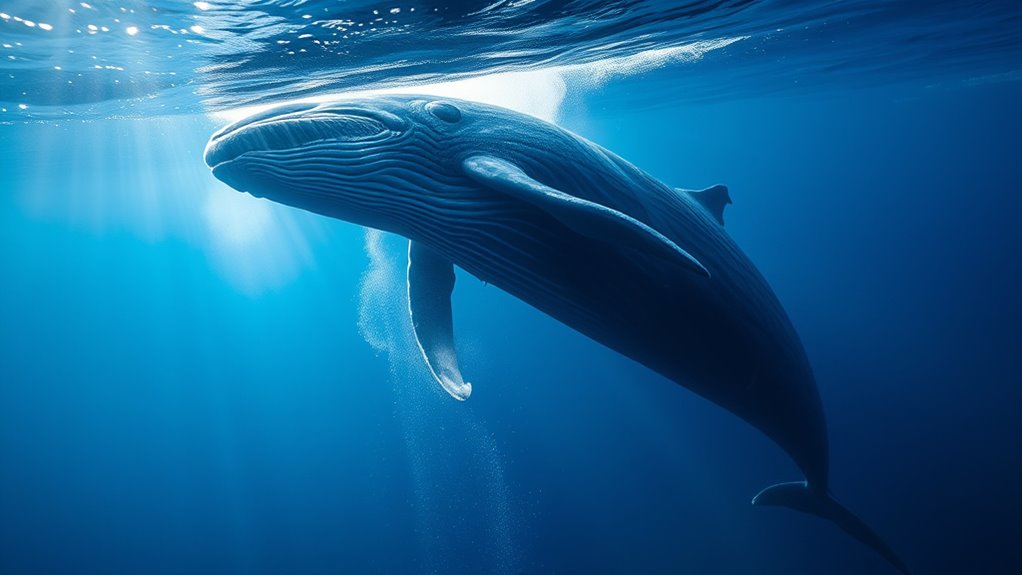
You’ll find the whale pump most effective in nutrient-rich coastal areas and polar regions where natural nutrient limitations are common. In these zones, whale excretions substantially boost phytoplankton growth, supporting local ecosystems. Recognizing these hotspots helps us understand where whales have the greatest impact on ocean productivity.
Nutrient-Rich Coastal Areas
Where do the whale pump’s effects reach their peak? Coastal areas with nutrient-poor waters benefit most, especially near whale habitats. These regions rely heavily on external nutrient sources to sustain phytoplankton growth. In places like the Gulf of Maine, Bay of Fundy, and Southeast Alaska, whale excretions markedly boost local productivity. These nutrient-rich zones support vibrant ecosystems, higher fish populations, and richer biodiversity. Additionally, coastal regions with diverse marine life are particularly impacted by these natural fertilization processes. The Gold IRA market exemplifies how diversification and natural resources can bolster financial stability, much like the ocean’s nutrient sources sustain marine ecosystems.
Polar and Subpolar Zones
Have you ever wondered why the whale pump is especially essential in polar and subpolar regions? These areas are often nutrient-poor and stratified, limiting natural nutrient mixing. Whales in these zones play a crucial role by bringing nutrients like iron, nitrogen, and phosphorus from deep waters to surface layers. Their fecal plumes fertilize phytoplankton, fueling blooms that support the entire food web. In the Southern Ocean, whales recycle iron, a key limiting nutrient, enabling vast phytoplankton growth that absorbs significant amounts of CO2. Migratory routes distribute nutrients across large distances, maintaining productivity in remote regions. Without the whale pump, these ecosystems would struggle with limited nutrients, reducing biological productivity and carbon sequestration. The process also supports marine biodiversity by sustaining a rich variety of marine life. Protecting whales in polar zones is vital for sustaining global ocean health and climate regulation.
The Significance of Whales in Sustaining Marine Ecosystem Productivity

Whales play a essential role in maintaining the productivity of marine ecosystems by acting as natural nutrient recyclers. As they feed at depth and surface to excrete nutrient-rich fecal plumes, they supply essential nutrients like nitrogen, iron, and phosphorus to phytoplankton, fueling primary production. Their vertical movement mixes nutrients from deep waters to surface layers, creating a biological pump that boosts phytoplankton growth, especially in nutrient-poor or stratified waters. This increased primary productivity supports higher food web levels, including commercially important fish species. By stimulating phytoplankton populations, whales help sustain biodiversity and enhance the overall health of ocean ecosystems. Their role is essential in maintaining the balance and resilience of marine environments, ensuring the productivity needed to support life across the ocean. Additionally, their movements facilitate the distribution of nutrients across different regions, contributing to the nutrient cycling vital for ecosystem sustainability. This process is a key example of how marine organisms influence global biogeochemical cycles and climate regulation. The presence of whales can also influence local ocean chemistry, further supporting diverse marine life. Furthermore, their contribution to nutrient redistribution helps mitigate the effects of ocean stratification, promoting healthier and more productive marine habitats.
Challenges Facing Whale Populations and Implications for Ocean Health

You need to recognize that declining whale populations threaten the nutrient recycling essential for healthy ocean ecosystems. Reduced whale numbers can weaken the whale pump, decreasing phytoplankton productivity and disrupting the carbon cycle. If these trends continue, they could lead to broader ecosystem imbalances and diminished ocean health.
Declining Whale Numbers
The decline in whale populations poses a significant threat to the ocean’s natural nutrient cycling processes. When whale numbers decrease, less nutrient-rich fecal matter reaches the surface, reducing phytoplankton growth and primary productivity. This decline weakens the ocean’s natural “whale pump,” disrupting nutrient distribution and creating a ripple effect through marine ecosystems. You might notice:
- Reduced nutrient supply in key feeding areas
- Decline in phytoplankton blooms and ocean productivity
- Lower carbon sequestration capacity due to less phytoplankton biomass
- Disruption of migratory nutrient transfer routes
- Overall decline in biodiversity and fish stocks tied to nutrient availability
Without enough whales, the ocean’s ability to sustain healthy, productive ecosystems diminishes, impacting global climate regulation and marine food webs.
Ecosystem Impact Risks
Rising threats such as habitat destruction, climate change, and illegal hunting are severely endangering whale populations, which in turn jeopardizes the ocean’s natural nutrient recycling processes. When whales decline, the essential nutrient transfer they facilitate diminishes, reducing phytoplankton productivity and disrupting the marine food web. Warming oceans and increased stratification limit natural nutrient mixing, making whales’ role even more critical. However, fewer whales mean less vertical nutrient transport, risking lower primary productivity and weakened carbon sequestration. Additionally, ongoing threats can cause behavioral changes, like altered migration patterns, further impairing nutrient distribution. Without healthy whale populations, the ocean’s ability to sustain biodiversity and regulate climate through nutrient cycling weakens, highlighting the urgent need for conservation efforts to preserve these keystone species and maintain ecosystem stability.
Comparing Natural Whale Fertilization to Human-Driven Ocean Fertilization

Natural whale fertilization offers a sustainable and complex method of enhancing ocean productivity by leveraging the animals’ natural behaviors to recycle nutrients and support phytoplankton growth. Unlike human-driven ocean fertilization, which involves adding nutrients like iron or nitrogen artificially, whale fertilization relies on natural processes that are self-regulating and ecosystem-friendly.
- Whales distribute nutrients over large areas through their migration and feeding habits
- Their excretions provide a balanced mix of nutrients, supporting diverse marine life
- Natural processes avoid risks of nutrient overload, harmful algal blooms, or ecosystem imbalance
- Human fertilization often targets specific regions, risking unintended environmental consequences
- Protecting whales preserves this natural, sustainable nutrient cycling that benefits the entire ocean ecosystem
Conservation Strategies to Preserve the Whale Pump and Enhance Climate Benefits
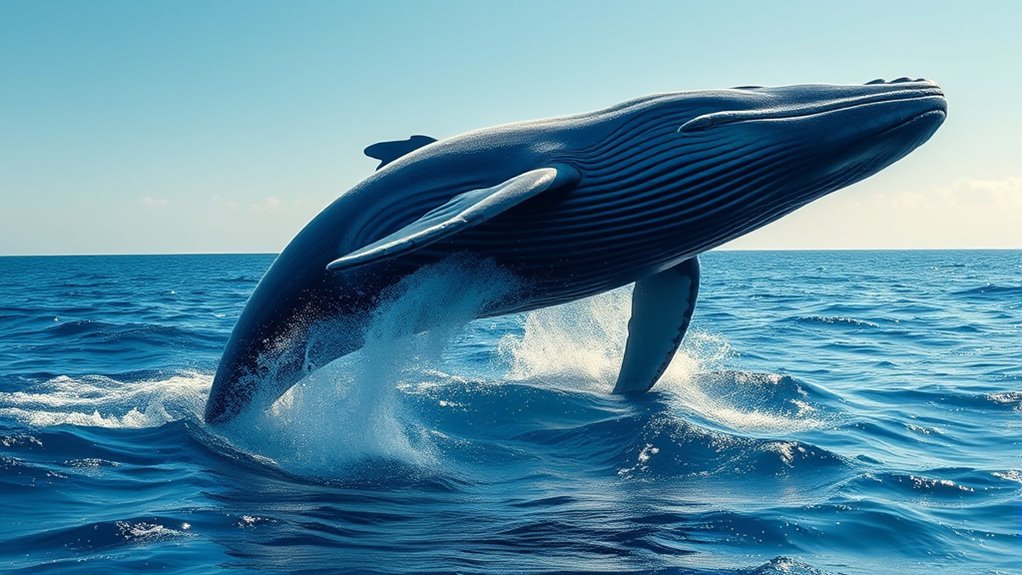
Conservation strategies are indispensable to maintain and enhance the whale pump’s role in supporting ocean health and climate regulation. Protecting whale populations through stronger anti-poaching laws, marine protected areas, and sustainable fisheries ensures their numbers grow, restoring their nutrient recycling impact. Supporting whale research helps fill data gaps about their ecological roles, guiding targeted conservation efforts. Reducing ship strikes and noise pollution minimizes stress and mortality, allowing whales to perform their vital functions. Promoting responsible whale-watching and public awareness fosters community support for protection initiatives. Restoring habitats and addressing climate change also sustain whale feeding grounds, enabling ongoing nutrient cycling. By safeguarding whales, you help preserve this natural climate solution, boosting ocean productivity and enhancing the ocean’s capacity to sequester carbon.
Frequently Asked Questions
How Do Whale Feces Differ From Other Natural Ocean Nutrients?
Whale feces differ from other ocean nutrients because they’re rich in key elements like nitrogen, phosphorus, and trace minerals such as iron, which are often limited in marine environments. Unlike typical nutrients, whale waste is concentrated and bioavailable, directly fueling phytoplankton growth. This natural fertilization creates a boost in primary productivity, especially in nutrient-poor waters, supporting the entire marine food web and helping absorb atmospheric CO2.
What Is the Estimated Contribution of Whales to Global Carbon Sequestration?
You should know that whales contribute approximately 200,000 metric tons of CO2 annually to global carbon sequestration. They do this by fertilizing phytoplankton through nutrient-rich waste, which absorbs CO2 during photosynthesis. When phytoplankton die, their carbon sinks to the deep ocean, effectively locking it away for centuries. This natural process highlights the whales’ essential role in climate regulation and maintaining healthy, productive oceans.
Which Regions Benefit Most From Whale-Induced Nutrient Recycling?
You’ll find the Gulf of Maine, Bay of Fundy, and Georges Banks benefit most from whale-induced nutrient recycling. Southeast Alaska’s coastal waters also see a boost, enriching nutrient-poor areas. In the Southern Ocean, whales recycle iron, supporting massive phytoplankton blooms. Migratory routes create “whale conveyor belts,” spreading nutrients across vast areas. Coastal zones near whale habitats often have higher biodiversity and fish abundance due to these nutrient inputs, enhancing local ecosystems.
How Does Whale Migration Influence Nutrient Distribution Across Oceans?
When whales migrate, they act like natural nutrient conveyor belts, carrying essential nutrients across vast ocean distances. As they feed in one area and excrete in another, they distribute nitrogen, iron, and other nutrients globally. This process enriches nutrient-poor regions, stimulates phytoplankton growth, and supports diverse marine life. Your understanding of whale migration highlights how these movements foster healthy, productive oceans by connecting different ecosystems through nutrient flow.
What Are the Main Threats to Whale Populations Affecting the Whale Pump?
You face threats like overhunting, ship strikes, climate change, and habitat loss, which reduce whale populations. These declines weaken the whale pump, decreasing nutrient recycling essential for ocean productivity. Pollution and noise pollution also disrupt migration and feeding, further impacting whales. Protecting whales from these threats helps maintain their crucial role in sustaining marine ecosystems and supporting global carbon sequestration efforts.
Conclusion
By protecting whales, you play a crucial role in maintaining the ocean’s health—like guardians of a delicate, thriving garden. Their natural fertilization fuels phytoplankton, which supports the entire food web and helps sequester carbon. Without these gentle giants, the ocean’s balance could unravel, diminishing its ability to sustain life. So, supporting whale conservation means safeguarding the vibrant, interconnected world beneath the waves for generations to come.