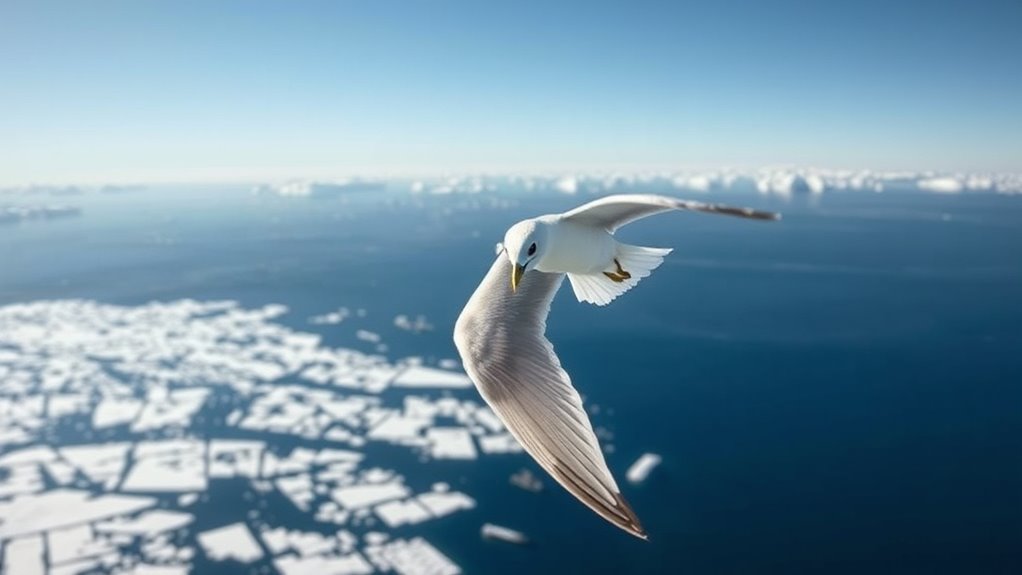

From Alaska to Antarctica, the Arctic tern sets out on an incredible 25,000-mile annual journey, traveling across oceans and continents. You’ll see it follow complex, indirect routes, guided by celestial cues, ocean currents, and magnetic fields. It feeds on small fish, taking advantage of productive zones and strong winds. Its physical adaptations, like long wings and sharp eyesight, help sustain these extreme journeys. Explore more to discover how climate change threatens this epic voyage.
Key Takeaways
- Arctic terns migrate approximately 25,000 miles annually between Alaska’s breeding grounds and Antarctic feeding zones.
- They navigate via celestial cues, geomagnetic fields, and ocean currents, following complex, indirect routes.
- During migration, they stop at key feeding sites like the North Atlantic Gyre and Indian Ocean upwellings to conserve energy.
- Adaptations such as sharp eyesight, aerodynamic wings, and efficient feeding strategies support their endurance over 1.5 million miles lifetime.
- Climate change threatens their migration routes, prey availability, and habitats, requiring ongoing conservation efforts.
Top picks for "alaska antarctica inside"
Open Amazon search results for this keyword.
As an affiliate, we earn on qualifying purchases.
The Magnitude of Arctic Tern Migrations
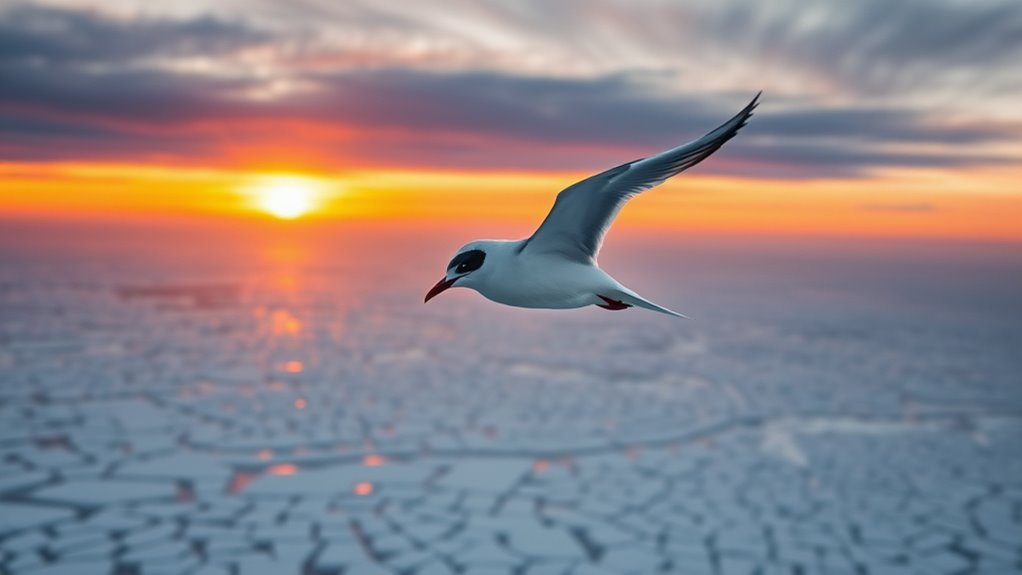
The Arctic tern’s migration is truly extraordinary in scope. You might be amazed to learn that these birds travel about 25,000 miles round-trip each year, crossing entire oceans between Arctic breeding sites and Antarctic feeding zones. Some Arctic terns follow complex routes, covering nearly 60,000 miles in a single migration, weaving through the Atlantic, around Africa, the Indian Ocean, and down to Antarctica. Routes differ: Baltic and Greenland terns follow East Atlantic flyways, while Alaskan terns take the West Coast of North America. Instead of a straight pole-to-pole journey, many meander across continents and oceans, stopping at productive regions like the Benguela Current and Weddell Sea. This incredible distance showcases their remarkable endurance and the importance of their long migratory cycle.
Routes and Pathways Across Continents and Oceans
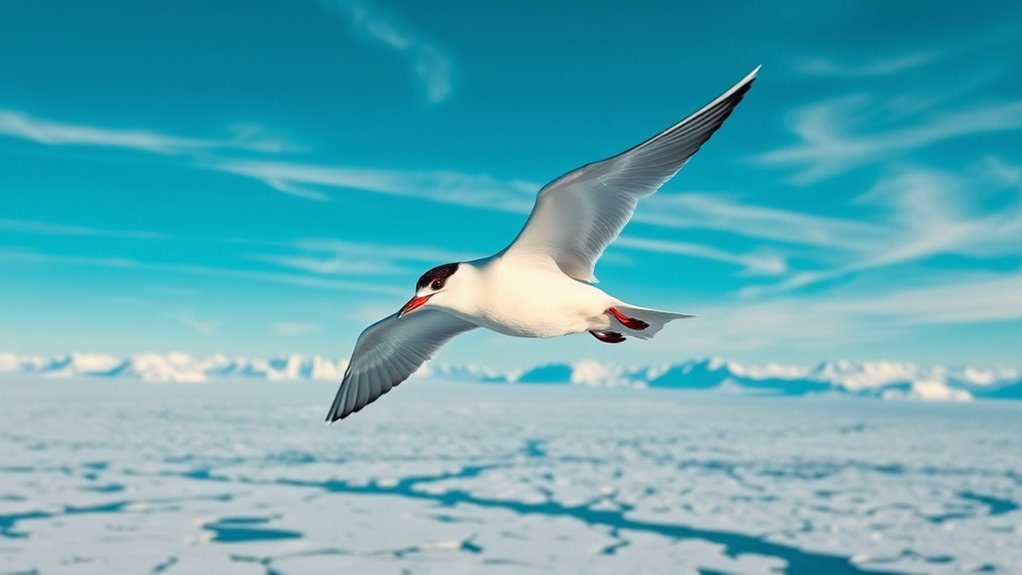
You’ll see that Arctic terns follow complex routes across continents and oceans, often taking indirect paths rather than flying straight pole to pole. They rely on key stopover sites in areas like the Benguela Current and Weddell Sea to rest and feed during their journey. These essential stopovers help them conserve energy and stay healthy for their epic migration.
Transcontinental Migration Routes
Arctic terns undertake astonishing transcontinental migration routes that span multiple continents and oceans, showcasing their remarkable navigational skills. You might imagine them weaving through the Atlantic, Africa, the Indian Ocean, and finally Antarctica. You might also be surprised to learn that their navigation techniques involve a sophisticated use of environmental cues, enabling such precise long-distance travel. Some follow direct paths, while others meander, stopping at productive feeding zones. These routes vary: Baltic and Greenland terns use east Atlantic flyways, while Alaskan terns take the west coast of North America southward. Their journeys can cover nearly 60,000 miles in a single cycle. To visualize, consider this table:
| Route Type | Key Regions |
|---|---|
| Direct Pole-to-Pole | Arctic breeding to Antarctic feeding zones |
| Indirect, Meandering | Atlantic, Indian Ocean, South America |
| Atlantic Flyways | Baltic, Greenland to Europe |
| Pacific to Antarctica | Alaska to South America via Pacific |
Their migration is a complex dance across the globe’s vastness. Migratory navigation relies heavily on celestial cues, ocean currents, and geomagnetic fields, allowing these birds to undertake such extensive journeys with precision. Additionally, their remarkable endurance enables them to sustain these long flights without fatigue. They also exhibit extraordinary adaptability, adjusting their routes and timing based on environmental conditions to optimize their survival during migration. The availability of survival gear such as food reserves and shelter materials is crucial during stopovers to maintain their strength.
Oceanic Stopover Sites
Ever wonder how Arctic terns navigate across vast oceans to find essential stopover sites? You’ll find that they rely on specific oceanic regions that provide vital resources. These stopovers include:
- The Benguela Current — a nutrient-rich zone off southwestern Africa, fueling feeding opportunities.
- The North Atlantic Gyre — a high-productivity area with abundant prey, helping terns refuel on their journey.
- Indian Ocean Feeding Grounds — key stopovers for terns traveling along routes to Antarctica, offering rich fish populations.
These sites aren’t randomly chosen; they’re driven by ocean productivity, wind patterns, and currents. By stopping here, Arctic terns conserve energy, replenish their fat reserves, and prepare for the next leg of their epic migration. Understanding oceanic productivity helps explain why these areas are crucial for their survival. Without these vital stopovers, their incredible journey would be impossible.
Unique Physical Adaptations for Extreme Journeys
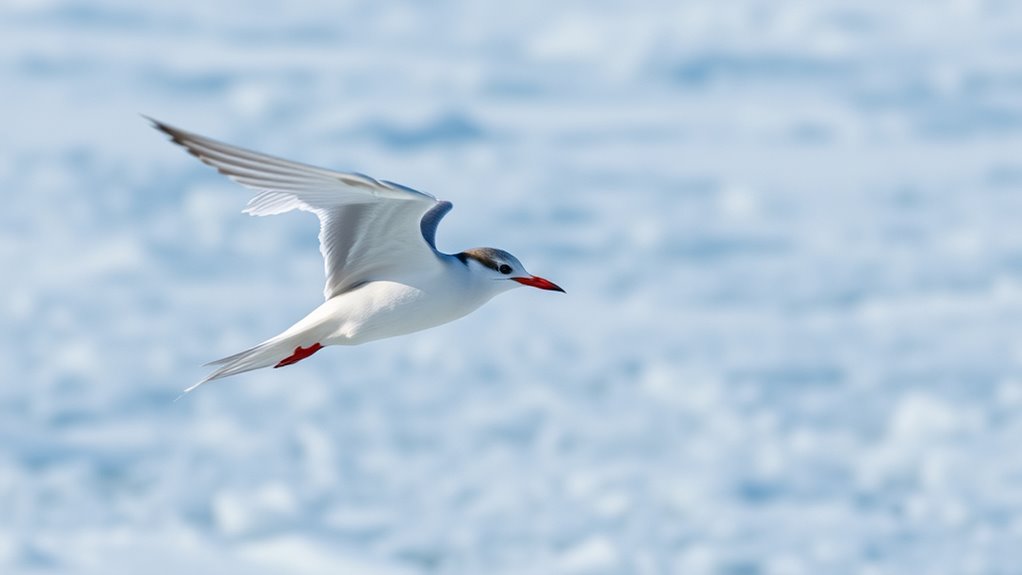
The Arctic tern’s body is uniquely adapted to withstand the rigors of its epic migrations. You notice its small, lightweight frame—around 100 grams—that minimizes energy use during long flights. Its long, pointed wings, spanning just over two feet, enable swift, agile movement over vast oceans, while aerodynamic shape helps it glide effortlessly on wind currents. Enhanced natural language processing improves human-computer interaction, demonstrating how advanced adaptations can optimize efficiency. The bright red webbed feet are perfect for brief water dives but aren’t meant for swimming. Sharp beaks and keen eyesight assist in catching small fish and insects along the way. Despite the harsh conditions, these physical traits allow the tern to conserve energy, navigate efficiently, and endure journeys totaling over 1.5 million miles in a lifespan. Its extreme migration distances showcase remarkable biological adaptations that enable survival in challenging environments. This combination of adaptations makes the Arctic tern a master of extreme, long-distance migration.
Feeding Strategies During Long-Distance Flights
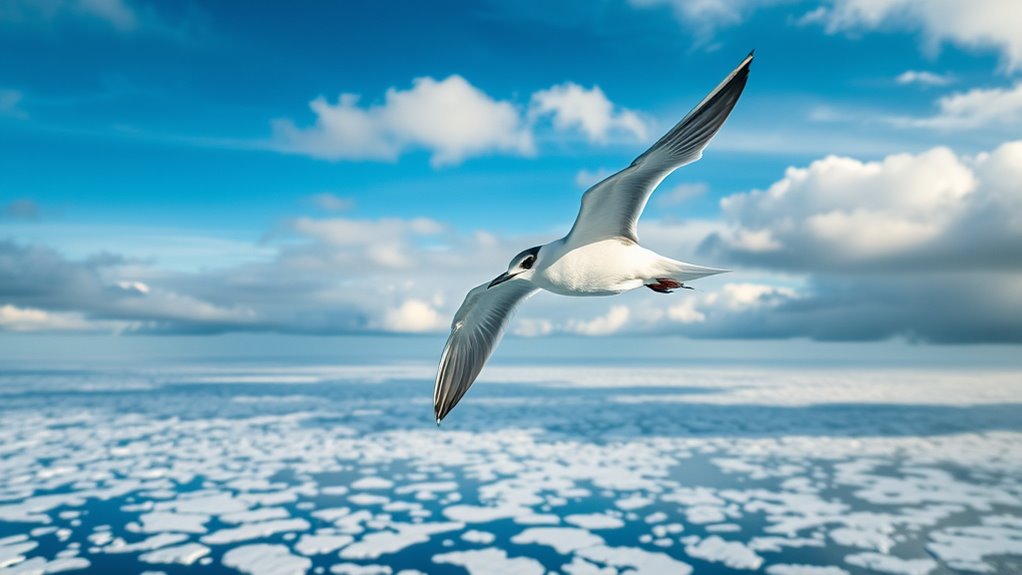
During their long flights, Arctic terns mainly feed on small fish they catch near the water’s surface, often by skimming or briefly grabbing prey. They also take advantage of ocean currents, which help conserve energy and position them in rich feeding areas. When necessary, they make quick, targeted dives to secure food, maximizing feeding efficiency during their epic journey. Additionally, their feeding success is influenced by natural juice detox plans, which support their overall health and stamina during these demanding migrations. Understanding foraging strategies helps explain how these birds sustain themselves during their extensive migrations, especially considering the importance of energy conservation techniques in their survival.
Surface Fish Capture
How do Arctic terns sustain themselves during their incredible long-distance flights? You might think it’s impossible to find enough food while soaring across vast oceans, but terns have clever strategies. They mainly catch surface fish by:
- Diving briefly to scoop up small fish near the water’s surface, using their sharp beaks.
- Hovering and scanning the water for movement, then plunging when prey is detected.
- Exploiting rich feeding zones, like the Weddell Sea or ocean currents, where fish congregate.
- They also adapt their feeding techniques to take advantage of the abundance of surface fish in productive waters, making efficient feeding possible even during extended flights. This combination of skill and environment sustains their epic journey.
Their lightweight bodies and agile wings let them stay aloft longer, conserving energy while hunting.
Exploiting Ocean Currents
Arctic terns skillfully harness ocean currents to extend their flight and find food over vast distances. By timing their flights with favorable currents like the Benguela and the North Atlantic, they conserve energy while covering thousands of miles. These currents push them toward productive feeding zones rich in small fish and insects they rely on. During migration, the terns adjust their flight paths to stay within these currents, maximizing their travel efficiency. They often follow wind patterns that complement ocean flows, allowing them to glide effortlessly across open waters. This strategic use of currents enables them to reach distant feeding areas, such as the Weddell Sea or Indian Ocean, with less effort. Exploiting ocean currents is essential for their survival during these demanding long-distance journeys.
Short Dive Feeding
Short dive feeding allows Arctic terns to take advantage of their swift, agile flight to capture prey even while covering thousands of miles. During long flights, you rely on quick, targeted dives to catch small fish and insects near the water surface. This strategy is essential when food is scarce, helping you maximize energy efficiency. Here are three key points about your feeding technique:
- You often execute brief, precise dives rather than prolonged plunges, conserving energy.
- Your sharp eyesight helps you spot prey from high altitudes during flight.
- You capitalize on areas with high productivity, like ocean currents and upwelling zones, for feeding opportunities.
- Using specialized hunting strategies allows you to effectively exploit diverse feeding grounds during migration. These tactics are supported by your adapted hunting strategies that enable you to successfully find food across different environments during your epic journey. Additionally, your ability to target specific prey enhances your efficiency during feeding bouts, ensuring you can sustain your long migratory distances. Exploiting productive feeding zones is crucial for maintaining the energy required for your extensive migration. Furthermore, your keen sensory abilities play a vital role in locating food in vast and varied habitats.
Breeding and Wintering Habitats at Opposite Hemispheres

The Arctic tern’s breeding and wintering habitats are located in opposite hemispheres, reflecting its remarkable migratory cycle. During summer, you’ll find them nesting along Arctic coasts, including Greenland, Alaska, and northern Europe. These areas provide the cold, open tundra and coastal zones ideal for raising chicks. When winter arrives, they migrate to the Antarctic, especially the pack-ice zones and Weddell Sea, where food is abundant during the southern summer. You’ll see them foraging over icy waters and open ocean, far from their breeding sites. This hemispheric separation allows the tern to enjoy continuous daylight and food resources. Different populations follow distinct routes, but all adapt to seasonal changes, ensuring they maximize feeding opportunities and reproductive success across the globe. Their incredible long-distance migration is facilitated by their exceptional navigation skills and endurance.
Mechanics and Drivers of Migration Patterns
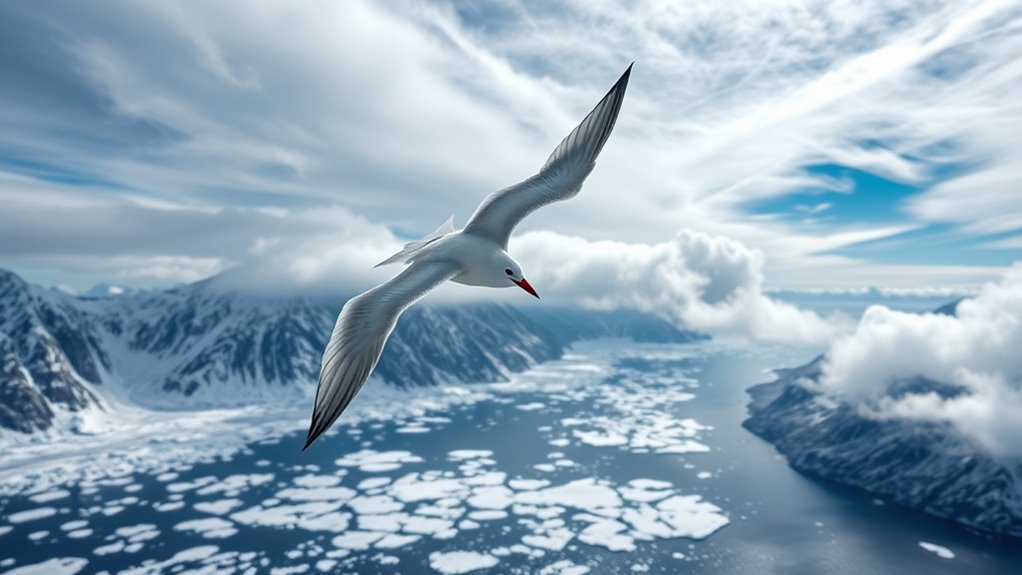
Have you ever wondered what drives the remarkable migration patterns of Arctic terns? Their routes are shaped by several key factors:
- Food availability – They follow rich feeding grounds like ocean currents and productivity hotspots such as the Benguela Current and Weddell Sea to ensure ample prey. Food distribution influences their route choices significantly, as they seek areas with high prey density. Additionally, their movement is affected by local ecosystem health, which determines prey abundance along their route.
- Wind and ocean currents – Terns adapt flight timing and routes to prevailing winds and currents, conserving energy during their long journeys. Their ability to navigate using environmental cues helps them stay on course across vast ocean expanses.
- Seasonal cues – They migrate in response to hemispheric seasons, moving to Antarctica’s summer as Arctic winter begins, maximizing daylight and food access.
- AI security measures – To protect their critical data and adapt to environmental changes, they employ advanced cybersecurity strategies that help monitor and respond to threats in their migratory habitats.
These mechanics enable terns to optimize energy use, minimize hazards, and align their migration with environmental conditions. Their flight is a finely tuned response to ecological drivers that sustain their epic journeys.
The Role of Environmental Factors in Migration Timing

Environmental factors such as temperature, daylight length, and ocean conditions directly influence when Arctic terns begin their migration. As days grow longer in the Arctic, you’ll notice the increasing light signals to terns that it’s time to leave breeding grounds and head south. Warmer ocean temperatures affect prey availability, prompting terns to adjust their departure to coincide with peaks in fish abundance. Ocean conditions like winds and currents also shape migration timing, helping terns conserve energy during long flights. When prey becomes scarce or ice cover expands, they delay or hasten their departure accordingly. These environmental cues guarantee terns migrate at suitable times, maximizing food access and survival chances during their epic journey. Their migration timing is a finely tuned response to the dynamic conditions of their environment, influenced by factors such as climate variability, which can alter migration patterns over time. Additionally, ocean currents play a crucial role by guiding and facilitating the long-distance travel of these seabirds, and changes in ocean chemistry can impact prey populations, further influencing migration timing.
Challenges Posed by Climate Change to Migration Routes

Climate change considerably disrupts Arctic terns’ migration routes by altering key environmental cues and habitats. You might notice that changes in sea ice, ocean temperatures, and prey distribution make traditional routes less predictable. These shifts threaten the timing and safety of their journeys. Specifically:
- Sea ice loss reduces resting and feeding areas, forcing terns to take longer or risk starvation.
- Altered wind and current patterns increase energy expenditure, making long flights more challenging.
- Decreased prey availability along migration corridors forces terns to deviate, risking exhaustion or missed stopovers.
As a result, your terns could arrive late, miss critical feeding windows, or struggle to find suitable habitats, jeopardizing their survival during migration.
Conservation Efforts and Future Outlook for Arctic Terns

Conservation efforts are crucial for ensuring the Arctic tern’s survival as they face increasing threats from habitat loss and changing migration patterns. You can help by supporting organizations that protect breeding sites in Arctic and Arctic-adjacent regions, such as Greenland and Alaska. Monitoring programs using geolocators and transmitters provide critical data on migration routes and habitat use, informing targeted conservation actions. Protecting key stopover sites and feeding grounds along migration corridors is essential, especially as climate change shifts ocean productivity and sea ice extent. Engaging in habitat restoration and advocating for policies that reduce greenhouse gas emissions can mitigate future risks. While Arctic terns aren’t currently endangered, proactive measures now will help secure their epic journey for generations to come.
Frequently Asked Questions
How Do Arctic Terns Navigate Such Vast Distances Accurately?
You might wonder how Arctic terns navigate such vast distances accurately. They rely on a combination of natural cues like the sun, stars, and Earth’s magnetic field. Their keen sense of smell helps identify specific ocean currents and feeding grounds. They also memorize landmarks and use wind patterns to stay on course. This sophisticated navigation system guarantees they reach their breeding and feeding sites with remarkable precision.
What Are the Main Threats to Arctic Terns During Migration?
You should know that the main threats to Arctic terns during migration include climate change, which shifts their breeding and feeding habitats, and loss of sea ice reducing food availability. Human activities like overfishing and pollution also threaten their survival by damaging ecosystems and contaminating food sources. Additionally, storms and harsh weather can cause exhaustion or injury, making their long journey even more perilous. Protecting key stopover sites is vital for their safety.
How Do Arctic Terns Find Sufficient Food Across Oceans?
They say “where there’s a will, there’s a way,” and Arctic terns prove it. You’ll see they find enough food by exploiting rich ocean currents and productive feeding grounds along their routes, like the Weddell Sea and the Benguela Current. Their keen eyesight and agile flight help them spot small fish and insects near the water’s surface. By timing their migrations to coincide with peak prey availability, they maximize their chances of sustenance over vast ocean distances.
Do All Arctic Terns Follow the Same Migration Routes?
No, all Arctic terns don’t follow the same migration routes. You’ll find that different populations have distinct paths; some migrate along the East Atlantic flyways, while others use the West Coast of North America. These routes vary based on breeding and wintering grounds, and some terns meander across continents and oceans instead of taking direct pole-to-pole paths. This diversity helps reduce competition and adapt to changing environmental conditions.
How Might Climate Change Alter Arctic Tern Migration Timing?
Climate change can substantially alter Arctic tern migration timing by shifting food availability and sea ice extent. You might notice terns arriving earlier or later at breeding and feeding grounds as they adjust to changing environmental cues. Warmer temperatures and reduced ice could disrupt traditional migration schedules, forcing them to adapt their timing to find enough food and suitable habitats, which could impact their survival and reproductive success.
Conclusion
As you follow the Arctic Tern’s incredible journey from pole to pole, it’s clear that their migration is a marvel of nature’s design. Coincidentally, just as they navigate changing climates, we’re reminded of our shared responsibility to protect their routes. Watching them soar across the globe, you realize that their survival depends on our actions. By safeguarding their habitats, you help guarantee this extraordinary journey continues for generations to come.