
Dolphins have incredibly complex social lives with constantly changing groups, requiring them to recognize many individuals and adapt quickly. They show long-term personalities and form deep bonds, often through playful behaviors and synchronized movements that reinforce relationships. Dolphins also pass skills and traditions through social learning, creating their own culture. Their social strategies are influenced by ecological factors like food availability. If you explore further, you’ll discover how these smart creatures master their fascinating social world.
Key Takeaways
- Dolphins form fluid, dynamic groups, constantly shifting bonds and recognizing hundreds of individuals to maintain complex social networks.
- They demonstrate long-term personality traits and preferences that influence social roles and alliance formations over decades.
- Dolphins use sophisticated communication, including signature whistles and synchronized movements, to strengthen bonds and convey social information.
- Social learning and cultural transmission through play, imitation, and shared behaviors create traditions that enhance group cohesion.
- Their advanced social cognition allows them to recognize, remember, and adapt to complex social environments, showcasing high intelligence.
The Fluid Nature of Dolphin Societies
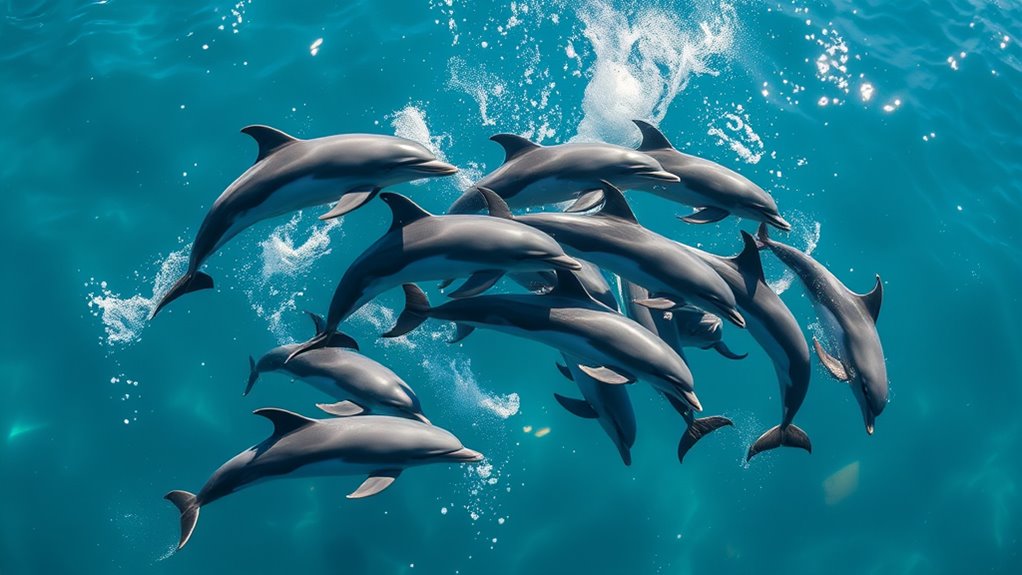
Dolphin societies are inherently fluid, with group compositions changing frequently and often unpredictably. You’ll notice that pods, which typically include 2 to 30 individuals, can split and merge multiple times an hour, depending on food availability and social needs. Sometimes, many pods combine into superpods of over 1,000 dolphins, creating large, dynamic gatherings. Despite this constant shifting, individual dolphins maintain stable social preferences, like favoring solitude or large groups, which they stick to over decades. This constant change demands dolphins to adapt quickly, recognize numerous individuals, and manage complex relationships. Such fluidity allows dolphins to optimize resource use and social bonding, showcasing their remarkable ability to navigate a constantly evolving social landscape with agility and sophistication. Their social behavior exemplifies social flexibility, enabling them to thrive within their intricate social networks. Moreover, their capacity for individual recognition plays a crucial role in maintaining social bonds amid the fluidity of their groups. Additionally, learning and memory are vital skills that help dolphins remember past interactions and social hierarchies, further supporting their complex social dynamics. Recognizing diverse communication signals is also essential for dolphins to coordinate and maintain harmony within their ever-changing groups.
Long-Term Social Traits and Personalities

You can observe that dolphins have stable social preferences, with some spending most of their time alone while others stay in large groups. These personality traits influence how they form bonds and interact over decades. Recognizing these consistent differences helps us understand their social complexity and adaptive strategies. Additionally, these behaviors may be linked to individual social styles, which are shaped by both innate tendencies and environmental factors. Properly understanding home decor can also reflect these social preferences, as the arrangement and style of living spaces often mirror personal traits and social behaviors. Furthermore, research shows that creativity in social interactions among dolphins can be influenced by their personality traits, highlighting the importance of individual differences in social dynamics. The study of these traits offers valuable insights into their behavioral ecology and adaptive mechanisms.
Consistent Social Preferences
Long-term social preferences in dolphins demonstrate that individual personalities remain remarkably stable over decades, shaping their social interactions and roles within groups. You can see this in how some dolphins consistently prefer solitude, while others seek constant company. These preferences influence their position within social networks, affecting relationships and cooperation. Despite shifting group compositions, their core social traits stay intact, guiding their behavior and interactions. Recognizing these stable preferences helps explain how dolphins maintain bonds and navigate complex social environments. Additionally, understanding social stability provides insight into their adaptive strategies and resilience over time. This stability is further supported by research showing that behavioral consistency can be a key factor in their long-term survival and social success. This consistency also underscores the importance of considering individual personalities when studying their social dynamics and long-term survival strategies. Moreover, research into these persistent traits reveals how behavioral stability contributes to group cohesion and individual success in diverse environments.
Personality’s Impact on Bonds
Individual personalities shape social bonds in dolphins just as they do in humans. Your behavior, whether bold or shy, influences how you connect with others and the roles you play within your group. Dolphins with outgoing, curious traits tend to form more central positions in social networks, fostering stronger alliances and better information sharing. Conversely, more reserved dolphins may prefer solitude or smaller groups, yet still maintain long-term bonds. These personality differences are stable from infancy through adulthood, affecting social strategies and survival. Your individual traits help determine alliance formation, cooperative behavior, and even responses to environmental challenges. Additionally, research indicates that personality traits are consistent over time and influence the stability of social bonds. The presence of long-term social traits can significantly impact group cohesion and collective decision-making. Moreover, understanding individual personalities can shed light on the mechanisms that sustain complex dolphin societies over generations. Studies also show that behavioral consistency plays a crucial role in maintaining social structures. Ultimately, personality shapes how dolphins establish, maintain, and adapt their social bonds over decades, highlighting the importance of individual variation in complex dolphin societies.
The Intricacies of Male Alliances and Cooperation

Male dolphins form complex, multi-level alliances that are essential for their reproductive success and social stability. These alliances often involve two to three tiers of cooperation, with dolphins shifting partners and strategies over time. You’ll notice that these bonds support cooperative behaviors like group defense, hunting, and competing for mates. Dolphins coordinate synchronized movements and vocalizations to reinforce alliance membership and signal intentions, demonstrating high cognitive abilities. These sophisticated social structures are supported by strategic planning, which allows dolphins to adapt their alliances based on changing circumstances. Such alliances extend beyond kinship, highlighting their capacity for long-term cooperation based on mutual benefit. Their cooperation reflects advanced social cognition, empathy, and long-term cooperation, making dolphin alliances among the most intricate and sophisticated social structures observed in non-human animals.
Recognizing and Maintaining Social Bonds

You can see how dolphins recognize each other through unique behaviors and physical cues that strengthen social bonds. They reinforce these ties with gestures like rubbing and synchronized movements that signal cooperation and trust. Observing their movement patterns, such as side-by-side surfacing, reveals how they maintain their complex social networks over time. Additionally, these behaviors are often vetted by researchers to ensure they are genuine indicators of social bonds. Recognizing these social signals is vital for understanding dolphin communication and social cohesion, which are essential for their survival and group dynamics. These intricate interactions highlight the importance of social recognition in maintaining the stability of dolphin societies. Understanding the behavioral cues that dolphins use can also inform conservation efforts by identifying the health of their social structures. Moreover, studying these cues can provide insights into communication strategies that dolphins employ to coordinate within their groups.
Recognizing Individuals
How do dolphins recognize each other amid the ever-changing composition of their social groups? You might think it’s all about sight, but dolphins rely on a sophisticated combination of cues. They use unique signature whistles—like names—to identify individuals, even when separated by distance. These whistles are learned early in life and remain stable over decades. Additionally, dolphins recognize each other through physical touches, such as rubbing or petting, which reinforce bonds. Body language and synchronized movements also help dolphins identify friends and allies. Despite the fluid nature of their groups, these recognition methods allow dolphins to maintain stable social bonds. This complex system supports their social cohesion, cooperation, and long-term relationships, even amid constant group changes.
Reinforcing Social Ties
Dolphins actively strengthen their social bonds through a variety of physical and behavioral interactions. They engage in rubbing, gentle nuzzles, and synchronized swimming to reinforce connections, demonstrating empathy and cooperation. These behaviors help maintain trust and social stability within groups. Dolphins also use vocalizations and body language to communicate and affirm alliances, ensuring clear signals of intent. Playful activities like chasing and object tossing serve as bonding rituals, fostering cooperation and shared experiences. By regularly participating in such interactions, dolphins keep their social networks strong, which is crucial for mutual defense, coordinated hunting, and reproductive success. Additionally, their ability to recognize and remember individuals highlights their advanced social cognition, which is vital for navigating their complex social lives. Advances in AI security technologies can offer insights into analyzing complex social behaviors, which may eventually benefit our understanding of social cognition in dolphins. These efforts reflect their complex social cognition and commitment to maintaining the intricate bonds that underpin their dynamic social lives.
Movement Synchrony
Movement synchrony plays a essential role in recognizing and maintaining social bonds among dolphins. When dolphins swim side-by-side or surfacing in unison, they send clear signals of alliance and trust. These coordinated behaviors help dolphins identify friends and reinforce their social relationships. By mimicking each other’s movements, dolphins demonstrate cooperation and empathy, strengthening group cohesion. Synchrony also facilitates communication without sound, which is useful in stealthy hunting or avoiding predators. Young dolphins learn social skills by observing and imitating their mothers’ movements, integrating into the social network. This synchronized activity promotes bonding, reduces conflicts, and ensures smooth cooperation within pods. Overall, movement synchrony acts as a social glue, helping dolphins navigate their dynamic, fission-fusion societies effectively.
Cultural Transmission and Learned Behaviors

Did you know that dolphins pass down unique behaviors and skills through social learning, creating a form of culture? You can observe this when calves imitate their mothers or peers, adopting specific foraging techniques or social routines. Synchronized swimming helps transmit knowledge visually, allowing dolphins to share information silently, which is essential for stealth during hunting or avoiding predators. Play behaviors, like chasing objects or engaging in mock fights, also serve as social learning tools, sharpening cognitive skills and strengthening bonds. These shared behaviors become traditions within groups, maintaining social cohesion and survival strategies across generations. By passing down these learned behaviors, dolphins develop complex social cultures that influence their interactions, environment, and adaptation, highlighting the importance of social transmission in their cognitive and social evolution.
Movement Synchrony and Social Signaling

You might observe dolphins surfacing side-by-side, which helps them communicate and strengthen social bonds. Imitative movement cues, like synchronized swimming, serve as visual signals that reinforce cooperation and trust. These coordinated behaviors act as social signals, showcasing alliance membership and fostering group cohesion.
Side-by-Side Surfacing
How do dolphins communicate and strengthen social bonds during their synchronized surfacing? When dolphins surface side by side, they engage in movement synchrony that acts as a powerful social signal. This coordinated behavior demonstrates trust, cooperation, and shared intent, reinforcing bonds within the group. Synchronized surfacing allows dolphins to read each other’s cues more easily, fostering mutual understanding. It also signals alliance membership, helping maintain social cohesion amid fluid group compositions. This behavior can convey aggression, reassurance, or affiliation, depending on context. Surfacing together emphasizes social harmony and collective identity, especially in complex societies where individual recognition matters. By aligning their movements, dolphins not only enhance communication but also display their social unity, supporting their intricate social structures and cooperative relationships.
Imitative Movement Cues
Imitative movement cues, such as synchronized swimming and coordinated gestures, serve as vital social signals among dolphins. They communicate trust, cooperation, and group cohesion, strengthening bonds within pods. When dolphins mirror each other’s movements, it signals a willingness to connect and cooperate, fostering alliance stability. These cues aren’t just about coordination—they convey complex social messages that help dolphins navigate their fluid societies.
| Dolphin Movement Cues | Social Significance |
|---|---|
| Synchronized swimming | Builds trust and signals unity |
| Coordinated gestures | Reinforces social bonds and cooperation |
| Mimicry during play | Promotes learning and social bonding |
This subtle imitation deepens relationships, ensuring survival in a dynamic, ever-changing social landscape.
Signaling Social Bonds
Movement synchrony among dolphins serves as a powerful form of social signaling that reinforces bonds and communicates group cohesion. When dolphins swim side by side or surface in unison, they send clear signals of alliance and mutual trust. These coordinated actions help establish and maintain social bonds, especially during complex behaviors like cooperative hunting or mate selection. Synchronized movements also serve as visual cues to others, indicating intent, status, or readiness to cooperate. By matching each other’s speed and direction, dolphins demonstrate empathy and understanding, which strengthens social ties. This form of signaling minimizes misunderstandings and promotes teamwork. Overall, movement synchrony acts as an essential tool for dolphins to communicate social loyalty, coordinate actions, and sustain their intricate social networks.
The Role of Play in Cognitive Development

Play plays a pivotal role in dolphin cognitive development by providing opportunities for social learning, problem-solving, and skill refinement. When you observe dolphins chasing each other or tossing objects, you’re witnessing activities that strengthen neural connections and enhance their mental agility. Play allows dolphins to experiment with new behaviors in a safe context, improving their ability to adapt to changing environments. It also fosters social bonds, as engaging in playful activities often involves cooperation, imitation, and communication. These interactions help dolphins develop complex social skills that are essential for maintaining alliances and maneuvering fission-fusion societies. By practicing play, dolphins refine their cognitive abilities, demonstrating that play isn’t just entertainment—it’s a vital component of their mental and social growth.
Ecological Drivers of Complex Social Structures

Ecological factors substantially shape the development and maintenance of dolphins’ intricate social systems. You’ll find that resource distribution, such as prey availability, influences group size and composition. In areas with abundant food, dolphins form larger superpods, fostering extensive social bonds and cooperation. Conversely, scarce resources lead to smaller, more stable groups, emphasizing individual relationships. Environmental conditions like water temperature and habitat type also impact movement patterns and social interactions. Predation risks drive dolphins to form alliances for defense and hunting efficiency. Additionally, seasonal changes in prey migration compel dolphins to adjust their social strategies, balancing between fission-fusion dynamics and stable bonds. These ecological drivers create a flexible social fabric, enabling dolphins to adapt their social structures for survival amid fluctuating environmental challenges.
Social Strategies in Fission-Fusion Dynamics
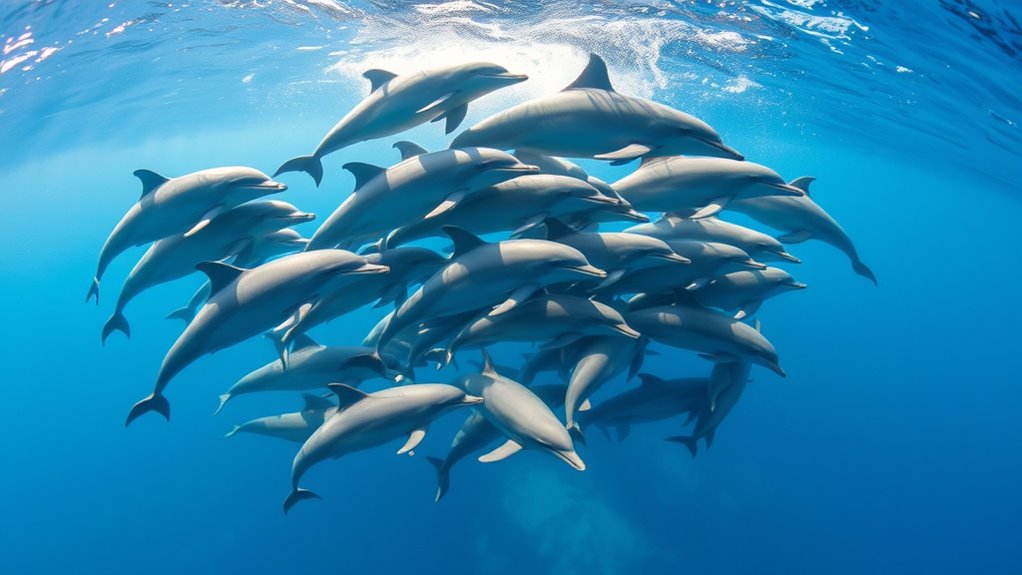
Dolphins employ sophisticated social strategies to navigate their fission-fusion societies, where group composition changes frequently. You’ll notice they carefully manage their associations, forming and dissolving bonds based on current needs and social goals. Dolphins track individual relationships, maintaining long-term bonds even as groups shift, which helps reinforce cooperation and cooperation. They also use synchronization, like surfacing together, to strengthen social ties and signal alliance membership. These strategies enable dolphins to balance the benefits of large group cooperation with individual safety and resource access. You’ll see them adapt quickly, shifting alliances or social roles as environmental conditions change. This dynamic social flexibility requires advanced cognition, allowing dolphins to optimize their social environment for survival, reproduction, and learning in an ever-changing aquatic landscape.
Implications for Conservation and Social Preservation

Understanding the complex social structures and cultural traditions of dolphins is essential for effective conservation efforts. You must recognize that dolphins rely heavily on their social bonds and learned behaviors to survive and thrive. Disrupting their social groups through habitat destruction, noise pollution, or hunting can fracture these bonds, impairing their ability to communicate, cooperate, and pass on cultural knowledge. Protecting key habitats and minimizing human impacts help preserve these intricate social networks. Additionally, respecting individual personalities and social roles ensures that conservation strategies support social cohesion. By conserving not just populations but their social and cultural fabric, you promote resilient dolphin communities capable of adapting to environmental changes. Ultimately, understanding their social complexity guides more effective, nuanced conservation policies that safeguard their long-term survival.
Frequently Asked Questions
How Do Dolphins Recognize and Remember Hundreds of Individual Peers?
You recognize and remember hundreds of your peers through a combination of advanced social cognition and unique individual traits. Dolphins identify each other by distinctive vocalizations, body markings, and synchronized behaviors. Your brain processes these cues, enabling you to maintain stable social bonds over decades. This ability helps you navigate dynamic group changes, form alliances, and foster cooperation, ensuring your social network remains strong despite constant group fluidity.
What Cognitive Skills Are Required to Maintain Multi-Level Alliances?
To maintain multi-level alliances, you need to recognize individuals, remember past interactions, and predict future cooperation. You must assess social hierarchies, adapt strategies based on shifting group dynamics, and communicate effectively through synchronized behaviors. You rely on cognitive skills like social memory, strategic planning, and emotional understanding. These abilities help you navigate complex social networks, strengthen bonds, and sustain cooperation across varying alliance levels, ensuring your group’s survival and success.
How Does Dolphin Culture Vary Across Different Regions?
You’ll find dolphin culture varies considerably across regions, shaped by distinct behaviors, vocalizations, and social traditions passed down within groups. In some areas, dolphins develop unique foraging techniques or specific vocal dialects, forming regional identities. These cultural differences influence how dolphins communicate, cooperate, and learn, highlighting the importance of preserving diverse populations to maintain the richness of dolphin social life and adaptability across their habitats.
In What Ways Do Dolphin Social Behaviors Influence Their Survival?
You see, dolphin social behaviors are their secret weapon for survival. By forming complex alliances, they boost their chances of finding food, defending against predators, and mating successfully. Their cooperation, empathy, and learned social skills help them adapt to shifting environments, like a well-oiled machine. These behaviors strengthen their social bonds, ensuring they stay connected and resilient, even when the waters get rough.
Can Dolphin Personalities Change Over Their Lifespan?
Yes, dolphin personalities can change over their lifespan. You might notice that a once shy dolphin becomes more social or an extroverted one becomes more cautious. These changes often result from experiences, environmental influences, or social interactions within their pods. As you observe dolphins over time, you’ll see their individual traits adapt, helping them navigate new situations, build bonds, or cope with environmental challenges effectively.
Conclusion
As you explore dolphin societies, you realize their social lives mirror our own—full of surprises and intricate bonds. It’s almost as if their complex behaviors, from alliances to play, emerge naturally, shaped by both environment and tradition. You start to see how these remarkable creatures teach us about connection and adaptability. In this dance of social fluidity, you can’t help but wonder—are we all more alike than we think, bound by the same need to belong?