
TL;DR

Prime made for students and young adults
- Fast, free delivery for dorm and study essentials
- Prime Video and Amazon Music included
- Member-only deals
Fossil evidence from the Silurian period shows that early ancestors of millipedes and centipedes had legs adapted for underwater life. This discovery challenges the notion that such limbs evolved solely for terrestrial environments.
Fossil evidence from the Silurian period, approximately 437 million years ago, shows that an ancestor of modern millipedes and centipedes had legs adapted for underwater life, challenging the idea that such limbs evolved exclusively for terrestrial environments.
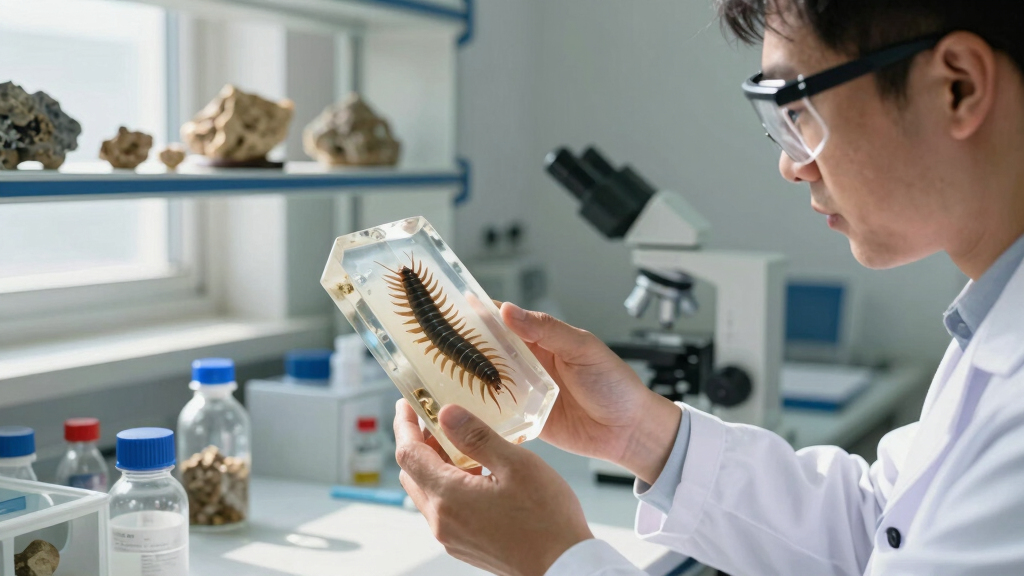
Researchers discovered 35 well-preserved fossils of Waukartus muscularis in the Waukesha Lagerstätte, Wisconsin. The fossils reveal a segmented, millipede-like arthropod with many uniramous limbs, indicating it was aquatic. Phylogenetic analysis places Waukartus just outside the crown group of myriapods, which typically have at least 17 limb pairs. The fossils show that Waukartus possessed limb structures similar to modern terrestrial myriapods but with adaptations suggesting an aquatic lifestyle. The presence of uniramous limbs, which lack exopods, indicates these features predate terrestrial adaptation and may have been co-opted later for land living, a process known as exaptation.
Why It Matters
This discovery is significant because it pushes back the timeline of limb evolution in myriapods and suggests that aquatic ancestors already had limb features associated with land adaptation. It challenges previous assumptions that such limbs evolved solely for terrestrial life, providing new insights into the evolutionary pathways of myriapods and other arthropods. Understanding these early adaptations helps clarify how complex limbs and terrestrial traits developed in the arthropod lineage.
As an affiliate, we earn on qualifying purchases.
Background
Prior to this discovery, the fossil record for early myriapod relatives was sparse, with gaps in understanding when and how terrestrial traits emerged. Euthycarcinoids, another group of aquatic arthropods, had been identified as stem-group myriapods, but the exact timing and nature of limb evolution remained unclear. The new fossils from Waukesha fill a critical gap, showing that aquatic ancestors already had limb structures similar to those used on land, implying a more complex evolutionary history than previously thought.
“The presence of limb structures suited for terrestrial life in an aquatic ancestor indicates that these features evolved before the transition to land, likely as exaptations.”
— Lead researcher in the study
“Waukartus sits just outside the crown group of myriapods, providing crucial insight into early limb evolution and the aquatic origins of these animals.”
— Paleontologist involved in the analysis
What Remains Unclear
While the fossils provide strong evidence for aquatic limb adaptations, details about the exact mode of feeding and the full extent of the animal’s lifestyle remain unclear. The precise functional role of the head appendages and whether they were sensory or feeding structures is still uncertain. Additionally, the transition from aquatic to terrestrial life in myriapods is not yet fully understood, and further fossil evidence is needed to clarify these evolutionary steps.
What’s Next
Future research will focus on finding more fossils to better understand the transition from aquatic to terrestrial adaptations in myriapods. Paleontologists aim to identify additional transitional forms that can shed light on the evolution of limbs and other terrestrial traits. Molecular studies may also complement fossil data to reconstruct the evolutionary timeline more precisely.
Key Questions
How does this discovery change our understanding of arthropod evolution?
It suggests that limb features associated with land adaptation existed in aquatic ancestors, indicating a more complex evolutionary pathway for myriapods than previously thought.
What specific features indicate that Waukartus was aquatic?
The presence of uniramous limbs lacking exopods, as well as the fossil’s marine depositional context, support an aquatic lifestyle.
Why is the concept of exaptation important in this context?
Exaptation refers to traits that evolve for one purpose but are later co-opted for another, such as limbs initially adapted for aquatic life later used for terrestrial walking.
Are there other fossils showing similar features?
Currently, Waukartus is a unique find, but ongoing excavations may uncover additional fossils that further clarify early limb evolution.
What implications does this have for understanding the evolution of other terrestrial arthropods?
It suggests that many terrestrial features may have originated from pre-existing aquatic adaptations, influencing how scientists interpret the evolutionary history of insects, arachnids, and other land-dwelling arthropods.
Halloween Picks
halloween
As an affiliate, we earn on qualifying purchases.