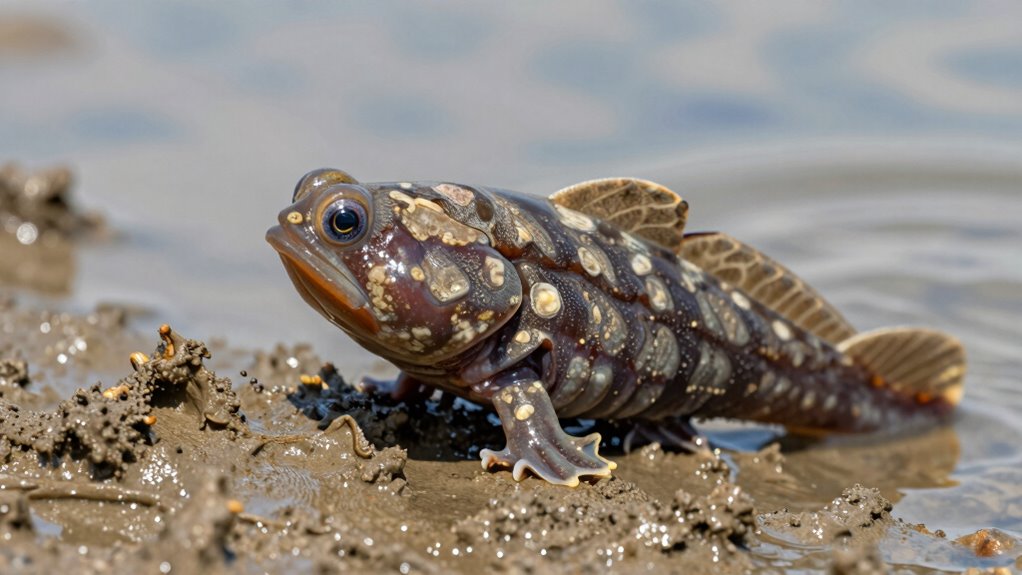

Meet the mudskipper, a fish that’s equally at home in water and on land. It uses powerful pectoral fins like limbs to crawl across mudflats, and its high-set eyes give it a broad view of its surroundings. Its thick, mucus-covered skin helps prevent dehydration and allows air breathing, making it a true dual habitat survivor. This fascinating creature showcases remarkable adaptations that blur the line between aquatic and terrestrial life—continue to explore its incredible features.
Key Takeaways
- Mudskippers are fish that can move and survive both in water and on land, showcasing dual habitat adaptations.
- They use muscular pectoral fins to crawl out of water and navigate mudflats like land creatures.
- Their high-positioned eyes provide a broad view for spotting predators and prey in both environments.
- Mudskippers breathe air through modified gill chambers and their skin, enabling terrestrial activity.
- They exemplify evolutionary innovation by blending aquatic and terrestrial features for survival.
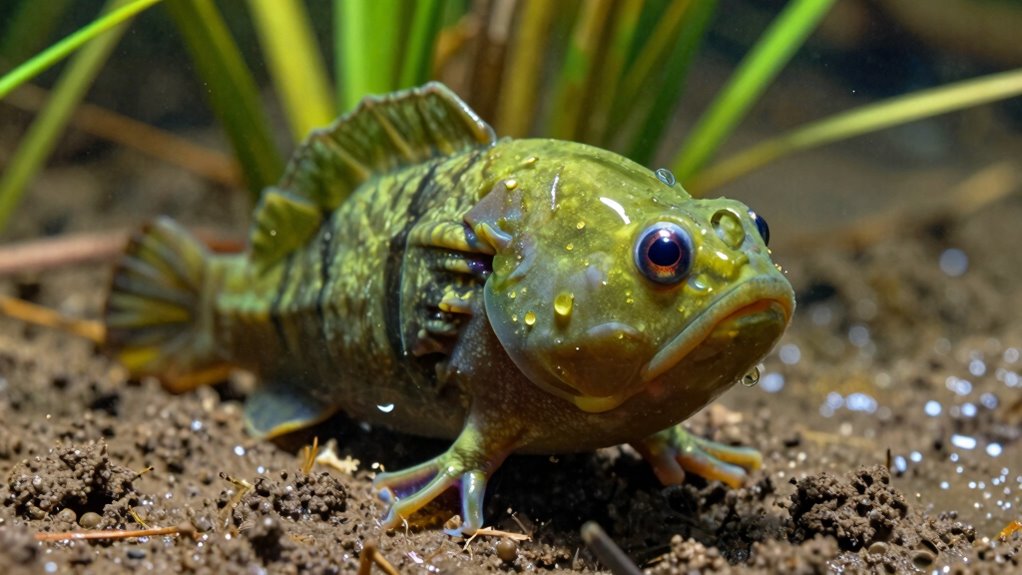
If you’ve ever wondered what it’s like for a fish to walk on land, meet the mudskipper. This extraordinary creature blurs the line between aquatic and terrestrial life, showcasing remarkable adaptations that allow it to thrive both in water and on mudflats. You’ll notice that its body is built for versatility, with features that highlight its evolutionary traits designed specifically for this dual existence. The mudskipper’s unique shape, with a robust, muscular pectoral fin structure, enables it to crawl out of water and move across land with surprising agility. These fins act almost like limbs, giving it the ability to propel itself over muddy surfaces, and this is a key example of aquatic adaptations that have evolved over time.
The mudskipper’s muscular fins act like limbs, enabling it to crawl and move across land with surprising agility.
As you observe a mudskipper, it becomes clear that its eyes are positioned high on its head, giving it an excellent vantage point to survey its surroundings both in water and on land. This is an important evolutionary trait, allowing it to spot predators or prey from a distance. Its skin is also specially adapted; it’s thick and often covered with mucus to prevent dehydration when out of water. This mucus layer isn’t just a defense mechanism—it’s a crucial developmental feature that helps maintain moisture and facilitates breathing through its skin when submerged or on land.
The mudskipper’s ability to breathe air is another striking example of its evolutionary traits. Unlike most fish that rely solely on gills, mudskippers possess modified gill chambers and skin that can absorb oxygen from the air, enabling them to survive in oxygen-poor mudflats. This adaptation is a direct response to their environment, where water levels can fluctuate dramatically. Their circulatory system also supports this terrestrial lifestyle, ensuring oxygen reaches tissues efficiently even when submerged or out of water for extended periods. Additionally, their ability to utilize cutaneous respiration highlights how their skin plays a vital role in their survival outside aquatic environments. These features highlight how their evolution has equipped them with the necessary tools to survive outside the aquatic domain.
In essence, the mudskipper embodies a fascinating case of evolutionary traits that blur the lines between aquatic and land animals. It’s a living testimony to how species can adapt over time, developing specialized features that allow them to exploit new habitats. You’re witnessing a creature that’s not just a fish but a marvel of evolution—perfectly adapted to navigate both worlds. Its aquatic adaptations and evolutionary traits make the mudskipper a true pioneer among fish, showcasing nature’s ability to innovate and evolve in unexpected ways.

MUDSKIPPER AQUARIUM GUIDE: The Complete Guide to Mudskipper Care, Habitat Setup, Feeding, Behavior, Breeding, and Advanced Aquarium Management.
As an affiliate, we earn on qualifying purchases.
As an affiliate, we earn on qualifying purchases.
Frequently Asked Questions
How Long Can Mudskippers Survive Out of Water?
You can expect mudskippers to survive out of water for up to a few hours, thanks to their unique aquatic adaptations. They breathe through their skin and the lining of their mouth and throat, which allows them to stay moist. Their breeding behaviors also involve land, where they often dig burrows to stay safe and moist. During this time, you’ll notice how well they adapt to both land and water environments.
Do Mudskippers Have Any Predators on Land?
You might be surprised, but mudskippers do face predators on land, like birds and crabs, especially during their mudskipper camouflage. As they perform their fascinating mudskipper mating rituals, predators are often distracted, giving you a glimpse of their vulnerability. Their ability to blend in helps them avoid being eaten, but the constant threat reminds you that even land-adapted fish can’t escape nature’s watchful eyes entirely.
Can Mudskippers Communicate With Each Other?
Yes, mudskippers communicate with each other using visual signals, sound, and chemical cues. You can observe their communication signals during territorial disputes or mating behaviors, where they display vibrant fin movements or body postures to establish dominance or attract mates. These behaviors help them coordinate activities and defend their space, making their interactions on land as dynamic as in the water.
What Do Mudskippers Eat on Land?
You’ll find that mudskippers primarily enjoy land-based feeding, devouring small invertebrates and insects. Remarkably, they can eat up to 20% of their body weight daily, showcasing their voracious appetite. Their mudskipper diet includes crustaceans, worms, and tiny fish, which they actively hunt on land. This adaptive feeding behavior helps them thrive in their unique brackish environments, combining aquatic and terrestrial diets seamlessly.
Are Mudskippers Endangered or Threatened Species?
You should know that mudskippers are not currently endangered or threatened. However, conservation efforts and habitat preservation are crucial to guarantee their populations stay healthy. Protecting their coastal and mangrove habitats helps prevent declines caused by pollution, development, and climate change. By supporting these efforts, you contribute to maintaining the mudskipper’s unique lifestyle and the delicate ecosystems they inhabit, ensuring they thrive for generations to come.
Conclusion
So, next time you see a mudskipper skimming across land, remember it’s not just a fish—it’s a master of both worlds. Its ability to thrive on land and water challenges what you thought was possible for aquatic life. Isn’t it amazing how nature blurs the lines we’ve drawn? The mudskipper proves that sometimes, breaking boundaries leads to incredible survival stories. Ready to explore more of these fascinating creatures that defy expectations?