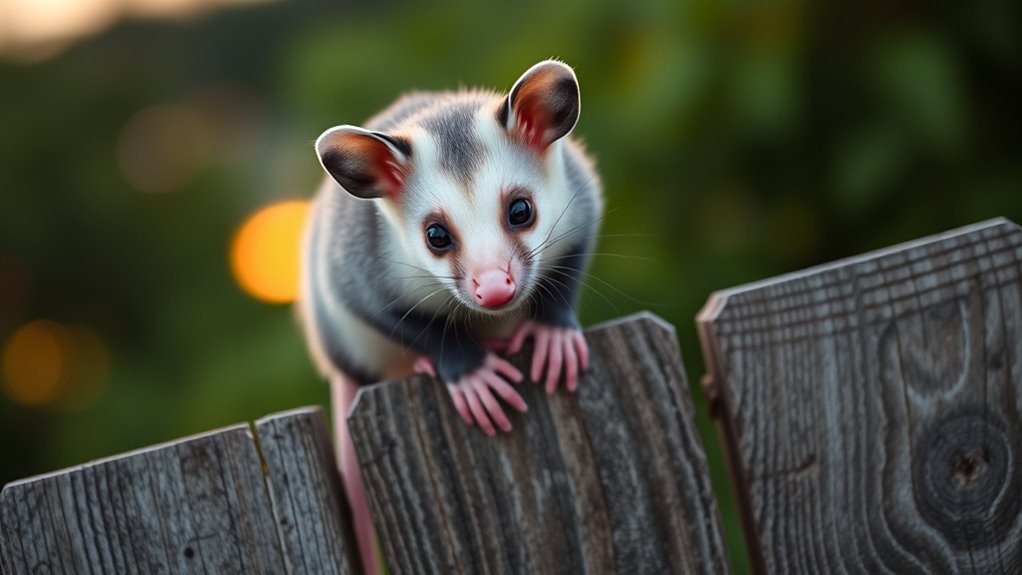

As the only marsupial native to America, the opossum has some amazing quirks. You’ll notice its small, grey body with a white face, and it uses a prehensile tail to grasp and balance. When threatened, it plays dead, emits a foul odor, and even foams at the mouth—disguising itself as decayed matter. It also resists venom and helps control pests like ticks and rodents. Learn more about these fascinating creatures and their unique survival tricks.
Key Takeaways
- The opossum is the only native marsupial in North America, with a pouch for developing young.
- They have more teeth than any other North American land mammal, totaling 50.
- Opossums play dead involuntarily, entering a limp state to deter predators with a foul odor and foam.
- They are resistant to snake venom and produce antibodies that neutralize toxins.
- Opossums help control pests by eating insects, rodents, and thousands of ticks each season.
Unique Physical Features That Set Opossums Apart

Opossums have several distinctive physical features that make them stand out among North American mammals. You’ll notice their small, cat-sized bodies covered in grey fur, with a white face and a long, pointed snout. Their round, dark eyes give them a curious expression, while hairless ears sit atop their head. They have an impressive 50 teeth—more than any other land mammal in North America. Their long, hairless, prehensile tail is versatile, used for grasping branches, balancing, and carrying nesting materials, but they don’t hang by it. Opposable thumbs on their hind feet enhance their climbing ability, making them agile climbers and skilled navigators of trees and rough terrain. These features collectively help them adapt to their nocturnal, solitary lifestyle. Additionally, their ability to regenerate tissue allows them to recover quickly from injuries, which is vital for their survival in the wild. They also possess a highly effective immune system, which helps them resist certain diseases that can affect other animals. Interestingly, their immune system is highly effective, helping them resist certain diseases that can affect other animals.
The Surprising Defense Mechanism of Playing Dead
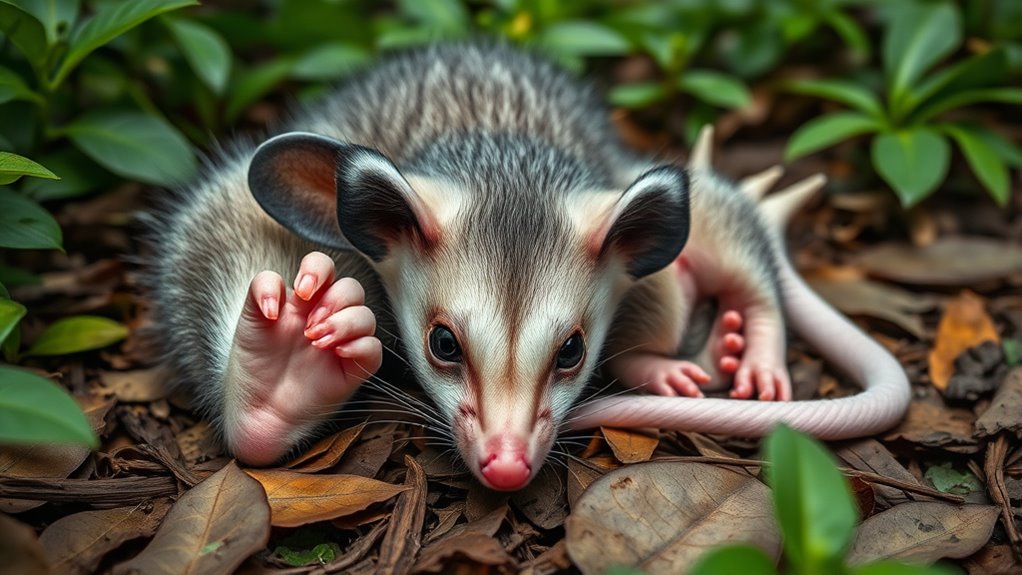
When threatened, you might be surprised to learn that opossums automatically enter a “playing dead” state. This involuntary response creates a convincing illusion that deters predators from attacking. By going limp, they effectively turn a dangerous situation into a safe escape. Interestingly, this behavior is a security measure that helps ensure their survival in the wild. Additionally, their ability to mask their scent further reduces the likelihood of detection by predators during this feigned death.
Involuntary Response Triggered
Have you ever wondered how opossums manage to avoid predators so effectively? When threatened, they don’t choose fight or flight. Instead, their bodies react involuntarily, triggering a remarkable defense. They enter a state called tonic immobility, where they go limp and remain motionless. This response isn’t a conscious choice but a reflex pushed by their nervous system. During this state, they foam at the mouth, emit a foul odor, and sometimes even release a greenish discharge, all designed to repel or confuse predators. Their muscles stay relaxed for minutes to hours, making them appear dead. Once the danger passes, their bodies regain normal movement, and they quietly scurry away, often leaving predators puzzled. This involuntary response is a vital survival tool in their natural environment.
Deterrent to Predators
Playing dead is one of the most startling and effective defense strategies opossums use to deter predators. When threatened, you might suddenly go limp, becoming unresponsive and appearing lifeless. Your mouth foams, and you emit a foul odor from glands near your anus, mimicking the smell of decay. This combination makes predators believe you’re already dead or unappetizing, encouraging them to abandon the attack. Your body remains motionless for minutes to hours, giving you a critical window to escape once the threat passes. This involuntary response is so convincing that many predators avoid further pursuit. By playing dead, you leverage a natural, evolved tactic that reduces your risk of injury or death, making it one of your most effective survival tools against predators.
Opossums’ Role in Controlling Pests and Disease
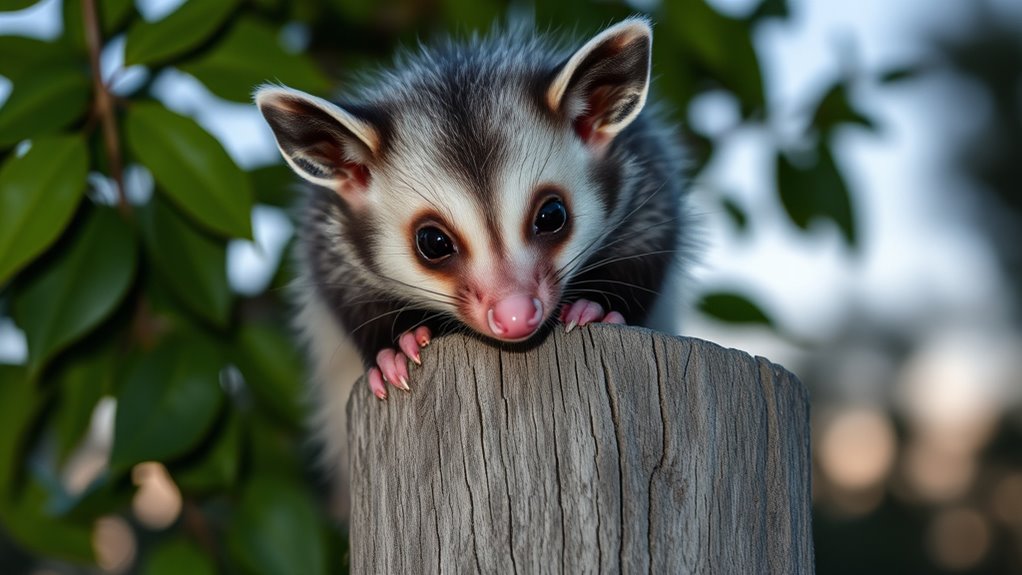
Opossums play a vital role in controlling pests and reducing the spread of disease in your environment. They help keep your yard and neighborhood cleaner by consuming insects, rodents, and even discarded food scraps. Their diet includes over 90% ticks, and they can eat more than 5,000 ticks per season, lowering the risk of Lyme disease. Opossums also eat snails, insects, and small rodents, which can carry various diseases. Their resistance to venom and ability to consume dangerous pests make them valuable allies in pest control. By scavenging through trash and hunting pests, they prevent infestations and reduce the spread of harmful pathogens. Their presence naturally diminishes pest populations, making your environment healthier and safer. Additionally, their natural foraging behavior aligns with mindfulness techniques, encouraging an attentive and balanced approach to interacting with local wildlife. Recognizing their ecosystem benefits can help foster a greater appreciation for these often-overlooked creatures. Moreover, studies show that their immune system is highly effective at fighting off infections, further enhancing their role as natural pest controllers.
Reproductive Secrets of the Virginia Opossum

You might be surprised to learn that Virginia opossums give birth to tiny, underdeveloped joeys that must travel from the birth canal to the mother’s pouch. Once inside the pouch, they stay for about 50 days, growing and developing before venturing out. Notably, females often produce multiple litters per year, each with several babies competing for limited nipples. Proper storage in a cool, dark place can help preserve the health of their offspring during development. Additionally, the opossum’s high adaptability allows it to thrive in diverse environments, ensuring the continuation of their reproductive cycle. An interesting reproductive trait is that the survival of the joeys depends heavily on the mother’s ability to provide sufficient nourishment, often leading to intense competition among the young. A remarkable aspect of their reproduction is the fact that opossums can sometimes give birth to more young than the available nipples, leading to intense competition among the joeys for nourishment.
Tiny Joeys’ Journey
Have you ever wondered how tiny opossum joeys make their incredible journey from helpless embryos to independent animals? It all starts with a rapid 13-day gestation. Once born, these tiny, blind, hairless babies instinctively crawl from the birth canal to their mother’s pouch, guided by smell and touch. Inside the pouch, they latch onto one of her 13 nipples, where they grow and develop. The essential role of the nipples in their development highlights the specialized reproductive strategy of marsupials. Their journey is a remarkable example of marsupial adaptation, transforming from fragile embryos into capable young animals. Notably, the specialized reproductive strategy of marsupials emphasizes their unique approach to nurturing their young, which differs significantly from placental mammals. Additionally, the rapid development process within the pouch allows them to mature quickly compared to other mammals. This distinct reproductive approach is part of what makes the opossum’s life cycle so fascinating and unique among mammals. Interestingly, the short gestation period is a key feature that distinguishes marsupials from other mammals, underlining their evolutionary adaptations.
Pouch Life Stages
Curious about what happens inside an opossum’s pouch during its early life stages? After birth, the tiny, blind joeys crawl from the birth canal and instinctively head straight for their mother’s pouch. Inside, they latch onto one of her 13 nipples, which swell to fit their tiny mouths, providing essential nourishment. The joeys remain in the pouch for about 50 days, where they continue developing, growing fur, and gaining strength. During this time, they’re completely dependent on their mother’s milk and protection. The pouch acts as a safe nursery, shielding them from predators and environmental hazards. As they grow, they gradually become more active, preparing for their next stage of independence outside the pouch. Additionally, the reproductive secrets of the Virginia opossum include the remarkable ability of females to produce multiple litters annually, ensuring the survival of their species. Furthermore, the pouch environment offers a controlled microclimate that helps regulate temperature and humidity, essential for healthy development. This environment also helps protect the joeys from external threats, such as predators and harsh weather conditions. Interestingly, the ability of opossums to adapt to diverse habitats contributes to their widespread presence across various regions.
Multiple Births Occur
The Virginia opossum’s reproductive process is remarkable because females often produce multiple litters each year, sometimes overlapping in time. This high reproductive rate helps guarantee their survival and spread across North America. During the breeding season, a female can conceive again shortly after giving birth. She may have up to two litters annually, each with 4-8 tiny joeys. After a quick 13-day gestation, the underdeveloped babies crawl into her pouch to continue developing. Inside, they latch onto her 13 nipples for nourishment and growth. Once they leave the pouch around 50 days, they ride on her back until about 100 days old, ready to fend for themselves. This rapid, overlapping reproduction keeps their populations thriving. Additionally, their ability to reproduce multiple times per year is a key factor in their successful population growth and adaptability.
How Opossums Resist Venom and Fight Off Rabies
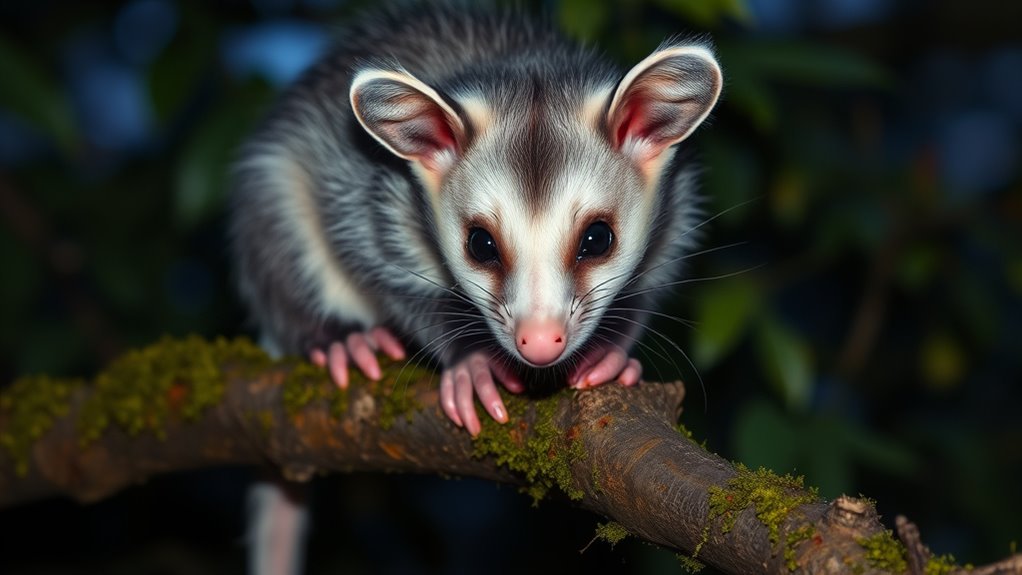
Opossums possess unique physiological traits that enable them to resist venom from certain snakes and fight off rabies infections. Their immune system is highly effective, producing antibodies that neutralize venom toxins, making them less susceptible to snake bites. Additionally, their low body temperature inhibits the replication of rabies virus, reducing infection risk. Unlike many animals, they rarely carry rabies because their immune defenses fight off the virus before it can establish itself. Their saliva and gland odors, especially during their “playing dead” state, can deter predators and pathogens. These adaptations, combined with their ability to self-groom and maintain hygiene, help protect their health. Moreover, recent studies suggest that their immune response to pathogens is particularly robust, offering further protection against various infections. Their ability to resist venom and manage infections highlights their remarkable survival strategies in environments filled with venomous snakes and rabies-carrying animals. For example, their genetic makeup plays a crucial role in their resistance, giving them an evolutionary advantage. Overall, their evolutionary traits give them a significant advantage in environments filled with venomous snakes and rabies-carrying animals.
Myths and Facts About Opossum Behavior

Many myths surround opossum behavior, leading people to misunderstand these creatures. You might think they hang by their tails or are aggressive, but that’s not true. Opossums rarely hang by their tails; they use them mainly for grasping and balance. They don’t seek out fights; instead, they hiss, show teeth, or play dead when threatened. Playing dead isn’t a conscious choice but an involuntary reflex. Contrary to popular belief, they are quite clean, grooming like cats to stay tidy. They also aren’t major carriers of rabies due to their immune system and low body temperature. Their calm demeanor and defensive tactics often get misinterpreted, but understanding the facts helps you appreciate their true behaviors.
The Opossum’s Place in North American Wildlife
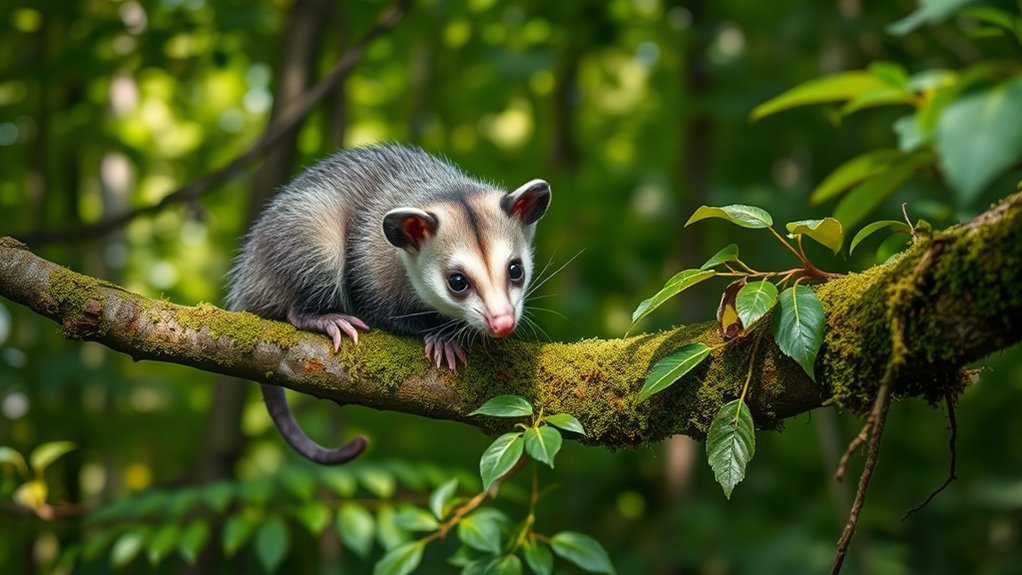
Despite common misconceptions about their behavior, opossums play a vital role in North American ecosystems. They help control pest populations by eating insects, rodents, and even venomous snakes, reducing the spread of diseases like Lyme disease. Their scavenging habits clean up carrion and discarded food, preventing the spread of decay and disease. Opossums also consume thousands of ticks each season, acting as natural pest controllers. Their ability to resist snake venom and their immune system’s robustness make them unique predators in their habitats. You’ll find them across the U.S., Canada, and Mexico, often in urban, suburban, and rural areas. Their presence helps maintain ecological balance by controlling pests and cleaning up the environment, making them an integral part of North American wildlife.
Frequently Asked Questions
Do Opossums Really Hang by Their Tails Like in Cartoons?
No, opossums don’t hang by their tails like in cartoons. You might see them gripping branches or hanging upside down temporarily, but they use their prehensile tail mainly to grasp and stabilize themselves, not to hang from for long periods. Their tails are strong and flexible, helping with climbing and carrying nesting materials, but they’re not used as a primary hanging tool.
How Long Can an Opossum Play Dead During a Defense?
You might wonder how long an opossum can play dead during a defense. It can stay in this “playing dead” state from a few minutes up to several hours, depending on the threat and situation. During this time, it remains limp, emits a foul odor, and foams saliva to deter predators. This instinctive behavior helps it escape danger, giving it a better chance to survive an attack.
Can Opossums Really Control Lyme Disease by Eating Ticks?
Yes, opossums can help control Lyme disease by eating ticks. When you see an opossum foraging, you’re witnessing a natural pest control agent in action. They consume over 90% of the ticks they encounter, potentially eating more than 5,000 ticks per season. By doing so, they reduce the number of infected ticks in your environment, lowering the risk of Lyme disease transmission to humans and pets.
Why Do Opossums Have More Teeth Than Any Other North American Mammal?
You’d be amazed to learn that opossums have more teeth than any other North American mammal, with 50 sharp, tiny blades ready to grip and shred. This dental arsenal helps them eat a wide variety of foods—from insects to small animals—and adapt to different diets. Their extra teeth act like a biological Swiss Army knife, giving them the flexibility to survive in diverse environments and handle anything their world throws at them.
Are Opossums More Resistant to Snake Venom Than Other Animals?
Yes, opossums are more resistant to snake venom than many other animals. You might find it fascinating that their immune system and low body temperature help them withstand venom from rattlesnakes and cottonmouths. This adaptation allows them to sometimes eat venomous snakes without harm. Their ability to resist venom is a remarkable survival trait, making them unique among North American mammals and aiding their role as natural pest controllers.
Conclusion
So, next time you see an opossum playing dead, remember—you’re witnessing one of America’s most fascinating wildlife wonders. They’re not just pesky pests; they’re nature’s little pest controllers and immune to venom and rabies. Ironically, their reputation as ugly, useless creatures masks a surprisingly resilient and essential role in our ecosystem. So, give these oddball marsupials a second look—you might just find them more remarkable than you ever thought.