
Geology rock collection kits vary from small, labeled starter sets to large assortments with fossils, books, or hands-on activities. My best overall pick is the Geosciences Industries Introductory Earth Science Rocks and Minerals Collection for buyers who want a collection centered on learning about specimens. The National Geographic Rock and Mineral Collection with 300+ Specimens stands out for sheer variety, while the National Geographic Geology Kit with Crystals, Gem Dig, and Rock Collection adds an activity-led experience. The main tradeoff is between specimen quantity, clear educational context, and extras that make the kit more engaging but may leave fewer pieces for building a reference collection. Read on for the full breakdown and guidance on choosing a kit that fits its recipient and purpose.

Prime made for students and young adults
- Fast, free delivery for dorm and study essentials
- Prime Video and Amazon Music included
- Member-only deals
Key Takeaways
- The strongest choice depends on the goal: Geosciences Industries is the learning-focused pick, while the National Geographic 300+ collection favors breadth of specimens.
- Activities change the experience: National Geographic’s crystal and gem-dig kit and Dan&Darci’s rock, fossil, and mineral assortment suit hands-on exploration more than a straightforward display collection.
- Small sets can still be useful: the 15-piece National Geographic and Piano Potato kits may suit first collections, but buyers seeking more comparison material should look at larger assortments.
- Labels and learning materials matter: a kit with fewer specimens can teach more effectively than a large box if its identification support helps children connect names to samples.
- “More pieces” does not automatically mean a better geology kit: specimen counts may include several categories or small samples, so match the kit’s contents and presentation to the learner’s actual interests.
| National Geographic Rock and Mineral Collection Kit with 15 Gemstones |  | Best Compact Starter Collection | Brand: Blue Marble | Age range: 8 years and up | Specimens: 15 rock and mineral specimens | VIEW LATEST PRICE | See Our Full Breakdown |
| National Geographic Rock and Mineral Collection with 300+ Specimens |  | Best for Maximum Specimen Variety | Brand: National Geographic | Specimen count: Over 300 | Included geodes: 2 break-open geodes | VIEW LATEST PRICE | See Our Full Breakdown |
| Piano Potato Rock and Mineral Kit, 15 Pieces |  | Best for Younger Beginners | Number of specimens: 15 | Included accessories: Storage box, magnifying glass, rock identification guide | Recommended age: 6 years and up | VIEW LATEST PRICE | See Our Full Breakdown |
| Geosciences Industries Introductory Earth Science Rocks and Minerals Collection |  | Best for Structured Earth Science Study | Brand: Geosciences Industries | Model: 13357 | Sample count: 75 | VIEW LATEST PRICE | See Our Full Breakdown |
| National Geographic Geology Kit with Crystals, Gem Dig, and Rock Collection |  | Best Multi-Activity Geology Bundle | Brand: Blue Marble | Age range: 8 years and up | Activities: Rock and mineral collection, gemstone dig, crystal growing | VIEW LATEST PRICE | See Our Full Breakdown |
| Dancing Bear 18-Piece Rock and Mineral Educational Collection |  | Best for Younger Beginners | Brand: Dancing Bear | Specimen count: 18 rocks and minerals | Recommended age: 4–12 years | VIEW LATEST PRICE | See Our Full Breakdown |
| National Geographic Rock Collection Box and Rocks & Minerals Book |  | Best for Collection Size and Reading | Brand: National Geographic | Age range: 8 years and up | Specimens: Over 300 rocks, minerals, and crystals | VIEW LATEST PRICE | See Our Full Breakdown |
| Dan&Darci Mega Rock, Fossil & Mineral Collection Kit for Kids |  | Best for Hands-On Group Exploration | Brand: Dan&Darci | Contents: 250+ rocks, gemstones, crystals, minerals, and fossils | Recommended age: 8 years and up | VIEW LATEST PRICE | See Our Full Breakdown |
| Toysmith Rock and Mineral Science Kit for Kids, 30 Specimens |  | Best for Testing and Identification | Brand: Toysmith | Age range: 8–12 years | Specimens: 30 total: 15 rocks and 15 minerals | VIEW LATEST PRICE | See Our Full Breakdown |
| Educational Insights Complete Rock, Mineral, and Fossil Collection |  | Best for Sorting and Classification | Brand: Educational Insights | Age range: 8 years and up | Specimens: 57 rocks, minerals, and fossils | VIEW LATEST PRICE | See Our Full Breakdown |
| PIBEX Rock Collection Starter Kit with 54 Rocks and Minerals |  | Best for Guided Learning | Brand: PIBEX | Set size: 54 rocks, crystals, and minerals | Contents: 9 polished gems, 45 raw specimens, learning book, rock ID and game cards, magnifier, storage box | VIEW LATEST PRICE | See Our Full Breakdown |
| Kids’ Rock, Gemstone & Crystal Collection Kit, 30 Pieces | 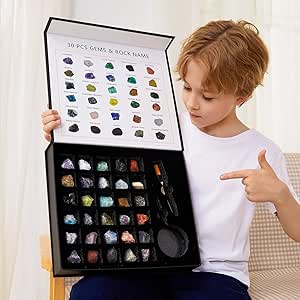 | Best for Hands-On Inspection | Brand: YXZZWL | Number of specimens: 30 | Included components: Rocks and gemstones, magnifying glass, brushes, full-color learning guide | VIEW LATEST PRICE | See Our Full Breakdown |
| geology rock collection kit | Brand | Age range | Model number | Weight |
|---|---|---|---|---|
| National Geographic Rock and M | Blue Marble | 8 years and up | NGFIRSTRM15 | — |
| National Geographic Rock and M | National Geographic | 8 years and up | NGRMF200 | — |
| Piano Potato Rock and Mineral | — | — | — | — |
| Geosciences Industries Introdu | Geosciences Industries | — | — | 3.6 pounds |
| National Geographic Geology Ki | Blue Marble | 8 years and up | NGCRYSTALBUN | — |
| Dancing Bear 18-Piece Rock and | Dancing Bear | — | — | 12 ounces |
| National Geographic Rock Colle | National Geographic | 8 years and up | — | — |
| Dan&Darci Mega Rock | Dan&Darci | — | DD-043 | 2 pounds |
| Toysmith Rock and Mineral Scie | Toysmith | 8–12 years | — | 0.45 kg |
| Educational Insights Complete | Educational Insights | 8 years and up | 5210 | — |
| PIBEX Rock Collection Starter | PIBEX | — | — | 1.7 lb |
| Kids’ Rock | YXZZWL | — | 105-30YSTZ | 1.73 kg |
More Details on Our Top Picks
National Geographic Rock and Mineral Collection Kit with 15 Gemstones
This kit makes the most sense for a young collector who wants a manageable set of recognizable specimens rather than a large assortment. Its 15 minerals include tiger’s eye, rose quartz, pyrite, and green fluorite, while the full-color guide gives children a reference for identifying what they have. A clear case and separate pouch also make it easier to keep the pieces together between sessions. Compared with the Piano Potato 15-piece kit, this option names several specimens and includes both a case and pouch; Piano Potato adds a magnifying glass but does not specify its specimen variety. The tradeoff is scale: unlike the National Geographic 300+ specimen collection, this is a small introduction, not a set for building a broad study collection.
Pros:- Includes 15 different rock and mineral specimens, including several named examples.
- Full-color guide supports specimen identification and geology learning.
- Clear storage case and pouch help keep the collection organized.
Cons:- The 15-piece selection offers less variety than larger collections in this roundup.
- Designed for ages 8 and up, so it may not suit younger children.
Best for: Children ages 8 and up who want a compact, organized first collection with named examples and a learning guide.
Not ideal for: Collectors seeking dozens of specimens, hands-on testing tools, or an activity such as cracking geodes.
- Brand:Blue Marble
- Age range:8 years and up
- Specimens:15 rock and mineral specimens
- Included components:Clear storage case, full-color learning guide, storage pouch
- Educational objective:Learn about geology
- Material:Minerals
- Item dimensions:9.2 × 6.1 × 2.2 inches
- Model number:NGFIRSTRM15
Our verdict“Choose this compact kit for a child who wants an organized first set of identifiable minerals, not a large or activity-heavy collection.”
National Geographic Rock and Mineral Collection with 300+ Specimens
For a child whose main goal is to handle and compare a wide range of geological finds, the 300-plus specimens make this the broadest collection among these five. The two break-open geodes add a hands-on reveal that a straightforward set such as the National Geographic 15 Gemstones kit does not offer. A magnifying glass and full-color guide also give young learners ways to inspect and identify what they uncover. That abundance is the point, but it brings a tradeoff: the contents are better suited to browsing a large assortment than studying a smaller, clearly specified set in depth. Some of the geode activity requires breaking the geodes open, so it calls for a suitable setup and adult help. Choose it for variety and discovery, not a tidy, tool-focused classroom sequence like the Geosciences Industries collection.
Pros:- Includes more than 300 genuine rocks, minerals, and crystals.
- Two break-open geodes add an active discovery element.
- Magnifying glass and full-color guide support close inspection and identification.
- Storage bag keeps the large assortment together.
Cons:- Opening the geodes requires breaking them and may call for adult supervision and a suitable work area.
- The large specimen count may be less useful to learners who prefer a smaller, structured study set.
Best for: Families with children ages 8 and up who want a large assortment to sort, inspect, and explore, including geodes to open.
Not ideal for: Buyers who want a compact collection, detailed classification tools, or an activity that avoids breaking materials.
- Brand:National Geographic
- Specimen count:Over 300
- Included geodes:2 break-open geodes
- Included accessories:Magnifying glass, storage bag, full-color learning guide
- Age range:8 years and up
- Educational objective:STEM
- Model number:NGRMF200
Our verdict“Pick this collection when specimen variety and geode discovery matter more than a compact, methodical set.”
Piano Potato Rock and Mineral Kit, 15 Pieces
The Piano Potato kit is the most age-accessible choice here, with a recommended age of 6 and up rather than the age-eight guidance on both National Geographic collections. Its 15 specimens, magnifying glass, identification guide, and storage box provide a simple starting point for handling and looking closely at rocks and minerals. Compared with the National Geographic 15 Gemstones kit, it includes an inspection tool and is aimed at younger learners, but its specimen variety is not described and it lacks that kit’s named examples and separate pouch. That missing detail makes it harder for a buyer to know what kinds of samples are included. This is a modest starter set for introductory exploration, not a broad reference collection like the 75-sample Geosciences Industries set.
Pros:- Recommended for ages 6 and up, younger than the National Geographic kits in this group.
- Includes 15 specimens for basic hands-on exploration.
- Magnifying glass and identification guide support close examination.
- Storage box provides a place to keep the kit together.
Cons:- Specimen variety and individual sample size are not specified.
- Offers fewer specimens and less detailed study equipment than larger educational sets.
Best for: Families or elementary classrooms introducing geology to children ages 6 and up who benefit from a magnifier and basic identification guide.
Not ideal for: Older learners or collectors who need a specified range of specimens, classification tools, or a large reference set.
- Number of specimens:15
- Included accessories:Storage box, magnifying glass, rock identification guide
- Recommended age:6 years and up
- Item weight:0.23 kg
- Theme:Geology
Our verdict“Choose this as a simple first geology set for a younger learner, but look elsewhere if you need a clearly described specimen lineup.”
Geosciences Industries Introductory Earth Science Rocks and Minerals Collection
This collection is the strongest fit for learners who need a study set rather than a discovery toy. Its 75 numbered samples, each about 1–2 inches, are paired with a streak plate, magnet, magnifier, index sheet, and study guide covering rock classification and the rock cycle. Those tools make mineral properties and rock types more concrete, especially for the listed grades 4–12. Compared with the National Geographic 300+ specimen collection, it has far fewer samples, but its numbering and testing tools create a more structured path through earth science. The tradeoff is sample size: pieces are relatively small, and the collection is heavier and larger than a child-focused starter kit. I’d favor this for guided lessons over the activity-rich National Geographic geology bundle.
Pros:- Includes 75 numbered samples for organized reference and study.
- Streak plate, magnet, and magnifier support hands-on examination of mineral properties.
- Study guide and index sheet address classification and the rock cycle.
- Covers igneous, sedimentary, and metamorphic rocks.
Cons:- Samples are approximately 1–2 inches, which may feel small for handling or display.
- Its classroom-oriented tools and format are less activity-focused than the National Geographic bundle.
Best for: Teachers, homeschoolers, and students in grades 4–12 who want numbered samples and tools for organized earth science lessons.
Not ideal for: Young children looking mainly for large, colorful specimens, geode cracking, or several separate hands-on activities.
- Brand:Geosciences Industries
- Model:13357
- Sample count:75
- Sample size:Approximately 1–2 inches
- Included components:Streak plate, magnifier, magnet, index sheet, study guide
- Topics:Mineral properties; igneous, sedimentary, and metamorphic rocks
- Recommended grades:4–12
- Dimensions:19.3 × 11 × 1.6 inches
- Weight:3.6 pounds
Our verdict“Choose this for structured classroom or homeschool geology study, especially when classification tools matter more than specimen size.”
National Geographic Geology Kit with Crystals, Gem Dig, and Rock Collection
This bundle is the pick for children who want to do more than sort specimens: it combines a rock and mineral collection, a gemstone dig, and a crystal-growing lab with a light-up display. Digging tools and two geodes add physical exploration, while the included learning guide gives the activities a geology focus. Compared with the National Geographic 300+ specimen collection, this kit offers a wider mix of activity types but is not presented as a 300-plus-piece reference assortment. It also takes more planning: crystal growing takes time, and some activities need adult supervision. At 6.6 pounds and nearly 14 inches long, it is a substantial bundle rather than a compact starter like the 15 Gemstones kit. Choose it for variety and projects, not quick, low-mess specimen identification.
Pros:- Combines a rock and mineral collection, gemstone dig, and crystal-growing activity.
- Includes real specimens and two geodes to crack open.
- Digging tools and a learning guide support active exploration.
- Light-up display gives the crystal-growing activity a presentation element.
Cons:- Some activities require adult supervision.
- Crystal growing takes time rather than providing an immediate result.
- At 6.6 pounds and 13.9 inches long, the bundle is less compact than the 15-piece kits.
Best for: Families with children ages 8 and up who want several geology projects, including digging, geode opening, and crystal growing.
Not ideal for: Buyers seeking a small, simple specimen set or children who need activities that produce immediate results with minimal adult help.
- Brand:Blue Marble
- Age range:8 years and up
- Activities:Rock and mineral collection, gemstone dig, crystal growing
- Included components:Crystal-growing lab with light-up display, gemstone dig kit, rock, mineral, and crystal activity set
- Number of kits:3
- Item dimensions:13.9 × 9.84 × 6.9 inches
- Item weight:6.6 pounds
- Materials:Gemstones, minerals, crystals
- Model number:NGCRYSTALBUN
Our verdict“Pick this bundle for a child who wants multiple geology projects and can spend time on them, rather than a compact collection for quick identification.”
Dancing Bear 18-Piece Rock and Mineral Educational Collection
For a first geology set aimed at younger children, the Dancing Bear 18-Piece Collection keeps the task manageable: its specimens come in a compact box with an information sheet, giving a child a place to start observing and sorting without a large assortment to organize. Its ages 4–12 recommendation also makes it the youngest-audience pick among these five; the Toysmith kit, by comparison, is geared to ages 8–12 and adds tools for testing specimens. That simpler setup is a tradeoff: the Dancing Bear kit has fewer pieces and no listed testing tools, so it offers less scope for extended comparisons. Each piece is about 1.25 inches, and the plastic box is practical for storage but less substantial than a display-focused case. I’d choose it for an introduction, not for a child ready for detailed classification work.
Pros:- Includes 18 rocks and minerals for a simple first collection
- Comes with a collection box and educational information
- Recommended for ages 4–12, younger than the other kits in this group
- Compact 9.25 x 4.5 x 1.5-inch box is easy to store
Cons:- The 18-piece assortment is smaller than the Toysmith and Educational Insights collections
- Individual specimens are approximately 1.25 inches
- Plastic box and lack of listed testing tools limit display and investigation options
Best for: Families introducing geology to children around ages 4–7 who want a small, contained set with basic educational information.
Not ideal for: Older children or classroom leaders seeking a large specimen variety, testing tools, or activities that support more advanced comparison.
- Brand:Dancing Bear
- Specimen count:18 rocks and minerals
- Recommended age:4–12 years
- Included materials:Plastic collection box and description sheet with educational information
- Materials:Acrylic and plastic
- Dimensions:9.25 x 4.5 x 1.5 inches
- Weight:12 ounces
- Educational objectives:Geological knowledge and scientific inquiry skills
Our verdict“Choose this set for a young child’s first, easy-to-store geology collection, but pick Toysmith or Educational Insights for more involved specimen study.”
National Geographic Rock Collection Box and Rocks & Minerals Book
This National Geographic kit is the strongest choice here for a child who wants both a large assortment and a substantial reading companion. It includes over 300 specimens, two geodes to crack open, and a 100-plus-page illustrated hardcover book, so it pairs collecting with guided earth-science reading. Compared with the Dan&Darci Mega Rock, Fossil & Mineral Collection Kit, it puts more emphasis on the book and geode activity; Dan&Darci instead supplies a learning mat, magnifier, display case, and pouch. The National Geographic set’s scale can make sorting and storage a bigger task, and opening geodes may call for adult supervision. It is also aimed at ages 8 and up, unlike the Dancing Bear set, which suits younger beginners. I’d favor this option when reading and specimen variety matter more than a compact, tool-led activity.
Pros:- Includes over 300 rocks, minerals, and crystals
- Two geodes add a hands-on discovery activity
- 100-plus-page, full-color hardcover book supports further reading
- Storage box is included for the collection
Cons:- Cracking geodes may require adult supervision
- The large assortment can take more effort to sort and store than smaller kits
- Recommended for ages 8 and up, so it is not the youngest-child option
Best for: Families with children ages 8 and up who want a large specimen assortment alongside a hardcover earth-science book and a geode activity.
Not ideal for: Younger children or buyers who prefer a compact kit with dedicated examination tools and less sorting or supervised setup.
- Brand:National Geographic
- Age range:8 years and up
- Specimens:Over 300 rocks, minerals, and crystals
- Geodes:2
- Book:Full-color hardcover, over 100 pages, English
- Included components:Collection and storage box
- Educational objective:STEM learning
- Battery required:No
Our verdict“Pick this National Geographic set for an older child who will use both a broad collection and a substantial earth-science book.”
Dan&Darci Mega Rock, Fossil & Mineral Collection Kit for Kids
The Dan&Darci kit is the most activity-oriented choice in this group: its 250-plus rocks, minerals, gems, and fossils arrive with a jumbo learning mat, magnifying glass, fossil display case, and collector’s pouch. Those extras give children places to examine, present, and carry specimens, making the set a better fit for shared exploration than the simpler Dancing Bear collection. Compared with the National Geographic book set, Dan&Darci supplies more hands-on accessories but does not list a long-form hardcover guide. Its broad assortment also means more pieces to sort, and the supplied description recommends it for ages 8 and up, despite the product title’s younger-age reference. I’d choose this for a child or small group that enjoys handling and organizing a varied collection; I’d skip it for buyers who want a clearly guided reading-led kit or a smaller starter set.
Pros:- Includes more than 250 rocks, gemstones, crystals, minerals, and fossils
- Learning mat gives specimens a dedicated space for sorting and discussion
- Magnifying glass, fossil display case, and collector’s pouch support different activities
- Suitable for individual or group STEM exploration
Cons:- Recommended age is 8 and up, despite the younger ages suggested in the title
- Large assortment may take time and space to organize
- No book or detailed identification guide is listed among the included accessories
Best for: Families or educators seeking a large, accessory-rich collection for children ages 8 and up to explore together.
Not ideal for: Buyers of a simple first set for younger children, or readers who want a detailed book-led guide and a smaller assortment to manage.
- Brand:Dan&Darci
- Contents:250+ rocks, gemstones, crystals, minerals, and fossils
- Recommended age:8 years and up
- Accessories:Jumbo learning mat, magnifying glass, fossil display case, and collector’s pouch
- Weight:2 pounds
- Educational objective:STEM
- Model number:DD-043
- Number of packs:1
Our verdict“Choose Dan&Darci for group-friendly, hands-on exploration with useful accessories, not for a compact or book-centered geology kit.”
Toysmith Rock and Mineral Science Kit for Kids, 30 Specimens
Unlike the larger assortment-led kits, Toysmith makes the identification process its main draw. Its 30 real specimens are split evenly between rocks and minerals, and the magnifying viewer, streak plate, nail, and other testing tools give children concrete ways to compare properties. That makes it a more structured investigation kit than the Dancing Bear set, which is aimed at younger learners but lists only an information sheet and collection box. Educational Insights offers a broader 57-piece mix of rocks, minerals, and fossils with charts and labels; Toysmith trades some variety for a compact set of testing tools. Its 8–12 age range means younger children may need help handling the activities, and its smaller collection is not designed to compete with 250-plus-specimen kits. I’d choose Toysmith for guided observation over sheer collecting volume.
Pros:- Includes 15 real rocks and 15 real minerals
- Magnifying viewer and testing tools support hands-on comparison
- Streak plate and nail add ways to investigate specimen properties
- Compact dimensions make the kit practical for storage or classroom use
Cons:- Designed for ages 8–12, so younger children may need assistance
- Thirty specimens provide less variety than the Educational Insights and large-assortment kits
- The listed contents focus on rocks and minerals rather than fossils
Best for: Children ages 8–12, parents, or teachers who want a compact collection with tools for examining and testing specimens.
Not ideal for: Younger children needing a simpler introduction, or collectors who prioritize a large assortment of fossils, crystals, and other specimens.
- Brand:Toysmith
- Age range:8–12 years
- Specimens:30 total: 15 rocks and 15 minerals
- Included tools:Nail, magnifying viewer, streak plate, and identification and testing tools
- Storage:Storage trays
- Dimensions:7.1 x 1.5 x 4.8 inches
- Weight:0.45 kg
- Manufacturer part number:3958
Our verdict“Choose Toysmith when testing and comparing specimens matter more than collecting the largest assortment.”
Educational Insights Complete Rock, Mineral, and Fossil Collection
Educational Insights earns its place as the lineup’s most balanced classification set: 57 specimens cover rocks, minerals, and fossils, while identification charts, self-adhesive labels, trays, and an information guide help children organize what they find. Compared with Toysmith’s 30-piece kit, it offers more variety and more explicit sorting support, though Toysmith has listed tools such as a streak plate and nail for testing properties. It also avoids the sheer volume of the National Geographic and Dan&Darci kits, which may suit a home or classroom that wants a substantial but still manageable collection. The intended age is 8 and up, so it is not the best fit for preschool introductions, and the listed warranty covers defects only. I’d choose it when labeling and classifying specimens are central to the activity, rather than geode cracking or tool-based testing.
Pros:- 57 specimens include rocks, minerals, and fossils
- Identification charts and information guide support learning
- Self-adhesive labels and storage trays aid classification and organization
- Designed for home or classroom STEM activities
Cons:- Recommended for ages 8 and up, limiting suitability for younger children
- Does not list geodes or testing tools such as a streak plate
- Manufacturer warranty covers defects only
Best for: Parents and educators seeking a manageable, varied collection with charts and labels for children ages 8 and up to sort and classify.
Not ideal for: Buyers seeking a kit for preschool-age children, a very large specimen count, or geodes and hands-on testing tools.
- Brand:Educational Insights
- Age range:8 years and up
- Specimens:57 rocks, minerals, and fossils
- Included learning materials:Identification charts and information guide
- Organization accessories:Self-adhesive labels and storage trays
- Model number:5210
- UPC:086002052100
- Warranty information:Manufacturer warranty covers defects only
Our verdict“Choose Educational Insights for a well-organized classification activity that balances specimen variety with charts, labels, and storage trays.”
PIBEX Rock Collection Starter Kit with 54 Rocks and Minerals
The 54-piece assortment gives beginners more specimens to compare than the 30-piece YXZZWL kit, while keeping the focus on rocks, crystals, and minerals rather than adding fossils or a digging activity. Its learning book, identification and game cards, and magnifier give children several ways to investigate the collection instead of simply sorting stones. The compartmentalized display box also makes it easier to keep pieces visible and grouped between sessions. The tradeoff is that the specimens are assorted and may vary from kit to kit, so buyers should not expect a fixed set. Age guidance is also inconsistent: one product highlight says 8+, while the product information lists 6 and up. I’d choose this for structured exploration, but skip it if uniform specimens or unambiguous age guidance matter most.
Pros:- 54 specimens provide more variety for sorting and comparing than the 30-piece YXZZWL kit
- Learning book and identification and game cards support guided activities
- Compartmentalized display box keeps specimens organized and visible
- Magnifier encourages closer inspection of specimen details
Cons:- Specimens vary, so the exact pieces may differ between kits
- Age guidance conflicts between the 8+ highlight and the 6+ product information
Best for: Families with children starting geology who want a larger specimen set plus cards and a book to guide identification activities
Not ideal for: Buyers who need a guaranteed identical specimen lineup or clear, consistent age guidance before purchasing
- Brand:PIBEX
- Set size:54 rocks, crystals, and minerals
- Contents:9 polished gems, 45 raw specimens, learning book, rock ID and game cards, magnifier, storage box
- Specimen size:1–1.5 inches
- Age recommendation:6 years and up; item highlight also states 8+
- Language:English
- Item dimensions:15.55 x 12.71 x 1.33 inches
- Weight:1.7 lb
Our verdict“Choose the PIBEX kit for a broad, activity-supported introduction to geology, provided variable specimens and conflicting age guidance are acceptable.”
Kids’ Rock, Gemstone & Crystal Collection Kit, 30 Pieces
This 30-piece kit is a simpler choice for children who want to handle and examine rocks, gemstones, and crystals without the larger lineup of the PIBEX 54-piece set. Its magnifying glass, brushes, and full-color learning guide pair observation with basic geology reading, giving young collectors practical tools for looking closely at specimens. That makes it a reasonable fit for exploratory sessions, though the description does not identify what the brushes are meant to clean or how sturdy either tool is. Compared with PIBEX, this kit offers fewer specimens and does not list identification cards or a compartmentalized display box, so it is less suited to organized classification. I’d pick it for straightforward, tool-assisted exploration; buyers seeking a defined identification system or stronger storage details should look elsewhere.
Pros:- 30 natural rocks, gemstones, and crystals provide variety for introductory exploration
- Magnifying glass supports close observation of specimen details
- Brushes add hands-on tools to the examination activity
- Full-color learning guide introduces specimen origins
Cons:- Includes 24 fewer specimens than the PIBEX 54-piece kit
- The description does not specify the quality or durability of the magnifying glass or brushes
- No compartmentalized display box or identification cards are listed
Best for: Children ages 6–18 and caregivers seeking a modest collection for guided observation with a full-color guide and basic examination tools
Not ideal for: Families who want a larger specimen assortment, named identification cards, or a clearly specified display and storage system
- Brand:YXZZWL
- Number of specimens:30
- Included components:Rocks and gemstones, magnifying glass, brushes, full-color learning guide
- Recommended age:6–18 years
- Educational objective:Exploratory skills and STEM
- Dimensions:13.5 × 11.5 × 2.3 inches
- Weight:1.73 kg
- Model number:105-30YSTZ
Our verdict“Choose this kit for basic, tool-assisted specimen exploration, but favor PIBEX if you want more pieces and a more structured identification setup.”

How We Picked
I compared the 12 kits by how well they serve the main purposes behind a geology collection: identifying and comparing rocks and minerals, starting a first collection, encouraging hands-on exploration, and providing enough context to make specimens educational. I weighed specimen variety alongside the usefulness of included books, labels, activity components, and the balance between rocks, minerals, gems, and fossils. Age fit and ease of handling also mattered, since a kit for a young beginner needs a different experience from a reference-oriented collection.
The ranking favors kits with a clear purpose and a good balance of specimens and learning support, rather than rewarding the biggest stated count alone. That puts the Geosciences Industries collection first for its introductory earth-science focus, while the National Geographic 300+ assortment earns a distinct place for breadth. Activity-rich kits rank well for engagement, but they are not treated as automatic substitutes for collections designed around specimen comparison. Each pick also has a tradeoff: buyers should check the kit’s emphasis and included learning aids before choosing.
Factors to Consider When Choosing Geology Rock Collection Kits
Before choosing a geology rock collection kit, decide what the recipient will do with it: sort and identify samples, build a display, read about earth science, or work through a hands-on activity. These kits can look similar by name while offering very different learning experiences. I would use the following factors to match the contents to the buyer rather than relying on the specimen count alone.
Choose Between a Reference Collection and an Activity Kit
A reference collection is most useful when the goal is to compare specimens, learn names, and revisit samples over time. Activity kits add a task, such as digging for gems, that can make a first session more engaging but may shift attention away from identifying the full collection. Neither format is automatically better; the right one depends on whether the recipient prefers sorting and studying or doing something hands-on. A common mistake is buying an activity-led kit for someone who mainly wants a labeled display, or a plain collection for a child who needs a guided task to stay interested. If the kit will be used in a classroom or shared by siblings, check whether its activities can be repeated and whether the remaining specimens still support learning afterward.
Read Specimen Counts in Context
A high count can offer more chances to compare, but it does not tell you how many distinct rock and mineral types are included or how large each sample is. Some kits also mix fossils, crystals, and other geological items, which can broaden the experience while leaving fewer examples of any one category. For a beginner, a manageable assortment with clear identification support may be easier to learn from than a much larger box. For a collector who likes sorting and cataloging, a broader set may be more appealing. Check what the count refers to and whether the listing distinguishes specimens from accessories or activity materials. Match the assortment to the intended use, not just the biggest number on the package.
Look for Useful Identification Support
Labels, a specimen guide, or a book can turn samples into a learning collection by helping users connect each piece to its name and properties. Without that context, a box may still be fun to handle, but it can be hard to tell what makes one sample different from another. Think about how much guidance the recipient needs: a child exploring independently may benefit from straightforward labels, while a family learning together may prefer more explanatory material. Do not assume that every kit includes the same level of information just because it is described as educational. Review the stated contents and consider whether you will need a separate reference book. Learning support often matters more over time than extra decorative pieces.
Match the Kit to the Recipient’s Age and Patience
A kit for a younger child should be easy to open, handle, and explore with an adult nearby; older learners may enjoy a wider assortment that invites classification and research. The right amount of complexity depends less on age alone than on whether the user enjoys reading instructions, sorting samples, or completing a guided activity. Small specimens can be difficult for young children to handle and may require close supervision, so check the product’s age guidance and safety information. A large collection can also feel overwhelming if there is no simple starting point. For a first kit, a clear theme or an activity may provide a more inviting entry than an unstructured box. Consider who will help with setup and cleanup as part of the choice.
Decide Whether Fossils and Gem Activities Belong in the Set
Some buyers want a focused rocks-and-minerals collection, while others prefer a broader earth-science assortment that includes fossils or a gem-dig activity. Extra categories can help a child explore related subjects and make a kit feel more varied. They can also dilute the number of rock and mineral samples, so a focused learner may prefer a collection built around those specimens. Before buying, ask whether the recipient has a particular interest in crystals, fossils, or the process of finding hidden items. A mixed kit can be a strong shared gift when interests are still developing, but it may be less satisfying for someone who wants a more systematic geology collection. Choose breadth when exploration is the priority and focus when comparison is the goal.
Plan for Storage and Continued Use
Specimens are easier to revisit when the kit has a practical way to keep them together and any labels or guide materials stay with the correct pieces. A display-friendly setup supports a collection hobby, while a box suited to sorting may work better for repeated learning sessions. Think about where the kit will live and whether the recipient is likely to carry it between home, school, or a club. If the kit includes an activity, check whether the materials are used up or the remaining samples can still be stored and studied. Avoid treating packaging as a permanent organizing system unless it is clearly designed for that purpose. A little planning around storage helps keep a starter collection useful beyond its first unboxing.
Frequently Asked Questions
Is a kit with hundreds of specimens automatically better for a beginner?
Not necessarily. A large assortment can offer more samples to sort, but a beginner may find a smaller, clearly labeled set easier to understand. Specimen count also does not show how many distinct rock and mineral types are included or how much identification guidance comes with the kit. If the learner enjoys organizing and exploring independently, a broad set may be a good fit. If they need a clear starting point, prioritize useful labels or a guide over the largest count.
Should I choose a rock collection or a kit with a gem-dig activity?
Choose a collection when the main goal is to compare, identify, or display specimens. A gem-dig activity suits a recipient who enjoys a guided, hands-on task and may make an initial session more engaging. The activity can take attention away from studying the whole assortment, so it may not be the best match for a budding collector. If the recipient likes both, a mixed kit can offer variety, but check whether it still includes enough specimens for ongoing comparison.
What should I check before buying a rock kit for a young child?
Check the manufacturer’s age guidance and safety information, especially if the kit contains small specimens or tools for an activity. Consider whether an adult will be available to help with handling, reading labels, and putting pieces away. A simple set with clear identification support may be easier for a young beginner than a large, unstructured assortment. If the child learns best by doing, an activity can help, but it should not replace checking that the kit suits their age. Plan for supervised use whenever the product guidance calls for it.
Do I need a separate book if the kit includes specimens?
It depends on how much information the kit provides about each sample. Labels can help with basic identification, while a book may explain how specimens differ and give the learner a broader earth-science context. If the recipient mainly wants to collect and display samples, included labels may be enough to start. For school projects or ongoing study, more detailed reference material can be useful. Check the product contents rather than assuming that every educational kit includes a substantial guide.
How do I choose between a focused geology set and one that includes fossils?
A focused rocks-and-minerals set makes more sense when the recipient wants to compare geological specimens or build a collection around those categories. Fossils broaden the subject and can appeal to children who are still discovering which parts of earth science interest them. The tradeoff is that a mixed assortment may devote fewer pieces to rocks and minerals. For a shared family activity or a first science gift, breadth can be a plus. For a more specific collection goal, choose a kit whose contents closely match that interest.
Conclusion
For the strongest all-around learning focus, I recommend the Geosciences Industries Introductory Earth Science Rocks and Minerals Collection as my best overall pick. The National Geographic Rock and Mineral Collection with 300+ Specimens is the best fit for buyers who prioritize breadth, while the National Geographic crystal-and-gem-dig kit is my choice for a more activity-led experience. For beginners, I would favor a manageable set with clear learning support over choosing by count alone; the 15-piece National Geographic collection is a compact starting point. Buyers seeking a more varied exploration kit can look to Dan&Darci’s rock, fossil, and mineral assortment, while a focused learner may prefer a geology-centered collection. There is no single best kit for every recipient: choose by whether the priority is studying specimens, exploring through activities, or simply starting a collection.