Educational astronomy telescopes for kids range from simple starter scopes to guided models that help families find objects in the sky. My best overall pick is the Celestron StarSense Explorer 130AZ Tabletop Telescope for its larger aperture and smartphone-assisted sky guidance. The Celestron FirstScope Signature Series is a simpler tabletop choice, while the Explore Scientific FirstLight 102mm suits families seeking a more capable premium instrument. The main tradeoffs are ease of aiming, optical capability, setup complexity, and whether a child can use the telescope independently. Read on for the full breakdown and a guide to choosing the right fit.

Prime made for students and young adults
- Fast, free delivery for dorm and study essentials
- Prime Video and Amazon Music included
- Member-only deals
Key Takeaways
- Guidance can matter as much as magnification: The StarSense models pair a phone-based sky guide with larger Newtonian optics, while basic kids’ scopes rely more on a finder and adult help.
- Tabletop designs reduce setup friction: FirstScope and StarSense 130AZ models avoid a tall tripod, but need a stable table or similar surface.
- Small-aperture starter scopes share a ceiling: The 50mm options from Koolpte, Luzsco, Sobrzy, and others are aimed at introductory use, not detailed deep-sky observing.
- A longer accessory list does not guarantee easier viewing: Multiple eyepieces and high magnification claims can add choices without making targets easier to locate or focus.
- The premium options serve different goals: The FirstLight 102mm refractor offers a more substantial optical platform, while the AstroMaster 76EQ adds an equatorial mount that can require more teaching and setup.




| educational astronomy telescopes for kid | Mount | Eyepieces | Focus |
|---|---|---|---|
| Educational Insights GeoSafari | Altazimuth | — | Manual |
| Koolpte Kids Telescope with 50 | Altazimuth | Two | Fixed focus |
| Celestron FirstScope Signature | — | — | Manual |
| Celestron StarSense Explorer 1 | Manual altazimuth tabletop Dobsonian-style base | 10 mm and 25 mm | Manual |
| Luzsco 50mm Beginner Telescope | Altazimuth | 6 mm and 20 mm | Manual |
| ToyerBee Kids Telescope with C | — | — | Manual |
| Celestron StarSense Explorer D | Manual altazimuth with dual-axis slow-motion controls | 10 mm and 25 mm | — |
| ToyerBee Kids’ Telescope with | Altazimuth | — | Manual |
| Sobrzy Beginner Telescope for | Altazimuth | — | — |
| Gskyer 70mm Refractor Telescop | Altazimuth | 25 mm (16x) and 10 mm (40x) | — |
| Celestron AstroMaster 76EQ New | Manual German equatorial | 20 mm (35×) and 10 mm (70×) | — |
| Jvcla Kids Telescope with Comp | — | 3 | Manual |
| NASA Lunar Telescope for Kids | Equatorial | Low-power and high-power | — |
| Celestron StarSense Explorer L | Manual altazimuth | 10 mm and 25 mm | — |
| Explore Scientific FirstLight | Twilight Nano altazimuth | — | — |
More Details on Our Top Picks
Educational Insights GeoSafari Starview Telescope for Kids
I’d pick the GeoSafari Starview for families who want astronomy activities to go along with looking through a telescope. Its activity journal gives kids projects to work through, while the 10x and 50x eyepieces offer two different viewing options. That makes it a more lesson-oriented choice than the Koolpte Kids Telescope, which includes a learning guide but has a fixed-focus design. The portable tabletop tripod also suits short sessions at home or outside, and daytime nature viewing gives kids more chances to use it than a night-sky-only routine.
The tradeoff is that this is a beginner instrument, not a path to detailed observations of faint objects. Manual focus also asks young users to make adjustments themselves, so the journal supports learning but does not remove the need for help. I’d choose it over the more capable Celestron FirstScope Signature Series Moon when structured activities matter more than a larger aperture and a Dobsonian observing experience.
Pros:- Activity journal gives kids structured projects to connect observing with learning.
- Two eyepiece magnifications provide different viewing options.
- Portable tabletop tripod suits home use and outdoor outings.
- Can be used for daytime nature viewing as well as stargazing.
Cons:- Beginner-focused design limits its appeal for children seeking more advanced observations.
- Manual focus requires adjustment and may need adult help for younger users.
Best for: Families with younger beginners who want guided astronomy projects and a telescope that can also be used for daytime nature viewing.
Not ideal for: Kids ready for more detailed lunar or deep-sky observing, or families who want a telescope with easier, more flexible focusing.
- Magnification:10x and 50x
- Mount:Altazimuth
- Focus:Manual
- Eyepiece description:Plossl
- Included accessories:Tabletop tripod, two lenses, and activity journal
- Intended use:Indoor and outdoor
Our verdict“Choose the GeoSafari Starview if guided activities and versatile daytime use matter more than advanced astronomical performance.”
Koolpte Kids Telescope with 50 mm Aperture, Tripod, Finder Scope, and Two Eyepieces
The Koolpte Kids Telescope is aimed at a younger starting point than the other picks here: it is listed for children ages 3 and up and comes with a guide introducing Moon and space topics. Its reflex finder and adjustable aluminum tripod give families basic tools for aiming and setting the viewing height, while its two eyepieces offer some variety. Compared with the GeoSafari Starview, Koolpte puts more emphasis on a conventional telescope setup and less on guided activities; GeoSafari’s journal is the stronger choice for project-based learning.
The main compromise is its fixed-focus design. That limits the child’s ability to refine focus for different targets, even though the listing mentions adjustable focusing controls. At 1.9 pounds, it is still a manageable option for family outings, but adult supervision is recommended during setup and use. I’d choose it for a first, shared introduction rather than for a child who wants more control over observing, where the manual-focus Celestron FirstScope offers a more hands-on learning experience.
Pros:- Recommended for children as young as 3, with adult supervision.
- Learning guide introduces Moon and space topics.
- Reflex finder helps with aiming at daytime or night-sky targets.
- Adjustable aluminum tripod and two eyepieces are included.
Cons:- Fixed-focus design limits the user’s ability to refine the view.
- Adult help is recommended for setup and use.
- The available information does not specify magnification values for the two eyepieces.
Best for: Families introducing preschool-age children to the Moon and basic telescope use, with an adult available to help set up and supervise.
Not ideal for: Older kids who want to adjust focus themselves or build skills with a more hands-on observing instrument.
- Objective lens diameter:50 mm
- Mount:Altazimuth
- Focus:Fixed focus
- Finderscope:Reflex
- Tripod:Adjustable aluminum
- Eyepieces:Two
- Weight:1.9 pounds
- Recommended age:3 years and up
- Included extra:Educational learning guide
Our verdict“Pick the Koolpte for a supervised first introduction for very young children, but choose a manual-focus model if independent observing skills are the goal.”
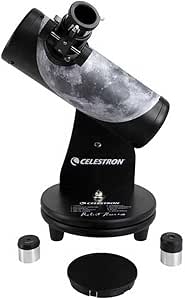
Celestron FirstScope Signature Series Moon Tabletop Dobsonian Telescope
The Celestron FirstScope Signature Series Moon makes the most sense for a child whose curiosity centers on the Moon. Its 76 mm aperture, tabletop Dobsonian mount, and included lunar eBook and Moon-map wrap turn observing into a focused learning project. Compared with the 50 mm Luzsco Beginner Telescope, the FirstScope has the larger aperture and a simpler push-to-point Dobsonian style, though Luzsco supplies more accessories, including a finderscope and Barlow lens.
The FirstScope’s two eyepieces support different views, but its limited accessory set and lack of a finderscope mean families may need more patience when locating targets. Its small aperture also makes it a weaker choice for faint deep-sky objects than the 130 mm Celestron StarSense Explorer 130AZ. Manual focusing helps teach how an instrument works, but can be fiddly at higher magnification. I’d rank it for lunar learning and portability, not as the most versatile telescope in this group.
Pros:- 76 mm aperture is larger than the 50 mm apertures of the Koolpte and Luzsco models.
- Tabletop Dobsonian mount offers straightforward manual pointing.
- Moon-map wrap and lunar eBook support focused learning.
- Compact, lightweight design is suited to outings and backyard use.
Cons:- No finderscope is included, which can make locating objects harder for beginners.
- Small aperture limits performance on faint deep-sky targets.
- Only two eyepieces are included, and manual focus can be challenging at higher magnification.
Best for: Kids and families who want a compact tabletop telescope for learning lunar features and practicing manual sky observation.
Not ideal for: Beginners who need a finderscope to locate targets, or young astronomers hoping to observe faint deep-sky objects.
- Aperture:76 mm
- Focal length:300 mm
- Eyepieces included:4 mm and 20 mm
- Mount type:Manual tabletop Dobsonian
- Focus:Manual
- Finderscope:Not included
- Field of view:1.3 degrees
- Additional learning features:Custom Moon-map wrap and lunar eBook
Our verdict“Choose the FirstScope if lunar observation and a hands-on tabletop Dobsonian are the priority, rather than broad deep-sky capability.”
Celestron StarSense Explorer 130AZ Tabletop Telescope
For a family ready to move beyond a basic children’s starter telescope, the StarSense Explorer 130AZ offers the strongest route to learning how to find celestial objects. Its smartphone app uses sky recognition to guide users toward stars, planets, nebulae, and galaxies, while the 130 mm reflector has substantially more aperture than the 76 mm Celestron FirstScope and the 50 mm Koolpte and Luzsco models. That added light-gathering capacity broadens what a curious child can try to observe.
This is still a manual telescope: the app helps with locating targets, but the user must aim and track the mount. A compatible smartphone is also needed for the StarSense guidance, so it is less self-contained than the GeoSafari Starview with its activity journal. The two eyepieces, red-dot finder, and phone dock make it a more capable learning setup, though families seeking a simple lunar starter may find the FirstScope easier to approach. I’d select this for supervised older kids ready to learn the sky beyond the Moon.
Pros:- StarSense app guidance helps beginners identify and locate a wider range of targets.
- 130 mm aperture exceeds the 76 mm FirstScope and 50 mm beginner models in this batch.
- Includes 10 mm and 25 mm eyepieces, a red-dot finder, and a smartphone dock.
- Tabletop Dobsonian-style base keeps the setup compact.
Cons:- StarSense guidance requires a compatible smartphone and supported operating system.
- Manual aiming and tracking still require practice.
- More involved setup may be a lot for very young children to manage independently.
Best for: Older children and families with a compatible smartphone who want app assistance finding a wider range of celestial objects.
Not ideal for: Families without a compatible phone, or younger beginners who want a simpler, less involved setup focused mainly on the Moon.
- Optical design:130 mm Newtonian reflector
- Focal length:650 mm
- Mount:Manual altazimuth tabletop Dobsonian-style base
- Eyepieces:10 mm and 25 mm
- Finderscope:StarPointer red-dot finderscope
- Field of view:1.3 degrees
- Focus:Manual
- Smartphone compatibility:Android 12 and later; iOS 18 and newer, including iPhone XR and newer
Our verdict“Choose the StarSense Explorer 130AZ for supervised kids ready to learn sky-finding with app guidance and a larger aperture.”
Luzsco 50mm Beginner Telescope for Kids with Tripod
The Luzsco 50mm Beginner Telescope is a practical choice when a child’s first astronomy kit should include several tools to try. Alongside two eyepieces, it supplies a finderscope, Barlow lens, tripod, and Moon observation guide, giving families more accessories to work with than the Celestron FirstScope’s two-eyepiece setup. Its 1.3-pound weight and stated 6–12 age range also make it an approachable pick for children who want to carry and set up their own lightweight kit with help.
That accessory count should not be confused with greater observing power: its 50 mm aperture is smaller than the FirstScope’s 76 mm and far smaller than the StarSense 130AZ’s 130 mm. The listed 20x–100x magnification range offers options, but manual focusing and a small aperture limit how useful the highest magnifications may be. I’d choose Luzsco for guided, hands-on starter activities; families prioritizing brighter views and an easy-pointing tabletop mount should look at the FirstScope instead.
Pros:- Moon observation guide supports hands-on learning.
- Includes a finderscope, two eyepieces, Barlow lens, and tripod.
- At 1.3 pounds, it is lightweight for a child-oriented kit.
- Designed for children ages 6–12.
Cons:- 50 mm aperture is smaller than the Celestron FirstScope’s 76 mm aperture.
- Manual focus requires hands-on adjustment.
- The high end of the listed magnification range may not be useful for every target.
Best for: Children ages 6–12 whose families want a lightweight first kit with a Moon guide, finderscope, and several accessories.
Not ideal for: Young astronomers seeking brighter views of faint objects or a larger aperture for broader observing ambitions.
- Objective lens diameter:50 mm
- Magnification:20x–100x
- Eyepieces:6 mm and 20 mm
- Mount:Altazimuth
- Focus:Manual
- Age range:6–12 years
- Weight:1.3 pounds
- Included accessories:Tripod, finderscope, Moon observation guide, and Barlow lens
Our verdict“Choose Luzsco for a lightweight, accessory-rich first kit, but pick a larger-aperture telescope if brighter or broader observing is the goal.”
ToyerBee Kids Telescope with Compass and 20x, 30x, and 40x Eyepieces
I’d choose this ToyerBee for a child who wants a straightforward first telescope and a few ways to experiment with magnification. Its 20x, 30x, and 40x eyepieces offer practice changing views, while the compass and reflex finderscope introduce basic direction-finding and target locating. Tool-free setup and an adjustable tripod make it less of a project to get started than the more involved Celestron StarSense Explorer DX 130AZ, which adds smartphone-guided target finding but also depends on a compatible phone. The tradeoff is that ToyerBee’s listed details don’t specify aperture, so I can’t compare its light-gathering ability with that 130 mm reflector or judge how well it will show dimmer objects. Its manual focus also asks young observers to learn by adjusting, rather than relying on guided aiming.
Pros:- Three eyepieces provide several magnification choices for beginner experiments.
- Compass and reflex finderscope introduce basic navigation and aiming.
- Tool-free assembly lowers the setup burden for children and caregivers.
- Adjustable tripod and 360° rotation allow flexible viewing positions.
Cons:- Manual focus requires practice, which may frustrate younger children at first.
- No aperture or focal-length data is provided for judging light gathering and optical potential.
Best for: Children and caregivers seeking an uncomplicated, tool-free first telescope for learning to aim at nearby objects and the Moon.
Not ideal for: Families prioritizing detailed optical specifications or smartphone-guided help finding a wide range of celestial targets.
- Brand:ToyerBee
- Model:JSD146
- Magnification:20x, 30x, and 40x
- Focus:Manual
- Finderscope:Reflex
- Included accessories:Compass and three eyepieces
- Tripod:Adjustable, stable, 360° rotation
- Assembly:Tool-free
Our verdict“Pick this ToyerBee for a simple, hands-on introduction to aiming and magnification, but choose the Celestron DX 130AZ if smartphone guidance and stated aperture matter more.”
Celestron StarSense Explorer DX 130AZ Smartphone-Guided Newtonian Telescope
For families who want astronomy lessons to lead beyond the Moon, I’d put the StarSense Explorer DX 130AZ ahead of the smaller beginner kits here. Its 130 mm aperture and StarSense app’s sky recognition help a child find suggested targets using the phone’s time and location, connecting what they see to where objects sit in the sky. That makes it a more instructive choice than either ToyerBee model, whose supplied eyepieces and finderscope support basic aiming but don’t offer app-led target suggestions. The advantage comes with conditions: you need a compatible smartphone, and the manual altazimuth mount still needs hands-on movement. This is also a larger, more involved instrument than a simple kids’ starter scope, so it suits an adult-child observing team better than a child expected to manage everything alone.
Pros:- StarSense sky recognition guides users toward celestial targets.
- The app recommends objects based on observing time and location.
- A 130 mm aperture offers more light-gathering capacity than the listed ToyerBee and Sobrzy beginner scopes.
- Includes two eyepieces, a full-height tripod, and a red dot finderscope.
Cons:- StarSense guidance requires a compatible Android or iOS smartphone.
- The manual mount still requires users to steer the telescope by hand.
- Its larger Newtonian setup may be more involved for children than the compact beginner models.
Best for: Families with a compatible smartphone who want children to learn target finding and explore beyond bright, easy-to-spot objects.
Not ideal for: Buyers seeking a phone-free, lightweight toy-scale telescope or a setup a young child can operate without adult help.
- Optical design:Newtonian reflector
- Aperture:130 mm (5 in)
- Focal length:650 mm
- Mount:Manual altazimuth with dual-axis slow-motion controls
- Eyepieces:10 mm and 25 mm
- Finderscope:StarPointer red dot
- Field of view:2 degrees
- Smartphone compatibility:Android 12 and later; iOS 18 and later, including iPhone XR and newer
- Warranty:2-year US warranty
Our verdict“Choose the DX 130AZ for a phone-guided family learning experience and greater aperture, provided you’re comfortable managing a manual telescope setup.”
ToyerBee Kids’ Telescope with Compass, Finderscope, and 3 Eyepieces
This ToyerBee has much of the same beginner appeal as the other JSD146 in this batch, but its listed 32 mm objective and 1.4 lb weight make it easier to judge as a small, portable starter kit. The three eyepieces, compass, reflex finderscope, and tool-free setup give children several simple ways to learn how a telescope is aimed and adjusted. I’d favor it over the Sobrzy TM0092 for families who value a stated lightweight build and rotation flexibility more than a lunar filter and higher advertised magnification. Its limitations are clear: manual focus takes practice, and the product data doesn’t give focal length or other optical-performance details. Compared with the Celestron DX 130AZ, this is a much simpler, smaller-scale introduction, not the pick for guided exploration of deep-sky targets.
Pros:- Light 1.4 lb listed weight supports easy carrying and setup.
- Three eyepieces provide 20x, 30x, and 40x options.
- Compass and reflex finderscope offer hands-on help locating targets.
- Tool-free assembly and 360° tripod rotation suit beginner use.
Cons:- Manual focus may be difficult for younger users to learn.
- The listed specifications omit focal length and other details needed to evaluate optical performance.
- Its 32 mm objective is smaller than the 50 mm Sobrzy and 70 mm Gskyer apertures in this batch.
Best for: Families wanting a lightweight, easy-to-carry first telescope for a child who will learn basic aiming and focus with an adult nearby.
Not ideal for: Young astronomers seeking detailed optical data, app-guided target finding, or a telescope intended to show a broad range of faint objects.
- Brand:ToyerBee
- Model:JSD146
- Objective lens diameter:32 mm
- Magnification:20x, 30x, and 40x
- Mount:Altazimuth
- Focus:Manual
- Item weight:1.4 lb
- Tripod:Stable, 360° rotation
- Warranty:5 years
Our verdict“Choose this ToyerBee for a light, simple learning kit, but pick the Sobrzy or Gskyer if a larger stated aperture is a higher priority.”
Sobrzy Beginner Telescope for Kids, 50mm Aperture, 20x–100x Magnification
I’d shortlist the Sobrzy for children ages 8–12 whose first astronomy lessons will focus on the Moon and bright planets. Its 50 mm aperture is explicitly stated, and the kit includes a lunar filter, two eyepieces, and a 1.5x erecting eyepiece—more accessories for comparing views than the simpler ToyerBee scopes provide. The advertised 20x–100x range looks broad, but magnification alone doesn’t tell me how much useful detail an instrument will show; the listed 400 mm focal length and 50 mm aperture set a more grounded expectation. Compared with the Gskyer’s 70 mm aperture, this is the smaller-aperture choice, though its age-specific positioning and lunar accessory package may suit a child’s first structured observing sessions. It still relies on manual focusing and manual aiming.
Pros:- 50 mm aperture and 400 mm focal length provide useful baseline optical specifications.
- Lunar filter adds a dedicated accessory for Moon-viewing sessions.
- Includes two eyepieces, a finder scope, and a 1.5x erecting eyepiece.
- Designed for beginner use by children ages 8–12.
Cons:- Manual focus and altazimuth aiming require hands-on adjustment.
- Its 50 mm aperture is smaller than the Gskyer’s 70 mm aperture.
- The listed 20x–100x range does not by itself establish the image detail available.
Best for: Families with children ages 8–12 who want a starter kit with a lunar filter and accessories for supervised Moon and bright-planet viewing.
Not ideal for: Buyers seeking app-assisted sky navigation, a larger aperture, or a telescope that avoids manual focusing and aiming.
- Brand:Sobrzy
- Model:TM0092
- Age range:8–12 years
- Aperture:50 mm
- Focal length:400 mm
- Magnification:20x–100x
- Mount:Altazimuth
- Included accessories:Adjustable tripod, finder scope, two eyepieces, 1.5x erecting eyepiece, and lunar filter
- Warranty:2-year manufacturer warranty
Our verdict“Pick the Sobrzy for an age-targeted lunar starter kit with a filter, but choose the Gskyer if a larger aperture and portable storage matter more.”
Gskyer 70mm Refractor Telescope with Carry Bag, Smartphone Adapter, and Wireless Remote
The Gskyer is the most travel-ready option in this group: its 70 mm refractor comes with a carry bag, and the smartphone adapter plus wireless remote let families try simple image capture without holding a phone against the telescope. That makes it a more versatile outing kit than the Sobrzy, whose included lunar filter is more specifically aimed at Moon-focused sessions, and it has a larger stated aperture than either ToyerBee. The 25 mm and 10 mm eyepieces provide 16x and 40x views; the 3x Barlow raises the listed maximum to 120x, though high magnification isn’t a guarantee of sharper detail. Its manual altazimuth controls and focus still require practice, and the 65–80 cm tripod may not suit every viewing position. The warning against pointing it at or near the Sun calls for careful adult supervision.
Pros:- 70 mm aperture is larger than the listed ToyerBee and Sobrzy apertures.
- Carry bag supports storage and transport between observing locations.
- Smartphone adapter and wireless remote enable basic image capture.
- Two eyepieces and a 3x Barlow provide several magnification combinations.
Cons:- Manual focus and altazimuth aiming require practice and adult guidance.
- The listed 120x maximum magnification does not guarantee useful image detail at that power.
- The supplied safety guidance warns against aiming at or near the Sun.
Best for: Families who want a transportable telescope for backyard and travel observing, with basic smartphone image-capture accessories.
Not ideal for: Children expected to operate a telescope alone, or buyers seeking app-guided target finding and a simple no-adjustment experience.
- Type:Refractor
- Aperture:70 mm
- Focal length:400 mm (f/5.7)
- Mount:Altazimuth
- Eyepieces:25 mm (16x) and 10 mm (40x)
- Barlow lens:3x
- Maximum magnification:120x
- Tripod:Adjustable aluminum, 65–80 cm
- Included accessories:Carry bag, smartphone adapter, and wireless camera remote
Our verdict“Choose the Gskyer for a portable family setup with a larger stated aperture and phone-photo accessories, as long as an adult can help with aiming and focus.”
Celestron AstroMaster 76EQ Newtonian Reflector Telescope with Two Eyepieces, Height-Adjustable Tripod and Deluxe Accessory Tray – Dark Blue
I’d choose the AstroMaster 76EQ for families who want astronomy to include learning how a telescope follows the sky, not just finding an object in an app. Its 76 mm reflector and two eyepieces support lunar and planetary viewing, while the slow-motion controls give a child a hands-on way to make small tracking adjustments. Compared with the app-guided Celestron StarSense Explorer LT 114AZ, it has less aperture and no guided object-finding, but its equatorial mount can make tracking practice part of the lesson. Tool-free assembly and a pre-assembled tripod ease the first setup; the tradeoff is that a German equatorial mount can feel unintuitive to a young beginner. Its modest aperture also limits faint deep-sky targets, and there is no motorized tracking. I’d pick it for supervised learners, not for kids who need the simplest path to finding targets.
Pros:- 76 mm fully coated mirror supports useful views of the Moon and brighter planets.
- Slow-motion controls provide hands-on tracking practice.
- Includes 20 mm and 10 mm eyepieces, a red-dot finder, and astronomy software.
- Tool-free assembly and a height-adjustable, pre-assembled tripod simplify setup.
Cons:- The German equatorial mount can be confusing for first-time users.
- The modest aperture is limited for faint deep-sky objects.
- No motorized or computerized tracking is included.
Best for: Families with an adult ready to help children learn manual equatorial tracking while viewing the Moon and brighter planets.
Not ideal for: Young beginners who want quick, intuitive setup or families focused on faint galaxies and nebulae; the mount takes practice and the aperture is modest.
- Optical aperture:76 mm
- Optical design:Newtonian reflector
- Mount:Manual German equatorial
- Eyepieces:20 mm (35×) and 10 mm (70×)
- Finder:StarPointer red-dot
- Tripod:Height-adjustable, pre-assembled
- Warranty:2 years
Our verdict“Choose the AstroMaster 76EQ for supervised kids ready to learn manual sky tracking, rather than for those who want app-guided simplicity.”
Jvcla Kids Telescope with Compass and 3 Eyepieces
The Jvcla Kids Telescope is the most age-specific, lightweight starter in this group: it is listed for ages 8–12 and weighs just 1.3 lb. Three eyepieces provide a modest 20×–40× range, giving a child a chance to compare magnifications without the more involved setup of the Celestron AstroMaster 76EQ. A compass, reflex finder, and adjustable tripod add simple orientation cues for early observing sessions. That simplicity has limits: the 32 mm objective and low magnification range make this a basic introduction, not a tool for detailed planetary study or faint deep-sky targets. The NASA Lunar Telescope offers up to 90× and an educational guide, making it a stronger fit for moon-focused learning. I’d favor Jvcla when portability and straightforward practice matter more than optical reach; skip it if a child is ready for more capable views.
Pros:- Low 1.3 lb weight is manageable for children to carry.
- Three eyepieces offer a 20×–40× magnification range.
- Compass and reflex finder give beginners basic object-location aids.
- Adjustable tripod and simple assembly suit introductory use.
Cons:- 32 mm objective and 20×–40× range limit detail and viewing ambitions.
- Basic specifications make it less suitable as a child’s skills develop.
- The supplied information does not describe an educational guide or astronomy software.
Best for: Parents seeking a very lightweight, age-targeted first telescope for an 8–12-year-old to practice basic aiming and magnification.
Not ideal for: Children wanting detailed lunar or planetary views, or families seeking a telescope with stronger light-gathering and higher magnification.
- Model:JSD145
- Recommended age:8–12
- Objective lens diameter:32 mm
- Magnification:20×–40×
- Eyepieces:3
- Focus:Manual
- Finder:Reflex
- Weight:1.3 lb
- Warranty:5 years
Our verdict“Pick this for a lightweight first telescope for an 8–12-year-old, but choose the NASA Lunar Telescope for more ambitious Moon viewing.”
NASA Lunar Telescope for Kids with Tripod and Finder Scope
For a child whose first astronomy goal is the Moon, the NASA Lunar Telescope puts the lesson ahead of broad all-sky ambitions. Its two eyepieces offer low- and high-power options up to 90×, and the included learning guide gives families a starting point for lunar observation. A smooth mount helps children scan the surface, while the finder scope supports basic aiming. Compared with the Jvcla Kids Telescope, this model offers higher stated magnification and a more clearly defined educational focus; compared with the Celestron StarSense Explorer LT 114AZ, it lacks app-guided discovery and a larger aperture for exploring a wider range of targets. The tabletop tripod may restrict where a child can observe, and the product’s learning focus is primarily lunar. I’d choose it for structured Moon sessions, not as the most versatile route into astronomy.
Pros:- Learning guide gives children a structured starting point for Moon observation.
- Two eyepieces offer low- and high-power viewing up to 90×.
- Finder scope and smooth mount support aiming and scanning the lunar surface.
- Designed for beginner assembly and use.
Cons:- Tabletop tripod can limit observing positions and placement options.
- Educational content and stated use focus mainly on lunar viewing.
- Manual aiming does not offer smartphone-guided target discovery.
Best for: Families introducing children aged 8 and up to lunar observation with a supplied learning guide and simple viewing setup.
Not ideal for: Children who want a full-height observing position, app-assisted sky tours, or a telescope aimed at a broad range of deep-sky objects.
- Brand:Blue Marble
- Recommended age:8 years and up
- Magnification:Up to 90×
- Eyepieces:Low-power and high-power
- Finder:Straight-through
- Lens coating:Fully coated
- Mount:Equatorial
- Field of view:0.85 degrees
- Included learning accessory:Educational learning guide
Our verdict“Choose this for a child’s first guided Moon-observation lessons, not for a more versatile, app-led introduction to the night sky.”
Celestron StarSense Explorer LT 114AZ Smartphone-Guided Newtonian Telescope
The StarSense Explorer LT 114AZ earns its place for making target-finding part of the learning experience: its compatible smartphone app uses sky recognition to guide children toward stars, planets, and selected deep-sky objects. Its 114 mm aperture gives it more light-gathering capacity than the 76 mm AstroMaster, making this the more ambitious option for families ready to explore beyond the Moon and bright planets. The app can lower the barrier to finding objects, but it does not move the telescope; children still need to steer the manual altazimuth mount and track targets themselves. It also depends on a compatible, relatively recent phone. Compared with the NASA Lunar Telescope, this Celestron has broader observing goals and a full-height tripod, but less emphasis on a supplied lunar learning guide. I’d choose it for tech-friendly families who want guided discovery with adult support.
Pros:- Sky-recognition app guides users toward stars, planets, and selected deep-sky targets.
- 114 mm reflector aperture provides greater light-gathering capacity than the AstroMaster 76EQ.
- Includes two eyepieces, a red-dot finder, smartphone dock, and full-height tripod.
- Manual altazimuth mount keeps basic pointing straightforward.
Cons:- The mount is manual, so users must steer and track objects themselves.
- App guidance requires a compatible, relatively recent smartphone.
- The supplied information does not list a dedicated educational guide.
Best for: Families with a compatible smartphone who want children to learn constellations and locate a broader mix of targets with app guidance.
Not ideal for: Households without a supported recent phone, or children who expect the telescope to track objects automatically once the app finds them.
- Optical design:Newtonian reflector
- Aperture:114 mm (4.5 in)
- Focal length:1000 mm
- Mount:Manual altazimuth
- Eyepieces:10 mm and 25 mm
- Field of view:2.04 degrees
- Finder:Reflex red dot
- Smartphone compatibility:Android 12 and later; iOS 18 and later, including iPhone XR and newer
- Warranty:2-year US warranty
Our verdict“Pick the StarSense Explorer LT 114AZ for smartphone-assisted discovery and broader viewing, provided your phone is compatible and a child can manage manual tracking.”
Explore Scientific FirstLight 102mm Refractor Telescope with Twilight Nano Mount
The Explore Scientific FirstLight 102 mm is the refractor pick for families who want a larger objective lens and a wide-field starting point for observing. Its 102 mm aperture and 600 mm focal length pair with an included Plössl 25 mm eyepiece, while the red-dot finder and Twilight Nano altazimuth mount support manual aiming. A smartphone camera adapter also lets a family experiment with basic lunar photos. Compared with the Celestron StarSense Explorer LT 114AZ, this refractor has a smaller aperture and lacks app-guided target finding, but it includes a camera adapter and avoids making a phone the navigation system. The supplied set includes only one eyepiece, so magnification options are limited until additional eyepieces are acquired. At 11.5 lb, it is also less child-portable than the Jvcla starter. I’d select it for adult-supported family sessions, not as the easiest solo telescope for a young child.
Pros:- 102 mm aperture offers a substantial objective for family observing.
- Included smartphone camera adapter supports basic photography experiments.
- Red-dot finder and altazimuth mount provide direct manual aiming.
- Supplied Plössl eyepiece, tripod, and mount make this a ready-to-assemble set.
Cons:- Only one eyepiece is included, limiting magnification choices without additional accessories.
- At 11.5 lb, it is less convenient for a child to carry than lightweight starter models.
- Manual pointing has no app-guided navigation or automatic tracking.
Best for: Families seeking a refractor with a smartphone camera adapter for shared observing and simple lunar-photo experiments.
Not ideal for: Young children expected to carry and operate a telescope alone, or buyers who want multiple eyepieces and guided target-finding in the box.
- Optical design:Refractor
- Aperture:102 mm
- Focal length:600 mm
- Focal ratio:f/6.47
- Mount:Twilight Nano altazimuth
- Focuser:Manual, 40 mm draw tube
- Eyepiece:Plössl 25 mm
- Optical tube length:60 cm
- Weight:11.5 lb
Our verdict“Choose the FirstLight 102 mm for adult-supported family observing and phone-photo experiments, rather than for a child needing the lightest, most guided starter.”
How We Picked
I compared these 15 telescopes as learning tools for children and families, not as interchangeable spec sheets. The main criteria were optical aperture and design, how a beginner aims and focuses the telescope, mount stability and setup demands, and whether included guidance or accessories support actual observing. I also considered how well each model could grow with a child’s interest, from first views of the Moon to learning to locate additional celestial targets.
The ranking favors models that balance usable views with a manageable learning curve. Smartphone-guided scopes and stable tabletop designs rise when their added support is likely to help a child find objects; simpler, smaller scopes remain useful for introductory use but rank lower when their limited aperture or basic mount restricts growth. Larger instruments earn consideration for capability, but setup complexity and adult involvement count against them for younger users. Product roles reflect their clearest fit, not a claim that one telescope suits every family.
Factors to Consider When Choosing Educational Astronomy Telescopes For Kids
Before choosing a model, match the telescope to the way your child will actually observe. Ease of finding an object, a steady mount, and a realistic view of what the optics can show often matter more than a long accessory list.
Match Aperture to Expectations, Not Magnification Claims
Aperture is the diameter of the telescope’s light-gathering opening, so it affects how much detail and faint light the instrument can reveal. For a child’s first lunar observations, a small beginner scope can be enough to make the Moon feel tangible and rewarding. Families hoping to explore dimmer targets should favor more aperture, while accepting a larger, heavier setup. A common mistake is choosing by the highest advertised magnification; magnification cannot replace light gathering or steady optics. High-power views can also look dimmer and harder to keep centered. Set expectations around bright, easy targets first, then let a child’s interests guide any step up.
Prioritize Finding Targets Before Adding Eyepieces
Beginners often spend more time locating an object than looking at it, especially when a telescope has a narrow field of view. Smartphone guidance can reduce that search burden, but it adds a phone setup step and depends on following the app’s instructions. A finder scope or red-dot-style aid can work well once a child learns how its view relates to the main telescope. More eyepieces may offer different viewing scales, yet frequent swaps can interrupt a young observer’s focus. Choose the guidance method your family is willing to teach and use. For a child who wants to operate independently, a straightforward aiming system may beat a larger accessory bundle.
Choose a Mount the Child Can Manage
The mount controls how smoothly the telescope points and how much the image shakes when touched. Tabletop designs keep the assembly compact, but they need a firm, level surface at the observing site. Tripod models can offer more placement flexibility, though lightweight legs may wobble and height adjustment can add setup work. Equatorial mounts introduce a useful astronomy concept, but their alignment and controls may be a hurdle for a young beginner. Think about where the family will observe: a patio, a bedroom window, or a darker site away from home each creates different demands. A stable, simple mount usually makes early sessions more pleasant than extra reach or a more advanced mechanism.
Plan for Adult Help and the Child’s Age
“For kids” does not mean every child can assemble, align, and focus every telescope without help. Younger children often benefit from an adult handling setup while they learn to aim and observe; older children may enjoy taking on more of the process. Small parts, adjustment knobs, phone pairing, and delicate optical surfaces all call for supervision suited to the child. Before buying, check whether the telescope’s controls and mounting steps seem manageable for the intended user. A model that invites repeated short sessions may teach more than a capable instrument that stays packed away. Treat independence as something the telescope should support gradually, not a feature guaranteed by its label.
Think About Storage, Transport, and Observing Location
A telescope that fits the family’s routine is more likely to be used. Tabletop scopes can be easier to store and carry, but their observing surface must travel with them or be available at the site. Tripod systems may be more versatile outdoors, although bags and extra components add carrying and setup demands. Refractors generally avoid the open-tube maintenance concerns associated with some reflector designs, while any telescope still needs careful storage to protect its optics. Avoid planning to observe through a household window: glass and indoor heat currents can degrade the view. If the family expects to travel to darker skies, portability and quick assembly may matter more than a larger instrument kept at home.
Pay More for a Clear Benefit, Not a Longer Feature List
A higher-tier telescope makes sense when its added aperture, guidance, mount, or optical quality solves a real problem for your family. Smartphone-guided models can help with object location; a larger aperture can support more ambitious observing; a more capable mount may provide room to develop new skills. Those gains come with possible tradeoffs in weight, assembly, cost, and the need for adult coaching. Accessories such as remotes and phone adapters are useful only if they support the observing routine you plan to follow. Compare the whole setup rather than counting included items. If the child is still deciding whether astronomy will hold their attention, a simpler scope plus a sky map or supervised observing session may be a wiser starting point.
Frequently Asked Questions
Which telescope in this roundup is most likely to help a child find objects without constant adult direction?
The Celestron StarSense Explorer models stand out because smartphone guidance can help users identify where to point the telescope. The 130AZ tabletop version offers a larger aperture, while the LT 114AZ uses a tripod-style setup. A phone guide still takes some learning, and an adult may need to help with setup and alignment at first. If your child prefers not to use a phone, a simpler scope with a finder can still teach basic aiming, but expect more hands-on coaching. Choose based on whether digital guidance fits your family’s observing habits.
Is a 50mm telescope enough for a child’s first astronomy experience?
A 50mm model can introduce basic telescope handling and provide a starting point for bright targets such as the Moon. Its modest aperture limits how much detail and faint light it can show, so it is less suited to families expecting broad exploration of dim objects. For a child who is unsure about the hobby, a simpler entry point may be reasonable if expectations stay grounded. If the child already has sustained interest, compare it with the larger-aperture options rather than focusing on advertised magnification. The right choice depends on whether portability and simplicity outweigh room to grow.
Should I choose a tabletop telescope or one with a tripod?
A tabletop telescope can be compact and quick to place, but it needs a solid surface at a comfortable height. A tripod gives more flexibility about where the telescope stands, though setup and stability vary by model. For family use at home, a sturdy outdoor table may make a tabletop design the simpler choice. For observing away from home or without a suitable surface, a tripod can be more practical. Consider the observing location before deciding, since the mount affects comfort and steadiness as much as portability.
Do smartphone-guided telescopes need a phone every time?
Smartphone guidance is a locating aid, not the telescope’s optical system, so the telescope can still be used for observing without relying on a phone for every view. The phone-based feature is most useful when learning to identify and point toward targets. Families should check the specific model’s setup instructions and app requirements, including whether the phone fits the mounting arrangement. A child may need help with the initial process, and screen use can be a distraction during an observing session. If avoiding devices is a priority, a traditional finder-based model may suit your routine better.
When is it worth choosing a larger or more advanced telescope for a child?
Paying for a larger or more advanced model makes sense when the child has a durable interest and the family can support setup, storage, and learning. More aperture can offer greater capability, while guided systems can reduce the challenge of locating objects. A more complex mount may also teach useful skills, but it can slow down spontaneous observing. For a first telescope, ease of use may matter more than maximum capability. Consider the child’s patience, the available observing space, and who will help before choosing a step-up instrument.
Conclusion
For most families, I would start with the Celestron StarSense Explorer 130AZ Tabletop Telescope as the best overall balance of guidance and optical reach. The best value depends on your priorities: the Celestron FirstScope Signature Series is the simpler tabletop pick, while a basic 50mm model may suit a tight, introductory use case. For beginners who need help locating objects, choose a StarSense model; for a young child’s first hands-on exposure, favor a straightforward scope and adult support. The best premium choice is the Explore Scientific FirstLight 102mm for families ready to manage a more substantial instrument. For specific needs, pick a compact tabletop design when storage and quick setup matter, or a tripod model when you lack a stable table. Match the telescope to the child’s interest and your family’s willingness to help, and the best choice becomes much clearer.