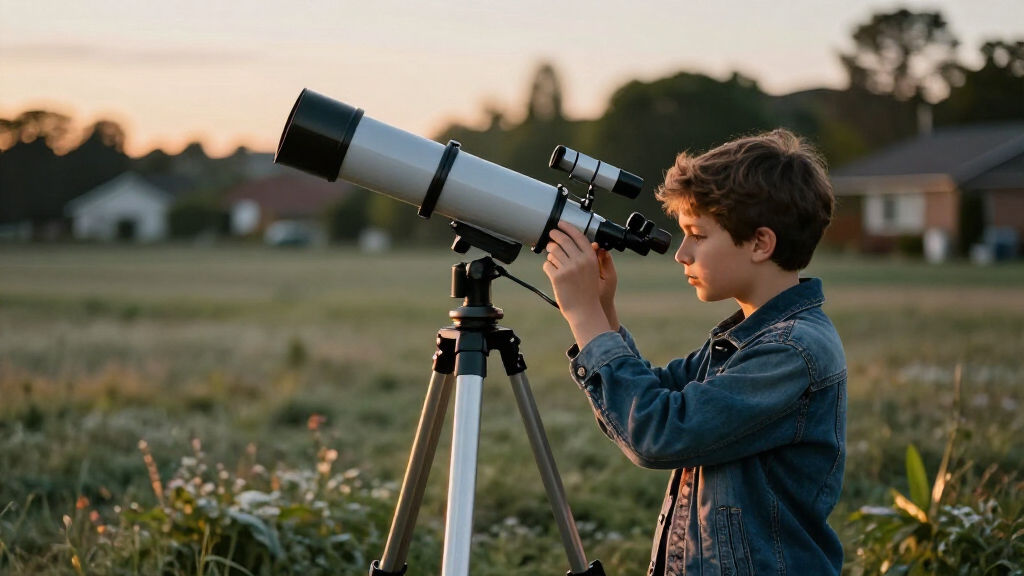

Choosing the right beginner telescopes for students requires balancing optical performance with ease of use. The Celestron Travel Scope 70mm stands out as the best overall pick due to its reliable optics and lightweight design, making it ideal for school trips. For younger children, the Educational Insights GeoSafari Starview Telescope offers a durable, simple alternative that withstands rough handling. The main tradeoff in this category is between aperture size and portability; larger lenses gather more light but become heavy and difficult to align. Continue reading for a detailed breakdown of these fifteen options to find the perfect match for your student’s needs.

Prime made for students and young adults
- Fast, free delivery for dorm and study essentials
- Prime Video and Amazon Music included
- Member-only deals
Key Takeaways
- Aperture matters more than magnification: Many student kits promise 100x zoom but lack the 70mm+ aperture needed to actually resolve lunar craters clearly.
- Alt-Az mounts are superior for students: Equatorial mounts are too complex for casual observation, whereas simple Alt-Az designs allow students to track the moon in seconds.
- Phone adapters are standard but variable: While many kits include smartphone mounts, only models with dedicated, sturdy brackets provide stable enough connections for sharp astrophotography.
- Portability drives usage frequency: Telescopes that fit into backpacks, like the Celestron Travel Scope series, see far more regular use than stationary tabletop models.
- Build quality varies by price tier: Plastic tripods on budget models often vibrate excessively; metal components in mid-range kits significantly improve image stability for classroom settings.


| beginner telescopes for student | Mount | Focal length | Magnification | Focus |
|---|---|---|---|---|
| Educational Insights GeoSafari | Altazimuth | — | 10x and 50x | Manual |
| Celestron Travel Scope 60 Refr | Manual alt-azimuth | 360mm | 54x and 135x with Barlow lens | — |
| MEEZAA Telescope for Adults & | Altazimuth | 500mm | — | Manual |
| Telescopes for Adults Astronom | Altazimuth | 600mm | 30x–66x | Manual |
| Telescope for Kids | Altazimuth | — | — | Manual |
| Gskyer 70mm Aperture 400mm AZ | Altazimuth | 400mm | Variable with included eyepieces and 3x Barlow lens | — |
| Telescope for Kids and Adults | Altazimuth | 300mm | 15x–150x | — |
| Telescope for Adults & Kids | — | 300mm | 15x–150x | — |
| Celestron Travel Scope 70mm Po | Altazimuth | 400mm | — | — |
| Telescope for Kids | — | 300mm | — | — |
| Telescope for Kids 8-12 | Altazimuth | 400mm | 20x–100x | Manual |
| NASA Lunar Telescope for Kids | Tabletop | — | 90x | Manual |
| Hawkko Portable Telescope for | Altazimuth | 500mm | — | Manual |
| Telescope for Kids | — | 400mm to 600mm | — | Manual |
| Telescope for Kids 8-12 | Altazimuth | 400mm | 20x–100x | Manual |
More Details on Our Top Picks
Educational Insights GeoSafari Starview Telescope
The GeoSafari Starview is the most lesson-oriented pick here: its activity journal gives students a simple way to turn looking at the sky or nearby nature into a structured exercise. Its 10x and 50x options are straightforward for children to try, while the tabletop tripod favors quick, low-fuss sessions over the taller observing setup of the MEEZAA 80mm. That makes this a practical choice for younger students who are still learning how to aim and focus, rather than buyers seeking detailed views of faint objects. The tradeoff is a limited beginner-level setup, with manual focusing that can take patience and no supplied aperture or focal-length details to compare optical capacity. Choose it for guided exploration; skip it if astronomy lessons call for a more capable telescope.
Pros:- Activity journal supports structured learning and observation
- Two supplied magnifications give children a simple way to compare views
- Tabletop tripod and portable format suit short indoor or outdoor sessions
- Can be used for nature observation as well as the night sky
Cons:- Beginner-level setup is limiting for students pursuing more detailed astronomy
- Manual focus may take repeated adjustment for a clear view
- Tabletop tripod offers less flexible positioning than taller tripod setups
Best for: Younger students and families who want a simple telescope paired with an activity journal for guided sky and nature exploration.
Not ideal for: Students ready to study finer celestial detail or buyers seeking a taller tripod and clearly specified optical capacity.
- Magnification:10x and 50x
- Eyepiece lens:Plossl
- Mount:Altazimuth
- Focus:Manual
- Tripod:Tabletop
- Included lenses:10x and 50x
- Learning accessory:Activity journal
Our verdict“Choose the GeoSafari Starview for a child’s first guided telescope activities, not for students seeking more detailed astronomical viewing.”
Celestron Travel Scope 60 Refractor Telescope
For students who carry their telescope between home, school, and outdoor trips, the Celestron Travel Scope 60 stands out for its 3.3-pound weight and included backpack. Its accessories also make it more prepared for mixed use than the GeoSafari Starview, which is simpler and more focused on guided beginner activities. The 360mm focal length and manual alt-azimuth mount favor a portable, hands-on setup, and terrestrial viewing gives students a reason to use it beyond clear nights. Its listed objective diameter is only 20mm, so I would not choose it for buyers prioritizing brighter celestial views over portability. Manual aiming also means students need a steady touch, and it lacks powered tracking. This is a travel-first learning telescope, not the strongest choice for detailed astronomy.
Pros:- Light 3.3-pound design and included backpack support portable use
- Terrestrial and celestial viewing suit varied student projects
- Includes eyepieces, a Barlow lens, and a Moon filter
- Manual alt-azimuth operation gives students direct practice aiming a telescope
Cons:- Listed 20mm objective diameter limits its appeal for buyers seeking brighter sky views
- Manual mount requires steady adjustments to follow moving objects
- No motorized tracking for hands-free observing
Best for: Students who want a lightweight telescope for both daytime nature observation and occasional skywatching, especially when carrying gear matters.
Not ideal for: Students whose main goal is brighter, more detailed celestial viewing or who want tracking to keep objects centered.
- Objective lens diameter:20mm
- Focal length:360mm
- Magnification:54x and 135x with Barlow lens
- Mount:Manual alt-azimuth
- Field of view:1.02 degrees
- Optical tube length:13 inches
- Weight:3.3 pounds
- Included accessories:Eyepieces, Barlow lens, Moon filter, travel backpack
Our verdict“Pick the Celestron Travel Scope 60 if portability and daytime nature study matter more than brighter, more detailed astronomy views.”
MEEZAA Telescope for Adults & Kids, 80mm Aperture, 500mm Refractor
The MEEZAA 80mm refractor gives families a broader starting setup than the smaller Telescope for Kids, 50mm 100x: its 80mm objective and 500mm focal length pair with two eyepieces and a 3x Barlow lens for varied viewing. That extra optical capacity makes it the more flexible pick for students sharing one telescope between skywatching and terrestrial observation, while the phone adapter and backpack support casual documenting and transport. The included 5×24 finderscope and adjustable tripod add useful setup options. The tradeoffs are manual focusing and a missing listed weight, which makes portability harder to judge despite the travel-oriented kit. Buyers should also note that warranty coverage details are not provided. Choose this for family versatility, rather than the simplest first lesson.
Pros:- 80mm aperture and 500mm focal length provide a more substantial starting setup than the 50mm kids’ model
- Includes two eyepieces, a 3x Barlow lens, and a 5×24 finderscope
- Phone adapter and backpack support documentation and transport
- Adjustable tripod can accommodate different observing positions
Cons:- Manual focus requires hands-on adjustment during observing
- Product data does not specify the telescope’s weight
- Warranty coverage details are not provided
Best for: Families with students who want one accessory-rich telescope for introductory skywatching, nature viewing, and phone-assisted documentation.
Not ideal for: Buyers who need a clearly stated carry weight, detailed warranty information, or a very simple setup for a young child’s first session.
- Objective lens diameter:80mm
- Focal length:500mm
- Eyepieces:25mm and 10mm
- Barlow lens:3x
- Finderscope:5×24
- Mount:Altazimuth
- Focus:Manual
- Tripod height range:16.92–44.48 inches
Our verdict“Choose the MEEZAA for a family seeking a versatile 80mm starter kit, but look elsewhere if clear portability and support details are priorities.”
Telescopes for Adults Astronomy, 80mm Aperture 600mm Refractor Telescope for Kids & Beginners, Compact and Portable Travel Telescopio with Backpack
This 80mm refractor is the most focused choice in this group for students who want a longer focal length and a straightforward range of supplied magnifications. Its 600mm focal length and K20mm and K9mm eyepieces produce listed magnifications of 30x–66x, a more restrained range than the MEEZAA 80mm with its 3x Barlow. That restraint suits beginners who may benefit from easier-to-manage views instead of chasing high magnification. A crosshair finderscope helps students aim, and the stated 840g weight supports carrying it to an observing spot. The compromises are a manual mount and a ceiling of 66x, which may frustrate students hoping to explore higher-power views. Pick it for simpler lunar and beginner sessions, not for advanced observing.
Pros:- 80mm aperture and 600mm focal length form a clear entry-level optical setup
- K20mm and K9mm eyepieces provide a defined 30x–66x range
- Crosshair finderscope helps students practice locating targets
- Listed 840g weight and included backpack support transport
Cons:- Maximum listed magnification of 66x may limit students seeking higher-power views
- Manual focus and altazimuth aiming require ongoing adjustment
- Build may not suit frequent or demanding use
Best for: Students and families who want a portable 80mm telescope with a manageable magnification range for introductory Moon and planet observations.
Not ideal for: Students who want a higher-power setup, powered tracking, or a sturdier option for frequent intensive use.
- Aperture:80mm
- Focal length:600mm
- Eyepieces:K20mm and K9mm
- Magnification:30x–66x
- Finderscope:5×24 with crosshair
- Mount:Altazimuth
- Focus:Manual
- Optical coating:Multi-coated
- Weight:840g
Our verdict“Choose this 80mm model for portable, beginner-friendly lunar sessions, but not if students need higher magnification or powered tracking.”
Telescope for Kids, 50mm 100x Beginner Telescope with Tripod
At 1.3 pounds, this 50mm telescope is an easy option for younger students to carry and handle, with a Moon observation guide that gives a first session a clear learning focus. Its two eyepieces, finderscope, and Barlow lens offer more accessories than the GeoSafari Starview, though the GeoSafari’s activity journal may better support broader, guided exploration. The claimed 20x–100x range sounds flexible, but the 50mm objective and beginner-level design make this a basic introduction rather than a tool for detailed astronomy. Manual focusing may also be difficult for the youngest children without adult help, and there are no powered features to track objects. This makes sense as a compact STEM starter for ages 6–12, not as a long-term telescope for students advancing their observing skills.
Pros:- Light 1.3-pound design is manageable for children to carry
- Moon observation guide gives beginners a focused activity
- Includes two eyepieces, a finderscope, and a Barlow lens
- Altazimuth mount introduces hands-on aiming
Cons:- 50mm objective and beginner-level design limit its usefulness for detailed astronomy
- Manual focus may be challenging for younger children without adult assistance
- No powered tracking or electronic features
Best for: Children ages 6–12 who need a lightweight first telescope for supervised Moon observation and hands-on STEM activities.
Not ideal for: Students seeking detailed celestial views, automatic tracking, or an instrument they can grow into as their astronomy skills advance.
- Objective lens diameter:50mm
- Listed magnification range:20x–100x
- Eyepieces:6mm and 20mm
- Mount:Altazimuth
- Focus:Manual
- Optical tube length:27.5 inches
- Weight:1.3 pounds
- Included accessories:Finderscope, Barlow lens, tripod, Moon observation guide
Our verdict“Choose this model as a light, Moon-focused first telescope for a young student, not as a long-term instrument for detailed observing.”
Gskyer 70mm Aperture 400mm AZ Mount Astronomical Refracting Telescope for Kids and Beginners
The Gskyer is my strongest all-around fit for a student starting with lunar viewing: its 70mm aperture and 400mm focal length make it a more balanced choice for observing the Moon than the shorter 300mm models from this lineup. Its eyepieces and 3x Barlow offer room to try different magnifications, while the phone adapter and wireless remote give a student a simple way to experiment with capturing views. A carry bag also makes it easier to take to a school event or a darker-sky spot. The tradeoff is that the included magnification accessories do not guarantee crisp high-power views, and the basic tripod can shake during focusing. Compared with the Celestron Travel Scope 70mm, this puts more emphasis on phone-assisted observing, while the Celestron has a backpack-oriented travel setup.
Pros:- 70mm aperture and 400mm focal length suit beginner lunar and general sky observing.
- Phone adapter and wireless remote support simple smartphone photo experiments.
- Carry bag and adjustable tripod make it easier to transport and set up outdoors.
- Eyepieces and 3x Barlow let students compare different magnification levels.
Cons:- Basic tripod may shake, making precise focusing and detailed viewing harder.
- High magnification depends on the eyepiece and Barlow and may not deliver clear views.
- A 5×24 finder scope can take practice to align with the main telescope.
Best for: Students and families who want one portable starter scope for lunar observing, basic sky exploration, and phone-assisted astronomy activities.
Not ideal for: Students focused on steady, high-magnification planetary detail or advanced astrophotography, since the basic tripod and entry-level optics limit those aims.
- Aperture:70mm
- Focal length:400mm
- Optical type:Refractor
- Mount:Altazimuth
- Finder scope:5×24 with cross-hair lines
- Magnification:Variable with included eyepieces and 3x Barlow lens
- Included accessories:Phone adapter, wireless remote, carry bag, adjustable tripod
Our verdict“Choose the Gskyer for a student-friendly mix of lunar viewing, portable storage, and phone-assisted exploration, but not for steady high-power observing.”
Telescope for Kids and Adults, 15X-150X Refracting Telescope with 70MM Aperture and Phone Adapter
This model makes the most sense for students who want a straightforward setup and a stated 15x–150x magnification range for switching between broader views and closer lunar looks. Its 300mm focal length is shorter than the Gskyer’s 400mm, so I would favor the Gskyer for a more balanced beginner sky-viewing setup; this one leans toward portability and quick outdoor sessions. The phone adapter adds a hands-on activity for a student, though phone photography through a small beginner scope is best treated as experimentation rather than a route to polished astrophotography. Manual focus keeps operation simple but calls for patient adjustments. The finder scope’s inverted image can also confuse a first-time user, and the supplied optics may need careful setup for their clearest view. Students wanting a ready-made star-learning aid may prefer the star chart included with the similar 300mm B0HB3JTV51 model.
Pros:- 70mm aperture supports beginner viewing of the Moon and brighter celestial targets.
- Includes 6mm and 20mm eyepieces with a 3x Barlow for different magnifications.
- Phone adapter offers a simple way to try capturing views.
- Portable design and straightforward assembly suit outdoor student use.
Cons:- 300mm focal length is shorter than the Gskyer’s 400mm, which may make lunar viewing less versatile.
- Inverted finder-scope image can make aiming less intuitive for beginners.
- Manual focusing and optics that may need fine-tuning require patience.
Best for: Students who want a compact, manually operated starter telescope for Moon viewing, outdoor observing, and basic smartphone photo experiments.
Not ideal for: Students who need guided star-identification materials, advanced imaging controls, or a steadier platform for fine planetary detail.
- Aperture:70mm
- Focal length:300mm
- Magnification:15x–150x
- Eyepieces:6mm and 20mm
- Barlow lens:3x
- Mount:Altazimuth
- Finder scope:5×24
- Tripod height:Up to 45 inches
Our verdict“Pick this for simple portable lunar observing and phone experiments, but choose a more stable or better-supported setup for detailed study.”
Telescope for Adults & Kids, 70MM Aperture FMC Optics Refractor Telescope with Phone Adapter and Tripod, 300MM Focal Length, 15X-150X Magnification, Travel Gift
The included star chart gives this 300mm refractor a useful classroom-to-backyard role: it pairs basic observing with a prompt for students to learn what they are looking for. Its 70mm aperture and 15x–150x range are in line with the other short-focal-length models here, including the B0H6F5R6DX, but this version adds a chart and lists fully multi-coated optics. That combination makes it the more lesson-oriented choice of the two, not a more capable instrument for advanced astronomy. It can also handle terrestrial viewing, which helps students practice aiming in daylight. The 3.5-pound weight supports outings, though the tripod may wobble when a student raises magnification, and manual focus means they must make small adjustments themselves. For students prioritizing a longer focal length, the Gskyer offers 400mm instead.
Pros:- Star chart can help turn first observations into a simple learning activity.
- Fully multi-coated optics are specified for the optical system.
- 15x–150x range, 20mm and 6mm eyepieces, and 3x Barlow offer several viewing options.
- Listed weight of 3.5 pounds suits student outings and portable use.
Cons:- 300mm focal length is shorter than the Gskyer’s 400mm.
- Manual focusing requires patient adjustments from a beginner.
- Tripod stability may limit clear viewing at higher magnifications.
Best for: Students or families who want a portable starter scope with a star chart for guided first lessons and occasional terrestrial viewing.
Not ideal for: Students seeking high-power planetary detail, motorized tracking, or a tripod platform that stays very steady during fine focusing.
- Aperture:70mm
- Focal length:300mm
- Magnification:15x–150x
- Eyepieces:20mm and 6mm
- Barlow lens:3x
- Finder scope:5×24
- Weight:3.5 pounds
- Included accessories:Phone adapter, tripod, star chart
Our verdict“Choose this model for a portable, chart-supported introduction to observing, rather than for steady high-magnification study.”
Celestron Travel Scope 70mm Portable Refractor Telescope with Backpack
For a student whose astronomy lessons happen at parks, camps, or school trips, the Celestron Travel Scope 70mm puts portability ahead of phone features. Its included backpack, 4.2-pound listed weight, and no-tool setup make carrying and storing the kit simpler than the Gskyer, which includes a carry bag but also emphasizes a phone adapter and wireless remote. The Celestron’s 400mm focal length matches the Gskyer’s and exceeds the 300mm models in this batch, a useful fit for beginner lunar observing. Fully coated optics and two eyepieces cover basic exploration, but the 70mm aperture remains modest: students should not expect fine detail on planets. Manual focus and an entry-level optical design also make this less suited to advanced projects. It is the travel-first pick, not the strongest choice for high-power work.
Pros:- Backpack and lightweight design make transport and storage convenient.
- No-tool setup suits beginners and shared family or school use.
- 70mm aperture and 400mm focal length provide a practical starting point for lunar observing.
- Two eyepieces and a star diagonal support basic viewing flexibility.
Cons:- 70mm aperture limits fine detail compared with larger-aperture beginner scopes.
- Manual focus offers no assisted tracking or imaging controls.
- Does not include the phone adapter and wireless remote supplied with the Gskyer.
Best for: Students and families who carry a telescope to camps, field trips, or outdoor study sessions and want a simple kit with its own backpack.
Not ideal for: Students seeking smartphone imaging accessories, advanced astrophotography, or detailed high-magnification planetary views.
- Objective lens diameter:70mm
- Focal length:400mm
- Mount:Altazimuth
- Focus type:Manual
- Finderscope:Reflex
- Optics coating:Fully coated
- Optical-tube length:17 inches
- Weight:4.2 pounds
Our verdict“Choose the Celestron for a student telescope that is easy to carry on trips, but look elsewhere for phone-based imaging or more demanding planetary observation.”
Telescope for Kids, 70mm Aperture Refractor Telescope with 15X-150X Magnification, Phone Adapter, and Tripod
This is the lineup’s most activity-oriented 300mm option: it combines a phone adapter and wireless remote with a tripod described as sturdy, giving students a way to aim, focus, and try basic lunar photos in one session. Its 70mm aperture, 20mm and 6mm eyepieces, and stated 15x–150x range are similar to the B0HB3JTV51, but this model highlights the remote and tripod rather than a star chart. That makes it a better fit for students who want to document observations, while the B0HB3JTV51 is more suited to chart-led learning. The tradeoff is that manual focus remains hands-on, and advertised high magnification does not mean every view will stay sharp. Its finder scope’s inverted image may also slow a beginner’s first attempts at locating targets.
Pros:- Phone adapter and wireless remote support simple student photo activities.
- 70mm aperture and included eyepieces cover basic Moon and bright-target viewing.
- Tripod is described as stable, which can help during focusing.
- Designed for tool-free beginner setup.
Cons:- 300mm focal length is shorter than the Gskyer and Celestron 400mm options.
- Manual focusing requires practice and does not provide automated tracking.
- Inverted finder-scope image can confuse new users, and high-power clarity is limited.
Best for: Students who want to pair beginner lunar observing with smartphone photo experiments and prefer a tripod described as stable.
Not ideal for: Students who need star-identification guidance, automated tracking, or dependable high-magnification detail for advanced projects.
- Aperture:70mm
- Focal length:300mm
- Magnification range:15x–150x
- Eyepieces:20mm and 6mm
- Finder scope:5×24
- Focus type:Manual
- Included accessories:Phone adapter, wireless remote, tripod
- Compatible devices:Smartphone
Our verdict“Pick this for hands-on lunar viewing with smartphone experiments, but choose a chart-included model for more guided sky lessons.”
Telescope for Kids 8-12, 100x Magnification Beginner Kids Telescope
This model keeps the learning curve modest: its 50mm aperture, manual focus, and altazimuth mount give students a simple way to practice aiming and focusing on the Moon. The listed 20x–100x range is useful for introductory viewing, though a high magnification number alone does not promise sharp planetary detail. Compared with the Hawkko Portable Telescope, this has a smaller aperture and fewer transport-focused extras, so it is less suited to sharing observations by phone or taking on frequent trips. Its advantage is a more direct, basic setup for a young learner who wants to get started without many add-ons. The tradeoff is limited room to grow: the modest aperture and basic build make this a first telescope, not a choice for students pursuing fine planetary or deep-sky views.
Pros:- Simple setup and manual operation suit new users
- 50mm aperture is appropriate for introductory lunar viewing
- Includes two eyepieces and a finder scope
- Adjustable tripod supports backyard and outdoor use
Cons:- Limited aperture restricts fine detail and dim-object viewing
- Basic construction may not suit frequent or demanding use
Best for: Students ages 8–12 who want a simple first telescope for Moon viewing and basic hands-on astronomy at home.
Not ideal for: Students seeking detailed planetary views or an instrument they can continue using as their astronomy skills advance.
- Aperture:50mm
- Focal length:400mm
- Magnification:20x–100x
- Mount:Altazimuth
- Focus:Manual
- Eyepieces:2 included
- Finder scope:Included
- Optical tube length:16.9 inches
Our verdict“Choose this as a simple first telescope for a student focused on learning the basics and viewing the Moon.”
NASA Lunar Telescope for Kids Ages 8-12 with Tripod and Finder Scope
This telescope has a narrower purpose than the other picks: it is framed around lunar observing, with two eyepieces and a finder scope to help a beginner locate and inspect bright targets. Its tabletop mount can be convenient on a steady surface, but it is less flexible outdoors than the adjustable tripods supplied with the 50mm beginner models from B0H4HQ3LKZ and B0GCMFRVR2. The listed 25mm objective is also notably smaller than their 50mm apertures, limiting how much light it gathers. That makes this a reasonable fit for short, guided sessions centered on the Moon rather than a student hoping to explore a broad range of celestial objects. The product data lists battery power but does not explain its use, so buyers should not assume the telescope operates like a fully manual, battery-free kit.
Pros:- Moon-focused design gives beginners a clear first observing goal
- Includes low- and high-power eyepieces
- Finder scope can help with locating bright targets
- Tabletop mount suits stable, short observing sessions
Cons:- 25mm objective gathers less light than the 50mm and 80mm options here
- Tabletop mounting limits placement and viewing flexibility
- Battery requirement is listed without a clear explanation of its function
Best for: Younger students who will observe mainly the Moon from a stable table, ideally with an adult helping them locate targets.
Not ideal for: Students wanting a flexible backyard telescope for a variety of targets or a conventional adjustable tripod setup.
- Objective lens diameter:25mm
- Magnification:90x
- Eyepieces:2: low-power and high-power
- Mount:Tabletop
- Focus:Manual
- Field of view:0.85 degrees
- Exit pupil diameter:0.28mm
- Power source:Batteries
Our verdict“Pick this for a young student whose first astronomy activity will center on the Moon from a stable surface.”
Hawkko Portable Telescope for Kids & Beginners 80mm Aperture 500mm
The Hawkko stands apart from the smaller 50mm models in this batch with an 80mm objective, which gathers more light and gives a student a stronger platform for beginner observing. Its backpack and phone adapter also make it the most outing-oriented pick here: students can carry the kit and attempt to share what they see, rather than treating it as a stay-at-home instrument. Compared with the B0GCMFRVR2, it offers more aperture and a phone adapter, but its lightweight tripod may wobble at higher magnifications. The broad listed zoom range should not be mistaken for reliably useful power at every setting. Decorative stickers add personalization, not optical capability. This makes most sense for a student who values portability and hands-on outdoor projects; those prioritizing a steadier setup may prefer a simpler 50mm option.
Pros:- 80mm aperture gathers more light than the 50mm models in this batch
- Backpack supports transport for outdoor learning
- Phone adapter offers a way to share observing sessions
- Manual altazimuth setup supports straightforward aiming
Cons:- Lightweight tripod may shake at higher magnifications
- High end of the listed zoom range may be difficult to use steadily
- Basic accessories may limit longer-term use as skills advance
Best for: Students and families who want to carry a telescope to outdoor STEM activities and try sharing views with a phone adapter.
Not ideal for: Students who need a steady high-magnification view or want a more rigid tripod for careful planetary observation.
- Objective lens diameter:80mm
- Focal length:500mm
- Zoom range:20x–150x
- Mount:Altazimuth
- Focus:Manual
- Eyepiece type:Kellner
- Finderscope:Straight-through
- Additional features:Phone adapter, decorative stickers, backpack
Our verdict“Choose the Hawkko for portable student outings where extra aperture and phone sharing matter more than high-power stability.”
Telescope for Kids, 50mm 100x Beginner Telescope with Tripod
For younger students, the appeal here is the hands-on starter kit: it includes two eyepieces, a reflex finder, a Barlow lens, and a tripod, while requiring no power. That combination can turn setup and aiming into part of a STEM activity. Its 50mm objective puts it in the same introductory class as B0H4HQ3LKZ and B0GCMFRVR2, rather than alongside the larger-aperture Hawkko. The supplied accessories add variety, but they do not change the light-gathering limit, and the basic manual focus may take patient adjustment to bring targets into view. Compared with the straightforward B0H4HQ3LKZ, this version leans more toward educational play and accessory-led exploration than a minimal observing setup. It is a sensible first project for a child, but students expecting detailed planetary views should choose a larger-aperture option.
Pros:- Includes two eyepieces, a Barlow lens, and a reflex finderscope
- Runs without a power source
- Lightweight design is practical for outdoor use
- Hands-on assembly and aiming can support STEM learning
Cons:- 50mm aperture limits detail and views of dimmer objects
- Manual focus may need patient fine adjustment
- Beginner-oriented design offers limited scope for advanced observing
Best for: Students ages 6–12 who enjoy assembling equipment and learning through screen-free backyard activities.
Not ideal for: Students focused on detailed astronomy observations or those who need quick, precise focusing without adult help.
- Objective lens diameter:50mm
- Focal length:400mm to 600mm
- Optical tube length:40cm
- Focus:Manual
- Finderscope:Reflex
- Coating:Multi-coated
- Power source:No power required
- Weight:600g
Our verdict“Choose this for a younger student who values assembling and exploring a complete, screen-free starter kit over advanced views.”
Telescope for Kids 8-12, 100x Magnification Beginner Kids Telescope
This is a compact, familiar starter configuration for students: a 50mm aperture, two eyepieces, finder scope, and altazimuth mount cover the basics without adding a complicated feature set. Its listed 1.5-degree field of view gives buyers a useful reference for how much sky may fit in view, although actual framing depends on the eyepiece and setup. Compared with the similarly named B0H4HQ3LKZ, the core aperture, focal length, magnification range, and included accessories are much alike; this listing adds a stated field of view and lightweight design, while the other specifies an adjustable tripod. The Hawkko offers a larger aperture for students prioritizing light gathering, but also carries a less stable lightweight tripod. This model favors simple backyard sessions, with the tradeoff of manual focusing and beginner-level optical reach.
Pros:- Starter kit includes a finder scope and two eyepieces
- Lightweight format is easier to move outdoors
- Altazimuth mount keeps aiming straightforward
- Listed field of view gives a useful framing reference
Cons:- 50mm aperture limits light gathering compared with the 80mm Hawkko
- Manual focus may take practice for younger students
- Beginner-level optics are not suited to detailed advanced observing
Best for: Students ages 8–12 who want a lightweight, basic kit for backyard Moon viewing and introductory stargazing.
Not ideal for: Students who want more light gathering, detailed planetary observation, or a telescope with less hands-on focusing.
- Aperture:50mm
- Focal length:400mm
- Magnification:20x–100x
- Field of view:1.5 degrees
- Mount:Altazimuth
- Focus:Manual
- Eyepieces:2 included
- Optical tube length:17 inches
Our verdict“Pick this for a student who wants a lightweight, basic backyard telescope and is ready to learn manual focusing.”

How We Picked
I evaluated these fifteen telescopes based on optical clarity, mechanical stability, and age-appropriate usability. The primary criterion was aperture size relative to price, as light-gathering capability directly determines what a student can see. I also prioritized mount simplicity, favoring Alt-Azimuth designs that allow quick pointing over complex equatorial mounts that require polar alignment. Durability was another key factor; I looked for models with robust tripods and stable focusers capable of surviving frequent transport to and from school or campsites. Finally, I considered the inclusion of educational accessories, such as star charts or phone adapters, which enhance the learning experience without requiring additional purchases.
| beginner telescopes for student | Mount |
|---|---|
| Educational Insights GeoSafari | Altazimuth |
| Celestron Travel Scope 60 Refr | Manual alt-azimuth |
| MEEZAA Telescope for Adults & | Altazimuth |
| Telescopes for Adults Astronom | Altazimuth |
| Telescope for Kids | Altazimuth |
| Gskyer 70mm Aperture 400mm AZ | Altazimuth |
| Telescope for Kids and Adults | Altazimuth |
| Telescope for Adults & Kids | — |
| Celestron Travel Scope 70mm Po | Altazimuth |
| Telescope for Kids | — |
| Telescope for Kids 8-12 | Altazimuth |
| NASA Lunar Telescope for Kids | Tabletop |
| Hawkko Portable Telescope for | Altazimuth |
| Telescope for Kids | — |
| Telescope for Kids 8-12 | Altazimuth |
Factors to Consider When Choosing Beginner Telescopes For Students
Selecting a telescope for a student involves more than just picking the most expensive model. Here are five factors to weigh before making a purchase.
Aperture vs. Magnification Myths
Students often get excited by high magnification numbers, but aperture is the true driver of image quality. A small 50mm aperture cannot support 100x magnification without producing a dim, blurry image. I recommend looking for at least 70mm to 80mm aperture for clear lunar views and brighter planets. If a product claims 150x magnification with a 50mm lens, expect significant loss of detail and contrast. Prioritize aperture size to ensure the student sees crisp, bright objects rather than fuzzy gray blobs.
Mount Type and Ease of Use
The mount determines how easily a student can find and track celestial objects. Alt-Azimuth (Alt-Az) mounts move up/down and left/right, mimicking binocular movement, which is intuitive for beginners. Equatorial mounts require alignment with the North Star and counterweights, a process that can frustrate young users. For classroom or backyard use, stick to simple Alt-Az designs. This reduces setup time and keeps the focus on observation rather than mechanical adjustment, preventing early discouragement.
Tripod Stability and Material
A shaky tripod ruins the viewing experience, especially at higher magnifications. Many budget telescopes for students come with flimsy plastic tripods that wobble with the slightest breeze or touch. Metal tripods, even if lightweight, offer far better stability and durability. When choosing, check if the tripod legs have independent leg locks or a central spreader. Stable support is critical; without it, the image will shake uncontrollably, making it impossible to keep the moon or planets in the eyepiece.
Portability and Storage
Students are more likely to use a telescope if it is easy to transport. Look for models that include a dedicated carrying case or backpack, like the Celestron Travel Scope series. Bulky, assembled telescopes are often left in the garage because setting them up feels like a chore. Compact refractors that disassemble quickly allow students to take them to dark-sky parks or school astronomy nights. Portability directly correlates with observation frequency, which is the best predictor of long-term interest in astronomy.
Educational Features and Accessories
Accessories can transform a telescope from a toy into a learning tool. Smartphone adapters allow students to capture images of the moon and share them with peers or teachers. Star charts or mobile app integration help users learn constellation patterns rather than just staring at random dots. Some kits include color filters to enhance planetary details. I recommend selecting a kit with at least one educational accessory to encourage active engagement and documentation of observations, reinforcing scientific habits.
Frequently Asked Questions
Do I need a telescope with a phone adapter for a student?
A phone adapter is highly recommended but not strictly necessary. It allows students to capture images of the moon and planets, which helps them document their observations and share findings with teachers or friends. However, the adapter must be sturdy; cheap, flimsy brackets can vibrate and ruin photos. If the student is interested in astrophotography or social sharing, prioritize a model with a dedicated, secure smartphone mount. Otherwise, a simple eyepiece view is sufficient for learning the basics of astronomy.
Is a refractor or reflector better for beginners?
For students, refractors are generally better. They are sealed tubes that require no maintenance, unlike reflectors which need collimation (alignment of mirrors). Refractors also provide upright images, which is helpful for daytime terrestrial viewing often done by children. Reflectors offer more aperture for the price but are bulkier and require careful handling. If the student is young or new to astronomy, a refractor offers a smoother, frustration-free learning curve with less risk of damaging optical components.
How much should I spend on a telescope for a student?
You can find functional options between $50 and $150. Under $50, you often get toy-grade optics that may discourage interest due to poor image quality. Between $50 and $100, you get entry-level refractors with 50-70mm apertures suitable for moon and planet viewing. Over $100, you enter territory with better optics and sturdier tripods. I suggest aiming for the $70-$100 range to balance cost with optical performance, ensuring the student sees enough detail to stay engaged without overspending on features they won’t use yet.
Can students see stars and nebulae with these beginner telescopes?
Beginner telescopes excel at viewing the Moon, Jupiter, Saturn, and bright star clusters. However, faint deep-sky objects like nebulae and galaxies require larger apertures and dark skies, which these student models lack. Students will see stars as points of light, not disks, which is normal. To manage expectations, focus initial observations on the Moon and planets. Using a star chart to identify constellations is a more realistic and rewarding goal for this equipment tier than hunting for faint galaxies.
How do I clean the lenses on a student telescope?
Cleaning lenses should be done rarely and carefully to avoid scratching coatings. Use a blower bulb to remove dust first. If smudges remain, use a microfiber cloth lightly dampened with lens cleaning solution, never household glass cleaner. I recommend teaching students to use lens caps religiously to prevent dirt buildup. Proper maintenance extends the life of the optics and ensures clear views. Never use paper towels or tissues, as they can scratch the delicate coatings on the eyepieces and objective lenses.
Conclusion
Selecting the right beginner telescopes for students depends on age, interest level, and portability needs. For most students, the Celestron Travel Scope 70mm offers the best balance of optics and ease of use. If you need a durable, simple option for younger children, the Educational Insights GeoSafari Starview is the safest bet. For those prioritizing maximum light-gathering capability on a budget, the MEEZAA 80mm Refractor provides superior aperture. Ultimately, choose a model that encourages frequent use through simplicity and portability, ensuring the student remains engaged with the night sky.
As an affiliate, we earn on qualifying purchases.Black Friday Picks

Ninja Foodi DualZone Smart XL Air Fryer, 10-Quart, 6-in-1, Black, DZ550