The best science experiment kits for family gatherings give kids different ages a way to join in without turning the day into a long, adult-led lesson. My best overall pick is the National Geographic Amazing Chemistry Set, whose 100+ experiments offer variety for repeat sessions; the National Geographic Gross Science Kit stands out for crowd-pleasing demonstrations, while Doctor Jupiter My First Science Experiments Kit suits younger children. The main tradeoff is between a large activity count and experiments that are quick, manageable, and easy for a mixed-age group to share. Age guidance, adult help, setup, and cleanup can matter as much as the number of activities. Read on for the full breakdown and guidance on choosing a kit that fits your gathering.

Prime made for students and young adults
- Fast, free delivery for dorm and study essentials
- Prime Video and Amazon Music included
- Member-only deals
Key Takeaways
- Experiment variety favors repeat gatherings: National Geographic Amazing Chemistry Set and Butterfly EduFields Science Kit advertise 100+ and 150+ activities, respectively, while focused kits such as the crystal-growing set offer fewer, more concentrated projects.
- Broad appeal is not the same as broad age suitability: Gross Science and science-magic kits lean on entertaining demonstrations, but Doctor Jupiter My First is specifically aimed at children ages 4+, making age fit a clearer starting point for younger groups.
- One standout theme can help a group get started: Volcano, glow-in-the-dark, gross-science, and crystal-growing kits give families a shared hook, though their narrower themes may offer less variety across later gatherings.
- Activity counts need context: A kit listing many experiments may involve repeated use of the same materials or more adult coordination; compare the instructions, age range, and project types rather than choosing by count alone.
- Family-friendly means workable logistics: Station-style and beginner-focused sets can be easier to run with children taking turns, while experiments involving multiple steps may call for a dedicated adult facilitator and a prepared workspace.
| Ooze Labs Chemistry Station Experiment Set |  | Best Overall for a Shared Family Science Station | Brand: Thames & Kosmos | Model number: 642105 | Age range: 6 years and up | VIEW LATEST PRICE | See Our Full Breakdown |
| National Geographic Gross Science Kit with 45 Experiments for Kids Ages 8–12 |  | Best for Gross-Out Group Entertainment | Brand: Blue Marble | Model number: NGMEGAGRS | Age range: 8 years and up | VIEW LATEST PRICE | See Our Full Breakdown |
| National Geographic Junior Chemistry Set with 50 Experiments |  | Best for Younger Beginner Groups | Brand: Blue Marble | Model number: NGJRCHEMT | Age range: 4 years and up | VIEW LATEST PRICE | See Our Full Breakdown |
| National Geographic Ultimate Volcano Science Kit for Kids Ages 8–12 |  | Best for a Shared Build-and-Show Activity | Brand: Blue Marble | Model number: NGVOLCANOULT | Age range: 8 years and up | VIEW LATEST PRICE | See Our Full Breakdown |
| National Geographic Magic Chemistry Set for Kids, 10 Experiments |  | Best for Short, Show-and-Tell Demonstrations | Brand: Blue Marble | Age range: 8 years and up | Number of experiments: 10 | VIEW LATEST PRICE | See Our Full Breakdown |
| Butterfly EduFields Science Kit for Kids, 150+ Experiments |  | Best for Activity Variety | Brand: Butterfly EduFields | Age range: 8 years and up | Number of experiments: 150+ | VIEW LATEST PRICE | See Our Full Breakdown |
| Kids’ Science Kit with 80 Experiments |  | Best for Mixed-Age Beginner Groups | Brand: Kuovei | Recommended age: 6 years and up | Experiments: 80 | VIEW LATEST PRICE | See Our Full Breakdown |
| PW Glow-in-the-Dark Science Experiments Kit for Kids Ages 8–12 |  | Best for a Glow-Themed Gathering | Brand: PW | Age range: 8–12 years | Activities: 15+ | VIEW LATEST PRICE | See Our Full Breakdown |
| National Geographic Chemistry Set with 45 Experiments for Kids Ages 8+ |  | Best for Classic Chemistry Demonstrations | Brand: National Geographic | Age range: 8 years and up | Number of experiments: 45 (title and description; component listing conflicts) | VIEW LATEST PRICE | See Our Full Breakdown |
| National Geographic Science Magic Kit for Kids Ages 8+ |  | Best for a Show-and-Tell Finale | Brand: Blue Marble | Age range: 8 years and up | Experiments included: 20 | VIEW LATEST PRICE | See Our Full Breakdown |
| Doctor Jupiter My First Science Experiments Kit for Kids Ages 4+ |  | Best for Preschool-Age Groups | Brand: Doctor Jupiter | Age range: 4 years and up | Experiment count: Over 100 | VIEW LATEST PRICE | See Our Full Breakdown |
| Doctor Jupiter Ultimate Science Experiments Kit for Kids, Ages 8+ |  | Best for Longer, Older-Kid Sessions | Brand: Doctor Jupiter | Age range: 8 years and above | Experiments: 135+ included; 90+ bonus experiments | VIEW LATEST PRICE | See Our Full Breakdown |
| National Geographic Amazing Chemistry Set, 100+ Experiments |  | Best for a Compact Chemistry Station | Brand: Blue Marble | Age range: 8 years and up | Experiments: 15 with included materials, plus 85 bonus experiments | VIEW LATEST PRICE | See Our Full Breakdown |
| National Geographic Crystal Growing Kit with 5 Activities |  | Best for a Patient, Display-Worthy Project | Brand: Blue Marble | Age range: 8 years and up | Activities: 5 crystal-growing activities | VIEW LATEST PRICE | See Our Full Breakdown |
| Doctor Jupiter Girls’ First Science Experiments Kit, Ages 4+ |  | Best for Parent-and-Child Activity Time | Brand: Doctor Jupiter | Age range: 4 years and up | Recommended age group: 4–8 years | VIEW LATEST PRICE | See Our Full Breakdown |
| science experiment kits for family gathering | Brand | Age range | Included components | Educational objective |
|---|---|---|---|---|
| Ooze Labs Chemistry Station Ex | Thames & Kosmos | 6 years and up | — | — |
| National Geographic Gross Scie | Blue Marble | 8 years and up | Gross Science Kit and experiment booklet | — |
| National Geographic Junior Che | Blue Marble | 4 years and up | Chemistry kit and lab tools | — |
| National Geographic Ultimate V | Blue Marble | 8 years and up | Volcano plaster, volcano mold, volcano paints, paint brush, and full-color learning guide | STEM |
| National Geographic Magic Chem | Blue Marble | 8 years and up | Magic wand, gloves, full-color learning guide, and experiment tools | STEM |
| Butterfly EduFields Science Ki | Butterfly EduFields | 8 years and up | — | — |
| Kids’ Science Kit with 80 Expe | Kuovei | — | Goggles, chemical materials, petri dishes, ping-pong ball, pigments, effervescent tablets, measuring cups, test tubes, gloves, rubber bands, droppers, straws, toothpicks, rotary needles, measuring spoons, balloons, twisting rods, rainbow candy, and color-changing flower | — |
| PW Glow-in-the-Dark Science Ex | PW | 8–12 years | Instruction manual (other kit contents unspecified) | — |
| National Geographic Chemistry | National Geographic | 8 years and up | — | STEM |
| National Geographic Science Ma | Blue Marble | 8 years and up | Materials for 20 experiments and a bonus experiment booklet | STEM |
| Doctor Jupiter My First Scienc | Doctor Jupiter | 4 years and up | — | Science |
| Doctor Jupiter Ultimate Scienc | Doctor Jupiter | 8 years and above | — | STEM |
| National Geographic Amazing Ch | Blue Marble | 8 years and up | — | STEM |
| National Geographic Crystal Gr | Blue Marble | 8 years and up | Crystal solutions, crystal-growing stones, display container, dinosaur mold, tree forms, safety gear, instructions, and Learning Guide | STEM |
| Doctor Jupiter Girls’ First Sc | Doctor Jupiter | 4 years and up | — | — |
More Details on Our Top Picks
Ooze Labs Chemistry Station Experiment Set
For a family gathering where several children may want to take turns, I’d put the Ooze Labs Chemistry Station first: its 57 pieces, roughly 20 experiments, and dedicated station give the activities a more organized, lab-like setup than the National Geographic Magic Chemistry Set’s 10 trick-style experiments. Clip-on experiment cards keep instructions visible while hands are busy, and the full-color manual adds explanations that can help adults turn a reaction into a conversation about science. The range includes slime, fizzing reactions, chromatography, and an underwater volcano, so the group has more variety than with the volcano-focused National Geographic Ultimate Volcano Science Kit. The tradeoff is that the station and tools need storage space, and some activities depend on chemicals supplied in the kit, limiting how easily the set can be replenished or improvised.
Pros:- About 20 activities cover slime, fizzing reactions, chromatography, and more
- Clip-on experiment cards keep instructions accessible during group activities
- Non-hazardous chemicals do not contain borax
- Full-color manual includes scientific explanations
Cons:- The station and assortment of equipment take up storage space
- Some activities rely on chemicals included in the kit, which can limit repeat use
Best for: Families hosting children ages 6 and up who want several kinds of hands-on chemistry activities organized around one shared station.
Not ideal for: Hosts with limited storage or families seeking experiments that can be repeated mainly with household supplies.
- Brand:Thames & Kosmos
- Model number:642105
- Age range:6 years and up
- Number of pieces:57
- Experiments:Approximately 20
- Included equipment:Chemistry station, beakers, test tubes, flasks, syringe, measuring cup, pipette, spatula, tube, petri dish, and funnel
- Chemicals:Non-hazardous; does not contain borax
- Manual:16-page, full-color experiment manual
- Warranty:1 year against manufacturer defects
Our verdict“Choose this set for a family gathering that needs a varied, organized chemistry station and has room to store it.”
National Geographic Gross Science Kit with 45 Experiments for Kids Ages 8–12
When a family gathering needs a strong dose of silly, the National Geographic Gross Science Kit has a clear social angle: its gross-themed activities can draw in children who might not choose a conventional chemistry lesson. It supplies materials for 15 experiments and adds instructions for 30 more using household items. That makes it less ready-to-run than the Ooze Labs Chemistry Station, which supplies a broader assortment of lab equipment, but it offers a useful path from kit activities to simple at-home follow-ups. Illustrated steps introduce polymers, chemical reactions, and pH science without making the booklet feel like a lecture. My main reservation is the headline count: only 15 experiments come with materials, so hosts should check the additional activity list and gather what it needs ahead of time. It’s also aimed at ages 8 and up, not the youngest cousins.
Pros:- Supplies are included for 15 gross science experiments
- Booklet adds 30 activities using common household items
- Illustrated, kid-friendly instructions support group participation
- Introduces polymers, chemical reactions, and pH science
Cons:- Materials are provided for only 15 of the 45 listed experiments
- The additional activities require household products to be gathered separately
- Age guidance starts at 8 years and up
Best for: Hosts with children ages 8 and up who enjoy gross-themed demonstrations and can set aside household supplies for extra activities.
Not ideal for: Families wanting materials for every listed experiment in one box or activities suited to preschool-age children.
- Brand:Blue Marble
- Model number:NGMEGAGRS
- Age range:8 years and up
- Experiments:45 total; materials included for 15
- Educational focus:STEM, polymers, chemical reactions, and pH science
- Included components:Gross Science Kit and experiment booklet
- Batteries:Not required
Our verdict“Pick this for an older-kid gathering where gross-out fun matters more than having every activity supplied in the box.”
National Geographic Junior Chemistry Set with 50 Experiments
For gatherings that include preschoolers or early elementary children, I’d favor the National Geographic Junior Chemistry Set over the age-8-and-up National Geographic Gross Science Kit. Its age guidance starts at 4, and more than 20 child-safe tools—including test tubes and goggles—give young participants tangible jobs while an adult leads. The 50 activities use a mix of kit materials and familiar household items such as baking soda and vinegar, so it can stretch beyond a single session if the host prepares supplies in advance. Compared with Ooze Labs, this is aimed more directly at younger beginners and relies more on household materials; it doesn’t offer the same dedicated station or range of included equipment. That broader age appeal comes with a supervision tradeoff: younger children will likely need help measuring, following steps, and handling experiments.
Pros:- Age guidance starts at 4 years and up
- More than 20 child-safe lab tools, including test tubes and goggles
- Illustrated step-by-step instructions suit beginner activities
- Household ingredients such as baking soda and vinegar can support repeat experiments
Cons:- Some activities require household items that are not included
- Young participants will need adult help with steps and materials
- Its beginner focus may offer less appeal to older children seeking more involved chemistry
Best for: Families gathering with children ages 4 and up who want accessible first experiments and child-sized lab tools for supervised activities.
Not ideal for: Groups seeking a self-directed kit for older children or a complete supply set that avoids household-item preparation.
- Brand:Blue Marble
- Model number:NGJRCHEMT
- Age range:4 years and up
- Experiments:50
- Lab tools:More than 20, including test tubes and goggles
- Included components:Chemistry kit and lab tools
- Battery required:No
- Dimensions:11 x 4.22 x 9.64 inches
- Weight:0.72 kg
Our verdict“Choose this for a supervised gathering with younger children who will benefit from simple instructions and hands-on lab tools.”
National Geographic Ultimate Volcano Science Kit for Kids Ages 8–12
The National Geographic Ultimate Volcano Science Kit is the most focused pick here, which makes it useful when a family gathering needs one activity everyone can watch together rather than a succession of small stations. Children build and paint a reusable volcano mold, then try eruptions with included powder and sound-producing pop crystals. That construction phase gives the group something to collaborate on before the reveal, unlike the Ooze Labs Chemistry Station’s wider menu of separate experiments. The kit also adds pumice, a geode, and a full-color guide, giving adults material for a short rocks-and-volcanoes discussion after the eruption. Its limitation is variety: it cannot match Ooze Labs or the Junior Chemistry Set for activity breadth, and some suggested eruption experiments call for common household items. Painting and setup also make it less immediate than a ready-to-follow chemistry activity.
Pros:- Build-and-paint volcano gives family members a shared preparation activity
- Reusable mold supports multiple eruptions
- Includes eruption powder and sound-producing pop crystals
- Pumice, a geode, and a full-color guide add geology context
Cons:- More focused on volcano activities than broad chemistry kits such as Ooze Labs
- Some suggested eruption experiments require household items
- Building and painting require more preparation than a ready-to-start activity
Best for: Families with children ages 8 and up who want to build, decorate, and present one repeatable science activity together.
Not ideal for: Hosts who need many distinct experiments, a quick activity with minimal setup, or a kit that supplies every suggested eruption material.
- Brand:Blue Marble
- Model number:NGVOLCANOULT
- Age range:8 years and up
- Educational objective:STEM
- Included components:Volcano plaster, volcano mold, volcano paints, paint brush, and full-color learning guide
- Additional specimens:Pumice and geode
- Dimensions:7.25 x 2.65 x 10 inches
- Weight:0.83 kg
Our verdict“Choose this for a gathering centered on a collaborative volcano build and a memorable group eruption, not for broad experiment variety.”
National Geographic Magic Chemistry Set for Kids, 10 Experiments
At a family gathering, a child who can perform a science trick for the whole room may get more engagement than one working through a longer sequence. The National Geographic Magic Chemistry Set leans into that format with 10 experiments such as making a coin float, changing liquid colors, and creating instant snow, plus a wand and illustrated guide. Unlike the National Geographic Ultimate Volcano Science Kit, which builds toward a shared eruption, these activities are framed as individual magic-style reveals; compared with Ooze Labs, there are fewer experiments and less emphasis on a broad chemistry station. That narrower scope can make it easier to present one activity at a time, but it gives families less variety for a long gathering. The included tools cover the listed experiments, while the age guidance of 8 and up makes this a poor match for younger cousins.
Pros:- Ten experiments use magic-trick presentation to invite group attention
- Includes tools for the listed activities
- Examples include floating a coin, changing liquid colors, and making instant snow
- Illustrated guide explains the science behind the tricks
Cons:- Ten experiments offer less activity variety than the Ooze Labs Chemistry Station
- Age guidance starts at 8 years and up, so it may not suit younger children
- Magic-trick format may be less appealing to families seeking a build or open-ended lab activity
Best for: Families with children ages 8 and up who enjoy taking turns performing short science demonstrations for a group.
Not ideal for: Hosts with younger children or families looking for a large set of varied activities to fill a long gathering.
- Brand:Blue Marble
- Age range:8 years and up
- Number of experiments:10
- Educational objective:STEM
- Included components:Magic wand, gloves, full-color learning guide, and experiment tools
Our verdict“Pick this for older children who want a compact set of science demonstrations they can perform for relatives.”
Butterfly EduFields Science Kit for Kids, 150+ Experiments
For a gathering where children want to keep moving from one activity to the next, the 150+ experiments give this kit the broadest stated selection in this group. Slime, bubbles, color reactions, and volcano activities offer different ways to participate, while illustrated, step-by-step instructions can help kids share the work rather than wait for one adult to explain every step. The included tray, measuring cups, gloves, and volcano mold support a more organized tabletop session. Compared with the National Geographic Chemistry Set with 45 Experiments, this kit promises substantially more activity options, but some experiments require adult participation, and its age guidance starts at 8. The large experiment count is a useful draw, though the supplied description does not specify how many activities can be completed using only the included materials.
Pros:- Offers more than 150 experiments across slime, bubbles, color reactions, and volcano activities.
- Illustrated step-by-step guidance supports children working together or following along with an adult.
- Includes a tray, measuring cups, safety gloves, and a volcano mold for varied activities.
- Meets U.S. ASTM standards, according to the product specifications.
Cons:- Some experiments require adult participation, which can limit how many children one caregiver can guide at once.
- The recommended age of 8 and up makes it less suited to gatherings centered on younger children.
- The product information does not clarify how many of the 150+ activities use the supplied materials.
Best for: Families hosting a longer gathering for children ages 8 and up who want a broad mix of experiment themes and shared, guided activities.
Not ideal for: Families with mostly younger children or a group expecting every experiment to be fully independent; some activities need adult participation, and the kit is intended for ages 8 and up.
- Brand:Butterfly EduFields
- Age range:8 years and up
- Number of experiments:150+
- Language:English
- Included equipment:50 ml test tube, measuring spoon, stirring stick, three measuring cups, tray, safety gloves, and volcano mold
- Additional materials:Three food colors, two food additives, snow powder, glow-in-the-dark powder, bubble solution, and gum arabic
- Safety standard:Meets U.S. ASTM standards
- Model number:Science Kit
Our verdict“Choose this kit for an older-child gathering where activity variety matters more than fully independent experimentation.”
Kids’ Science Kit with 80 Experiments
The age 6+ recommendation gives this kit an advantage when a family gathering includes younger school-age children alongside older siblings. Its 80 activities progress from simpler to more challenging, so a group can start with accessible tasks and let older kids take on more involved steps. Goggles, gloves, droppers, test tubes, and measuring tools also make it feel ready for a range of shared experiments, rather than focused on one kind of demonstration. Compared with the Butterfly EduFields Science Kit, it lists fewer experiments, but its younger starting age may fit a broader family mix. The tradeoff is that some activities use chemical materials and need careful handling. The listed dimensions are unusually small for a kit with many components, so buyers should not rely on them as a clear guide to storage space.
Pros:- Includes guidance for 80 experiments with a stated progression from simple to more challenging activities.
- Recommended for ages 6 and up, making it a fit for gatherings with younger children.
- Goggles and gloves are included alongside tools such as droppers, test tubes, and measuring cups.
- Guidance cards explain both steps and scientific principles.
Cons:- Some experiments use chemical materials that require careful handling and adult oversight.
- The listed dimensions of 1 x 1 x 1 inches appear unusually small for the described component assortment.
- The product description does not establish how many activities can be completed without additional household supplies.
Best for: Families bringing together children ages 6 and up who want activities that can progress from simpler experiments to more challenging ones.
Not ideal for: Groups seeking clearly documented storage dimensions or activities children can handle without close supervision; chemical materials require careful handling.
- Brand:Kuovei
- Recommended age:6 years and up
- Experiments:80
- Theme:Scientist
- Material:Plastic
- Included components:Goggles, chemical materials, petri dishes, ping-pong ball, pigments, effervescent tablets, measuring cups, test tubes, gloves, rubber bands, droppers, straws, toothpicks, rotary needles, measuring spoons, balloons, twisting rods, rainbow candy, and color-changing flower
- Dimensions:1 x 1 x 1 inches (as listed)
- Weight:0.75 kg
Our verdict“Pick this for a mixed-age group that needs a lower age starting point and a graduated set of activities, with adults ready to supervise.”
PW Glow-in-the-Dark Science Experiments Kit for Kids Ages 8–12
The glow-in-the-dark theme gives this kit a clear job: make a short science session feel like a special event, rather than provide a large menu of unrelated projects. Its 15+ chemistry and physics activities include glowing slime and luminous reactions, while illustrated instructions give children a structure for observing what changes. Compared with the Kids’ Science Kit with 80 Experiments, this is a much narrower activity set, but that focus can make it easier to build a gathering around one memorable theme. It is also more compact than a broad kit, at 10.91 x 8.46 x 1.81 inches. The main buying concern is the contents list: it names an instruction manual but does not specify the experiment materials. Adult help may also be needed, so it is not the strongest choice for a self-directed group.
Pros:- Offers 15+ activities centered on glow-in-the-dark chemistry and physics.
- Includes glowing slime and luminous reactions suited to a themed group activity.
- Illustrated instructions support observation, logical thinking, and problem-solving.
- Listed dimensions make it a relatively compact option compared with the broader experiment kits.
Cons:- The included-components field lists an instruction manual but does not specify the experiment supplies.
- Some activities may require adult assistance.
- With 15+ activities, it offers far fewer listed experiments than the Butterfly EduFields or Kuovei kits.
Best for: Families planning a focused activity for children ages 8–12 who are drawn to glowing slime and luminous science demonstrations.
Not ideal for: Hosts who need a clearly itemized supply list, many different experiment themes, or activities children can reliably run without adult help.
- Brand:PW
- Age range:8–12 years
- Activities:15+
- Theme:Chemistry
- Material:Polyvinyl Alcohol (PVA)
- Included components:Instruction manual (other kit contents unspecified)
- Dimensions:10.91 x 8.46 x 1.81 inches
- Weight:0.41 kg
Our verdict“Choose this for a small, glow-focused activity session, but check the available kit contents before relying on it as the gathering’s only experiment set.”
National Geographic Chemistry Set with 45 Experiments for Kids Ages 8+
For a family gathering built around crowd-friendly reactions, this set names memorable activities such as a volcano eruption, geyser, and rocket launch. That gives the host a clearer chemistry-centered plan than the glow-focused PW kit, while illustrated instructions introduce the steps and science behind each activity. The stated 45 experiments offer a middle ground between that smaller themed set and the Butterfly EduFields Science Kit, which lists more than 150. Its age guidance starts at 8, so it is better suited to older children than a group with many younger participants. One specification needs caution: the included-components field refers to a “Mega Science Kit with 100+ easy experiments,” conflicting with the 45 experiments stated in the title and description. I would treat the activity count as unclear until that discrepancy is resolved.
Pros:- The described 45 experiments include attention-grabbing volcano, geyser, and rocket activities.
- Illustrated instructions explain experiment steps and chemical reactions.
- Introduces chemistry fundamentals, the scientific process, and safe experiment practices.
- Requires no batteries.
Cons:- The component listing says “100+ easy experiments,” conflicting with the stated 45 experiments.
- The 8+ age recommendation may not suit gatherings centered on preschool or younger elementary-age children.
- The listed materials field identifies rubber but does not provide a detailed inventory of experiment supplies.
Best for: Families with children ages 8 and up who want a chemistry-led gathering featuring familiar reaction demonstrations such as a volcano and geyser.
Not ideal for: Buyers who need a consistent, clearly verified experiment count or who are planning activities mainly for children under 8.
- Brand:National Geographic
- Age range:8 years and up
- Number of experiments:45 (title and description; component listing conflicts)
- Included-components listing:“Mega Science Kit with 100+ easy experiments”
- Educational objective:STEM
- Material:Rubber
- Battery requirement:No batteries required
- Dimensions and weight:8.78 x 3.19 x 11.93 inches; 2.9 pounds
Our verdict“Choose this for an older-child group that wants classic chemistry demonstrations, provided the conflicting activity-count information is acceptable.”
National Geographic Science Magic Kit for Kids Ages 8+
This kit turns science into a group performance: children can present 20 experiments as magic tricks, with a wand and white gloves helping frame each result as a small show. That format can give a family gathering a shared finale, unlike the more experiment-count-focused Butterfly EduFields Science Kit or the chemistry demonstrations in the National Geographic Chemistry Set. Illustrated instructions and explanations connect the tricks to the science behind them, so the performance has an educational payoff as well as an audience. The bonus guide adds more than 85 activities using common household items, but those are not all supported by the included kit materials. That makes this a good choice for a host willing to gather supplies and organize turns, not for someone seeking a large all-in-one experiment assortment.
Pros:- Combines 20 science experiments with a magic-trick presentation format.
- Includes a wand and white gloves to support a simple performance setup.
- Illustrated instructions explain the activities and the science behind them.
- Bonus guide adds more than 85 experiments using common household items.
Cons:- Only 20 experiments use the included kit materials.
- The 85+ bonus activities depend on household items that are not included.
- A performance format may mean more waiting between turns than a set designed for simultaneous stations.
Best for: Families with children ages 8 and up who enjoy performing for relatives and want experiments that can double as a group show.
Not ideal for: Hosts who want every listed activity to use supplied materials or prefer open-ended hands-on stations over taking turns presenting tricks.
- Brand:Blue Marble
- Age range:8 years and up
- Experiments included:20
- Bonus experiments:85+ using common household items
- Educational objective:STEM
- Materials:Metal and paper
- Included components:Materials for 20 experiments and a bonus experiment booklet
- Model number:NGMEGAMAGIC
Our verdict“Pick this for a gathering where children want to perform science tricks, not for a host seeking the largest ready-to-run collection of experiments.”
Doctor Jupiter My First Science Experiments Kit for Kids Ages 4+
For a family gathering with younger children, this kit makes shared experiments approachable: the illustrated, step-by-step instructions give adults a clear way to guide activities such as water fireworks and walking water. Its claim of more than 100 experiments offers variety across repeat visits, though some activities may need extra household supplies, so the count does not mean every project is ready to go from the box. Compared with the Doctor Jupiter Ultimate kit, this one suits ages 4 and up rather than children 8 and older, making it a better match for mixed-age family groups with preschoolers. The tradeoff is adult involvement: younger kids will need supervision and help with measuring or handling materials. I’d choose it for hands-on participation, not for a fully independent activity station.
Pros:- Designed for ages 4 and up, making it accessible to younger children.
- Illustrated instructions can help adults lead activities without inventing each step.
- Includes tools and ingredients for a range of hands-on experiments.
- More than 100 listed experiments provide options beyond a single gathering.
Cons:- Some activities may require adult assistance, limiting independent group play.
- The included materials are finite, and some experiments may call for extra supplies.
Best for: Families hosting preschoolers who want guided, simple experiments adults and children can do together.
Not ideal for: Gatherings where children need to work independently or where hosts want every experiment’s materials included.
- Brand:Doctor Jupiter
- Age range:4 years and up
- Experiment count:Over 100
- Set name:My First Science Kit
- Included tools:2 beakers, 1 conical flask, spatula, 2 stirring sticks, 2 spray bottles, 2 cups, funnel, safety goggles, and tray
- Other included components:Food essences, baking powder, chalk powder, corn starch, leaves, food colors, instruction manual, and bonus experiment booklet
- Educational objective:Science
- Safety standard:ASTM F963-17
Our verdict“Choose this for a family gathering centered on adult-guided experiments that younger children can join.”
Doctor Jupiter Ultimate Science Experiments Kit for Kids, Ages 8+
Among these Doctor Jupiter options, this is the stronger pick for a gathering with older children who want a longer menu of activities. It includes materials for 135+ experiments, with examples such as color-changing activities, glowing water, and an underwater volcano; the 90+ bonus experiments stretch the guide further using household items. That distinction matters for hosts: the included experiments are more ready to run, while the bonus section calls for advance supply checks. Compared with the National Geographic Amazing Chemistry Set, this kit offers a much larger stated experiment count, but its age guidance begins at 8, so it is less suitable for a group that includes preschoolers. Leak-proof bottles help contain included chemicals, though adult supervision and a prepared work area still make sense for a busy family table.
Pros:- Includes materials and illustrated instructions for more than 135 experiments.
- Bonus guide adds more than 90 activities using household items.
- Leak-proof bottles help contain the included chemical materials.
- Tools such as a measuring cylinder and test tube stand support guided experimenting.
Cons:- Bonus experiments depend on household items that are not included.
- The age recommendation of 8 and up excludes younger children from independent participation.
- A large activity count can require planning to select and prepare suitable projects for a gathering.
Best for: Families with children ages 8 and up who want a broad set of guided activities and are willing to gather household supplies for bonus projects.
Not ideal for: Hosts planning one activity for a group that includes young preschoolers or expecting every listed experiment to use only kit materials.
- Brand:Doctor Jupiter
- Age range:8 years and above
- Experiments:135+ included; 90+ bonus experiments
- Included tools:Measuring cylinder, conical flask, spatula, stirring sticks, test tube stand, cups, funnel, tray, and soap moulds
- Other included components:Glycerin flakes, food essences, food colors, experiment ingredients, instruction manual, and bonus experiment booklet
- Educational objective:STEM
- Manufacturer:Metis Learning Solutions Pvt. Ltd.
Our verdict“Pick this for an older-child gathering where variety matters and the host can prepare household supplies for bonus experiments.”
National Geographic Amazing Chemistry Set, 100+ Experiments
This set is a practical choice when a family gathering needs a compact chemistry station rather than a sprawling activity kit. The box measures 8.78 x 3.19 x 11.93 inches and includes test tubes, beakers, and pipettes, giving children familiar lab tools for 15 experiments with included materials. Its guide adds 85 more household-item experiments, but those are ideas, not 85 fully supplied projects. Compared with the Doctor Jupiter Ultimate kit, National Geographic’s set is less expansive in included-material activities, yet its small footprint and defined chemistry focus can make it easier to set out on a crowded table. Ages 8 and up also make it a poor fit for very young cousins. I’d choose it for a host who can source common supplies and prefers a focused chemistry activity over a broad range of topics.
Pros:- Compact dimensions make it easier to store and set up on a crowded activity table.
- Includes materials for 15 hands-on chemistry experiments.
- Test tubes, beakers, and pipettes give activities a recognizable lab-tool feel.
- The guide adds 85 further experiments using common household items.
Cons:- Materials are supplied for only 15 of the listed experiments.
- The 85 bonus activities require household items not included in the kit.
- Recommended for ages 8 and up, limiting use with younger children.
Best for: Hosts with limited table space who want older children to explore chemistry using lab-style tools and can supply common household materials.
Not ideal for: Families seeking many fully supplied activities, or gatherings where children younger than 8 need to participate.
- Brand:Blue Marble
- Age range:8 years and up
- Experiments:15 with included materials, plus 85 bonus experiments
- Included tools:Test tubes, beakers, and pipettes
- Educational objective:STEM
- Dimensions:8.78 x 3.19 x 11.93 inches
- Item weight:1.8 pounds
- Model number:NGMEGACHEMAR
Our verdict“Choose this compact kit for an older-kid chemistry corner if you are comfortable supplying materials for the bonus activities.”
National Geographic Crystal Growing Kit with 5 Activities
For gatherings where the activity can continue beyond the afternoon, this kit offers a different rhythm from the quick, guided experiments in Doctor Jupiter My First Science Experiments. Its five crystal-growing activities include glow-in-the-dark and underwater crystals, plus a dinosaur figure and crystal trees, giving children distinct projects to choose from. The display container and learning guide help turn the results into something the family can revisit after the gathering. The tradeoff is pace: crystal growing is a project to set up and watch, not a sequence of fast experiments for keeping a large group busy at once. At ages 8 and up, it also suits older children better than the Doctor Jupiter kit for ages 4 and up. I’d pick it when the shared appeal is making and displaying a project, rather than rotating through many short activities.
Pros:- Five different crystal-growing activities offer a choice of project.
- Glow-in-the-dark and underwater crystal options add variety to the finished displays.
- Includes a display container, molds and forms, and an educational guide.
- Safety gear and instructions are included with the project materials.
Cons:- Crystal growing is less suited to fast-paced group activities than short experiments.
- Recommended for ages 8 and up, so younger children may need a separate activity.
Best for: Families with children ages 8 and up who enjoy slower projects and want a crystal display to keep after the gathering.
Not ideal for: Hosts who need several quick activities for a large group or need a kit suited to children under 8.
- Brand:Blue Marble
- Age range:8 years and up
- Activities:5 crystal-growing activities
- Included components:Crystal solutions, crystal-growing stones, display container, dinosaur mold, tree forms, safety gear, instructions, and Learning Guide
- Educational objective:STEM
- Dimensions:8.97 x 5.35 x 7.2 inches
- Item weight:2.2 pounds
- Material type:Crystals
Our verdict“Choose this for an older-child gathering built around a slower crystal project and a keepsake display.”
Doctor Jupiter Girls’ First Science Experiments Kit, Ages 4+
This kit is built for parent-and-child participation: its illustrated instructions and tools support shared experiments across water, color, volcano, and other topics. With more than 100 listed experiments, it offers the same broad activity count as Doctor Jupiter My First Science Experiments, and both target children starting at age 4. The Girls’ First kit lists psyllium husk among its materials and includes five fabric face masks, while the My First kit lists chalk powder instead; those differences may influence which activities or supplies suit a family’s plans. The age range is specifically listed as 4–8, which makes it less flexible for groups centered on older kids than the Doctor Jupiter Ultimate kit for ages 8 and up. Adult help is still needed for some projects, and the included materials may not cover every activity.
Pros:- Covers multiple topics, including water, color, and volcano science.
- Illustrated step-by-step instructions support shared activities for children and adults.
- Includes tools and materials for hands-on experiments.
- Designed to encourage problem-solving and STEM learning.
Cons:- Some experiments require adult participation, limiting independent use.
- The stated recommended age group of 4–8 may not suit gatherings with mostly older children.
- Some activities may need supplies beyond the finite set included.
Best for: Families with children ages 4–8 who want a shared, screen-free activity led by an adult.
Not ideal for: Gatherings focused on older children, or hosts looking for experiments children can complete without adult participation.
- Brand:Doctor Jupiter
- Age range:4 years and up
- Recommended age group:4–8 years
- Experiments:Over 100
- Included tools:2 beakers, conical flask, spatula, 2 stirring sticks, 2 spray bottles, 2 cups, funnel, safety goggles, and tray
- Other included components:5 fabric face masks, rose and mango essences, baking powder, psyllium husk, corn starch, peppermint leaves, food colors, instruction manual, and bonus experiment booklet
- Educational focus:Problem-solving skills and STEM
- Safety standard:ASTM F963-17
Our verdict“Pick this for a family gathering with children ages 4–8 when an adult can join in and guide the experiments.”
How We Picked
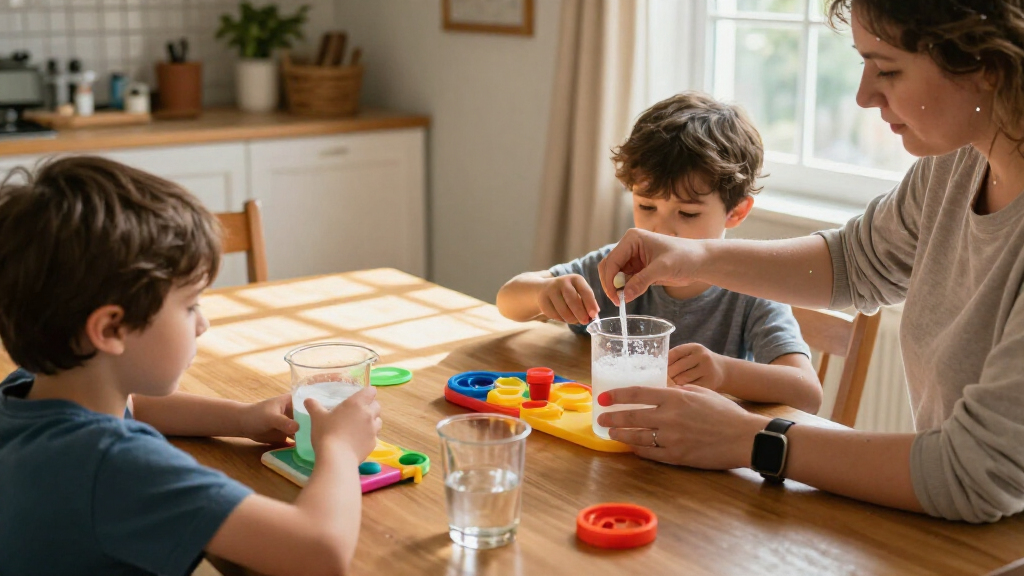
I ranked these kits for the realities of a family gathering: mixed ages, shared attention, limited setup time, and adults who may need to supervise more than one child. I weighed age fit, activity variety, group participation, theme appeal, and likely ease of following the instructions. A kit needed more than a high experiment count to rank well; I looked at whether its stated format and focus seemed suited to keeping a group involved.
The National Geographic Amazing Chemistry Set leads for its broad activity range, while the Gross Science kit and Doctor Jupiter’s preschool-oriented option serve distinct gathering styles. Focused kits such as the volcano, glow-in-the-dark, and crystal-growing sets rank as stronger choices for a specific shared activity than as all-purpose picks. Since product details do not establish actual completion time, cleanup demands, or how many children can work at once, I treat those as questions for buyers to check in the instructions rather than making unsupported claims. Every kit has tradeoffs: narrow themes limit variety, large activity counts can require more planning, and younger-age options may not hold older children’s attention as well.
Factors to Consider When Choosing Science Experiment Kits For Family Gatherings
For a gathering, the right kit is less about owning the most experiments and more about matching the group, the room, and the amount of adult help available. I would make these decisions before choosing by theme or activity count.
Match the kit to the youngest participant
At a mixed-age gathering, the youngest child often sets the supervision level, even when older children are eager to do more. Start with the age guidance, then check whether the instructions call for adult help rather than assuming an age label means independent use. A kit aimed at ages 4+ may make it easier for young children to participate, but older cousins may want a more involved challenge alongside it. One common mistake is buying for the oldest child and asking younger children to watch. If ages vary widely, plan simple roles such as measuring, reading steps, or recording observations so children can contribute at different levels.
Choose between variety and a shared theme
A broad kit can support more than one gathering and let the host pick activities to suit the group. A focused theme—such as volcanoes, crystals, glow effects, gross science, or magic—can make the first activity easier to introduce because everyone knows what the session is about. The tradeoff is that a themed set may feel repetitive if the family wants to use it often. Avoid treating the largest advertised experiment count as a guarantee of the most varied experience; check whether activities rely on distinct procedures and materials. For a one-time celebration, a memorable theme may matter more than long-term range, while a recurring family activity benefits from varied project types.
Plan for group size and turn-taking
A kit designed for one child to follow instructions may not naturally keep a larger group involved. Before buying, look for clues about whether materials are shared, whether activities can be repeated, and whether children need to perform steps in sequence. If only one person can handle a key part at a time, assign rotating jobs or prepare a second activity for waiting children. It is easy to overlook this when a kit advertises many experiments: quantity does not tell you how many children can participate at once. For larger gatherings, prioritize demonstrations that invite observation and discussion, or split the children into small teams with an adult at each station.
Treat setup and cleanup as part of the activity
Family hosts often have less time and workspace than a classroom, so check the instructions for preparation, household supplies, and cleanup before the event. A project that needs a clear surface, advance preparation, or careful handling may be a poor fit for a busy kitchen table even if the children like the topic. Protect the gathering by setting out a washable work area and gathering any listed supplies before guests arrive. Do not assume that a kit contains every item needed simply because it is sold as a set. When the host is also supervising children, a short, self-contained activity may be more practical than a multi-step project that needs constant attention.
Balance spectacle with participation
Big visual moments can draw a group together, but a showy demonstration can leave most children watching rather than doing. Think about whether the gathering goal is a shared spectacle, hands-on turns, or a mix of both. Volcano and magic-themed activities can provide an easy focal point, while broader chemistry sets may give children more chances to work through different tasks. A frequent buying mistake is choosing a dramatic theme without checking whether each child gets a meaningful role. Pair a demonstration with questions, predictions, or simple observation tasks so children who are waiting still have something to do.
Pay for the kind of repeat use you will actually get
A larger activity collection can make sense when the kit will return to the table across several weekends or gatherings. For a single event, a smaller focused set may be a better match if its theme fits the children and its activities are easy to organize. Do not use activity count alone as a stand-in for value; consider how many projects appeal to your group and whether the materials and instructions support repeat sessions. If the family includes children with different interests, broad chemistry or general science kits can offer more choice, while a themed kit gives the host a clearer plan. Choose based on likely use, not the hope that every listed activity will be completed.
Frequently Asked Questions
Which kind of kit works best when children at the gathering are different ages?
Start with the youngest child who will take part, then check the age range and adult-supervision guidance rather than relying on the older children’s abilities. A younger-child kit such as Doctor Jupiter My First may lower the barrier to participation, but older children may need extra roles or a more advanced activity. For a wide age spread, plan activities where children can contribute at different levels, such as following steps, measuring, observing, or explaining what they notice. If the kit does not offer that flexibility, use separate stations or choose a second activity for older participants.
Should I pick a kit with the most experiments or one with a clear theme?
Choose by the gathering’s purpose. A high activity count, as seen in the National Geographic Amazing Chemistry Set or Butterfly EduFields kit, can offer more options for repeat use, but the count alone does not show how different or group-friendly the activities are. A focused volcano, crystal, glow, or gross-science theme can make a one-day event easier to organize and more memorable. Before deciding, check the activity list and instructions for variety, required supplies, and adult involvement. The best fit is the one whose actual projects match your group, not simply the biggest number on the box.
Can one kit keep a large family group busy at the same time?
Not necessarily: experiment count does not indicate how many children can work at once. Check whether the kit provides shared materials, calls for steps to happen in sequence, or describes activities suitable for demonstration. If several children need to take turns, divide them into small groups or give waiting children observation and prediction tasks. For a larger gathering, having an adult lead each station can prevent bottlenecks. If the instructions do not clarify group use, plan as though the kit may need extra household supplies or a backup activity.
What should I check before buying a kit for a gathering at home?
Read the age and supervision guidance, then scan the instructions for preparation, workspace needs, and supplies that are not included. Consider where the children will work and whether the host can give one activity sustained attention while also managing the gathering. A project that needs a clear table or careful sequencing may be hard to run in a crowded room. Set up a protected surface and collect listed materials before guests arrive. If the instructions are unclear about cleanup or group participation, choose a simpler activity or prepare a second adult-led station.
Is a themed kit a better choice than a general science set for a one-time family event?
A themed kit can be easier to present as a shared event activity because it gives everyone a common focus, such as volcanoes, crystals, glow effects, or science magic. A general set may provide more choice, but the host has to select an activity that fits the ages, timing, and space. For a single gathering, decide whether you value a clear central demonstration or a menu of projects more. Check that the theme includes enough participation for the children attending, not just an appealing headline. If you expect to reuse the kit, broader variety may have more lasting appeal.
Conclusion
For most families, I would start with the National Geographic Amazing Chemistry Set as the best overall choice, particularly when variety for repeat gatherings matters. The Butterfly EduFields Science Kit is my best-value-style pick for families who want a large range of advertised activities, though I would check the activity list and supervision needs before buying. For a more specialized, high-impact session, choose a focused kit such as the volcano or gross-science set; those are my premium-style options when theme matters more than breadth. Beginners and families with younger children should look first at Doctor Jupiter My First Science Experiments Kit, while a group seeking a distinctive shared activity may prefer the glow-in-the-dark or crystal-growing kit. Match the choice to the youngest participant, group size, and available adult help, and the kit is more likely to work as a gathering activity rather than just a box of projects.