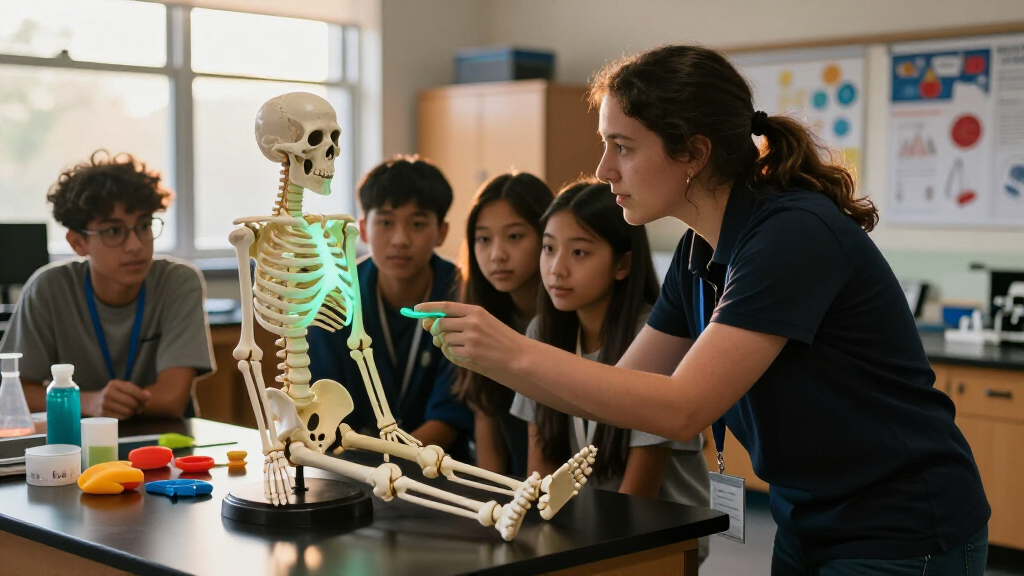
For classrooms that need spooky anatomy models with genuine teaching value, I’d put the 70.8-inch life-size skeleton with a nervous system first: its full-scale display and added anatomical detail suit whole-class demonstrations. The glow-in-the-dark GobiDex kit is a more playful choice for younger learners, while the 15-part removable torso models make internal organs easier to teach up close. The main tradeoff is between scale and lesson detail, classroom storage, and how much Halloween styling you want alongside science content. Small desk models save space but show less, while life-size models need room and careful handling. Read on for the full comparison, selection criteria, and advice for matching a model to your class.

Prime made for students and young adults
- Fast, free delivery for dorm and study essentials
- Prime Video and Amazon Music included
- Member-only deals
Key Takeaways
- Life-size models lead for whole-class visibility: The 70.8-inch skeleton options pair full-scale proportions with a nervous-system feature; posters or a rolling stand may make one version a better classroom fit than another.
- Small skeletons trade reach for easy storage: The 17- to 19-inch desktop models offer movable limbs for close study without the footprint of a standing skeleton.
- Removable torso parts teach a different lesson: The 11-inch, 15-part body models focus on organs and internal structures, so they complement rather than replace a skeleton.
- Halloween decor and anatomy instruction are not the same priority: The two-pack posable skeletons lean toward seasonal display, while labeled or articulated educational models are better suited to repeated lessons.
- Glow-in-the-dark appeal can help engage younger students: The GobiDex kit adds a playful visual hook, but teachers should prioritize age suitability and clear anatomy learning goals over spectacle alone.



| spooky anatomy models for classroom | Material | Weight | Height |
|---|---|---|---|
| Human Skeleton Model for Anato | Real human specimen, as listed | 21.6 pounds | 70.8 inches |
| NLShan Human Skeleton Model fo | Non-toxic PVC | 1.08 pounds | — |
| Anatomy Lab Human Skeleton Mod | — | — | — |
| Breesky Human Skeleton Model f | Plastic, implied in product data | 1.1 pounds | 17.7 inches |
| Halloween Life Size Posable Hu | Plastic | 5.7 pounds | — |
| Human Body | Plastic | — | — |
| 17.72 Inch Mini Skeleton Anato | Hard PVC | 1.08 pounds | 17.72 inches |
| 70.8-inch Human Skeleton Model | PVC | 23.3 pounds | 70.8 inches |
| GobiDex Human Body Skeleton Mo | Plastic | — | — |
| 7.8-inch Mini Human Skeleton M | PVC plastic | — | 7.8 inches |
| Breesky Scientific Human Skele | Metal | — | 33.4 inches |
| Human Body Model with 15 Remov | Non-toxic PVC | — | — |
| Breesky Human Skeleton Model f | Polyvinyl chloride (PVC) | 22 pounds | 70.8 inches |
| ZENFUN 11 inch Human Body Mode | PVC | 1.26 pounds | — |
| Human Skeleton Model for Anato | PVC | 22.4 pounds | 70.8 inches |
More Details on Our Top Picks
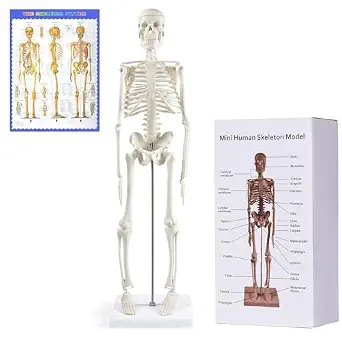
Human Skeleton Model for Anatomy – Life Size with Nervous System, 70.8 inches, Rolling Stand, Educational Medical Model
For a classroom that needs a commanding, full-size teaching aid, this 70.8-inch model is the strongest instructional pick in this group. Its 206 articulated bones, removable skull, rolling stand, and three posters support demonstrations that a desktop model such as the Anatomy Lab 19-inch Desktop Skeleton cannot match for scale or visibility. The stand also lets a teacher move it between teaching areas, though its 21.6-pound weight makes that less effortless than the smaller models suggest. One unusual tradeoff is the listing’s claim that it is made from real human specimens; that may be unsuitable for schools seeking a clearly synthetic classroom prop or concerned about specimen sourcing. Choose it for serious anatomy lessons, not casual Halloween display, and confirm the material details suit your school.
Pros:- Full-size proportions make demonstrations easier to see across a classroom.
- 206 articulated bones and a removable skull support hands-on skeletal lessons.
- Rolling stand with five wheels allows movement between teaching spaces.
- Three colorful posters add reference material beyond the physical model.
Cons:- At 21.6 pounds, it is heavier to reposition than the desktop models.
- The real-human-specimen material claim may raise sourcing or classroom suitability concerns.
- Its full-size footprint requires dedicated storage and display space.
Best for: Secondary or post-secondary teachers who need a room-visible, full-size skeleton for anatomy demonstrations and can accommodate a heavy rolling model.
Not ideal for: Elementary classrooms seeking a lightweight, clearly synthetic prop, or schools that prefer not to use models described as real human specimens.
- Height:70.8 inches
- Number of bones:206
- Material:Real human specimen, as listed
- Stand:Rolling stand with five wheels
- Posters included:3 colorful posters
- Detachable skull:Yes
- Weight:21.6 pounds
- Listed uses:Education, medical study, research
Our verdict“Choose this model for visible, full-scale anatomy instruction if its specimen material and storage demands fit your school.”
NLShan Human Skeleton Model for Anatomy: Scientific Model with Movable Arms, Legs & Display Stand – 17.7-inch Mini Human Skeleton Model for Study and Display
The NLShan stands out among the compact picks for its range of movable joints: arms, legs, shoulders, elbows, wrists, knees, and ankles can support simple movement lessons without requiring a full-size display. Its non-toxic PVC construction also offers a clear synthetic alternative to the life-size model in this roundup, whose listing describes real human specimen material. At 17.7 inches, though, it is best for small-group viewing or a teacher’s desk, not for showing fine skeletal details to an entire class. Compared with the Breesky 17-inch model, the NLShan description spells out more articulation points, while both remain compact plastic teaching aids. Its joints need careful handling, and PVC may not feel as durable as a more substantial model.
Pros:- Movable joints across the shoulders, elbows, wrists, knees, and ankles give lessons several demonstration points.
- Non-toxic PVC provides a synthetic-material option for classrooms.
- Removable skull supports basic skull-focused instruction.
- Display stand keeps the model upright for desk or small-group presentation.
Cons:- The 17.7-inch scale is too small for clear whole-class viewing from a distance.
- Plastic construction may be less durable than more substantial models.
- Careful handling is needed to preserve joint flexibility.
Best for: Teachers who want a compact, synthetic skeleton for small-group lessons on joint movement, classroom display, or individual student handling.
Not ideal for: Teachers needing a room-visible model or students who require close study of fine skeletal detail; its small scale limits both uses.
- Model size:17.7 inches
- Material:Non-toxic PVC
- Weight:1.08 pounds
- Dimensions:11.4 x 6.06 x 0.2 inches
- Base size:4.75 x 4.75 inches
- Removable skull:Yes
- Articulation:Movable arms, legs, shoulders, elbows, wrists, knees, and ankles
Our verdict“Pick the NLShan for compact joint demonstrations and synthetic construction, but not for full-room visibility or detailed close study.”
Anatomy Lab Human Skeleton Model, 19-inch Desktop Skeleton with Movable Arms and Legs
This 19-inch desktop skeleton is a practical middle ground for lessons where students need to inspect removable parts up close. The skull cap, mandible, arms, and legs come off, making the model more useful for focused handling than the full-size rolling skeleton, while its stated anatomically correct details give it a stronger classroom emphasis than the Halloween-oriented two-pack. A stand keeps it ready for demonstration, but the listing does not include posters or specify extensive joint articulation, so it offers fewer teaching aids than the full-size model and fewer named movement points than the NLShan 17.7-inch model. Its scale suits a desk or small group; it will not provide the visual impact of a life-size figure across a room.
Pros:- Removable skull cap, mandible, arms, and legs enable focused part-by-part discussion.
- Movable arms and legs add basic interaction beyond a fixed display model.
- Included stand supports upright desk or small-group presentation.
- Its 19-inch size is more substantial than the 17.7-inch mini models.
Cons:- Still too small for easy viewing from the back of a classroom.
- The product data lists no posters or other supplemental teaching materials.
- The listed movable parts do not specify the same range of joint articulation as the NLShan model.
Best for: Teachers and students who need a desktop model with removable skeletal sections for close, small-group anatomy activities.
Not ideal for: Classrooms that need a life-size demonstration figure, extra learning materials, or a model with a clearly detailed range of movable joints.
- Size:19 inches
- Movable parts:Arms and legs
- Display stand:Included
- Removable parts:Skull cap, mandible, legs, and arms
Our verdict“Choose this desktop model for removable-part lessons at close range, rather than whole-class visibility or extensive motion demonstrations.”
Breesky Human Skeleton Model for Anatomy: 17-inch Movable Skeleton for Study and Display
The Breesky’s advantage is its small, simple display format: at 17.7 inches with a 4.75-inch-square base, it can sit on a desk or shelf where a full-size skeleton would take over the room. The movable arms, legs, and jaw, plus a removable skull cap, make it more interactive than a static Halloween decoration. Compared with the Anatomy Lab 19-inch Desktop Skeleton, however, the Breesky is slightly smaller and its supplied details describe fewer removable components; it is better treated as a compact visual aid than a model for extensive part-by-part instruction. Basic anatomical detail and the absence of internal structures also limit lesson depth. It suits classrooms that need an easy-to-place spooky display with some teaching use, not a primary anatomy resource.
Pros:- Compact size and 4.75-inch-square base fit limited display space.
- Movable arms, legs, and jaw allow basic demonstrations.
- Removable skull cap offers a simple point of interaction.
- Designed for both study and display, including themed classroom settings.
Cons:- Basic anatomical detail offers less depth than larger or more feature-rich teaching models.
- No internal structures are included.
- The small scale limits visibility for whole-class instruction.
Best for: Teachers who need a compact skeleton for a desk, shelf, or small-group display and want basic movable features for demonstrations.
Not ideal for: Anatomy instructors who need extensive removable parts, detailed internal structures, or a model visible across a large classroom.
- Height:17.7 inches
- Base dimensions:4.75 x 4.75 inches
- Weight:1.1 pounds
- Material:Plastic, implied in product data
- Movable parts:Arms, legs, and jaw
- Removable skull cap:Yes
Our verdict“Choose the Breesky for a space-saving display with basic movement, not as the main model for detailed anatomy teaching.”
Halloween Life Size Posable Human Skeletons, 2 Pack Adult and Child
This set earns its place for classrooms that want Halloween atmosphere and a size comparison in one display: it pairs a 5-foot-4-inch adult skeleton with a 2-foot child skeleton. Their articulated limbs can help prompt discussion about skeletal form, but these are primarily themed props, not substitutes for the 206-bone instructional model in this roundup. Unlike the NLShan mini skeleton, the pair offers striking scale and a child-sized figure; unlike that teaching model, it provides no listed removable skull, stand, or supplemental anatomy materials. The plastic construction is suited to indoor or outdoor decoration, but its display needs more room and may feel less authentic than a dedicated study model. I’d choose it for seasonal lessons or a spooky classroom scene, with a separate resource for detailed anatomy.
Pros:- Includes both adult and child figures for contrasting display scale.
- Articulated limbs allow flexible posing and broad movement demonstrations.
- Plastic construction is listed as suitable for indoor and outdoor use.
- Strong horror theme fits seasonal classroom displays and events.
Cons:- The Halloween-focused design is less suited to year-round anatomy instruction.
- Full-height adult display requires substantial room.
- Plastic construction may look less authentic than a dedicated anatomy model.
Best for: Teachers planning a Halloween-themed classroom or event who want two different skeleton sizes to support broad visual comparisons.
Not ideal for: Teachers seeking a detailed, durable-for-close-handling anatomy teaching model or a compact year-round classroom aid.
- Included figures:One adult skeleton and one child skeleton
- Adult skeleton size:5 feet 4 inches
- Child skeleton size:2 feet
- Material:Plastic
- Weight:5.7 pounds
- Color:White/Gray
- Theme:Horror
- Mounting type:Wall mount
Our verdict“Choose this pair for a spooky seasonal display and broad size comparisons, not for detailed skeletal study.”
Human Body, Skeleton, Heart, Half Size Skull with Brain Models
Best for multi-model anatomy lessons, this set gives a classroom several ways to introduce the body: a torso, skeleton, heart, and skull with brain. That variety makes it more useful for rotating demonstrations than a skeleton-only option such as the 17.72 Inch Mini Skeleton Anatomy Model. The included manuals and educational guides can help students connect what they see to basic anatomy, while the carrying case supports storage between lessons. Its hand-painted finish also gives the models a more display-ready look than plain plastic skeletons. The tradeoff is that each piece is relatively small—the skeleton is 17.7 inches tall and the torso is 11 inches—so it is better for small groups than whole-class viewing. Delicate details may also need careful handling, and the set is not presented as medical-training equipment.
Pros:- Four distinct models support lessons on the body, skeleton, heart, and brain
- Manuals and educational guides provide material for structured study
- Hand-painted details make the pieces suitable for classroom display
- Carrying case helps keep the models together during storage and transport
Cons:- The 17.7-inch skeleton and smaller components may be hard to see from the back of a classroom
- Detailed models may require careful handling to avoid damage
- The set is aimed at education rather than medical training
Best for: Teachers of students aged 14 and up who want several compact models for small-group anatomy stations and guided lessons.
Not ideal for: Teachers who need a life-size demonstration model for a large classroom, or buyers seeking equipment for advanced medical training.
- Set includes:Human body, skeleton, heart, half-size skull with brain
- Skeleton height:17.7 inches
- Torso height:11 inches
- Heart height:8 inches
- Skull size:3.5 inches
- Material:Plastic
- Age range:14 years and up
- Included learning and storage items:Manuals, educational guides, and carrying case
Our verdict“Choose this set for older students and small-group lessons that benefit from several compact anatomy models rather than one large skeleton.”
17.72 Inch Mini Skeleton Anatomy Model with Movable Arms and Legs
Best for posing and demonstrations, this 17.72-inch skeleton has movable arms and legs, letting teachers show basic joint positions or set up a Halloween-themed anatomy display. Its hard PVC construction and stable posing make it a more flexible prop than the GobiDex Human Body Skeleton Model Kit, which focuses on an assembled, glow-in-the-dark learning activity. Compared with the life-size 70.8-inch model, this one takes far less room and is easier to place on a desk or move between stations. That compact scale is also its main limit: students will not get the visibility or detail of a full-size classroom skeleton, and the product description does not list anatomical charts or lesson guides. Assembly may take some patience, so it suits teachers who value poseability and display versatility over a more complete teaching package.
Pros:- Movable arms and legs allow varied poses for demonstrations
- Compact 17.72-inch height is easier to store than a life-size model
- Hard PVC construction is described as resistant to cracking and fading
- Can serve as an anatomy prop, art reference, or Halloween display
Cons:- Small scale limits visibility and detailed anatomical study
- PVC lacks the weight and tactile feel of bone-like materials
- Assembly may be challenging for some users
Best for: Teachers who want a compact, poseable skeleton for desk demonstrations, art references, or seasonal anatomy displays.
Not ideal for: Classrooms needing a large, highly visible teaching skeleton or a model accompanied by detailed anatomy charts and learning materials.
- Height:17.72 inches
- Dimensions:4.72 x 4.72 x 17.72 inches
- Weight:1.08 pounds
- Material:Hard PVC
- Movable parts:Arms and legs
- Assembly:Assembly required
Our verdict“Pick this model when poseable display value matters more than life-size classroom visibility or included teaching materials.”
70.8-inch Human Skeleton Model for Anatomy with Nervous System & Charts, Stand
Best for full-class demonstrations, this life-size skeleton is easier to use as a shared visual reference than the compact 17.72 Inch Mini Skeleton Anatomy Model. At 70.8 inches, it gives a teacher a prominent way to point out skeletal structures, while the nervous system and carotid artery details add content beyond a basic skeleton. The movable joints, charts, and wheeled metal stand make it more lesson-ready than small decorative models; the dust-proof cover also helps protect it between uses. Those classroom advantages come with a real space and handling cost: it weighs 23.3 pounds, and the stand and model require assembly. Compared with smaller kits, it is a stronger choice for a dedicated teaching area, but less practical for frequent room changes or limited storage.
Pros:- Life-size height makes features easier to point out to a whole class
- Nervous system and carotid artery details extend beyond basic skeletal study
- Wheeled metal stand supports display and repositioning
- Charts and dust-proof cover add teaching and storage utility
Cons:- At 23.3 pounds, it is heavy for frequent transport
- Assembly is more involved than with compact desktop skeletons
- Requires substantially more floor and storage space than mini models
Best for: Science teachers and training rooms that need a life-size model with added nervous-system detail for whole-class instruction.
Not ideal for: Teachers with limited floor or storage space, or those who need a lightweight model to move between classrooms often.
- Height:70.8 inches
- Material:PVC
- Weight:23.3 pounds
- Stand:Metal stand with wheels
- Additional anatomy:Nervous system and carotid artery
- Included:Charts and assembly instructions
- Other included item:Dust-proof cover
- Joints:Movable
Our verdict“Choose this life-size model for a dedicated classroom demonstration area where scale and added anatomy detail outweigh portability.”
GobiDex Human Body Skeleton Model Kit, Glow in The Dark Science Kit for Kids
Best for younger learners, the GobiDex kit combines a 12.6-inch skeleton with 40 pieces and an illustrated manual, giving children a hands-on activity rather than just a display model. Its glow-in-the-dark finish adds a playful Halloween hook that can help a teacher draw attention to a basic anatomy lesson. Compared with the Human Body, Skeleton, Heart, Half Size Skull with Brain Models, it is aimed at younger students and emphasizes assembly and engagement instead of presenting several separate anatomical structures. That focus also limits its classroom depth: the description identifies basic skeletal learning, not detailed organ or nervous-system study. Assembly can be difficult for some children, and there are no electronic effects or moving parts once the model is built. It makes sense for guided STEM activities, not as the room’s main anatomy reference.
Pros:- Glow-in-the-dark bones add a memorable visual element to spooky anatomy lessons
- Forty-piece kit gives children a hands-on assembly activity
- Illustrated manual supports guided learning
- Designed for learners aged 8 to 16
Cons:- Covers basic skeletal structures rather than broader anatomy
- Assembly may challenge some children without adult help
- No electronic features or moving parts for continued demonstration
Best for: Teachers and families working with children aged 8 to 16 who want a glow-in-the-dark assembly activity for introductory STEM lessons.
Not ideal for: Older students or classrooms that need movable joints, detailed anatomy, or a large model visible across the room.
- Size:12.6 x 5.71 x 3.15 inches
- Number of pieces:40
- Material:Plastic
- Age range:8–16 years
- Finish:Glow in the dark
- Included learning item:Illustrated manual
- Assembly:Assembly required
Our verdict“Choose GobiDex for a supervised, age-appropriate skeleton-building activity rather than an advanced or large-format teaching model.”
7.8-inch Mini Human Skeleton Model for Anatomy Learning, Student Teaching, Desk Display & Halloween Decor
Best compact desk model, this 7.8-inch skeleton is suited to individual handling, small desks, and portable study rather than a whole-class demonstration. Movable joints and a rotatable head let students explore basic positioning, while the detachable skull cap offers a closer look at the skull than the 17.72 Inch Mini Skeleton Anatomy Model provides by scale alone. The display base can be detached for storage, making this a practical choice where cabinet space is tight. Its small size is the key compromise: it cannot match the visibility of a 17.72-inch model, let alone the 70.8-inch life-size option, and its listed features do not extend to detailed anatomical systems. Repeated repositioning may also wear the joints over time. I’d choose it for individual exploration or a desktop Halloween display, not as the class’s central teaching aid.
Pros:- Small format is easy to carry and store
- Movable joints and rotatable head support basic posing
- Detachable skull cap provides access to the skull interior
- Detachable base offers flexible display and storage
Cons:- At 7.8 inches, it is difficult to use as a whole-class visual aid
- Limited anatomical detail makes it unsuitable for advanced study
- Movable joints may lose durability with repeated handling
Best for: Students and teachers who need a lightweight, close-up desk model for individual anatomy exploration or compact classroom displays.
Not ideal for: Teachers presenting to a full class or advanced learners who need detailed anatomy beyond basic skeletal features.
- Height:7.8 inches
- Item dimensions:3.15 x 1.57 x 8.66 inches
- Material:PVC plastic
- Movable joints:Yes
- Head:Rotatable
- Skull cap:Detachable
- Display base:Detachable
Our verdict“Pick this model for portable, individual study when compact storage matters more than classroom-wide visibility.”
Breesky Scientific Human Skeleton Model for Anatomy, 33.4” Skeleton with Metal Stand, Removable Arms & Legs, Educational and Halloween Decor
The 33.4-inch height gives this skeleton a useful middle ground: it is more visible for a small-group lesson than a desktop model, without the footprint of the 70.8-inch Breesky life-size skeleton. Its articulated joints and removable arms and legs let teachers show how limbs connect and move, while the metal stand supports upright display between lessons. That scale also suits a classroom Halloween display that can pull double duty as a teaching aid. The tradeoff is durability: the description warns that parts may be fragile if handled roughly, so this is better for guided demonstrations than frequent unsupervised handling. It is also less suited to teaching fine organ anatomy than the 11-inch torso models, which expose internal parts directly.
Pros:- Articulated joints and removable limbs support hands-on demonstrations of skeletal movement.
- At 33.4 inches, it is more prominent than a desktop skeleton while remaining smaller than a life-size model.
- Metal stand provides a dedicated display and study base.
- Can serve as both a science teaching aid and Halloween decor.
Cons:- The model may be fragile if students handle or reassemble it roughly.
- Its stated adult age range makes it a poor choice for younger students.
- It takes more display space than compact torso or desktop models.
Best for: Teachers who want a medium-size, articulated skeleton for supervised joint demonstrations and seasonal classroom display.
Not ideal for: Classrooms needing a child-proof model for frequent independent handling, or lessons focused on internal organs rather than bones.
- Height:33.4 inches
- Material:Metal
- Model number:85cm-3
- Age range:Adult
- Items included:1
- Stand:Metal stand
- Removable parts:Arms and legs
Our verdict“Choose this for supervised skeletal demonstrations when a desktop model feels too small but a life-size skeleton would overwhelm the classroom.”
Human Body Model with 15 Removable Parts, 11 Inch Anatomy Educational Display
For a classroom lesson about organs rather than bones, this 11-inch torso puts the main teaching pieces in one compact display. Its 15 detachable parts include the brain, heart, lungs, stomach, liver, and intestines, giving students a hands-on way to explore where major systems sit in the body. Compared with the Breesky 33.4-inch skeleton, it has less impact as a spooky room centerpiece and cannot demonstrate full-body joint movement; in return, it offers a clearer route into internal anatomy and is easier to carry between classrooms. The PVC construction is described as non-toxic, but its small removable pieces call for adult oversight around younger children. Some assembly is required, and the listed age range starts at 14, so I would not treat it as an all-ages activity prop.
Pros:- Fifteen removable components make organ placement and basic body-system lessons interactive.
- Includes major organs and structures such as the brain, heart, lungs, and intestines.
- Compact 11-inch format is easy to transport and store.
- Non-toxic PVC construction is specified in the product data.
Cons:- Small detachable pieces pose a choking risk for young children.
- It does not offer the full-skeleton scale or joint demonstrations of the Breesky 33.4-inch model.
- Some assembly is required, and the stated age range excludes younger students.
Best for: Science teachers and students aged 14 and up who want a portable, hands-on model for introducing major organs and body systems.
Not ideal for: Teachers seeking a large Halloween skeleton display, lessons on skeletal articulation, or an activity for young children who may mouth small parts.
- Size:11 inches
- Material:Non-toxic PVC
- Detachable parts:15
- Age range:14 years and up
- Included components:Trunk, brain, heart, esophagus and aorta, lung, skull cap, stomach, diaphragm, liver, pancreas and spleen, intestines, educational brochure
- Model year:2023
- UPC:791315246626
Our verdict“Pick this compact torso when organ identification matters more than a large, spooky skeleton display.”
Breesky Human Skeleton Model for Anatomy – Life Size Medical Skeleton with Nervous System, 70.8 inches, with Rolling Stand and 3 Posters
For a classroom that needs a skeleton students can study from across the room, this 70.8-inch model makes anatomy visible at near-human scale. Its 206 articulated bones and movable, removable joints support lessons on structure and movement, while the rolling stand helps staff reposition it without carrying the full model. Three included posters add wall-based reference material, giving this pick a broader teaching setup than the 33.4-inch Breesky skeleton, which is easier to fit on a smaller display area but offers less full-scale presence. The tradeoff is the commitment: at 22 pounds and roughly six feet tall, it needs storage and floor space, and PVC does not reproduce the feel of bone. This is a teaching model, not a substitute for clinical equipment.
Pros:- Near-life-size height makes skeletal structures easier to demonstrate to a group.
- 206 articulated bones and movable, removable joints support movement and structure lessons.
- Rolling stand allows repositioning around the classroom.
- Three educational posters provide additional visual reference.
Cons:- At 22 pounds and 70.8 inches tall, it needs substantial floor and storage space.
- PVC does not replicate the texture of real bone.
- Its size and construction suit indoor teaching and display, not clinical procedures.
Best for: Middle-school, high-school, and college classrooms that need a prominent full-size skeleton for ongoing lessons and display.
Not ideal for: Small rooms, teachers who need a model to carry between classes often, or buyers focused on organ anatomy rather than skeletal structure.
- Height:70.8 inches
- Material:Polyvinyl chloride (PVC)
- Weight:22 pounds
- Number of bones:206
- Joints:Removable and movable
- Stand:Rolling stand
- Included posters:3
- Listed dimensions:70.8 x 70.8 inches
Our verdict“Choose this as the main classroom skeleton when full-size visibility and rolling mobility justify the space it occupies.”
ZENFUN 11 inch Human Body Model for Anatomy, 15 Pcs Removable Human Torso Anatomical Model with Heart, Head, Skull, Brain, Skeleton, Digestive System for Teaching and Medical Education
The ZENFUN’s 11-inch torso format is a practical fit for desks, small-group stations, and classrooms that cannot give a life-size skeleton permanent floor space. It offers 15 removable parts, including organs and skeletal structures, so students can take components out and return them as they trace basic anatomy. Its hand-painted finish is intended to make the parts easier to distinguish visually, while the compact size keeps storage simple. Compared with the similarly sized Human Body Model with 15 Removable Parts, this listing emphasizes hand-painted components and easy cleaning, but both are small-part torso models rather than dramatic skeleton centerpieces. That compactness limits the visible detail, and the product data flags assembly instructions as a possible weak point. I would choose it for tabletop exploration, not whole-class viewing from a distance.
Pros:- Fifteen detachable components allow hands-on exploration of internal anatomy.
- Hand-painted parts help distinguish structures during tabletop lessons.
- Compact 11-inch size supports easy storage and transport.
- PVC construction is described as eco-friendly and easy to clean.
Cons:- Small scale limits anatomical detail and visibility for larger groups.
- Assembly directions may not be sufficient for every user.
- Removable pieces require supervision around young children.
Best for: Teachers setting up compact anatomy stations or students who need a portable tabletop model with removable organs and skeletal parts.
Not ideal for: Classrooms needing a large Halloween focal point, a life-size skeleton, or fine details visible from across a room.
- Size:11 inches
- Number of parts:15
- Material:PVC
- Weight:1.26 pounds
- Package dimensions:11.14 x 5.63 x 3.62 inches
- Model number:Z-HumanBodyModel-p
- First available:March 14, 2026
Our verdict“Choose this for portable, close-up organ lessons when a compact model matters more than a dramatic classroom display.”
Human Skeleton Model for Anatomy – Life Size Medical Skeleton with Nervous System, 70.8 inches, Rolling Stand, 3 Posters
This life-size skeleton shares the classroom-ready scale and poster bundle of the Breesky 70.8-inch model, but its listing specifically highlights detachable parts alongside 206 articulated bones. That makes it a fit for teachers who want students to inspect components up close as well as follow whole-body structure on the standing model. The rolling stand adds flexibility for moving it between a lesson area and a display spot, while three posters supply supporting visual references. Against the Breesky version, the supplied details are less specific about the model’s weight and construction beyond PVC; the listed weight is 22.4 pounds, making frequent movement a real task despite the wheels. Like the other full-size option, it takes substantial floor space and offers physical interaction for education, not medical procedures.
Pros:- Life-size height gives whole-body anatomy strong classroom visibility.
- 206 articulated bones and detachable parts support varied demonstrations.
- Rolling stand helps reposition the model within a teaching space.
- Three educational posters provide supplementary anatomy references.
Cons:- At 22.4 pounds, it can be cumbersome to move despite the rolling stand.
- PVC offers a visual and physical teaching aid but is not real bone.
- Its size requires dedicated floor and storage space.
Best for: Teachers who want a full-size classroom skeleton with detachable components for supervised close-up demonstrations.
Not ideal for: Small classrooms, frequent room-to-room transport, or lessons centered on removable organs rather than bones.
- Height:70.8 inches
- Number of bones:206
- Material:PVC
- Weight:22.4 pounds
- Stand:Rolling stand
- Posters:3 educational posters
- Detachable parts:Yes
Our verdict“Choose this full-size option if detachable skeletal parts are a priority and your classroom can accommodate its weight and footprint.”

How We Picked
I compared these 15 options through the needs of a classroom, not just their spooky appearance. The main criteria were anatomical teaching value, the usefulness of movable or removable parts, visibility from different classroom distances, likely storage demands, and the kind of lesson each model supports. I also separated full-size skeletons, desktop skeletons, organ-focused torso models, and decor-led props because they serve different jobs and should not be treated as interchangeable.
The ranking favors models that combine clear instruction with practical classroom use. A life-size skeleton with nervous-system detail ranks above a decorative prop for broad anatomy teaching, while compact and glow-in-the-dark picks earn their place for close-up activities or younger groups. Where listings describe similar life-size models, I treat posters, stands, and other included extras as useful differentiators rather than assuming the core skeleton is different. Product descriptions do not provide every detail a teacher might want, so I avoid assuming durability, labeling, or classroom safety beyond the stated features.
Factors to Consider When Choosing Spooky Anatomy Models For Classrooms
The right spooky anatomy model depends less on how dramatic it looks than on what students will do with it. I’d match the model to the lesson, the class age, and the space available before choosing a scale or Halloween feature.
Match the model to the lesson, not just the theme
Start by naming the learning task: identifying bones, tracing the nervous system, or locating organs are different teaching needs. A skeleton makes skeletal structure visible, but it will not replace a torso model when students need to examine removable organs. A decorative skeleton can support a seasonal display without offering the same lesson detail as an educational model. One common mistake is buying a single model and expecting it to teach every body system. If your curriculum spans systems, a focused model for each activity may be more useful than one prop with a spooky finish.
Choose a scale students can actually see and handle
Life-size models are easier to reference from across a room and can anchor teacher demonstrations. Their height and stand also create storage, movement, and setup demands that a product title alone may not reveal. Desktop models suit small groups, desk work, and crowded classrooms, but students may need to pass them around to see details. Avoid choosing the largest option just because it looks impressive; it can become inconvenient if there is no safe parking spot between lessons. Think about viewing distance as well as the shelf or floor space the model will occupy.
Treat movable parts as a teaching tool, not a decoration
Movable limbs can help students connect joints and bones to movement, while removable organs let a teacher reveal structures in sequence. Those features are useful only when the class activity calls for hands-on interaction. Repeated handling can also mean more pieces to keep track of and more setup between groups. Before choosing a model with detachable parts, plan who will handle it and where pieces will be stored. For younger classes or shared equipment, fewer loose components may be easier to manage than a highly interactive kit.
Decide how much spooky styling belongs in the lesson
A glow-in-the-dark finish or seasonal skeleton display can draw attention, especially during Halloween activities. But visual drama can distract from anatomy if students cannot connect the effect to a learning objective. Use decor-led models for engagement, classroom displays, or short themed activities; choose more anatomically focused models for recurring instruction. Check whether the spooky feature changes how the model is presented, rather than assuming it adds educational detail. A balanced approach is to pair one playful display item with a more informative model for hands-on teaching.
Check what the listed extras contribute
Stands, charts, and posters can make a model easier to present or give students another reference point, but extras do not automatically improve anatomy instruction. Compare what each included item actually supports: a rolling stand affects placement, while a chart may help explain structures beyond what students can see on the model. Do not treat similarly titled products as identical or assume a poster is labeled with the content your class needs. Check the product details for what is included and how it will be used. If a model will stay in one spot, a rolling stand may matter less than a compact footprint or a stable display base.
Plan for classroom routines and care
Shared teaching models need a routine for setup, student handling, cleanup, and storage. Small removable pieces are easier to misplace, and tall models may need a designated space away from busy walkways. Ask who will move the model and whether students will be permitted to handle it before choosing a format. A model that is easy to store and reset may see more classroom use than a larger display that takes extra effort to bring out. For any age group, review the seller’s care and age guidance rather than inferring suitability from a playful design.
Frequently Asked Questions
Should I choose a life-size skeleton or a desktop model for a classroom?
Choose a life-size model when you need students across the room to see overall proportions or want a standing demonstration piece. A desktop model is easier to store, move between groups, and use for close observation at a table. The smaller scale can limit visibility during whole-class teaching, while the larger format takes dedicated space. If your lessons include both demonstrations and small-group activities, consider which use happens more often before paying for scale you may not need.
Can a skeleton model teach organ systems, or do I need a torso model too?
A skeleton is the clearer choice for bones and, on models that include it, nervous-system features. A torso with removable parts gives students a more direct way to inspect organs and their positions inside the body. These formats answer different questions, so neither is a full substitute for the other. If your class focuses on several body systems, choose around the next unit’s learning goals or pair a skeleton with a compact torso model when the budget and storage allow.
Are glow-in-the-dark or Halloween skeletons suitable for anatomy lessons?
They can support a themed activity or make a display more engaging, but appearance alone does not make a model instruction-ready. Check whether the product offers the anatomical features, articulation, or removable parts your lesson requires. The GobiDex kit is the standout playful option in this lineup, while the two-pack posable skeletons lean more toward seasonal display. I would use spooky styling as an engagement feature and keep a more detailed teaching model available for lessons that require accurate structure work.
What should I check before buying a model with removable parts?
Check how many parts detach, what body structures they represent, and whether the listing explains how they fit back into the model. Then plan where pieces will be stored and how students will handle them during activities. More removable parts can support hands-on learning, but they also add setup and loss-prevention work. For a class with frequent rotations or younger learners, a simpler model may be easier to manage; for guided small-group lessons, detachable parts can make internal anatomy clearer.
When is a premium life-size model worth choosing over a smaller one?
A life-size model is a better fit when it will serve as a regular demonstration tool, remain on display, or need to be visible from multiple desks. Features such as a nervous system, rolling stand, or included posters may add value if your lessons will use them. Those extras matter less when the model will be brought out only for occasional activities or stored in a tight space. Compare the feature list with your actual teaching routine rather than treating size or accessories as automatic upgrades.
Conclusion
For most classrooms that want one central teaching display, I’d choose a 70.8-inch skeleton with a nervous system as the best overall direction: it combines full-scale visibility with more anatomy than a decor-only skeleton. For best value in a compact format, the movable 17- to 19-inch desktop skeletons are the practical pick when close study and easy storage matter more than room-wide visibility. The best premium choice is a life-size version with a rolling stand and posters if those extras fit your teaching routine. For beginners and younger learners, the glow-in-the-dark GobiDex kit offers a playful entry point, while teachers starting with internal organs should choose an 11-inch removable-part torso. If your specific need is seasonal decor rather than detailed instruction, the two-pack posable skeletons make more sense than an educational model; choose according to the lesson you need students to remember.