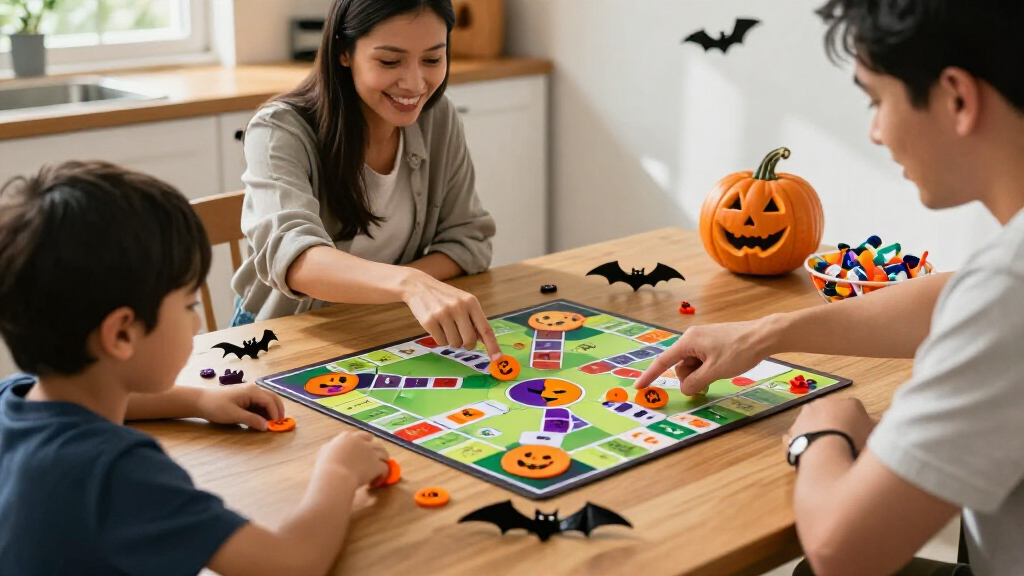

Choosing a Halloween educational board game means balancing spooky atmosphere with the kind of thinking and social play you want around the table. Ghost in the Attic is my pick for younger children who can benefit from cooperative decisions, while Ghost Fightin’ Treasure Hunters Anniversary Edition offers the broadest range of teamwork and challenge for older players. For a seasonal strategy night, Haunted Halloween: The Trick-or-Treat Game adds character powers and portals; Boooo-opoly leans more toward counting, turn-taking, and familiar property trading.

Prime made for students and young adults
- Fast, free delivery for dorm and study essentials
- Prime Video and Amazon Music included
- Member-only deals
The main tradeoff is how directly each game supports learning. The cooperative haunted-house games foreground communication and shared problem-solving, while Boooo-opoly makes its educational value more about counting and basic transactions. Age and group size matter, too: Ghost in the Attic is listed for six players, whereas the two treasure and trick-or-treat games accommodate two to five. I rank these by the balance of Halloween theme, useful learning opportunities, and flexibility for family play—not by how spooky their components look.
Key Takeaways
- Best for younger cooperative play: Ghost in the Attic is aimed at ages 5 and up and centers on shared decisions, though its listed six-player count may not suit smaller groups.
- Most flexible learning challenge: Ghost Fightin’ Treasure Hunters supports 2–5 players, offers basic and advanced cooperative play, and adds a one-versus-all option for ages 8 and up.
- Best for seasonal strategy: Haunted Halloween uses costume powers, portals, and other theme-specific mechanics, but its roughly 35-minute play time and Halloween focus may be a narrower fit.
- Best for counting practice: Boooo-opoly uses property trading, rent, and play money to bring counting and light strategy into a familiar 2–6-player format.
- Choose by group before theme: The games differ in age guidance and player counts, so matching the box’s listed range to your actual family is as important as choosing a favorite Halloween premise.
| Ghost in the Attic Cooperative Board Game |  | Best Overall for Younger Cooperative Play | Brand: Peaceable Kingdom | Game type: Cooperative strategy and deduction game | Players: Listed as 6 | VIEW LATEST PRICE | See Our Full Breakdown |
| Mattel Games Ghost Fightin’ Treasure Hunters Anniversary Edition |  | Best for Flexible Team Challenges | Brand: Mattel Games | Players: 2–5 | Recommended age: 8 years and up | VIEW LATEST PRICE | See Our Full Breakdown |
| Haunted Halloween: The Trick-or-Treat Game |  | Best for Seasonal Family Strategy | Brand: Castle Clark | Genre: Family, strategy | Players: 2–5 | VIEW LATEST PRICE | See Our Full Breakdown |
| Late for the Sky Boooo-opoly Halloween Family Board Game |  | Best for Counting and Larger Groups | Brand: Late for the Sky | Players: 2–6 | Recommended age: 8 years and up | VIEW LATEST PRICE | See Our Full Breakdown |
| Halloween educational board game | Brand | Players | Recommended age | Components |
|---|---|---|---|---|
| Ghost in the Attic Cooperative | Peaceable Kingdom | Listed as 6 | 5 years and up | Game board, light-up ghost, 3 explorers, 4 camera flash tokens, spinner, and instructions |
| Mattel Games Ghost Fightin’ Tr | Mattel Games | 2–5 | 8 years and up | Board, 4 treasure hunter movers, 24 ghost movers, 6 haunting figures, 8 treasure jewels, 56 cards, movement die, 2 fight dice, and rules |
| Haunted Halloween: The Trick-o | Castle Clark | 2–5 | 7 years and up | — |
| Late for the Sky Boooo-opoly H | Late for the Sky | 2–6 | 8 years and up | Cards, board, tokens, play money, deed cards, and event cards |
More Details on Our Top Picks
Ghost in the Attic Cooperative Board Game
Ghost in the Attic earns my top spot for families who want the Halloween story and the learning activity to point in the same direction. Players work together to keep a ghost from escaping a haunted mansion, making the shared goal a natural prompt for discussion: what should the group do next, and how can players coordinate? The game is recommended for ages 5 and up, making it the youngest-listed option here. Its glow-in-the-dark board and light-up ghost add atmosphere without making the educational case depend on decoration alone.
Compared with Boooo-opoly, this is a stronger choice when the goal is cooperation rather than practice with money, counting, and property choices. It also presents a more accessible starting point than Ghost Fightin’ Treasure Hunters, which is aimed at ages 8 and up and has basic and advanced modes. The supplied description highlights strategy, shared decision-making, and creative problem solving, so I would pick this for a family that wants children to contribute ideas as a team instead of competing over individual gains.
The main practical question is the listed player count: the specifications say 6 players, which may make this an awkward match for smaller households if that number reflects a required group size. I would check the game’s instructions or seller details before buying for a regular two- or three-player group rather than assuming it scales down. The included camera flash tokens, explorers, spinner, and light-up piece also introduce small components, and the listing notes a choking hazard. Compared with the more flexible 2–5-player ranges of Ghost Fightin’ Treasure Hunters and Haunted Halloween, that group-size uncertainty is the clearest drawback. Still, for a suitable group with younger children, its combination of shared problem-solving and readable spooky visuals makes it my strongest all-around pick.
Pros:- Cooperative objective encourages discussion and shared decisions.
- Recommended for children ages 5 and up, younger than the other listed games.
- Glow-in-the-dark board and light-up ghost add a distinct Halloween atmosphere.
- Explorers and camera flash tokens support strategic, problem-solving play.
Cons:- The listed six-player count may limit fit for smaller groups.
- Small parts present a choking hazard for young children.
- Its cooperative style may not satisfy players who want direct competition.
Best for: Families with children ages 5 and up who want a spooky cooperative game built around shared decisions and group problem-solving.
Not ideal for: Buyers who need a clearly flexible game for two or three players, or households where small game pieces are a safety concern.
- Brand:Peaceable Kingdom
- Game type:Cooperative strategy and deduction game
- Players:Listed as 6
- Recommended age:5 years and up
- Components:Game board, light-up ghost, 3 explorers, 4 camera flash tokens, spinner, and instructions
- Material:Plastic
- Item weight:0.64 kg
- UPC:195130353086
Our verdict“I recommend Ghost in the Attic for younger families seeking cooperative Halloween problem-solving, provided the listed six-player format suits their group.”
Mattel Games Ghost Fightin’ Treasure Hunters Anniversary Edition
For families who want a little more structure and room to adjust the challenge, Ghost Fightin’ Treasure Hunters Anniversary Edition is the most versatile game in this lineup. Players search for eight treasure jewels and try to escape before six rooms become haunted. That creates a clear planning problem for the team: collect what they need, manage the growing threat, and decide when to move. Its basic and advanced cooperative options give families a way to choose between a gentler entry and a more demanding group challenge.
Its 2–5-player range is more convenient than Ghost in the Attic’s listed six-player count for many households, though it does not accommodate the six players supported by Boooo-opoly. It also has a wider style range than the all-cooperative Ghost in the Attic: the Head Haunter mode lets one player control the ghosts, changing a shared team puzzle into a one-versus-all contest. That flexibility helps it serve families with mixed preferences, but buyers should know that the competitive mode is a different experience rather than simply a harder version of cooperation.
Recommended for ages 8 and up, this is a less obvious first pick for preschool and early-elementary players than Ghost in the Attic. Its many ghost movers, haunting figures, treasure pieces, and cards suggest a busier table setup; that can support a richer challenge, but may be more to manage for a family seeking a short, very simple game. The supplied details also note that the manufacturer warranty is not included, and colors or decorations may vary. Compared with Haunted Halloween, this game’s appeal rests less on character abilities and seasonal candy collection and more on its escalating team objective and selectable modes. I rank it second because it offers the strongest balance of educational planning and play-format flexibility for older children, but its age guidance and component load make it a less universal choice than the top pick.
Pros:- Two cooperative difficulty options can suit different experience levels.
- Head Haunter mode changes the format to one player versus the others.
- The treasure-and-haunting objective encourages shared planning and decisions.
- Supports 2–5 players, including smaller family groups.
Cons:- Recommended for ages 8 and up, making it less suitable for younger children than Ghost in the Attic.
- The supplied listing says a manufacturer warranty is not included.
- A large assortment of pieces may take more setup and table management.
Best for: Families with children ages 8 and up who want cooperative planning, adjustable challenge, and an optional one-versus-all mode.
Not ideal for: Households with younger children seeking an uncomplicated first board game, or groups of six who need every player to join.
- Brand:Mattel Games
- Players:2–5
- Recommended age:8 years and up
- Modes:Cooperative and Head Haunter
- Components:Board, 4 treasure hunter movers, 24 ghost movers, 6 haunting figures, 8 treasure jewels, 56 cards, movement die, 2 fight dice, and rules
- Item weight:732 g
- Item dimensions:16 × 16 × 0.1 inches
- Model number:HXT19
Our verdict“I would choose Ghost Fightin’ Treasure Hunters for older children who want a cooperative challenge with room to change the play style.”
Haunted Halloween: The Trick-or-Treat Game
Haunted Halloween: The Trick-or-Treat Game is the most overtly trick-or-treat-centered pick in the group. Players take spooky character roles, collect candy in a graveyard, and avoid ghosts while using portals, glowsticks, BOOst Tokens, and costume powers. That collection of special mechanics offers more variety than the straightforward counting-and-trading focus of Boooo-opoly. For families who want the game’s Halloween setting to shape how turns work—not just decorate the board—this is the one I would shortlist first.
It supports 2–5 players and is recommended for ages 7 and up, placing it between Ghost in the Attic’s younger age guidance and Ghost Fightin’ Treasure Hunters’ more mature recommendation. Its stated 35-minute playing time gives buyers a useful expectation: this is a more involved session than a quick filler, but still framed as family-night or party play. The character powers and portals make the game feel distinct from the cooperative haunted-house problem solving of the first two picks. The supplied description does not present it as a cooperative game, so I would choose it for families interested in strategic individual turns rather than assuming the group will be working toward one shared outcome.
The tradeoff is that its identity is closely tied to Halloween. That makes the theme a draw for seasonal play but may leave it on the shelf the rest of the year, unlike a less season-specific family game. It also tops out at five players, while Boooo-opoly supports six, and its 2.2-pound box may be less convenient to carry than the lighter listed Ghost in the Attic. Compared with Ghost Fightin’ Treasure Hunters, its appeal comes from costume powers and trick-or-treat choices rather than selectable cooperative difficulty. I place it third because its thematic mechanics are engaging for a seasonal gathering, yet its narrow calendar appeal and more limited player count make it less broadly useful as an educational family-game choice.
Pros:- Halloween characters and themed mechanics shape play rather than serving only as decoration.
- Portals, costume powers, glowsticks, and BOOst Tokens provide varied strategic choices.
- Supports 2–5 players and is recommended for ages 7 and up.
- A stated 35-minute playing time helps families plan a game-night session.
Cons:- The Halloween theme may limit interest outside the season.
- Maximum group size is five, fewer than Boooo-opoly’s listed six players.
- The description does not identify a shared cooperative objective.
Best for: Families or party hosts with players ages 7 and up who want Halloween-specific strategy and a game session around 35 minutes.
Not ideal for: Buyers seeking a game that feels natural to play year-round, accommodates six players, or clearly centers on cooperative learning.
- Brand:Castle Clark
- Genre:Family, strategy
- Players:2–5
- Recommended age:7 years and up
- Playing time:35 minutes
- Included component:3D pumpkin candy token holder
- Materials:Cardstock and plastic
- Dimensions and weight:12.5 × 9.5 × 0.1 inches; 2.2 pounds
Our verdict“I recommend Haunted Halloween for seasonal family groups that value theme-driven choices more than year-round versatility or cooperative play.”
Late for the Sky Boooo-opoly Halloween Family Board Game
Boooo-opoly takes a more familiar route than the other three games: players buy properties, collect rent, and trade Haunted Houses for Full Moons. That structure makes it the clearest fit here for families who want to practice counting, taking turns, and light decision-making through a property-trading format. Its 2–6-player range also gives it the largest maximum group size in the lineup, which is useful for a Halloween gathering with cousins or adults and children around one table.
Compared with Ghost Fightin’ Treasure Hunters, Boooo-opoly is less focused on team planning and changing difficulty levels. It also lacks the distinctive character powers and portals that define Haunted Halloween. Its educational appeal is simpler and more familiar: handling play money, following turn order, and making basic choices about buying or trading. The recommended age is 8 and up, so it aligns with Ghost Fightin’ Treasure Hunters on age guidance, but the property-game format may be easier for some families to recognize than that game’s escalating haunted-room objective.
That familiarity comes with a real limitation: the game relies partly on dice rolls and luck, so a player’s decisions will not control every outcome. Buyers who want the strongest emphasis on cooperative problem-solving should choose Ghost in the Attic or Ghost Fightin’ Treasure Hunters instead. Like Haunted Halloween, the spooky theme may also make it less appealing outside October, and the supplied description does not include a playing-time estimate. I rank it fourth not because counting and turn-taking lack value, but because its educational angle is narrower and its property-trading structure is less directly tailored to group problem-solving than the cooperative leaders. It makes sense for the right audience: a larger mixed-age group comfortable with a luck-influenced trading game.
Pros:- Supports up to six players, the largest listed group size in this roundup.
- Play money, rent, and property trading create opportunities for counting and simple choices.
- Punny Halloween spaces and themed tokens give the familiar format seasonal character.
- Designed for ages 8 and up and suitable for mixed family groups.
Cons:- Dice rolls and luck influence outcomes, reducing the effect of player decisions.
- The Halloween theme may have less appeal outside the season.
- Its educational focus is narrower than the cooperative problem-solving in the top-ranked games.
Best for: Families and party groups with players ages 8 and up who want Halloween-themed property trading, counting, and a format that supports up to six players.
Not ideal for: Buyers looking for cooperative problem-solving, a low-luck strategy experience, or a Halloween game with mechanics that feel less like property trading.
- Brand:Late for the Sky
- Players:2–6
- Recommended age:8 years and up
- Game type:Property trading board game
- Components:Cards, board, tokens, play money, deed cards, and event cards
- Material:Cardboard
- Language:English
- Edition:Standard
Our verdict“I recommend Boooo-opoly for larger groups that value counting and familiar property trading, not for families seeking the most cooperative learning experience.”

How We Picked
I compared these four games as Halloween educational board games, not just seasonal entertainment. For this roundup, educational value includes more than formal lessons: I looked for opportunities to practice cooperation, planning, deduction, counting, turn-taking, and making decisions with other players. I also gave weight to whether the game’s description identifies concrete mechanics that support those skills, rather than treating a Halloween setting as educational by itself.
Age and group fit shaped the order as well. A game designed for children ages 5 and up serves a different household from one recommended for ages 8 and up, and the listed player range affects whether a game works for a small family or a larger gathering. I compared each stated range and called out mismatches that could matter at the table. Where a listing gives an unusual or potentially restrictive count, I report it rather than guessing at a different number.
I then ranked the options by the balance of learning opportunities, play flexibility, and seasonal appeal. Ghost in the Attic leads for younger children because its cooperative structure gives families a clear shared goal. Ghost Fightin’ Treasure Hunters follows for its range of modes and more developed challenge. Haunted Halloween brings flavorful strategic choices but is more narrowly seasonal, while Boooo-opoly offers recognizable counting and trading at the cost of a luck-heavy property-game structure. I do not treat component effects or a spooky theme as proof of learning; the focus stays on how a family might use the mechanics together.
Finally, I considered tradeoffs disclosed in the supplied product details, including small parts, age guidance, player limits, reliance on dice, and Halloween-specific appeal. The descriptions do not establish classroom outcomes or guarantee that every child will enjoy a particular style of play. My recommendations are intended to help families choose a game that fits their group and the kind of thinking they want to encourage.
| Halloween educational board game | Brand | Game type | Components | Material |
|---|---|---|---|---|
| Ghost in the Attic Cooperative | Peaceable Kingdom | Cooperative strategy and deduction game | Game board, light-up ghost, 3 explorers, 4 camera flash tokens, spinner, and instructions | Plastic |
| Mattel Games Ghost Fightin’ Tr | Mattel Games | — | Board, 4 treasure hunter movers, 24 ghost movers, 6 haunting figures, 8 treasure jewels, 56 cards, movement die, 2 fight dice, and rules | — |
| Haunted Halloween: The Trick-o | Castle Clark | — | — | — |
| Late for the Sky Boooo-opoly H | Late for the Sky | Property trading board game | Cards, board, tokens, play money, deed cards, and event cards | Cardboard |
Factors to Consider When Choosing Halloween Educational Board Games
These four games share a Halloween wrapper, but they do not teach or play alike. I would start with who will play, what kind of thinking you want to encourage, and whether the game should work beyond the season. Those answers separate a cooperative haunted-house challenge from a candy-collecting strategy game or a themed property-trading session.
Match the game to the age and experience level
Use the listed ages as a first filter, then think about the style of decisions your group enjoys. Ghost in the Attic is listed for ages 5 and up, making it the youngest recommendation here. Its shared goal and simple description make it the natural option for families starting Halloween board games with younger children, though the small parts call for adult attention and the six-player listing deserves a check before purchase.
Haunted Halloween is listed for ages 7 and up, while Ghost Fightin’ Treasure Hunters and Boooo-opoly are listed for ages 8 and up. The two older-age options are not interchangeable: Ghost Fightin’ Treasure Hunters builds around an escalating team challenge and different modes, while Boooo-opoly uses familiar money and property mechanics. If players are new to board games, I would favor a style they already understand. If they are comfortable planning together, the treasure hunt provides a more involved shared objective.
Choose the learning style, not just the spooky theme
For communication and shared problem-solving, I would compare Ghost in the Attic with Ghost Fightin’ Treasure Hunters. Both give the group a common challenge, but the latter offers basic and advanced cooperative play and a one-versus-all alternative. Ghost in the Attic’s appeal is its younger age guidance and dramatic ghost components. That makes it an easier recommendation for families prioritizing an approachable team experience, assuming the group size works.
For other skills, the choices shift. Boooo-opoly is the clearest match for counting play money, tracking rent, and taking turns. Haunted Halloween offers strategy through portals, costume powers, and other themed mechanics, but the supplied description does not promise a cooperative educational experience. I would choose it for theme-driven decisions and seasonal fun, not as a substitute for a clearly shared team objective. Educational value here comes from the kind of conversation and practice a group gets during play, rather than from a formal lesson claim.
Check player count before buying
Player limits can rule out an otherwise appealing choice. The supplied details list Ghost Fightin’ Treasure Hunters and Haunted Halloween for 2–5 players, so both suit small groups but do not reach six. Boooo-opoly supports 2–6 and is the straightforward option when a larger family or gathering needs everyone at the same table.
Ghost in the Attic is listed for six players rather than with a range. Because that differs from the other listings, I would verify how the game handles a smaller number of players if you expect regular two- or three-player sessions. Do not assume a stated group size is a minimum or maximum unless the product instructions confirm it. Matching a game to the actual group can matter more than choosing the most elaborate components.
Decide how much seasonality is acceptable
All four options lean into Halloween, but their mechanics may affect how often a family brings them out. Haunted Halloween is especially tied to trick-or-treating, costumes, and candy, so its appeal may peak during the season. Boooo-opoly also uses a Halloween setting around a recognizable property-game structure. If you only want a game for October parties, that seasonal focus is a feature rather than a drawback.
For a game you may use as a general family activity at other times, focus more on whether the core play remains appealing without the holiday. The cooperative challenge in Ghost Fightin’ Treasure Hunters or Ghost in the Attic may hold attention through teamwork and planning, though both remain spooky games. I would not choose on portability or storage alone: the supplied descriptions do not give complete box-size details for every option, and the listed dimensions for Ghost Fightin’ Treasure Hunters may not describe its packed box.
Balance excitement with practical tradeoffs
Lighting effects and themed pieces can make a Halloween game memorable, but they are only one part of the buying decision. Ghost in the Attic has a light-up ghost and glow-in-the-dark board, alongside a warning about small parts. Ghost Fightin’ Treasure Hunters includes many movers, cards, and dice for its layered challenge, which may mean more pieces to organize. Haunted Halloween lists a 3D pumpkin candy token holder, while Boooo-opoly includes play money, deed cards, and event cards.
Think about the children at the table, tolerance for setup, and whether your group prefers shared goals or individual competition. If a child is still learning to manage small components, adult supervision matters. If the group dislikes games where luck can swing outcomes, Boooo-opoly is a weaker match. If one player enjoys being the opponent, Ghost Fightin’ Treasure Hunters has a mode built around that preference. The best fit is the one whose tradeoffs your group will accept, not simply the one with the most Halloween effects.
Frequently Asked Questions
Which Halloween educational board game is best for younger children?
Ghost in the Attic is the youngest-listed option, recommended for children ages 5 and up. Its cooperative goal can prompt children to share ideas and make decisions with the group, while the glow-in-the-dark board and light-up ghost add Halloween atmosphere. The listing also flags small parts as a choking hazard and gives a player count of six, so I would check both safety and group fit before choosing it.
Which game is best for practicing cooperation?
I would compare Ghost in the Attic and Ghost Fightin’ Treasure Hunters. Both are described around shared play, but the latter adds basic and advanced cooperative options and a Head Haunter mode for groups that sometimes prefer one-versus-all play. Ghost in the Attic is recommended for younger children; Ghost Fightin’ Treasure Hunters is recommended for ages 8 and up. The right choice depends on age, group size, and how much challenge the family wants.
Which option supports the largest group?
Boooo-opoly supports 2–6 players, the broadest stated range among the four choices. Ghost Fightin’ Treasure Hunters and Haunted Halloween each support 2–5 players. Ghost in the Attic is listed for six players, but the supplied specifications do not give a range, so I would verify whether it suits a smaller group before purchasing for regular family play.
Which game is best for counting practice?
Boooo-opoly is the clearest fit if you want play to involve money, rent, property choices, and turn-taking. Those mechanics can give children opportunities to count and follow a basic transaction, but dice rolls and luck influence outcomes. For families more interested in cooperation and group problem-solving than money handling, Ghost in the Attic or Ghost Fightin’ Treasure Hunters is a better match.
Are these Halloween games likely to work year-round?
That depends on whether your group enjoys the mechanics beyond the seasonal setting. Haunted Halloween and Boooo-opoly are explicitly built around Halloween imagery and may be most appealing during the season. The cooperative objectives in Ghost in the Attic and Ghost Fightin’ Treasure Hunters could make teamwork the main draw, though both remain spooky-themed games. I would choose a seasonal title freely if your goal is an October game night, and prioritize the core play style if you want to bring it out throughout the year.
Conclusion
For families with younger children, I would start with Ghost in the Attic if the six-player listing fits and an adult can supervise its small parts. For older children who like team challenges, Ghost Fightin’ Treasure Hunters has the strongest mix of adjustable cooperative play and a one-versus-all alternative. Choose Haunted Halloween for seasonal strategy and trick-or-treat flavor; its player cap and narrow theme are the tradeoffs. Pick Boooo-opoly when your priority is counting, turn-taking, and a six-player property-trading game, rather than low-luck or cooperative problem-solving.
My overall recommendation is to decide on learning style and group size before choosing by artwork. The games offer distinct experiences: shared haunted-house decisions, escalating treasure teamwork, character-driven Halloween strategy, or familiar property trading. Matching that experience to the people at your table will make the game more useful than choosing solely for its spooky components.