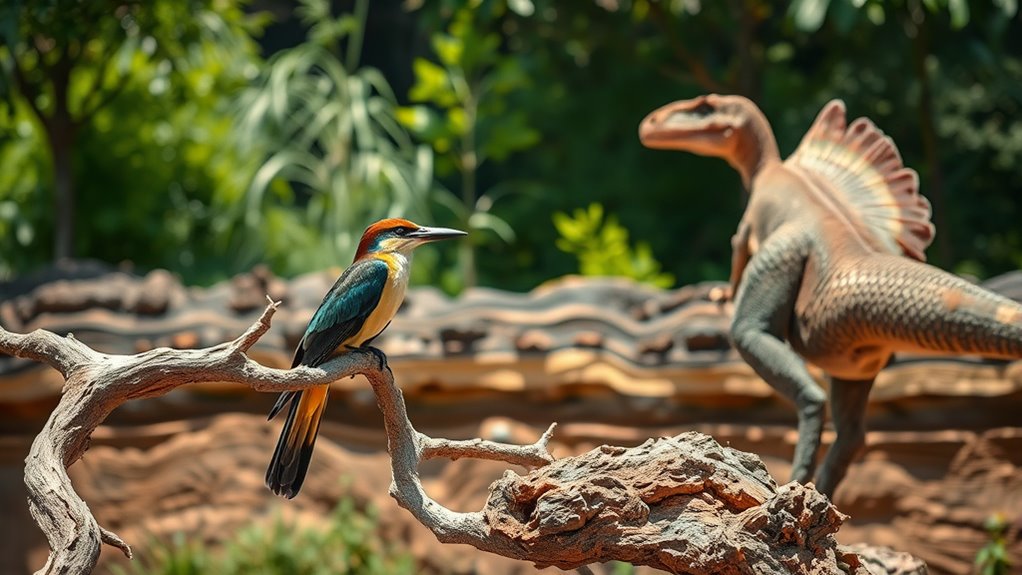

You might be surprised to learn that birds are direct descendants of theropod dinosaurs, sharing many physical features like hollow bones and feathers. Fossil discoveries such as Archaeopteryx showcase the progression from dinosaurs to birds, highlighting their evolutionary link. Scientists have uncovered evidence of shared behaviors and flight adaptations using advanced techniques. To explore how this connection reshapes our understanding of life’s history, keep exploring these fascinating evolutionary links.
Key Takeaways
- Birds evolved from theropod dinosaurs, sharing features like hollow bones and feathered forelimbs.
- Fossil evidence, such as *Archaeopteryx*, shows transitional traits linking dinosaurs and birds.
- Feathers originated for display and insulation, later supporting flight in bird ancestors.
- Similar skeletal structures, including wishbones, demonstrate direct evolutionary connections.
- Advanced imaging and molecular techniques confirm genetic and behavioral links between birds and dinosaurs.
The Ancient Roots of Birds

Birds did not suddenly appear; instead, they evolved from ancient theropod dinosaurs that roamed the Earth millions of years ago. These ancestors already exhibited signs of avian intelligence, such as problem-solving and social behaviors. Over time, their nesting behaviors became more sophisticated, demonstrating parental care and the ability to build complex nests. Establishing a routine These traits laid the groundwork for modern bird survival strategies. You can see how their intelligence helped them adapt to various environments, ensuring the survival of their offspring. The connection between birds and dinosaurs becomes clearer when you recognize these behaviors and traits, which highlight their shared evolutionary history. This ancient link underscores how bird evolution involved gradual changes driven by intelligence and reproductive strategies. Evolutionary traits played a crucial role in shaping their development and survival, emphasizing the importance of behavioral adaptations in their evolutionary success. Additionally, fossil evidence supports the idea that many physical features of birds originated from their dinosaur ancestors, illustrating the deep biological connection.
Key Fossil Discoveries Linking Birds and Dinosaurs

Fossil discoveries have played a pivotal role in revealing the deep evolutionary connection between birds and dinosaurs. One groundbreaking find was the discovery of *Archaeopteryx*, which showcased both dinosaur-like features and early bird traits. More recent fossils, like *Microraptor*, demonstrate the link through preserved feathers and flight adaptations. Additionally, fossils of nesting behaviors, such as well-preserved nests with eggs, reveal that some dinosaurs exhibited complex avian behaviors. These fossils suggest that avian intelligence was developing long before modern birds appeared. By studying these key discoveries, scientists understand how nesting behaviors and other traits evolved gradually, bridging the gap between non-avian dinosaurs and birds. The evidence from fossilized nesting sites provides further insight into the behaviors that may have contributed to the evolution of flight and social structures. These fossils are essential pieces of the puzzle, confirming the close evolutionary relationship we see today.
Shared Physical Traits Between Birds and Theropod Dinosaurs

You’ll notice that both birds and theropod dinosaurs have feathered forelimbs, showing how feathers likely evolved for purposes beyond flight. Their hollow bones also reveal a lightweight structure that helped with movement and agility. These shared physical traits highlight their close evolutionary relationship. Additionally, understanding these features can deepen our appreciation for personal growth and wellness by recognizing the importance of adaptability and resilience in evolution. Recognizing physical adaptations can further enhance our understanding of how evolutionary traits support survival and success. Moreover, these characteristics exemplify how biological features can serve multiple functions, emphasizing the complexity of evolutionary development. The study of AI vulnerabilities also demonstrates the importance of ongoing monitoring and adaptation in technological evolution. Studying resilient traits in ancient species provides insights into how organisms can thrive amidst changing environments.
Feathered Forelimbs Evolution
Have you ever wondered how birds share so many physical features with their dinosaur ancestors? One striking connection is their feathered forelimbs. Fossil evidence shows theropod dinosaurs had proto-feathers on their arms, which later evolved into the complex feathers of birds. These feathers allowed for flight, but they also played roles in thermoregulation and display. As birds developed the ability to migrate, their feathered forelimbs became essential for navigation and endurance. Additionally, the evolution of birdsong is linked to these feathers, as they aid in visual communication and courtship displays. The shared structure of forelimbs highlights how these features adapted over millions of years, bridging the gap between terrestrial dinosaurs and modern birds. This evolution underscores the deep physical and behavioral connections between them.
Hollow Bone Structure
The lightweight, hollow bones found in birds trace back to their theropod dinosaur ancestors, highlighting a shared physical trait that improved both agility and flight capabilities. These bones reduce overall weight, enabling birds to soar and maneuver efficiently, which is essential for complex behaviors like migration. Their avian intelligence, including navigational skills, relies on this skeletal adaptation to sustain long-distance travel. Hollow bones also support the evolution of more dynamic flight patterns, giving birds better control and endurance. This structural link underscores how physical traits influenced behavioral complexity, including migration patterns driven by seasonal changes. Recognizing this shared trait emphasizes the deep evolutionary connection, illustrating how a simple skeletal feature can have profound effects on behavior and survival strategies across millions of years. The development of hollow bone structure was a crucial step that facilitated the transition from non-flying dinosaurs to the highly capable flyers we see today. Additionally, studies suggest that hollow bones may have contributed to the diversification of flight styles among different bird species, further emphasizing their importance in evolutionary history.
The Evolution of Flight and Feathers

The evolution of flight and feathers marks a crucial step in the rise of birds from their dinosaur ancestors. Feathers initially provided insulation and display, but eventually became essential for flight. These adaptations allowed early creatures to glide, then develop powered flight, transforming their survival strategies. As feathers became more specialized, they supported behaviors like avian migration and nest building. You can see how flight influenced these activities—migrating long distances for better resources or finding safe nesting sites. Feathered dinosaurs likely used their wings for balance and display, paving the way for modern birds. The development of lightweight bones and muscular systems further enhanced their flying capabilities. This evolutionary leap set the foundation for the diverse, flight-capable birds we see today. Additionally, the presence of Pimple Patches in skincare routines underscores the importance of targeted solutions in maintaining overall health and appearance.
How Modern Birds Are Direct Descendants of Certain Dinosaurs

Modern birds are direct descendants of certain theropod dinosaurs, sharing many physical features that reveal their common ancestry. You’ll notice similarities in their skeletal structures, such as hollow bones and wishbone-shaped sternums, which support flight. These dinosaurs also exhibited behaviors like nesting and caring for young, paralleling avian behavior today. As they evolved, they adapted to various ecological niches, from forest canopies to open plains, allowing birds to thrive in diverse environments. Their ability to exploit different habitats stems from their evolutionary link to dinosaurs that already occupied complex ecological roles. This connection explains why birds display such a wide range of adaptations, behaviors, and diets, making them true modern representatives of the ancient dinosaur lineage.
Scientific Techniques Uncovering the Dinosaur-Bird Connection

Scientists have developed a variety of techniques to reveal the deep evolutionary links between birds and dinosaurs. By examining fossils and applying advanced methods, researchers uncover clues about avian intelligence and nesting behaviors. For example, CT scans allow you to see inside fossils, revealing brain structures that suggest high avian intelligence. Comparative anatomy shows similarities in bone structures related to flight and feather arrangement. Molecular analysis of preserved proteins helps trace genetic connections. Trace fossils, like nesting sites, demonstrate behaviors shared with modern birds. Additionally, studying fossilized nests and eggs uncovers nesting behaviors that link ancient dinosaurs to their avian descendants. The discovery of feathered dinosaur fossils has been particularly influential in establishing the evolutionary connection. These techniques combine to provide compelling evidence of the evolutionary bridge between dinosaurs and birds, highlighting behaviors and traits that have persisted through millions of years. Advances in paleogenetics are now enabling scientists to analyze ancient DNA fragments, further solidifying these evolutionary links. Furthermore, innovative imaging technologies, such as synchrotron radiation, allow researchers to examine the internal structures of fossils with unprecedented detail, revealing skeletal similarities that reinforce the connection. The integration of Comparative anatomy with molecular data offers a comprehensive understanding of the shared lineage. Recent developments in computational modeling also help simulate dinosaur flight and feather arrangements, providing deeper insights into their relationship with birds.
Implications of This Evolutionary Relationship for Understanding Earth’s History

Understanding the evolutionary link between birds and dinosaurs reshapes our view of Earth’s history by revealing how life on our planet has continually adapted over millions of years. This connection helps us better grasp major events like mass extinctions, which drastically reshaped life’s course. By studying how birds survived past climate change and mass extinctions, you gain insights into resilience and adaptation strategies that shaped evolution. Recognizing that birds are living dinosaurs underscores the importance of biodiversity in Earth’s history, emphasizing how life responds to environmental shifts. This knowledge highlights the importance of protecting ecosystems today, as climate change may trigger future mass extinctions. Additionally, analyzing the development of feathers in some dinosaur species offers clues about the evolution of flight and other complex traits. The variety of dinosaur species that exhibited different adaptations provides further understanding of evolutionary processes. For example, examining fossil evidence allows scientists to reconstruct ancient ecosystems and trace evolutionary pathways. Studying behavioral adaptations in extinct species can also shed light on how survival strategies evolved over time. Furthermore, exploring survival techniques used by ancient species enhances our comprehension of resilience in changing environments. Overall, the relationship between birds and dinosaurs deepens our understanding of life’s persistence amid Earth’s ever-changing climate and catastrophic events.
Frequently Asked Questions
How Do Bird Songs Relate to Dinosaur Communication?
Bird songs directly relate to dinosaur communication through avian vocalization, which evolved from ancient dinosaur calls. When you listen to bird songs, you’re hearing a modern form of this early communication, showcasing the song evolution that dates back millions of years. These vocalizations helped dinosaurs and early birds attract mates and establish territory, shaping the complex behaviors we observe in bird communication today.
Can Bird Behaviors Provide Clues About Dinosaur Social Structures?
You can learn a lot about dinosaur social structures by observing bird behaviors, as about 80% of bird species display complex social systems. Nesting behaviors reveal how they protect and care for offspring, hinting at cooperative strategies among ancient creatures. Flock dynamics show group cohesion and communication, which likely mirrored dinosaur social interactions. These behaviors help us piece together how dinosaurs might have organized and interacted within their communities.
Are There Any Living Reptiles That Resemble Ancient Bird Ancestors?
You’ll notice that some living reptiles, like crocodilians and certain lizards, resemble ancient bird ancestors due to their reptile adaptations and retained ancient reptile traits. Crocodiles, in particular, exhibit features such as powerful jaws, armored bodies, and semi-aquatic lifestyles, echoing traits of early archosaurs. These reptiles give you a glimpse into evolutionary history, showing how ancient reptile traits persisted and evolved into the diverse species you see today.
How Does the Study of Feathers Inform Us About Dinosaur Ecology?
Studying feathers helps you understand dinosaur ecology by revealing details like feather pigmentation, which indicates their environment and behavior, and nesting behaviors, showing how they cared for their young. You can see how some dinosaurs used feathers for display or insulation, shedding light on their social lives. This evidence helps you piece together their habits, habitats, and evolutionary adaptations, painting a clearer picture of their role in ancient ecosystems.
What Role Did Climate Change Play in Bird and Dinosaur Evolution?
Climate change acted as a powerful sculptor, shaping bird and dinosaur evolution through its relentless climate impact. You see, shifting temperatures and environmental conditions prompted evolutionary adaptations, forcing species to survive or perish. These changes drove diversification, guiding dinosaurs to adapt to new habitats and eventually helped birds evolve flight and other traits. Fundamentally, climate change was a catalyst, pushing evolution forward as life responded to the planet’s ever-changing face.
Conclusion
You might be surprised to learn that over 1,000 dinosaur species have been discovered, and many share features with modern birds. This evidence confirms that birds are direct descendants of theropod dinosaurs, giving you a new perspective on life’s history. Recognizing this link not only rewrites what you thought about dinosaurs, but also highlights the incredible story of evolution. It’s a fascinating reminder that the ancient past still influences the world you see today.