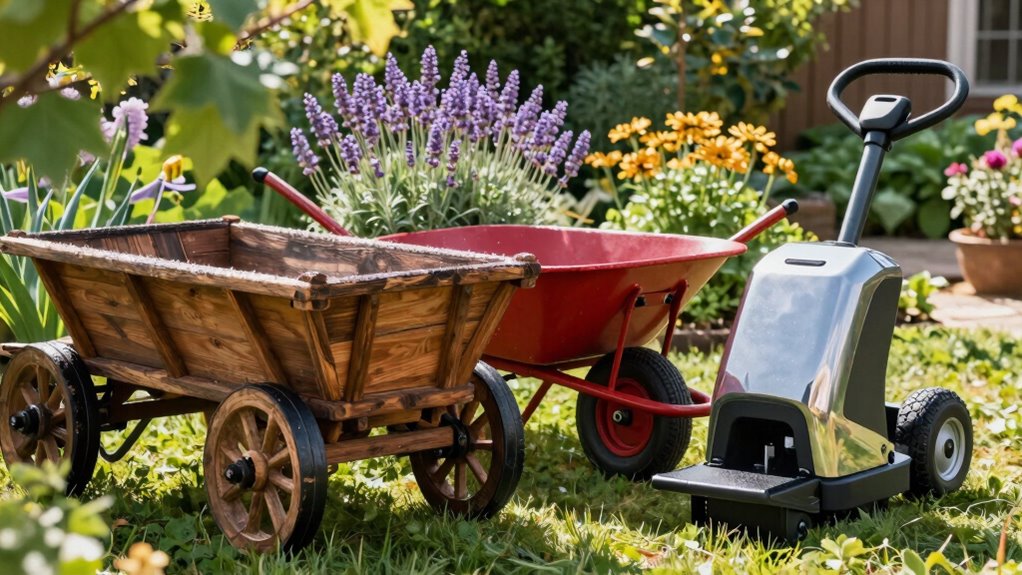
When you’re deciding between a garden cart, wheelbarrow, or electric hauler, think about your needs. Wheelbarrows are great for tight spaces and rough terrains, but require more physical effort. Garden carts balance maneuverability and capacity, making them user-friendly. If you’ve got heavy loads and less mobility, electric haulers are your best bet, though they need more storage space. Each option has its strengths, so stick around to find out which one fits your gardening style best.
Key Takeaways
- Maneuverability: Wheelbarrows are best for tight spaces, while garden carts offer stability and electric haulers handle larger loads but are less agile.
- Terrain Adaptability: Wheelbarrows excel on rough terrain, garden carts provide stability, and electric haulers easily navigate tough conditions.
- Ease of Use: Electric haulers require less physical effort, garden carts are easier to manage than wheelbarrows, which demand more strength.
- Cargo Capacity: Electric haulers can carry the heaviest loads, garden carts balance capacity and maneuverability, while wheelbarrows have the least capacity.
- Storage Considerations: Wheelbarrows are compact for storage, garden carts often fold, while electric haulers need more space for storage.
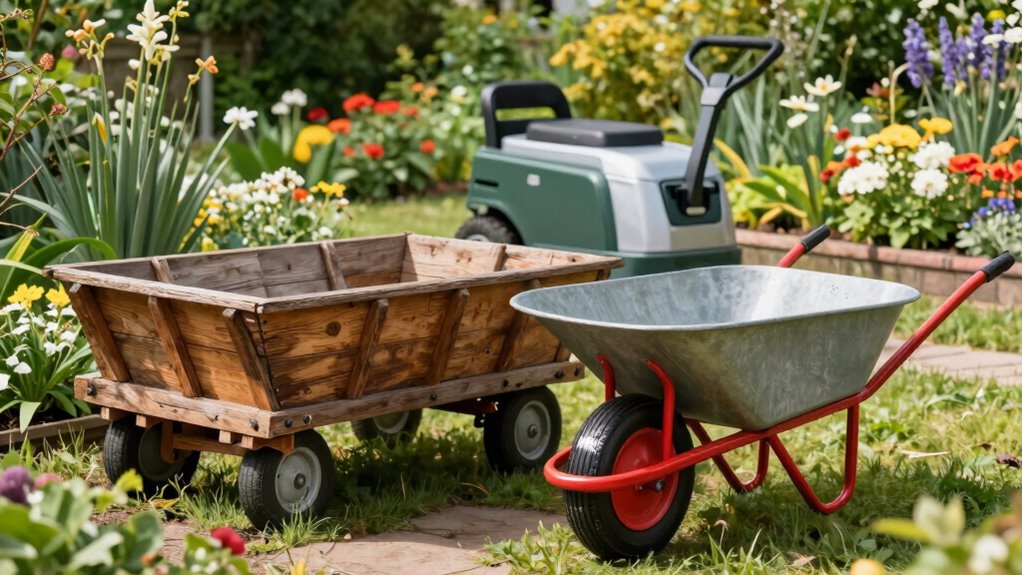
When it comes to transporting garden supplies, you’ve got options: garden carts, wheelbarrows, and electric haulers. Each has its strengths, and choosing the right one depends on what you need. If you’re hauling heavy loads, you might want to look at the cargo capacity of each option. Wheelbarrows typically carry less weight but excel in tight spaces. Electric haulers can handle larger loads with ease, while garden carts often strike a balance between the two.
Let’s explore the maneuverability comparison. Wheelbarrows are designed for agility, making them perfect for traversing narrow paths or crowded gardens. You can easily pivot and turn, thanks to their single wheel. However, this design can lead to challenging weight distribution, especially when the load is uneven. On the other hand, garden carts come with two or four wheels, offering greater stability. This means you won’t have to worry as much about tipping over, and you can transport bulkier items with confidence. Electric haulers, while powerful, can be a bit cumbersome in tight spaces, but they shine in open areas where their strength can be fully utilized. Incorporating urban farming innovations like powered electric haulers has expanded their capabilities in various environments.
Terrain suitability is another significant factor. If your garden’s got rough or hilly terrain, wheelbarrows can handle those challenges with their maneuverability, although it might require more physical effort on your part. Garden carts often feature larger tires and a lower center of gravity, providing stability on uneven ground. Additionally, terrain adaptability ensures that your chosen tool remains effective regardless of the landscape. Electric haulers, with their robust build, can tackle tough terrains without breaking a sweat, but you’ll need to reflect on where you’ll store them since they can be bulky. Proper terrain considerations can help in selecting the most suitable equipment for your garden’s unique landscape.
Ease of use is important too. Wheelbarrows demand a bit more physical strength, while garden carts are generally easier to push or pull. Electric haulers take convenience to the next level, allowing you to transport heavy loads with minimal effort, but they require charging and maintenance. If ergonomic features are prioritized, you might find that some models are designed to reduce strain during extended use. Additionally, considering ergonomic design can make a big difference in reducing fatigue during prolonged use. Finally, think about storage options. Wheelbarrows can be easily stored in small spaces, while garden carts often fold up for compact storage. Electric haulers may require more space, so contemplate your garden’s layout.
Each option has its pros and cons, but with the right choice, you’ll find transporting your garden supplies a breeze.

VEVOR Heavy Duty Steel Garden Cart 900 lbs Garden Wagon Cart on Wheels
- Load Capacity: 900-lb capacity for heavy items
- Multipurpose Design: Convertible from cart to flatbed
- Durable Construction: Heavy-duty steel for stability
As an affiliate, we earn on qualifying purchases.
As an affiliate, we earn on qualifying purchases.
Frequently Asked Questions
What Materials Are Garden Carts Typically Made From?
Garden cart materials typically include steel, plastic, and wood. Steel carts are durable and can handle heavy loads, while plastic carts are lightweight and rust-resistant, making them easy to maneuver. Wood offers a classic look but may require more maintenance. When choosing among garden cart types, consider your needs—whether you prioritize strength, ease of use, or aesthetics. Each material has its benefits, so pick one that suits your gardening style best.
How Do I Maintain My Wheelbarrow for Longevity?
To maintain your wheelbarrow for longevity, keep it clean and dry after each use. Inspect the tire pressure regularly and replace worn-out tires promptly. Lubricate the wheel bearings and check for rust; a little anti-corrosive spray can go a long way. Invest in wheelbarrow accessories like a protective cover and a sturdy liner to enhance durability. By following these wheelbarrow maintenance tips, you’ll guarantee it lasts for years to come.
Can Electric Haulers Handle Rough Terrain?
Yes, electric haulers can handle rough terrain challenges effectively. Their design often includes sturdy wheels and robust suspension systems, enhancing electric hauler performance on uneven ground. You’ll find that many models are built to navigate obstacles like rocks and roots, making them versatile for various outdoor tasks. Just guarantee you choose one specifically rated for the type of terrain you’ll encounter, and you’ll maximize its capabilities for any job.
What Is the Weight Capacity of a Standard Garden Cart?
Most standard garden carts can handle weight limits ranging from 300 to 600 pounds, depending on the model. When you’re tackling various garden tasks, knowing the weight capacity helps you avoid overloading and potential damage. It’s essential to choose one that fits your specific needs, ensuring you can transport soil, plants, or tools efficiently. So, always check the specifications before making a purchase to get the best performance out of your cart.
Are Electric Haulers Environmentally Friendly?
Yes, electric haulers can be environmentally friendly. They often use battery efficiency to reduce emissions, making them a sustainable choice for transporting materials. By opting for electric over gas-powered options, you’re not just cutting down on pollution; you’re also supporting cleaner energy sources. Plus, many models are designed to be energy-efficient, ensuring you get the most out of each charge while minimizing your carbon footprint. It’s a smart step toward sustainability!
Conclusion
When it comes to choosing between a garden cart, wheelbarrow, or electric hauler, consider your needs, your space, and your energy. If you want versatility, go for a garden cart; if you seek strength, a wheelbarrow’s your best bet; if you crave convenience, an electric hauler will save you time. Each option has its strengths, each serves its purpose, and each can make your gardening tasks easier. Pick the one that fits your style and get to work!