The success of the ozone layer recovery shows that international cooperation, science-driven policies, and long-term efforts can effectively solve complex environmental problems. By phasing out harmful chemicals through agreements like the Montreal Protocol, we’ve seen measurable improvements in ozone health. This story teaches that coordinated global action, backed by scientific evidence, can bring positive change. Staying committed now can help us learn how similar strategies could address other pressing environmental issues.
Key Takeaways
- International cooperation, exemplified by the Montreal Protocol, successfully reduced ozone-depleting chemicals, demonstrating effective global environmental action.
- Scientific monitoring and evidence-guided policies are crucial for tracking progress and ensuring environmental recovery.
- Long-term commitment and sustained efforts can reverse environmental damage once deemed irreversible.
- The ozone recovery story highlights the importance of responsible human choices and policy enforcement in protecting the planet.
- The success offers a model for addressing other environmental challenges, emphasizing science, collaboration, and perseverance.
How the Ozone Hole Came to Be

The ozone hole developed primarily because of human activities that released ozone-depleting substances into the atmosphere. During the mid-20th century, industries used chemicals like chlorofluorocarbons (CFCs) in refrigeration, air conditioning, and aerosol sprays. These chemicals are stable in the lower atmosphere but rise into the stratosphere, where they are broken down by UV rays, releasing chlorine and bromine atoms. These atoms then attack ozone molecules, causing their destruction. Since the ozone layer protects life on Earth from harmful ultraviolet radiation, its depletion resulted in increased skin cancers and ecological damage. The Antarctic region is especially vulnerable because of its extremely cold temperatures, which foster conditions that accelerate ozone loss. Human activities, thus, directly contributed to the formation of the ozone hole.
The Role of Human Activities in Ozone Depletion

Human activities have played a central role in causing ozone depletion by releasing harmful chemicals into the atmosphere. You might not realize it, but your everyday choices contributed to this environmental crisis. Here are three key ways:
Human actions significantly contribute to ozone depletion through chemical emissions and everyday choices.
- Releasing chlorofluorocarbons (CFCs) from aerosols and refrigerants, which damage ozone molecules.
- Industrial processes that emitted halons and carbon tetrachloride, intensifying ozone layer thinning.
- Improper waste disposal and use of chemicals in manufacturing, adding to ozone-depleting substances in the atmosphere.
These human actions increased the concentration of harmful chemicals, which rose into the stratosphere and broke down ozone molecules. Understanding this helps you see how human behavior directly impacts the environment and underscores the importance of responsible choices.
International Action: The Montreal Protocol

International cooperation played a crucial role in addressing ozone depletion through the Montreal Protocol, a landmark treaty established in 1987. You see, this agreement brought countries together to phase out the production and use of ozone-depleting substances like CFCs. Because of this unified effort, global consumption of these harmful chemicals has dropped by over 50% since 1986. Countries quickly adopted the treaty, demonstrating how collective action can tackle environmental crises. The treaty’s success is evident in the stabilization and gradual recovery of the ozone layer. Scientific research provided clear evidence that reductions in ozone-depleting chemicals directly led to positive changes. The Montreal Protocol proves that when nations unite with a common goal, they can make meaningful progress toward saving our planet. Ozone layer recovery is now underway thanks to these global efforts, highlighting the importance of international environmental agreements and their role in fostering global cooperation.
Tracking the Ozone Layer’s Recovery
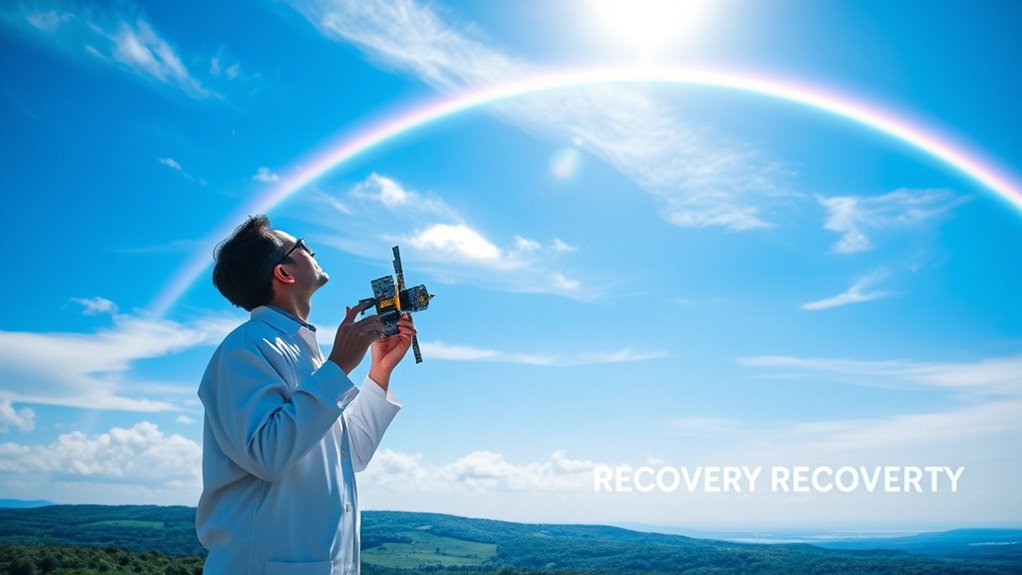
You can see how scientists track the ozone layer’s recovery using satellite monitoring techniques that measure ozone hole size over time. By analyzing patterns in ozone depletion and recovery, they identify specific signs that show progress. These methods allow researchers to confidently assess whether policies like the Montreal Protocol are working. Additionally, advancements in remote sensing technology have greatly improved the precision of these observations. The evolution of data analysis algorithms has further enhanced the ability to interpret complex satellite data accurately. Modern monitoring methods incorporate machine learning to detect subtle changes, providing more reliable data for policy decisions. Furthermore, integrating scientific data with environmental models helps predict future ozone layer behavior under various scenarios. Enhanced data accuracy from improved sensors also contributes to more reliable trend analysis and policy evaluation.
Satellite Monitoring Techniques
Satellite monitoring techniques play a crucial role in tracking the recovery of the ozone layer by providing continuous, precise measurements of ozone concentrations over time. These techniques include advanced sensors and instruments mounted on satellites that orbit Earth, capturing detailed data across the globe. Here’s how they help:
- They regularly gather high-resolution images of the ozone layer, allowing scientists to monitor changes year after year.
- They detect specific patterns in ozone concentration, helping identify areas of recovery or persistent depletion.
- They enable real-time analysis of ozone trends, which informs policy decisions and international cooperation efforts. This is essential for implementing effective environmental policies based on accurate data.
- These methods also utilize security features, such as password protection and data encryption, to ensure the integrity and confidentiality of the collected information.
With satellite data, scientists can confidently track the ozone layer’s health and measure the success of global initiatives like the Montreal Protocol.
Ozone Depletion Patterns
Tracking the recovery of the ozone layer involves identifying specific patterns in ozone concentration changes over time. You can observe this through data showing how ozone levels fluctuate annually, especially during the Antarctic spring. Over decades, scientists noted a distinct pattern: the ozone hole expanded rapidly until around 2000, then gradually shrank as emissions decreased. This pattern reflects the effectiveness of international policies like the Montreal Protocol. The table below highlights key trends:
| Year | Ozone Hole Size (million km²) | Key Observation |
|---|---|---|
| 2000 | 28.4 | Largest extent recorded |
| 2010 | 21.0 | Signs of beginning recovery |
| 2020 | 15.0 | Continued shrinking |
| 2022 | 13.5 | Near historic lows |
| 2024 | 20.0 | Slight increase, overall decline |
This pattern signals ongoing healing, confirming the positive impact of global efforts. Additionally, monitoring techniques have become more sophisticated, providing more precise data to track the ozone layer’s health. The ongoing scientific research continues to support the importance of international cooperation in environmental preservation.
Signs of Recovery
One of the clearest indicators of the ozone layer’s recovery is the emergence of a distinct “fingerprint” pattern in scientific data. As ozone-depleting substances decline, researchers observe specific changes that confirm healing. Here’s what to look for:
- Growing Clarity: Satellite data from 2005 onward shows a more defined recovery pattern, matching predictions from environmental models.
- Confidence Levels: By 2018, scientists were 95% sure that reductions in chemicals caused the ozone layer to improve.
- Smaller Ozone Holes: The 2024 ozone hole ranked as the seventh smallest since 1992, measuring nearly 20 million square kilometers—signaling ongoing recovery.
- Monitoring Techniques: The use of performance cookies helps scientists analyze data trends more effectively, ensuring accurate assessment of the ozone layer’s health.
These signs reveal that international efforts and scientific monitoring are effectively restoring the ozone layer.
Scientific Evidence Confirming Ozone Healing

Scientific evidence has increasingly confirmed that the ozone layer is healing, thanks to advances in observation and analysis techniques. Researchers now use satellite data, which provides detailed, real-time measurements of ozone concentrations worldwide. By comparing these observations with computer simulations, scientists identify a specific “fingerprint” pattern of ozone recovery. Over time, this pattern has grown clearer, allowing experts to attribute ozone healing directly to reductions in ozone-depleting substances. By 2018, there was a 95 percent confidence that the decline in harmful chemicals was responsible for the observed recovery. Recent measurements, including the smaller size of the 2024 ozone hole, further validate that the ozone layer is gradually strengthening. This scientific proof demonstrates the tangible success of global efforts to repair the ozone recovery process, especially as improved observation techniques enable more precise tracking of environmental changes. The integration of AI security technologies in environmental monitoring enhances the accuracy and efficiency of data analysis, supporting ongoing recovery efforts. Additionally, ongoing research into environmental monitoring methods continues to improve our understanding of ozone layer dynamics, providing new insights into climate change mitigation.
The Timeline of Ozone Depletion and Rebound

The timeline of ozone depletion and rebound reveals how the ozone layer has changed over the past decades. You can see this through key milestones.
- The ozone hole expanded rapidly from the 1970s to its largest size around 2000, reaching about 28.4 million square kilometers.
- After the implementation of the Montreal Protocol in 1987, emissions of ozone-depleting substances dropped sharply, and by 2000, the ozone hole stopped expanding.
- In recent years, the ozone hole has steadily shrunk, with 2024 marking its seventh smallest size since recovery began in 1992.
- Scientific research and satellite data clearly track this progress, demonstrating how global environmental efforts with energetic alignment can influence positive outcomes. Scientific monitoring continues to provide valuable insights into the ozone recovery process, reinforcing the importance of sustained action.
- The ongoing recovery of the ozone layer highlights the importance of sustainable policies and continued international cooperation to protect the environment. Additionally, the success of this recovery demonstrates the effectiveness of regulatory measures, serving as a model for addressing other environmental issues.
Projected Future of the Ozone Layer

Projections indicate that the ozone layer could fully recover by around 2066 if current policies and efforts remain in place. Continued adherence to the Montreal Protocol is vital for this timeline. As recovery progresses, you might see fewer ozone holes and more stable ozone levels globally. Occasional years may experience small fluctuations, but overall, the trend remains positive. Scientific models show that, by mid-century, the ozone layer should return to pre-1980 conditions. This recovery depends on sustained international cooperation and policy enforcement. Understanding the environmental recovery process can help us appreciate the importance of ongoing global efforts. Here’s a visual overview: sound design techniques can be used to effectively communicate these environmental changes through multimedia presentations.
Lessons Learned From the Ozone Recovery Movement

The recovery of the ozone layer offers valuable lessons about how international cooperation and strong policies can solve complex environmental problems. First, you see that binding agreements like the Montreal Protocol can unite countries to act swiftly and effectively. Second, scientific research is vital; it provides clear evidence and specific “fingerprints” that track progress and confirm success. Third, long-term commitment matters—persistent efforts over decades can reverse damage once seen as irreversible. These lessons show that coordinated global action, backed by science, can bring about real environmental change. They also highlight that even in the face of severe issues, determined cooperation and policy can restore balance—offering hope for tackling other urgent environmental challenges.
Applying the Ozone Success Model to Other Environmental Challenges

To address other environmental issues, you should prioritize strong international cooperation, just like with the ozone layer. Scientific monitoring tools are essential for measuring progress and guiding policy decisions. Committing to long-term policies guarantees sustained effort and real change, making success achievable over time.
International Cooperation Effectiveness
How effective is international cooperation when tackling global environmental challenges? It’s proven vital in the ozone story. You see, the Montreal Protocol united countries to cut harmful emissions. Here’s what made it work:
- Strong international agreement that bound nations to specific targets.
- Shared scientific knowledge that identified clear “fingerprints” of ozone depletion and recovery.
- Long-term commitment through continuous monitoring and policy adjustments.
This collaborative approach led to rapid emission reductions, showing how collective action can resolve complex problems. The success demonstrates that when countries work together, guided by science and sustained policies, they can achieve impressive environmental victories. Applying this model to issues like climate change could bring similar positive outcomes.
Scientific Monitoring Tools
Scientific monitoring tools played a crucial role in tracking the ozone layer’s recovery, providing precise, real-time data on ozone concentrations and the size of the ozone hole. Satellite instruments like NASA’s Aura and ESA’s Sentinel satellites collect high-resolution images and measurements that reveal subtle changes over time. These tools help you see the ozone hole’s expansion and contraction, enabling accurate trend analysis. Atmospheric sensors and ground-based stations complement satellite data, offering detailed local observations. By analyzing these data, you can identify specific “fingerprints” of ozone depletion and recovery, establishing clear links between policy actions and environmental outcomes. This scientific approach allows you to confidently assess progress, making informed decisions and adjustments. Such monitoring techniques proved essential in overcoming the ozone crisis and serve as a model for other environmental challenges.
Long-term Policy Commitment
Long-term policy commitment is essential for translating environmental science into lasting change, as demonstrated by the ozone layer recovery. Your dedication over decades shows how sustained efforts create real impact. Here’s what it takes:
- Consistent international cooperation, like the Montreal Protocol, ensures countries stay aligned.
- Maintaining policies over time prevents setbacks and keeps progress on track.
- Regular scientific monitoring confirms that policies work and guides adjustments.
Frequently Asked Questions
How Long Did It Take for the Ozone Layer to Start Showing Signs of Recovery?
You’ll notice signs of ozone recovery starting around 2000, about 13 years after the peak size of the ozone hole in 1987. Once emissions of ozone-depleting substances decreased markedly due to international efforts like the Montreal Protocol, the ozone layer began to heal. By 2000, satellite data showed the ozone hole stopped expanding, and gradual signs of recovery became clear, with full recovery projected around 2066.
What Specific Policies Helped Accelerate the Ozone Layer’s Healing Process?
You should know that a 50 percent reduction in ozone-depleting gases by 2022 played a key role in accelerating healing. The Montreal Protocol, enacted in 1987, was the most effective policy, driving global cooperation to cut harmful chemicals like CFCs. By establishing binding international agreements, it assured rapid compliance, demonstrating that coordinated policies can successfully restore environmental health, even after decades of damage.
Are There Any Remaining Challenges Hindering the Ozone Layer’s Full Recovery?
Yes, some challenges still hinder full recovery. You need to monitor illegal production and trade of ozone-depleting substances, which can undermine progress. Additionally, climate change affects the ozone layer, causing unexpected fluctuations. Delays in replacing outdated equipment and ensuring compliance in all countries also pose risks. Continued research, international cooperation, and strict enforcement are essential to overcoming these hurdles and achieving complete ozone layer recovery.
Can the Ozone Layer Fully Recover Without Continued International Cooperation?
Nope, the ozone layer can’t fully recover without international cooperation—it’s that simple. If you think nations will suddenly stop caring once the ozone heals, think again. Continued global effort is essential to keep ozone-depleting substances at bay, or else history might repeat itself. The atmosphere’s not a free-for-all; it needs teamwork, policies, and commitment, or we’ll be right back where we started—fighting over a thin, fragile shield.
How Can the Success of Ozone Recovery Influence Climate Change Mitigation Efforts?
Your actions can substantially influence climate change mitigation by showing that international cooperation and scientific research work. Just like the ozone recovery, global efforts to reduce emissions and follow binding agreements can create real change. By supporting policies, reducing your carbon footprint, and advocating for sustainable practices, you help build momentum. Your involvement demonstrates that collective action and long-term commitment are essential to tackling environmental challenges effectively.
Conclusion
The ozone story is a shining lighthouse guiding you through complex environmental challenges. It shows that, with timely action and global cooperation, even the deepest damage can begin to heal. Think of it as tending a delicate garden—you must nurture, protect, and work together to see it flourish again. By learning from this success, you hold the power to steer other environmental issues toward a healthier, brighter future.