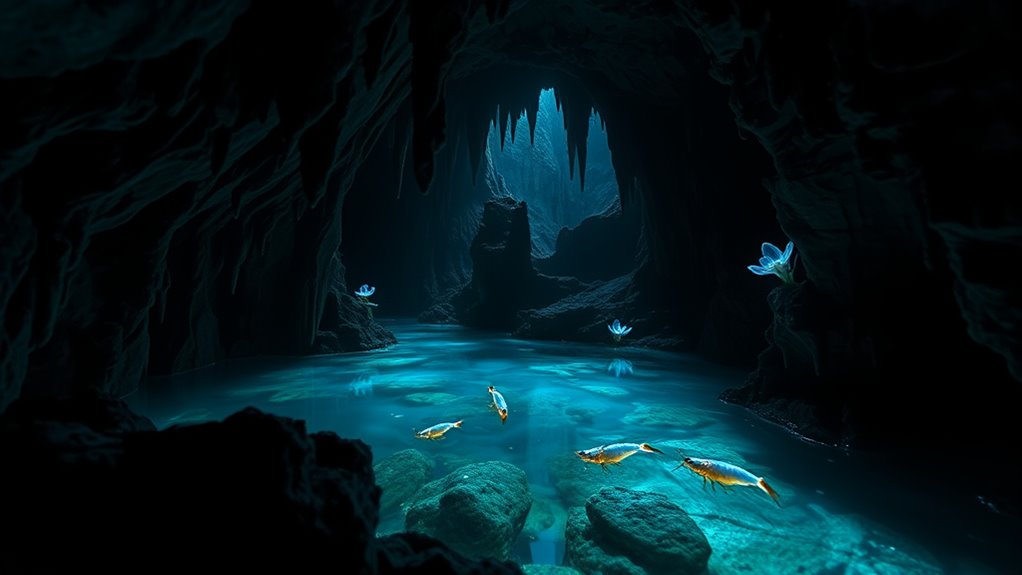

In cave ecosystems, animals adapt uniquely to eternal darkness by losing pigmentation and eyes, developing sensitive antennae or whiskers, and sometimes creating bizarre mouthparts. They rely on touch, vibrations, and chemical cues for survival, conserving energy with slow movements and reduced activity. Their environment’s stability and scarcity of food lead to slow growth, lipid storage, and specialized behaviors. If you keep exploring, you’ll uncover how these creatures and their habitats have evolved remarkable solutions to life without sunlight.
Key Takeaways
- Cave organisms exhibit unique adaptations like loss of pigmentation and eyes, relying on enhanced non-visual senses for survival.
- They use chemical cues, vibrations, and tactile senses to navigate and find food in perpetual darkness.
- Nutrient input from surface ecosystems sustains cave life, supporting microbial communities and specialized invertebrates.
- Energy conservation strategies, such as slow movement and lipid storage, are vital due to limited resources.
- Human activities threaten these fragile ecosystems, making conservation essential for preserving cave biodiversity.
Unique Physical Traits of Cave-Dwelling Animals

Cave-dwelling animals exhibit striking physical traits that set them apart from their surface counterparts. You’ll notice they often lack pigmentation, giving them a pale or albino appearance because they don’t need camouflage or UV protection in perpetual darkness. Many have reduced or completely lost eyes, as sight becomes useless underground. Instead, they rely on enhanced non-visual senses; for example, fish may detect vibrations with lateral lines, while invertebrates develop elongated antennae to sense their environment. Morphologically, you might observe bizarre mouthparts adapted for specialized feeding and silk-secreting legs or defensive chemical nozzles for survival. These adaptations enable cave animals to thrive in a harsh, resource-scarce environment, highlighting how evolution molds their bodies to meet the challenges of eternal darkness and limited resources. Additionally, many cave species demonstrate unique sensory adaptations that allow them to navigate and find food without sight, emphasizing the importance of specialized sensory capabilities in such extreme habitats. Such sensory evolution underscores the importance of adaptation in survival within extreme environments.
Environmental Factors Shaping Cave Life

The physical adaptations of cave animals are shaped by the unique environmental conditions they face underground. You’ll notice the perpetual darkness eliminates reliance on vision, leading to the loss of eyes and pigmentation. Instead, these creatures develop heightened non-visual senses like vibration detection or elongated antennae to find food and avoid predators. The stable environment with constant temperature, high humidity, and limited water circulation influences their physiology, often resulting in lower metabolic rates to conserve energy. Nutrient scarcity from limited external input further drives adaptations like lipid storage and slow movements, maximizing energy efficiency. Additionally, the oxygen levels can be low, prompting some species to reduce oxygen needs. These environmental factors collectively shape the unique biological traits that enable cave dwellers to survive in such extreme, resource-limited conditions. Furthermore, the environmental factors underscore how natural selection favors specialized adaptations that ensure survival in these isolated habitats. The energy conservation strategies observed in cave animals exemplify how organisms adapt to prolonged resource scarcity and environmental extremes. Recognizing the importance of environmental stability helps explain the remarkable resilience of cave ecosystems in maintaining life under harsh conditions. Moreover, biological adaptations such as slow growth rates and reproductive strategies are crucial for persistence in these challenging environments.
Food Web Dynamics in Darkness
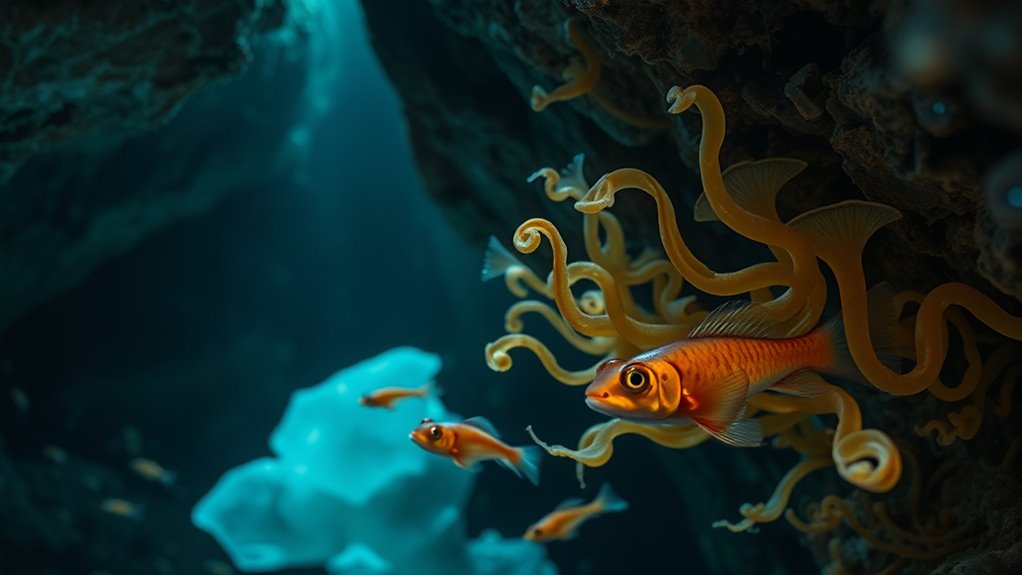
In the perpetual darkness of cave ecosystems, energy flows through a specialized and tightly interconnected food web that relies entirely on external organic inputs. You’ll find that nutrients enter mainly as leaf litter, animal waste, or guano from surface animals, supporting bacteria and fungi that form the foundation of the web. Small invertebrates feed on these microbes, creating a primary consumer level. These invertebrates then serve as prey for larger species like salamanders, crustaceans, and fish adapted for low oxygen environments. Since sunlight doesn’t power photosynthesis, energy transfer depends on external organic matter, making the web fragile and dependent on surface ecosystems. The organisms have evolved behaviors to conserve energy, and nutrient flow remains limited, reinforcing the web’s simplicity and specialization. The web’s reliance on external organic inputs makes it particularly vulnerable to changes in surface conditions and pollution. Additionally, the interconnected nature of the web highlights the importance of maintaining healthy surface environments for the stability of cave life. Modern noise levels of equipment used in cave research are designed to minimize disturbance to these sensitive environments. Recognizing the importance of regional conservation efforts can help protect these fragile ecosystems from external threats. Moreover, understanding the microbial communities within caves can shed light on their vital roles in nutrient cycling and ecosystem stability.
Evolutionary Changes Driven by Darkness

Darkness exerts a powerful influence on the evolutionary trajectory of cave species, driving significant morphological and behavioral changes. You’ll notice that many lose pigmentation and develop a ghostly, albino appearance because coloration isn’t needed in eternal darkness. Eyes often diminish or disappear altogether, as vision becomes useless. Instead, these animals enhance their non-visual senses—elongated antennae, lateral lines, or vibration detection—allowing them to find food and avoid predators effectively. Lower metabolic rates evolve to conserve scarce energy resources, and physiological traits like lipid storage support survival during food shortages. Morphological adaptations, such as bizarre mouthparts or silk-secreting legs, develop to meet specialized feeding and survival needs. These changes showcase how darkness shapes organisms’ forms and functions over generations, demonstrating the profound impact of evolutionary pressures in subterranean environments. Additionally, research into adaptation mechanisms reveals the remarkable ways organisms optimize survival strategies in perpetual darkness. Understanding these evolutionary responses helps scientists appreciate how species can drastically alter their biology to thrive in extreme environments. Moreover, the development of sensory organs exemplifies how organisms can reallocate resources to enhance survival in extreme habitats. This is further supported by the fact that environmental interactions strongly influence developmental changes, leading to highly specialized traits suited for life in darkness.
Behavioral and Physiological Adaptations

You’ll see that cave animals conserve energy through behaviors like slow movement and reduced activity, helping them survive long periods without food. They also enhance their senses, relying on vibrations or elongated antennae to detect prey and avoid predators in complete darkness. To cope with limited resources, these creatures lower their metabolic rates and store energy as lipids, ensuring they can endure food scarcity. Additionally, some species develop specialized sensory adaptations that allow them to navigate and find food effectively in the absence of light. These adaptations often include enhanced tactile perception, allowing them to better interpret their environment through touch, and they may also utilize energy conservation strategies to extend survival during times of extreme food shortage. Recognizing the importance of vibrational sensitivity, these animals can detect subtle environmental cues to locate food or avoid threats in their dark habitats. Furthermore, some cave dwellers have evolved to have reduced eyesight or even blindness, relying entirely on other senses for survival.
Energy-Conserving Behaviors
Animals living in cave ecosystems have evolved a variety of energy-conserving behaviors and physiological adaptations to survive in environments where food is scarce and resources are limited. You’ll notice they move slowly or intermittently, reducing energy expenditure during foraging. Many species lower their metabolic rates, allowing them to survive longer without food, while storing high-energy lipids to sustain themselves. Some animals produce fewer offspring, conserving energy for survival. You may observe behaviors like minimal territoriality or reduced activity levels to avoid unnecessary energy use. These adaptations help them endure extended periods of starvation and limited resources. Their physiological traits, combined with cautious behaviors, make them highly efficient at conserving energy in the challenging, resource-scarce conditions of the cave environment. Additionally, some species utilize specialized physiological mechanisms such as enhanced fat storage or metabolic suppression to further optimize energy conservation. Furthermore, these animals often exhibit behavioral flexibility, allowing them to adapt their activity patterns in response to the availability of resources.
Sensory Enhancement Strategies
In the perpetual darkness of cave environments, species have developed remarkable sensory enhancement strategies to navigate, locate food, and detect predators. You rely less on sight and more on heightened non-visual senses. Many species have elongated antennae or whiskers that detect vibrations and chemical cues in the environment. Fish and invertebrates may possess lateral lines or sensitive touch organs to sense water movements. Echolocation, used by some cave bats, allows precise navigation and hunting in total darkness. These adaptations improve your ability to find resources and avoid threats despite limited or no vision. Physiological changes, like increased density of sensory cells, bolster these capabilities. Overall, your sensory systems become finely tuned, compensating for the absence of light and ensuring survival in the challenging cave environment.
Metabolic Rate Adjustments
To survive in the nutrient-scarce environment of caves, organisms have evolved to markedly lower their metabolic rates, conserving energy until food becomes available. This adaptation helps them endure long periods without nourishment. You’ll notice they do this through various means:
- Reducing activity levels, such as slow or intermittent swimming, to lower energy use
- Increasing lipid stores, providing energy reserves during scarcity
- Producing fewer offspring, minimizing energy investment in reproduction
- Developing physiological traits like oxygen efficiency to survive in low-oxygen conditions
These adjustments allow cave dwellers to survive extended periods without food, optimizing energy use in a hostile environment. Their metabolic slowdown is a key survival strategy that balances energy expenditure with the limited resources available.
Challenges and Conservation of Cave Ecosystems
Human activities, like tourism and resource extraction, threaten cave ecosystems by disrupting fragile habitats and altering environmental conditions. Protecting this unique biodiversity requires safeguarding both the caves and their surrounding surfaces to guarantee nutrient flow remains uninterrupted. Addressing these challenges is essential to preserve the specialized species that depend on these ecosystems for survival.
Human Impact Threats
Despite their remote and stable environments, cave ecosystems face increasing threats from human activities that jeopardize their delicate balance. You might inadvertently introduce pollutants, disturb sensitive species, or cause physical damage through tourism or resource extraction. Human impact includes:
- Pollution from chemicals, sewage, or trash entering cave systems, harming fragile organisms.
- Habitat destruction caused by construction, mining, or land development near cave entrances.
- Disturbance from frequent human visits, which can alter behaviors and increase stress on species.
- Introduction of invasive species that compete with or prey on native cave fauna, disrupting existing food webs.
These threats threaten the unique adaptations and low reproductive capacity of cave species, underscoring the need for careful management and protection efforts to preserve these hidden ecosystems.
Protecting Unique Biodiversity
Protecting the unique biodiversity of cave ecosystems presents significant challenges due to their delicate and specialized nature. These habitats host species with highly adapted traits that are vulnerable to disturbances. Human activities like tourism, pollution, and land development threaten their fragile balance. To mitigate these risks, you must focus on safeguarding both the caves and surrounding environments that supply nutrients. Implementing strict access control, monitoring, and habitat restoration are essential steps. Below is a table highlighting key conservation strategies:
| Strategy | Focus Area | Outcome |
|---|---|---|
| Restricted access | Minimize human impact | Preserve delicate habitats |
| Habitat restoration | Repair damaged cave features | Support biodiversity resilience |
| Surface ecosystem protection | Maintain nutrient flow | Sustain food sources for cave species |
| Education and regulation | Raise awareness and laws | Reduce harmful activities |
Maintaining Nutrient Sources
Maintaining the delicate balance of nutrient sources in cave ecosystems presents significant challenges because these environments rely heavily on external organic input to sustain their unique communities. Without sunlight, energy depends on organic matter like leaf litter, animal droppings, or carcasses entering the cave. This limited input creates a fragile food web that supports specialized species. To understand this better, consider that:
- Organic detritus fuels bacterial and fungal growth at the base of the food chain.
- Small invertebrates feed on these microbes, serving as prey for larger animals.
- Nutrients mainly originate from surface ecosystems, making caves vulnerable to surface disturbances.
- Even minor changes in surface land use can drastically impact nutrient flow and cave biodiversity.
Preserving nutrient sources is vital to maintain these delicate, interconnected systems.
Frequently Asked Questions
How Do Cave Animals Communicate Without Visual Cues?
You might notice that cave animals communicate without visual cues by relying on other senses. They use vibrations, sound waves, or chemical signals to send messages. For example, fish detect water vibrations, while invertebrates use scent trails or chemical cues. These methods are highly effective in darkness, allowing them to find mates, warn of predators, or coordinate hunting, all without needing sight.
What Genetic Mechanisms Underlie Regressive Traits Like Eye Loss?
You see, gene regulation plays a key role in eye loss, where mutations deactivate or silence genes responsible for eye development. You might notice changes in signaling pathways like Sonic hedgehog, which suppress eye formation. Over generations, natural selection favors these mutations because maintaining eyes is energetically costly in darkness. This genetic mechanism results in regressive traits, like reduced or absent eyes, as cave animals adapt to their environment.
How Do Cave Species Reproduce in Such Isolated Environments?
You might think it’s a tall order, but cave species have adapted their reproduction to survive in isolation. They often produce fewer offspring to conserve energy, and some delay reproduction until conditions improve. Many rely on external food sources like surface detritus for nourishment, which influences their breeding cycles. These creatures master the art of patience, ensuring their species persists despite the challenging, resource-scarce environment.
Are Cave Ecosystems Resilient to Environmental Changes?
You might think cave ecosystems are resilient, but they’re actually quite fragile. Since they rely heavily on external nutrient inputs and have low species diversity, even small environmental changes can cause big disruptions. Human activities like pollution or habitat disturbance can quickly threaten these delicate systems because their specialized species can’t adapt or recover easily. Safeguarding cave environments and their surrounding areas is essential to ensure their long-term survival.
What Role Do Microorganisms Play in Cave Nutrient Cycles?
Microorganisms in caves drive nutrient cycles by breaking down organic matter like leaf litter and animal waste, transforming it into simpler compounds accessible to other cave organisms. You’ll find bacteria and fungi forming the base of the food web, supporting invertebrates and small fish. These microbes recycle nutrients efficiently in the limited environment, ensuring energy flows sustain the delicate ecosystem despite scarce external inputs.
Conclusion
As you explore these shadowy worlds, remember that cave ecosystems are delicate tapestries woven from resilience and adaptation. Darkness molds life into mystical forms, whispering secrets of evolution and survival. Protecting these hidden domains is like safeguarding a precious, flickering flame in eternal night—fragile yet essential. By understanding and conserving these subterranean marvels, you preserve the silent symphony of life thriving beneath the surface, a demonstration to nature’s uncanny ability to flourish in the shadows.