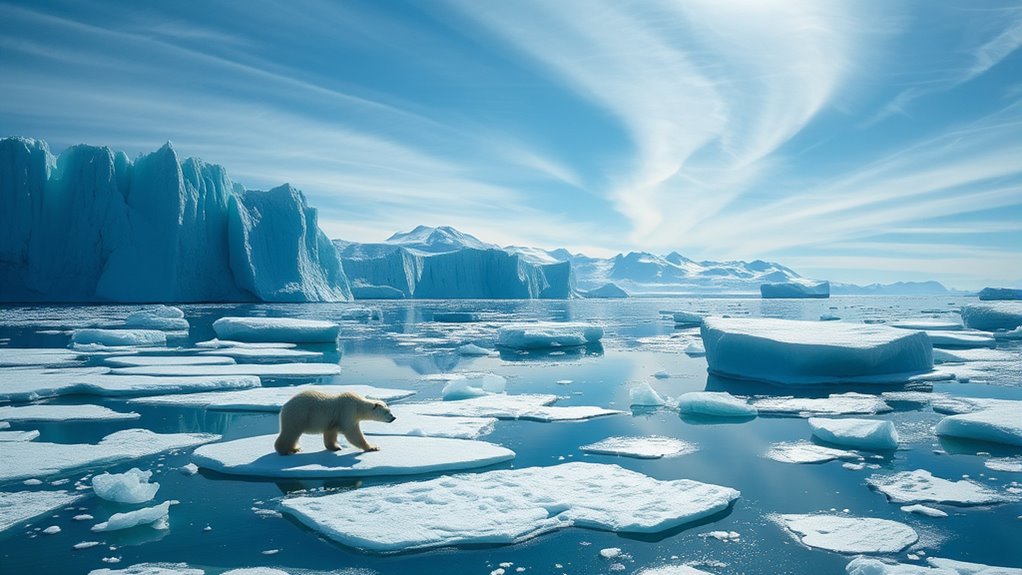

The polar paradox shows how life in the Arctic and Antarctic thrives despite extreme cold. In the Arctic, animals like polar bears and seals use thick insulation and migrate to survive, while Arctic microbes produce antifreeze proteins. In Antarctica, tough mosses and specialized fish endure freezing temperatures with unique adaptations. Both regions demonstrate incredible resilience, with their ecosystems and humans developing strategies for survival. Exploring further reveals just how astonishing life can be in these icy frontiers.
Key Takeaways
- Despite extreme cold, Arctic and Antarctic ecosystems host specialized life forms with unique adaptations like blubber, antifreeze proteins, and migratory behaviors.
- Arctic species thrive in water-based environments, while Antarctic life is mostly limited to land and ice-free coastal zones.
- The polar paradox shows how extreme conditions foster highly specialized survival strategies in both regions.
- Microorganisms survive via dormancy or antifreeze proteins, exemplifying resilience in icy habitats.
- Human and animal adaptations demonstrate remarkable resilience and resourcefulness in the face of frozen environments.
Contrasting Landscapes: Landmasses and Ocean Basins

The Arctic and Antarctic showcase stark differences in their landscapes, shaped by their unique geographic settings. You’ll find the Arctic as an ocean basin surrounded by landmasses like Eurasia, North America, and Greenland, creating a mostly water-based environment. In contrast, Antarctica is a continent entirely covered by a thick ice sheet, surrounded by the vast Southern Ocean. The Arctic’s sea ice floats atop the ocean, only a few meters thick, while Antarctica’s ice cap sits on solid land, with ice layers reaching thousands of meters thick. These geographic differences influence their climates and seasonal ice patterns. The Arctic’s oceanic nature results in more dynamic ice behavior, whereas Antarctica’s land-based ice sheet leads to colder, more stable conditions. This fundamental contrast underpins the distinct characteristics of each polar region. Additionally, the presence of integration with data tools in modern climate research enhances our understanding of these contrasting environments, allowing scientists to observe climate variability with increasing precision. The ongoing advancements in climate monitoring techniques provide crucial insights into how these polar regions are responding to global climate change, highlighting the importance of continuous biodiversity conservation efforts in these fragile ecosystems.
Temperature Extremes and Climate Dynamics

Despite their icy appearances, the Arctic and Antarctic experience vastly different temperature extremes driven by their unique climates. In winter, the Arctic’s average temperature drops to around -40°C, but it can reach -69.6°C, notably in Greenland. Meanwhile, Antarctica’s winter temperatures plummet to about -60°C, with record lows of -93.3°C on the East Antarctic Ice Sheet. The elevation of Antarctica’s landmass and its high-altitude ice sheet contribute to its colder conditions. The temperature difference between these records highlights how Antarctica’s continental landmass and elevation make it considerably colder than the Arctic’s oceanic environment. These climate dynamics are shaped by geographic features and atmospheric factors, producing stark contrasts in temperature extremes despite both poles being frozen wildernesses. Additionally, the climate dynamics at play are influenced by atmospheric circulation patterns that distribute heat differently across these regions, and ongoing research into climate variability helps explain these differences. Understanding regional climate patterns provides further insight into these temperature disparities and their broader implications. Moreover, creative problem-solving in climate science allows researchers to develop more accurate models for predicting future climate scenarios in these sensitive regions.
The Role of Elevation and Atmospheric Pressure

Elevation and atmospheric pressure play critical roles in shaping the climate differences between the Arctic and Antarctic. Higher elevations, like Antarctica’s ice sheet, cause temperatures to drop further due to adiabatic cooling. Since atmospheric pressure decreases with altitude, colder air persists at higher elevations, intensifying cold conditions. Additionally, the interaction between elevation and atmospheric pressure influences the persistence of cold temperatures in polar regions. This pressure variation also affects the density of cold air masses, further contributing to temperature extremes. To illustrate, consider the following:
| Feature | Arctic | Antarctic | Effect |
|---|---|---|---|
| Average Elevation | Low, mostly sea level | High, continent-wide ice sheet | More temperature stability in Arctic |
| Temperature Drop | Moderate, due to limited elevation | Significant, due to high elevation | Colder overall in Antarctica |
| Atmospheric Pressure | Slightly higher | Lower | Enhances cooling at higher altitude |
| Climate Impact | Less extreme temperature variation | More extreme temperature variation | Elevation amplifies Antarctic cold |
Furthermore, the distribution of landmass and ocean also influences the regional climate, with the Arctic’s oceanic surroundings moderating temperature fluctuations. Understanding these factors helps explain the stark temperature contrasts observed in polar environments.
Characteristics and Variability of Sea Ice

Sea ice exhibits notable differences in both characteristics and seasonal variability between the Arctic and Antarctic. In the Arctic, sea ice is mainly perennial, floating on ocean water, and averages 2-3 meters thick, with multiyear ice reaching 3-4 meters. It retains about 40% through summer, showing significant seasonal fluctuations. Conversely, Antarctic sea ice is thinner, generally less than 1 meter, and mostly seasonal, with only about 15% retention during summer. Heavy snowfall thickens Antarctic ice via snow and seawater flooding, forming “snow ice.” The Arctic’s extensive, thicker ice reflects more sunlight, while Antarctic sea ice’s thinner cover influences different climate feedbacks. These variations stem from their distinct geographic and climatic contexts, resulting in contrasting patterns of ice formation, persistence, and seasonal change. Additionally, understanding climate variability helps explain how these differing ice types respond to changing global temperatures, with regional climate patterns playing a pivotal role. The geographical differences between the regions significantly influence their ice dynamics and responses to environmental changes.
Impacts of Climate Change on Polar Ice and Ecosystems

Climate change has profoundly altered the polar regions, impacting both ice dynamics and ecosystems. You’ll notice shrinking sea ice, especially in the Arctic, where extent, thickness, and volume hit historic lows since 1979. This loss accelerates warming due to reduced sunlight reflection, fueling a feedback loop. In Antarctica, sea ice fluctuates without a clear warming trend, but overall, changes threaten habitat stability. You may observe:
- Melting ice sheets and glaciers contributing to rising sea levels
- Disrupted food chains affecting marine mammals and seabirds
- Altered weather patterns influencing polar and global climates
- Loss of habitat for indigenous Arctic populations and wildlife, which can lead to environmental stress on local communities and ecosystems. These changes also affect polar ice melt rates, further amplifying global climate effects. The melting of ice influences sea level rise, impacting coastal regions worldwide. These shifts threaten the delicate balance of polar ecosystems, with far-reaching implications for Earth’s climate system. Historical data reveal long-term trends and developments that help us understand these rapid changes, emphasizing the importance of climate monitoring to inform mitigation strategies.
Unique Ecosystems and Biodiversity in the Poles

You’ll see that Arctic marine life has developed remarkable adaptations to survive extreme cold, such as thick blubber and specialized hunting strategies. In contrast, Antarctic vegetation remains scarce, limited to hardy algae, mosses, and lichens that endure the harsh conditions. These unique ecosystems highlight how life in the poles has evolved differently to thrive despite the extreme environment. Additionally, the presence of biodiversity in these regions showcases nature’s incredible resilience and capacity for adaptation under such severe circumstances. The challenges posed by climate change threaten these delicate habitats and emphasize the importance of data privacy and conservation efforts to protect these fragile ecosystems amidst ongoing environmental challenges.
Adaptations of Arctic Marine Life
Arctic marine life has evolved remarkable adaptations to survive the region’s harsh conditions, where cold temperatures, seasonal ice cover, and limited resources challenge survival. These creatures have developed unique features to thrive in extreme cold and fluctuating environments.
- Thick blubber and dense fur insulate marine mammals like seals and polar bears.
- Specialized antifreeze proteins prevent ice formation in fish blood.
- Compact body shapes reduce heat loss and conserve energy.
- Breeding and feeding habits synchronize with seasonal ice melt and formation.
These adaptations allow Arctic species to navigate icy waters, find scarce food, and endure freezing temperatures. Their resilience highlights the extraordinary ability of life to adapt in one of Earth’s most extreme environments.
Antarctic Vegetation Limitations
Despite the extreme cold and harsh conditions, Antarctic vegetation remains remarkably limited in diversity and extent, shaping unique ecosystems that differ markedly from those at the Arctic. You’ll find almost no vascular plants, with vegetation mostly confined to algae, mosses, and lichens. These hardy organisms cling to rocks, soil, and ice-free coastal areas where sporadic moisture and sunlight are available. The continent’s high elevation, permanent ice cover, and minimal soil development severely restrict plant growth. Unlike the Arctic’s tundra, Antarctic ecosystems lack large terrestrial herbivores or predators, making plant life more isolated and fragile. Cold temperatures, strong winds, and low nutrient availability further limit vegetation. As a result, Antarctic plant communities form sparse, specialized assemblages, playing critical roles in supporting the continent’s minimal terrestrial biodiversity.
Human Presence and Cultural Adaptations

You see how indigenous communities in the Arctic develop unique strategies to survive in extreme cold and limited resources. Researchers in Antarctica form tight-knit teams, adapting to isolated, harsh conditions while balancing scientific goals and cultural identities. Yet, preserving these cultural practices amid changing environments and international research demands remains a complex challenge.
Indigenous Adaptation Strategies
Indigenous communities in the Arctic have developed unique strategies to survive and thrive in one of the world’s most extreme environments. You adapt by using traditional knowledge to hunt, gather, and navigate icy terrains efficiently. You craft specialized tools like umiaks and kayaks for transportation and hunting. Your diets primarily rely on marine mammals, fish, and Arctic plants, ensuring high energy intake. You build semi-permanent dwellings, such as tents and sod houses, suited to harsh weather. Cultural practices emphasize seasonal migrations, community cooperation, and oral traditions that transmit survival skills. You also innovate with clothing made from animal skins and furs to maintain body heat. These strategies enable you to sustain your way of life despite the challenges posed by the freezing, changing environment.
Researcher Community Dynamics
Researcher communities in polar regions adapt to extreme conditions through innovative cultural practices and specialized routines. You quickly learn to prioritize safety, relying on strict protocols and teamwork. Cultural adaptations include unique communication methods and shared rituals that foster camaraderie despite isolation. To understand these dynamics, consider this table:
| Aspect | Arctic | Antarctic |
|---|---|---|
| Population | Indigenous communities, researchers, locals | Mostly international scientists, no natives |
| Living Conditions | Compact, modular habitats, subsistence activities | Station-based, highly controlled environments |
| Cultural Practices | Indigenous traditions, community bonding | Scientific collaboration, minimal social ties |
| Adaptation Challenges | Harsh weather, limited supplies | Extreme cold, logistical complexity |
These practices shape resilient communities, blending cultural heritage with the demands of polar life.
Cultural Preservation Challenges
Preserving cultural identities in polar regions faces significant challenges as human presence becomes increasingly transient and technology-dependent. You may find that traditional practices are fading, replaced by modern influences and limited interaction with local environments. You could struggle to maintain language, rituals, and community bonds amid rapid change. Environmental shifts threaten to erase cultural landmarks and historical sites. Additionally, the influx of international researchers and tourists risks diluting indigenous cultures and disrupting social cohesion.
- Indigenous knowledge and customs risk being lost
- Language decline due to limited transmission
- Cultural sites face deterioration or neglect
- External influences reshape local traditions and identities
The Polar Paradox: Survival Strategies in Extreme Environments

Despite the extreme conditions, life in the Arctic and Antarctic has evolved remarkable survival strategies that highlight a fascinating paradox: the harshest environments often foster the most specialized adaptations. In the Arctic, animals like polar bears and seals have thick blubber and dense fur to insulate against freezing temperatures. They migrate or hibernate to conserve energy during winter. Meanwhile, Arctic vegetation such as mosses and lichens endure cold and nutrient scarcity through slow growth and resilience. In Antarctica, species like penguins and seals adapt by breeding during the short summer, utilizing dense feathers or blubber for insulation. Some microorganisms survive by entering dormant states or producing antifreeze proteins. These strategies demonstrate how life not only persists but thrives by evolving unique solutions tailored to extreme polar conditions.
Frequently Asked Questions
How Do Polar Night and Midnight Sun Affect Local Ecosystems?
During polar night and midnight sun, you notice dramatic changes in local ecosystems. The extended darkness of polar night limits photosynthesis, forcing plants and algae to adapt or shut down, impacting food webs. Conversely, the midnight sun provides continuous light, boosting plant growth and supporting active animals like polar bears and penguins. These extreme light cycles shape breeding, migration, and survival strategies, creating unique ecological dynamics at both poles.
What Are the Main Challenges for Indigenous Peoples in the Arctic?
You face challenges like changing ice conditions, which threaten traditional hunting and travel routes. Climate shifts cause unpredictable weather, impacting food sources and safety. Limited infrastructure and remote locations make healthcare, education, and economic development difficult. Melting sea ice and permafrost also threaten your homes and livelihoods. Additionally, balancing cultural traditions with modernization becomes harder as environmental changes force adaptation, risking the loss of your ancestral ways of life.
Why Does Antarctic Sea Ice Fluctuate More Than Arctic Sea Ice?
You might find it interesting that Antarctic sea ice varies more because of its unique environment. Unlike the Arctic, which is an ocean surrounded by land, Antarctica is a continent covered by a thick ice sheet, with sea ice forming along its coast. This makes Antarctic sea ice more sensitive to temperature changes and ocean currents, causing fluctuations. These dynamic factors lead to greater variability compared to the relatively stable Arctic sea ice.
How Do Polar Animals Adapt to Extreme Temperature Variations?
You see, polar animals adapt to extreme temperatures through physical and behavioral strategies. They develop thick fur, blubber, or feathers to insulate against cold. Some migrate to warmer areas during harsh winters, while others enter hibernation or torpor to conserve energy. Additionally, they have specialized blood flow systems to retain heat or reduce heat loss, helping them survive the intense cold and temperature fluctuations of their environments.
What Role Does Ocean Circulation Play in Polar Climate Regulation?
You might find it fascinating how ocean circulation acts like a gentle master, balancing polar climates. It redistributes warm and cold waters, moderating extreme temperatures and influencing ice formation. By carrying heat from the equator toward the poles, it helps prevent the poles from becoming too icy or too warm. This oceanic dance maintains the delicate climate equilibrium, ensuring polar regions stay within their unique and crucial temperature ranges.
Conclusion
You see, the polar regions are like icy heartbeats at Earth’s core—frozen yet essential. Despite their chill, life finds a way to dance in the frost, adapting like a masterful artist blending colors on a cold canvas. As climate change melts this icy symphony, you’ll realize that understanding these polar paradoxes isn’t just science; it’s a story of resilience, a reminder that even in the coldest places, life’s warmth endures and whispers of hope.