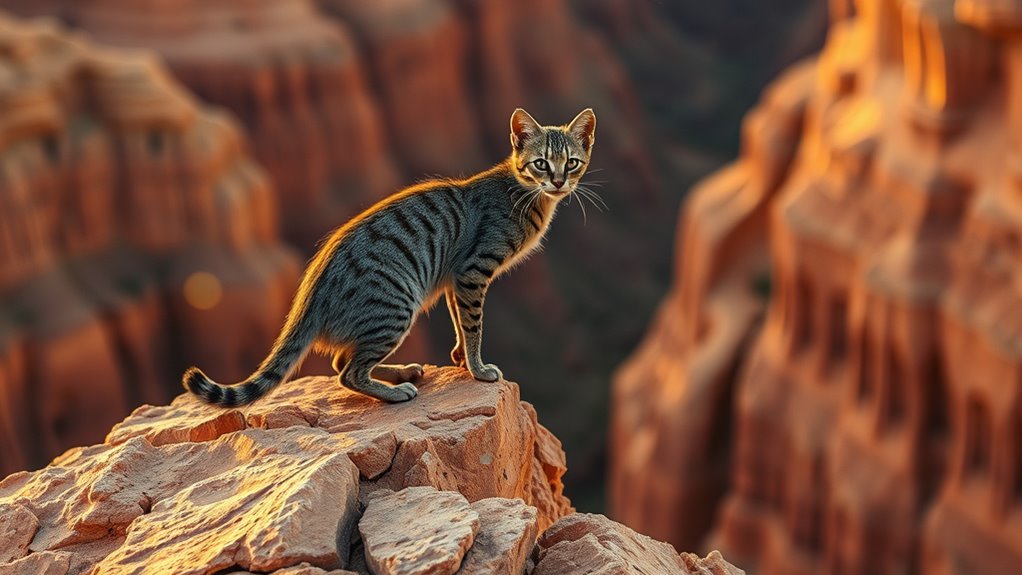

Discover the clever ringtail cat, a master of southwestern canyons and rocky deserts. You’ll find it roaming at night between sea level and high mountain elevations, using rocky crevices and abandoned dens for shelter. Its sharp senses, agility, and stealth help it hunt insects, small mammals, and plants across seasons. With remarkable adaptations like a long tail and retractable claws, it’s a true trickster of the wild. Keep exploring to uncover more of its secret survival strategies.
Key Takeaways
- Ringtail cats are nocturnal, highly agile mammals known for their clever use of rocky terrains and dens for survival.
- They utilize stealth, sharp senses, and musk to evade predators like owls and hawks in desert and canyon habitats.
- Their flexible climbing abilities and territorial behaviors help them navigate and defend their rugged territories.
- Seasonal dietary shifts—from insects in summer to small mammals and nectar—demonstrate their adaptability and resourcefulness.
- Their distinctive appearance and clever survival strategies have earned them the nickname “Clever Trickster of the Canyon.”
Top picks for "clever trickster canyon"
Open Amazon search results for this keyword.
As an affiliate, we earn on qualifying purchases.
The Southwestern Range and Distribution of Ringtails
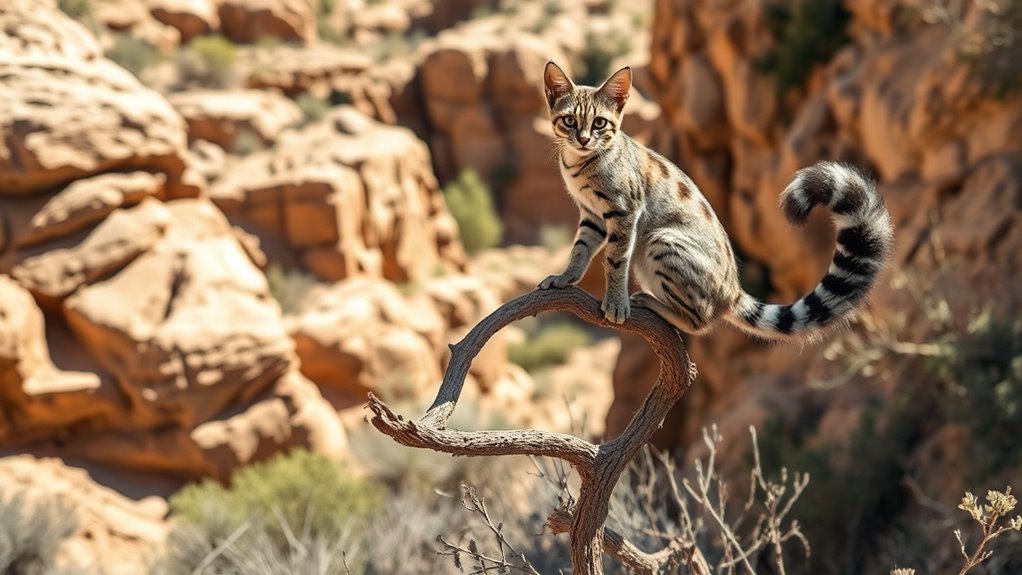
Ringtails occupy a broad range across the southwestern United States and into Mexico, making them highly adaptable to diverse desert and mountain habitats. You’ll find them from southwestern Oregon and eastern Kansas south through California, Nevada, Utah, Colorado, Arizona, New Mexico, Oklahoma, and Texas. Their distribution extends into Mexico, from Baja California to Oaxaca and Veracruz. Occasionally, outlying populations appear in Arkansas, Louisiana, Alabama, and Ohio—usually due to accidental transport on railroad cars. Recognized as Arizona’s state mammal, they thrive at elevations up to 2,900 meters, although they’re most common between sea level and 1,400 meters. This wide range showcases their resilience in various environments, from arid deserts to rugged mountain terrains.
Preferred Habitats and Denning Sites

They prefer rocky desert habitats with nearby water sources, such as riparian canyons, caves, and mine shafts, which provide essential shelter and denning sites. These environments offer plenty of hiding spots and protection from predators. You’ll find them in semi-arid regions, chaparral, oak woodlands, pinyon-juniper forests, and montane conifer areas. Their dens are often in tree hollows, rock crevices, abandoned burrows, mine shafts, or old buildings. Ringtails rarely stay more than three nights in one den unless weather forces them to. Their home ranges can reach up to 136 hectares, with males occupying larger territories than females. You’ll notice they’re highly adaptable, using natural and man-made structures for shelter and safety. Their ability to thrive in varied environments demonstrates their remarkable adaptability to different habitats, which is a testament to their behavioral flexibility. This adaptability is supported by their innovative problem-solving skills, allowing them to navigate complex terrains and find new shelter options as needed. Additionally, their adaptability to urban areas highlights their capacity to exploit human-altered landscapes for survival.
Nighttime Adventures and Activity Patterns

As night falls, canyon ringtail cats become highly active, engaging in their nocturnal adventures across rugged terrains. You might notice their quiet movements as they search for food, relying on their keen senses and agility. They typically stay solitary, only coming together during mating season from February to May. Their activity peaks during the night, but they occasionally venture out at dusk. These cats spend daytime hours sleeping in dens like rock crevices, abandoned burrows, or caves. Their secretive nature keeps them elusive, making sightings rare despite healthy populations in places like the Grand Canyon. As they navigate steep slopes and rocky ledges, they rely on their long tails for balance and their sharp hearing to detect predators, ensuring their survival in the wild. Their activity patterns are greatly influenced by their nocturnal lifestyle and environmental conditions. Understanding their behavioral adaptations helps explain their ability to thrive in such challenging environments. Additionally, their diet primarily consists of small mammals, birds, and insects, which they hunt with remarkable skill in the darkness. Recognizing the importance of their activity cycle can aid in conservation efforts and enhance appreciation for their unique lifestyle.
Dietary Choices Across Seasons

Seasonal changes markedly influence the diet of canyon ringtail cats, prompting them to diversify their food sources throughout the year. In spring and summer, insects are their main fare, providing high protein to support activity and reproduction. As fall arrives, they shift to eating more plants, nuts, and insects, adapting to the seasonal abundance of these foods. During winter, their diet leans toward small mammals, birds, and remaining insects, helping them conserve energy when prey is scarce. They also supplement their diet with nectar from agaves, especially in dry months. Ringtails can survive without free water, deriving moisture from their food. This dietary flexibility allows them to thrive across varied habitats and seasons, ensuring they get the nutrients needed for survival amid changing environmental conditions. Additionally, their dietary adaptability enables them to cope with fluctuations in prey availability and habitat alterations.
Predators and Survival Strategies

You’ll notice that canyon ringtails rely on their stealth and nocturnal habits to stay hidden from predators like owls and hawks. When threatened, they release musk to deter attackers and quickly escape through rocky crevices and steep slopes. Their agility allows them to dart away from danger, making them tough to catch despite their small size. Using behavioral adaptations and physical adaptations, they can effectively avoid many threats in their environment. Their use of vertical space utilization helps them navigate and escape in rugged terrain. A contrast ratio in their environment, such as shadowed crevices, further enhances their ability to remain unseen. Additionally, their ability to vibrational awareness helps them detect approaching predators, increasing their chances of survival.
Stealth and Nocturnality
Ringtails rely heavily on their stealth and nocturnal habits to avoid predators and survive in their harsh environments. By moving silently through rocky terrain, they stay hidden from threats. Their active hours at night help them avoid daytime predators like hawks and coyotes. To stay safe, they:
- Use their sharp senses—especially hearing and smell—to detect danger early.
- Remain hidden in dens or behind rocks during the day, only emerging at dusk or night.
- Rely on their agility and quick movements to escape predators if discovered.
- Their behaviors are influenced by their adaptability to environments, which enhances their survival strategies in diverse habitats.
- Their behavioral flexibility allows them to adjust their activity patterns based on environmental conditions, further improving their chances of survival.
- Studies show that their nocturnal activity is a key factor in avoiding many predators, highlighting the importance of their behavioral adaptations.
Their secretive lifestyle makes them difficult to spot, even in areas with healthy populations. These behaviors, combined with their nocturnal activity, give ringtails a vital edge in avoiding predators and securing survival in the wild.
Musk as Defense
How do canyon ringtail cats defend themselves against predators? One effective trick they use is releasing musk when threatened. This strong-smelling odor acts as a powerful deterrent, discouraging predators from attacking further. When startled or cornered, they lift their tail and spray a foul, pungent liquid that clings to predators or nearby surfaces. This smell signals danger, making predators hesitate or retreat altogether. Their nocturnal and secretive nature enhances this strategy, reducing chances of encounters. Additionally, their keen senses, like sharp hearing and excellent vision, help them detect threats early, giving them time to react and spray musk if needed. This combination of chemical defense and heightened awareness makes the ringtail a challenging target for predators in their rugged canyon habitats. Moreover, their adaptability to harsh environments allows them to survive and evade threats effectively. Their ability to remain undetected relies heavily on their stealth tactics, which are crucial for their survival in predator-rich areas. Studies also suggest that their territorial behavior further reduces the risk of encounters with predators or rival species. Furthermore, some research indicates that their social interactions can play a role in collective defense strategies, enhancing their overall survival chances. Interestingly, the use of musk is a common chemical defense mechanism among various small mammals that face high predation.
Agile Escaping Tactics
Canyon ringtail cats rely heavily on their exceptional agility and quick reflexes to escape predators in their rugged environments. When danger lurks, you need to act fast and use your surroundings.
- You dart quickly through rocky crevices, using your slender body to slip into narrow spaces out of reach.
- Your long, balanced tail helps steady you on steep slopes and boulders, allowing rapid, precise movements.
- When startled, you excrete musk as a distraction, giving you precious seconds to vanish into hiding spots like caves or abandoned burrows.
- Your nocturnal habits and acute hearing further enhance your ability to detect danger early, ensuring your survival amid predators.
This combination of speed, balance, and defensive scent makes you a master at avoiding threats. Your nocturnal habits and acute hearing further enhance your ability to detect danger early, ensuring your survival amid predators.
Unique Physical Traits and Adaptations
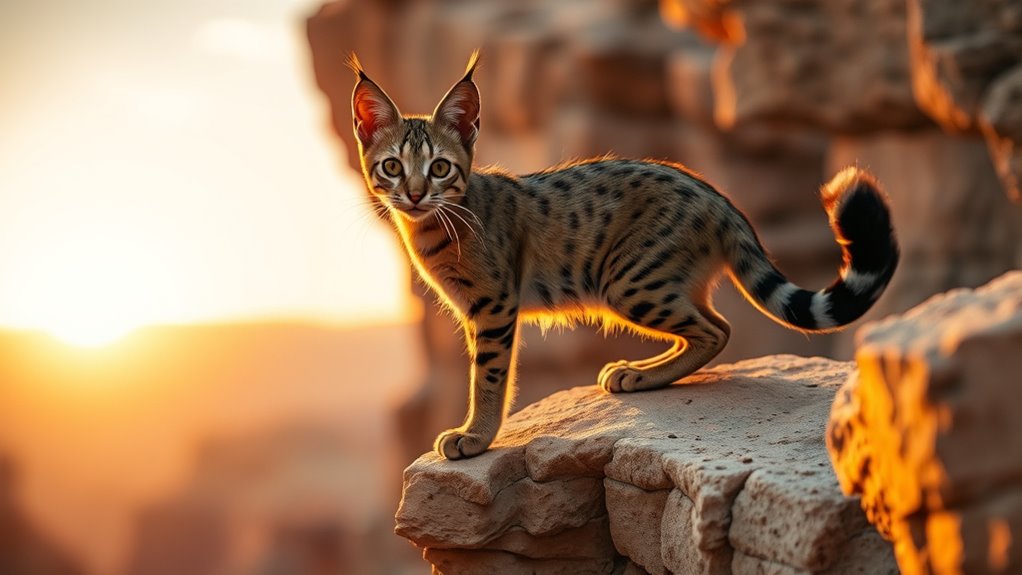
You’ll notice that canyon ringtail cats are incredibly agile, allowing them to navigate steep slopes and rocky terrain with ease. Their long tails help maintain balance as they move across narrow ledges and vertical surfaces. Plus, their cat-like grooming habits keep their fur clean and well-maintained, supporting their stealthy, nocturnal lifestyle.
Agile Rocky Terrain Navigation
The ringtail’s remarkable ability to navigate rugged rocky terrain stems from its specialized physical traits and adaptations. You’ll notice its long tail, which acts as a balancing pole, helping you stay steady on steep slopes and narrow ledges. Its small, compact body allows you to squeeze into tight crevices and climb vertical surfaces with ease. Your sharp, retractable claws grip uneven surfaces, providing stability as you leap between rocks. Additionally, your flexible ankles enable you to rotate your paws, offering better traction on angled surfaces. These adaptations work together, allowing you to swiftly and safely traverse canyon walls, rocky outcroppings, and steep slopes—making you a true master of your rugged environment.
Distinct Cat-like Grooming
Distinct cat-like grooming is a defining physical trait of the ringtail, setting it apart from other small mammals. You’ll notice how it meticulously cleans its fur by licking its face, paws, and body in a manner similar to domestic cats. This grooming behavior helps maintain its sleek coat, which is dense and soft, providing insulation and protection against the desert environment. The ringtail’s facial features, including sharp eyes and a small, pointed nose, resemble those of a feline, further emphasizing its cat-like appearance. Its agile movements and grooming habits reflect its evolutionary adaptations for stealth and efficiency. This grooming not only keeps its coat in top condition but also plays a crucial role in social signaling and scent marking, essential for communication and territory defense in the wild.
Frequently Asked Questions
How Long Do Ringtails Typically Live in the Wild?
You’ll find that ringtails typically live around 3 to 4 years in the wild, though some can reach up to 6 years with good survival conditions. Their lifespan depends on factors like predation, food availability, and environmental stresses. You might notice young ringtails are more vulnerable to predators like owls and hawks, which can shorten their lives. Their agility and secretive nature help increase their chances of reaching those years.
Are Ringtails Domesticated or Kept as Pets?
You can’t really keep ringtails as pets because they’re wild animals with specialized habitat needs. They’re not domesticated and tend to be secretive and solitary, making them hard to train or care for properly. Plus, many regions have laws protecting them, so capturing or keeping a ringtail without proper permits is illegal. It’s best to appreciate these clever creatures in their natural canyon and desert habitats rather than as pets.
What Is the Social Behavior of Ringtails Outside of Mating Season?
Outside of mating season, you’ll find that ringtails are mostly solitary animals. They spend their nights foraging alone in rocky and semi-arid habitats, rarely interacting with others except during the brief mating period from February to May. During the day, they sleep in dens like tree hollows or abandoned burrows. Their secretive, nocturnal behavior helps them stay hidden and avoid predators while they hunt for food.
Do Ringtails Communicate With Each Other Through Vocalizations?
Did you know that ringtails are mostly silent animals? They rarely vocalize, relying instead on their keen senses and body language to communicate. Outside of mating season, they chiefly use scent marking and subtle gestures to share information, especially about territory or danger. Their nocturnal and secretive nature means vocal communication isn’t essential. So, while they mostly keep quiet, they effectively communicate through other quiet, yet meaningful, methods.
How Do Ringtails Navigate in Complete Darkness?
You can imagine how ringtails navigate in complete darkness by relying on their exceptional senses. They use their keen hearing and sharp vision to detect movement and locate objects, even in low light. Their agile bodies and long tails help maintain balance on rocky surfaces, while their ability to move silently allows them to explore their environment stealthily. This combination of senses and physical adaptations makes them highly capable in complete darkness.
Conclusion
So, next time you spot a ringtail darting through the desert night, remember you’re witnessing a true master of disguise and mischief. With all their clever tricks and daring antics, they’ve turned surviving the Southwest’s harshest conditions into an art form. Think of them as the canyon’s cheeky little escape artists—proof that even in the wild, a little cunning goes a long way. Who knew the desert’s best trickster was hiding right in plain sight?