
Repurposing retired wind turbine blades offers a sustainable solution for resource management and infrastructure upgrades. You can transform these decommissioned blades into durable components, like highway signs and street furniture, which enhances both economic and environmental benefits. By embracing circular economy practices, you'll help reduce waste and pollution. Innovative recycling technologies, such as solvolysis, also contribute to this effort. Keep exploring, and you'll discover even more ways to support sustainability in the wind energy sector.
Key Takeaways
- Decommissioned turbine blades can be repurposed into structural components, enhancing infrastructure sustainability while reducing waste.
- Innovative designs for repurposed blades provide economic benefits and align with sustainable resource management goals.
- The Re-Wind Network offers design catalogs to inspire creative applications for retired blades in public spaces.
- Advancements in recycling technologies, like solvolysis, enable high-quality recovery of materials for future use in new blades.
- Embracing a circular economy approach fosters collaboration and market demand for recycled materials, supporting carbon neutrality in wind energy.
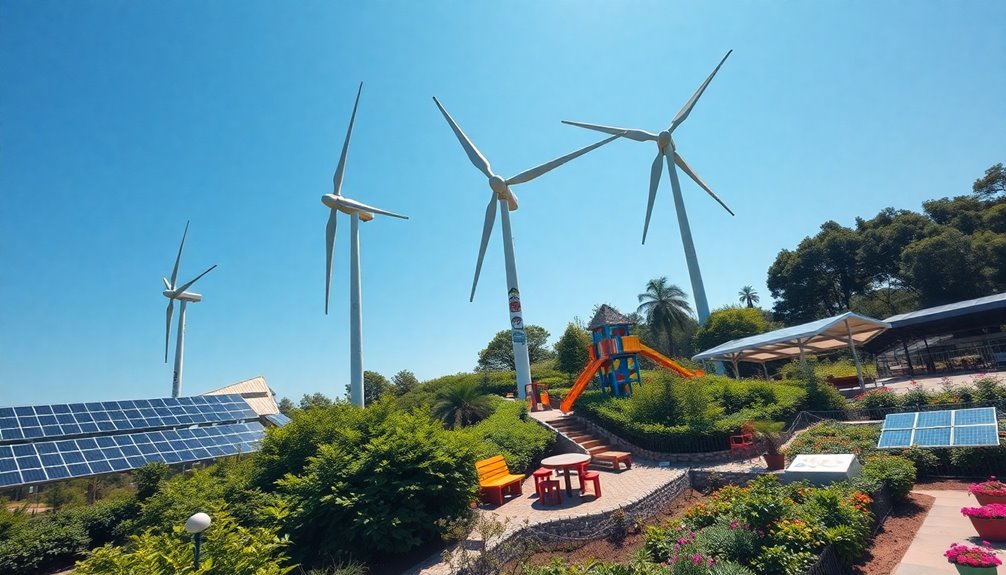
As the wind energy sector grows, managing the end-of-life disposal of turbine blades becomes increasingly critical. You mightn't realize that many decommissioned blades often end up in landfills or incineration facilities. Their complex composite materials make recycling a daunting challenge, leading to environmental pollution and the loss of valuable resources. By 2030, an estimated 570 million tonnes of blade waste could clutter the EU, making it essential to explore innovative solutions.
One promising approach is the circular economy, focusing on recycling and repurposing blades. Solvolysis emerges as a highly effective method, recovering up to 90–100% of materials while maintaining 50–60% quality. This not only reduces waste but also lowers the carbon footprint associated with disposal. Wind turbines from the 1990s and 2000s are nearing end-of-life, highlighting the urgency of addressing this issue.
You may also find interest in developing thermoplastic resins that simplify recycling processes, ultimately decreasing costs and enhancing the recyclability of future blades.
Repurposing retired blades is another viable pathway. Imagine seeing decommissioned blades transformed into structural components for highway overhead sign structures or even street furniture like benches and planters. Their unique design and durability provide economic and environmental benefits, aligning with your sustainable resource management goals.
The Re-Wind Network even publishes design catalogs promoting these innovative initiatives, although market demand remains a challenge.
Advancements in recycling technologies further bolster these circular approaches. Solvolysis stands out as the most circular solution, even if it requires significant energy input. Meanwhile, projects like DecomBlades successfully recover glass fibers for reuse in new blades, showcasing the potential for closed-loop systems.
Industry initiatives also signal a commitment to sustainability. Companies like LM Wind Power aim for zero waste blades by 2030 while pursuing carbon neutrality.
As you consider the future of wind energy, embracing these circular economy solutions for turbine blades can significantly enhance sustainable resource management and infrastructure upgrades.

Recycled Materials for Construction Applications: Plastic Products and Composites
As an affiliate, we earn on qualifying purchases.
As an affiliate, we earn on qualifying purchases.
Frequently Asked Questions
How Are Retired Wind Turbine Blades Transported for Repurposing?
When it comes to transporting retired wind turbine blades for repurposing, you'll typically rely on trucks for their flexibility on complex routes.
Sometimes, ships are used for long distances, especially over water.
Rail transport can be tricky due to size limitations, requiring specialized cars.
You'll need special permits and careful route planning to navigate roads and bridges.
It's crucial to account for seasonal weather conditions that might impact your transportation timeline.
What Are the Environmental Benefits of Repurposing Wind Turbine Blades?
When you repurpose wind turbine blades, you significantly reduce waste and lower environmental impact.
This process diverts materials from landfills, cutting down greenhouse gas emissions and conserving resources. By using these blades in infrastructure, you decrease the need for new raw materials, which further reduces emissions.
Plus, innovative recycling methods can turn the blades into valuable materials, promoting sustainability and contributing to global net-zero goals.
It's a win for both the planet and your community.
Can Retired Blades Be Recycled Entirely, or Only Repurposed?
Imagine a world where nothing goes to waste; that's the dream, right?
When it comes to retired wind turbine blades, they can't always be recycled entirely due to complex materials. You might find some blades repurposed effectively, like in playgrounds or noise barriers, but many still face challenges in complete recycling.
The industry's moving toward better recycling techniques, aiming for a future where every part finds new life, embracing sustainability.
What Industries Can Benefit From Repurposed Wind Turbine Blades?
You'll find that various industries can benefit from repurposed wind turbine blades.
Construction companies can use them for highway signs, bridges, and playground equipment, while manufacturers can recycle the fiberglass into new composites for automotive parts.
The energy sector gains from innovative recycling processes that support sustainability.
Additionally, by integrating these materials, businesses can significantly reduce their carbon footprint and contribute to a circular economy, fostering environmental responsibility across multiple sectors.
How Long Do Retired Wind Turbine Blades Last Before Needing Repurposing?
Imagine a race against time, where wind turbine blades stand tall for 20 to 25 years before they need to be repurposed or replaced.
After their long journey harnessing the wind, they're often retired, with thousands decommissioned annually.
You might find it surprising that by 2050, the U.S. could face a staggering 2.2 million metric tons of these blades, highlighting the urgency of finding sustainable solutions for their future.
Conclusion
Incorporating circular economy solutions for retired wind turbine blades not only reduces waste but also opens up exciting opportunities for sustainable infrastructure. Did you know that over 14,000 wind turbines are expected to be decommissioned in the next few years? By repurposing these blades, we can transform them into valuable resources, like composite materials for construction or even artistic installations. Embracing this innovative approach helps you contribute to a greener future while maximizing resource efficiency.