
Many misconceptions about evolution fade when you understand key facts. Humans didn’t directly evolve from monkeys but share a common ancestor from millions of years ago. Evolution has no goal or direction; it’s a branching process driven by environmental pressures and mutations. A scientific theory explains observed phenomena reliably, not just guesses. Natural selection favors traits that boost reproductive success, not strength alone. If you explore further, you’ll discover how science clarifies these common misunderstandings about life’s fascinating changes.
Key Takeaways
- Evolution involves branching from common ancestors, not direct transformation of existing species into new ones.
- There is no “ladder of progress”; evolution is a non-directional process driven by environmental and genetic factors.
- Scientific theories, like evolution, are well-supported explanations based on extensive evidence, not mere guesses.
- Natural selection favors traits that increase reproductive success, such as camouflage or social skills, not just physical strength.
- Evolution explains biological change over time; it is separate from the origin of life, which involves chemical processes creating initial organisms.
The Misunderstanding: Humans Evolved From Monkeys
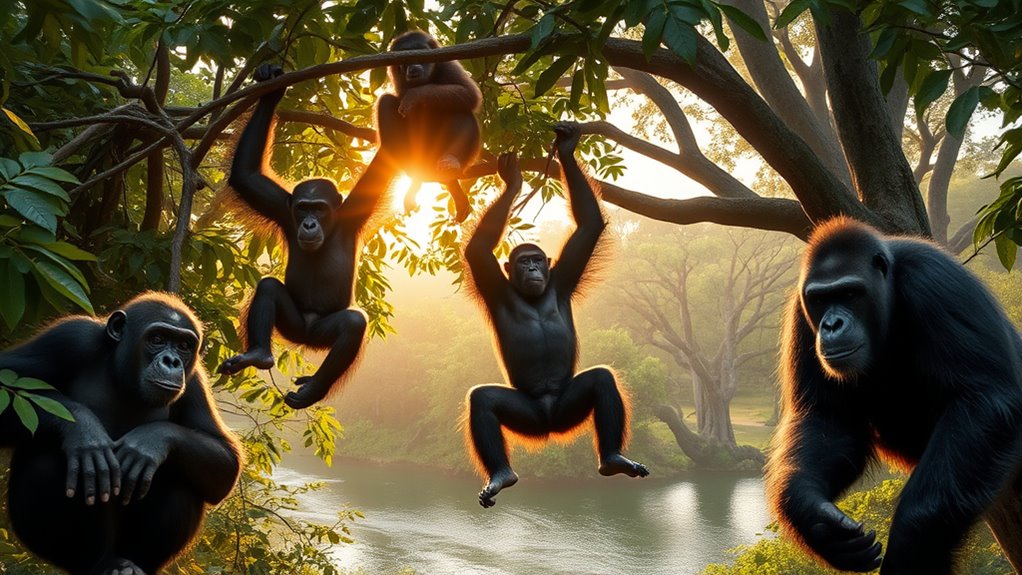
Many people believe that humans evolved directly from modern monkeys or apes, but that’s not accurate. Instead, humans and chimpanzees share a common ancestor that lived around 6 to 7 million years ago. This ancestor was neither human nor chimp, but a separate species from which both lineages diverged. Modern monkeys and apes are different branches that split off much earlier, approximately 25 million years ago, from our shared ancestors. Evolution doesn’t mean that humans came from the primates we see today. Instead, both humans and these primates evolved separately over millions of years, branching out from a common ancestor. Understanding evolutionary divergence helps clarify how complex life forms like humans developed through gradual changes rather than direct descent from current primates. Additionally, the process of speciation describes how new species emerge over time through genetic variation and environmental pressures. Recognizing the distinction between common ancestry and direct evolution is key to understanding the evolutionary process.
Evolution Has a Specific Goal or Direction

Contrary to common misconceptions, evolution does not follow a predetermined path or aim for specific outcomes. It’s a branching process, like a family tree, with multiple lineages evolving independently. Traits change because of environmental pressures and random mutations, not because of a goal to reach “higher” or “better” forms. Evolution lacks a “ladder of progress,” and all species are equally evolved, just in different ways. Your understanding might benefit from this table:
| Evolution’s Nature | Misconception Corrected |
|---|---|
| Goal-oriented | No specific goal exists |
| Linear progression | It’s a branching process |
| Progression toward “better” | All adaptations depend on environment and chance |
Evolution isn’t about purpose; it’s about change driven by survival and reproduction. Recognizing that mutation plays a central role in the process can help clarify why evolution is inherently unpredictable and non-directional. Additionally, genetic variation is the raw material upon which natural selection acts, further emphasizing the randomness inherent in the process. Understanding that environmental pressures influence the direction of adaptations can help dispel the myth of a purposeful evolution. Moreover, adaptive traits emerge as beneficial responses to specific environmental challenges, not as steps toward a predetermined goal. Recognizing the non-linear nature of evolution helps us appreciate the diversity and complexity of life’s history on Earth.
The Meaning of “Theory” in Scientific Context

In everyday language, the word “theory” often suggests a guess or a hunch, but in science, it has a much stronger meaning. A scientific theory is a well-supported explanation based on extensive evidence and testing. It’s not just a guess; it’s a framework that helps us understand natural phenomena. For example, the theory of evolution is backed by genetics, fossils, and comparative anatomy, making it a robust scientific concept. Scientific theories like gravity and evolution are accepted by most scientists because they reliably explain observations and predict outcomes. When scientists call evolution a theory, they’re indicating it’s a high-confidence, evidence-based explanation, not a tentative idea. This clarification helps dispel misconceptions and emphasizes the strength of scientific understanding. Additionally, application timing for related treatments demonstrates how carefully structured approaches can enhance outcomes. Recognizing the difference between hypotheses and scientific theories is fundamental to appreciating the robustness of scientific explanations. Moreover, understanding the distinction between a scientific theory and a mere hypothesis is crucial for grasping the reliability of scientific knowledge. A clear understanding of these terms also aids in public scientific literacy, promoting better appreciation of scientific progress and trust in scientific findings.
Natural Selection Is About Strength, Not Reproductive Success

Natural selection does not favor the strongest individuals, but rather those with traits that increase their reproductive success. Being physically powerful doesn’t guarantee passing on genes. Instead, traits like camouflage, speed, or social cooperation often matter more. Consider this table:
| Trait | Advantage | Example |
|---|---|---|
| Camouflage | Avoid predators, survive longer | Chameleon changing color |
| Reproductive Tactics | Produce more offspring, ensure survival | Mating dances, nest building |
| Disease Resistance | Live longer, reproduce more | Resistant bacteria |
| Social Cooperation | Share resources, protect kin | Wolves hunting in packs |
Your reproductive success depends on traits that help you attract mates, evade threats, and thrive in your environment—adaptive traits can be crucial for survival and reproductive success in changing environments. It’s important to recognize that natural selection operates through the differential success of individuals based on their traits, not just physical strength. Additionally, reproductive strategies often play a more significant role in evolution than mere physical prowess. For example, behavioral adaptations such as complex mating rituals can significantly influence reproductive outcomes. Understanding the importance of behavioral flexibility can also shed light on how species adapt to rapidly changing environments and improve their chances of reproductive success.
Evolution Explains Change, Not the Origin of Life

Evolution provides a powerful explanation for how living organisms change over time, but it doesn’t address how life initially began. The origin of life, or abiogenesis, is a separate scientific field that examines how non-living molecules organized into the first living cells. Evolution focuses on mechanisms like natural selection, genetic drift, and mutations that drive change after life exists. It explains how species adapt and diversify over generations, not how life started from non-living matter. Understanding the origin of life involves chemistry, geology, and early Earth conditions. Researchers explore prebiotic chemistry to understand how complex molecules could have formed under conditions on early Earth. Recognizing this distinction clarifies that evolution is about biological change, not the initial emergence of living systems. Both areas are essential, but they investigate different questions within science. For example, research into the origin of life explores how complex molecules could have formed under prebiotic conditions, and studies of molecular self-assembly contribute to understanding this process. Additionally, advances in astrobiology help scientists examine how extraterrestrial environments might support the emergence of life.
Frequently Asked Questions
How Long Does the Process of Evolution Typically Take?
The process of evolution varies widely, so there’s no fixed timeframe. Sometimes, it happens quickly, within a few generations, especially under strong environmental pressures or in small populations. Other times, it takes millions of years for significant changes to occur. Factors like mutation rates, natural selection, and environmental shifts influence the speed. Overall, evolution is a dynamic process that can be rapid or gradual, depending on circumstances.
Can Humans Still Be Evolving Today?
Did you know that humans are still evolving today? You can see this in the rapid development of antibiotic resistance in bacteria or changes in our populations’ genetics. Because evolution is driven by environmental pressures and random mutations, it continues as long as conditions change. So, yes, you’re part of an ongoing process, adapting and changing in response to the world around you, just like every other living thing.
What Evidence Supports the Theory of Evolution?
You can see the evidence supporting evolution in genetics, paleontology, and comparative anatomy. DNA analysis shows how species are related, while fossils reveal transitional forms demonstrating change over time. Similarities in body structures across species indicate common ancestors. Observations of rapid evolution, like antibiotic resistance, further confirm ongoing change. All this evidence builds a strong, well-supported scientific framework that explains how life adapts and diversifies over generations.
Is Evolution Related to Genetic Mutations?
Yes, evolution is closely related to genetic mutations. When mutations occur, they change an organism’s DNA, creating new variations. These variations can be beneficial, harmful, or neutral. If a mutation improves an organism’s chances of reproducing, natural selection may favor it, leading to evolution. So, every tiny genetic change can set off a chain reaction, shaping the incredible diversity of life we see today.
How Do Fossils Provide Evidence for Evolution?
Fossils show how species have changed over time by preserving physical remains of ancient organisms. You can see *intermediate* forms that link different species, like fossils with features of both fish and amphibians. These records reveal the sequence of evolutionary steps, helping you understand how life evolved. By comparing fossils from different periods, you see patterns of change, confirming that species adapt and transform across millions of years.
Conclusion
Now that you’ve busted these myths, remember that evolution isn’t some secret Illuminati plot or a straight line from dinosaurs to smartphones. It’s a complex, ongoing process driven by reproductive success, not strength or destiny. Like trying to find Wi-Fi on a pirate ship, misunderstanding leads to confusion. Keep questioning, stay curious, and embrace science’s true story—an epic, ever-changing adventure that’s as real as your last Netflix binge.