

Poachers now use sophisticated online tactics, exploiting digital platforms, encrypted messaging, and social media to hide illegal wildlife trade. They rely on fake licenses, fraudulent documents, and encrypted transactions to evade law enforcement. Protectors respond by analyzing digital footprints, sharing intelligence across borders, and deploying AI tools to track trafficking networks. Community engagement and technology-driven solutions are vital for countering these new tactics. To discover how experts stay ahead in this fight, keep exploring this essential issue.
Key Takeaways
- Protectors now leverage digital forensics, AI, and data analysis to track and intercept trafficking networks more effectively.
- Authorities use real-time intelligence sharing and international cooperation to disrupt poaching and trafficking routes.
- Traffickers employ encrypted messaging, fake licenses, and online platforms to evade detection, prompting new countermeasures.
- Community-based conservation efforts empower locals to monitor, report, and reduce poaching activities sustainably.
- Advanced technology, such as blockchain and license verification systems, helps authenticate permits and combat illegal sourcing.
Top picks for "poacher protector tactic"
Open Amazon search results for this keyword.
As an affiliate, we earn on qualifying purchases.
The Scope of Global Wildlife Crime

Wildlife crime is a vast and persistent problem that affects over 4,000 species across 162 countries and territories. You might not realize it, but the illegal wildlife trade generates around $20 billion each year, fueling organized crime networks worldwide. Authorities worldwide have seized approximately 13 million items and 16,000 tonnes of wildlife products between 2015 and 2021, yet trafficking continues unabated. You’ll see traffickers exploiting gaps in regulations, often using airports, sea cargo, and online platforms to smuggle everything from ivory to medicinal plants. Despite decades of enforcement efforts, traffickers adapt their routes and methods constantly, making this a challenging battle. This global issue demands international cooperation, strengthened laws, and innovative tactics to effectively combat wildlife crime. Enhanced enforcement methods are being developed to better track and intercept illicit shipments, including utilizing biological tracking technologies to verify species origin and authenticity.
Targeted Species and Their Significance

Poachers target some species more than others due to their high market value and rarity, making them prime targets in wildlife trafficking. Elephants are sought for their ivory, while rhinos are prized for their horns, often used in traditional medicine. Big cats like tigers and leopards are hunted for their skins and body parts, which fetch high prices. Pangolins are the most heavily trafficked mammals, valued for their scales and meat. Marine species like sharks and eels are also targeted, often for their fins and medicinal uses. Timber species such as cedar and rosewood are trafficked for furniture and decorative items. These species’ ecological importance and economic value drive illegal trade, threatening their survival and disrupting ecosystems worldwide. Understanding the spiritual symbolism behind some of these animals can also deepen awareness of their significance and the importance of protecting them. Additionally, many of these species are affected by coastal erosion and habitat loss, which further endanger their populations and habitat destruction, making conservation efforts even more challenging. The loss of these species can also have knock-on effects on local communities that depend on healthy ecosystems for their livelihoods.
Common Routes and Tactics of Traffickers

Traffickers exploit a variety of routes and methods to move illegal wildlife products across borders, often adapting quickly to enforcement efforts. They frequently use air, sea, and land corridors, seizing opportunities at airports, seaports, and border crossings. Mail shipments and parcel services are popular channels for smaller, high-value items like pangolins and rhino horns. Online platforms and social media expand their reach, enabling discreet transactions and networking. Traffickers also exploit legal loopholes by using fraudulent licenses, claiming animals are captive-bred, or mislabeling shipments. They frequently shift routes and methods based on enforcement patterns, making detection difficult. Organized crime groups coordinate complex logistics, often collaborating across countries to mask their activities and evade authorities, ensuring their illegal trade persists despite ongoing efforts. Additionally, traffickers are increasingly leveraging technology and data analysis to optimize their operations and avoid detection.
Role of Online Platforms in Modern Trafficking

Online platforms have become key tools for wildlife traffickers, with digital marketplaces providing anonymous venues to sell endangered species. Social media channels are exploited to reach wider audiences and coordinate shipments discreetly. Traffickers also use fake licenses online to pass wild-caught animals as legal, complicating enforcement efforts. Additionally, the use of online marketplaces facilitates rapid transactions and broadens the reach of illegal wildlife trade networks. Recognizing that creativity can be harnessed to develop innovative strategies, law enforcement agencies are exploring new digital tools to combat trafficking more effectively. Incorporating linguistic variations and understanding cultural terminologies can also aid in identifying illegal trade patterns across different regions. Moreover, understanding personality traits can help in profiling and intercepting traffickers based on behavioral patterns. Developing advanced monitoring tools that analyze online content can further enhance detection of illicit activities.
Digital Marketplaces Exploited
Digital platforms have become a critical tool for wildlife traffickers, allowing them to reach a global audience with ease. You might find traffickers listing endangered species or products like ivory, pangolin scales, or exotic pets on online marketplaces. They often use coded language or hidden keywords to evade detection, making it harder for authorities to identify illegal activity. Traffickers also exploit anonymous payment systems and encrypted messaging apps to coordinate transactions securely. These platforms offer traffickers a discreet space to advertise, negotiate, and finalize deals without physical contact. As a result, the online marketplace has become a bustling hub for illegal wildlife trade, fueling demand and complicating enforcement efforts. Protecting these digital spaces requires vigilant monitoring and advanced digital forensics. Recognizing the individual responses of different traffickers can help law enforcement tailor strategies to combat these crimes more effectively. Additionally, understanding market trends can provide insights into evolving trafficking methods and target points for intervention. Moreover, the use of digital footprints by traffickers can reveal patterns that are crucial for tracking and disrupting illegal operations. Implementing technological solutions such as AI-powered monitoring tools can significantly enhance detection capabilities and disrupt trafficking networks more efficiently. Regular updates on digital monitoring techniques are essential to keep pace with traffickers’ adaptive tactics.
Social Media as Channels
Social media platforms have become powerful tools for wildlife traffickers, enabling them to reach a vast, global audience with relative ease. They use private groups, direct messaging, and coded language to sell illegal wildlife products discreetly. Traffickers often post images and videos showcasing rare species or parts, attracting buyers who seek exotic items. These platforms allow them to hide their identities behind fake profiles, making detection difficult. Additionally, algorithm-driven recommendations can connect traffickers with potential customers worldwide. Social media also facilitates the rapid spread of new trafficking trends and methods, making it harder for authorities to keep up. Despite efforts to monitor and remove illegal content, traffickers continually adapt their tactics, exploiting the platform’s reach to sustain and expand illegal trade networks. Moreover, encrypted messaging features help traffickers communicate securely, further complicating enforcement efforts. The use of digital platforms has transformed wildlife trafficking into a more sophisticated and elusive crime, challenging law enforcement efforts worldwide. As a result, understanding the role of online network dynamics is crucial in developing effective countermeasures against wildlife trafficking. Recognizing the importance of community monitoring can enhance efforts to identify and report illegal activities on these platforms. Given the evolving nature of digital communication, leveraging advanced detection technologies is essential to combat these illicit activities effectively.
Online Fraudulent Licensing
Wildlife traffickers have increasingly turned to online platforms not only to sell illegal products but also to manipulate licensing systems that appear legitimate. They exploit fake or fraudulent licenses to pass off wild-caught animals as legally sourced, making detection difficult. These schemes often involve counterfeit documents, unverified breeders, or manipulated databases. Traffickers also target online marketplaces with fake permits, bypassing stricter border checks. To combat this, authorities are working on:
- Tracking digital footprints of license applications and transfers
- Using blockchain technology for transparent, tamper-proof licensing records
- Identifying and shutting down fake licensing websites
- Collaborating with online platforms to flag suspicious documents and activity
- Implementing license verification systems that utilize advanced technology to authenticate genuine permits and reduce fraudulent activities
This approach aims to disrupt the illusion of legality, making it harder for traffickers to exploit loopholes and ensuring genuine licensing controls are enforced.
International Collaboration and Enforcement Efforts

International collaboration plays a crucial role in combating wildlife trafficking by enabling countries to share intelligence, coordinate enforcement actions, and strengthen legal frameworks. You benefit from global operations like Operation Thunder 2024, which involved 138 countries and resulted in hundreds of arrests. Organizations such as INTERPOL and the World Customs Organization facilitate real-time information sharing, helping authorities track traffickers and dismantle networks. Enforcement efforts now include joint training, customs reform, and community engagement to reduce poaching. You also see increased cooperation with private companies, identifying illegal supply chains and shutting down trafficking routes. These efforts improve enforcement consistency and close gaps exploited by traffickers. Overall, international partnerships are essential for disrupting transnational wildlife crime and building a united front against poaching and trafficking.
Challenges in Legal Prosecution and Corruption Issues

Despite widespread enforcement efforts, prosecuting wildlife traffickers remains a significant challenge, largely due to corruption and weak legal systems. You face obstacles like:
- Low conviction rates, with only a small fraction of arrests leading to prison sentences
- Corruption that hampers investigations and allows traffickers to operate with impunity
- Limited use of anti-corruption laws in wildlife crime cases, reducing accountability
- Variations in monitoring, enforcement, and reporting standards across countries
These issues enable traffickers to exploit legal gaps, bribe officials, and evade justice. Often, low-level offenders are prosecuted, while high-level traffickers remain unpunished. Strengthening legal frameworks, combating corruption, and ensuring consistent enforcement are essential steps to improve prosecution success. Inconsistent enforcement undermines efforts to hold traffickers accountable and allows illegal activities to flourish, especially when legal system weaknesses leave gaps in accountability.
Harnessing Technology for Wildlife Crime Prevention

Harnessing technology has become vital in the fight against wildlife crime, as authorities increasingly turn to digital tools to detect and disrupt trafficking networks. You can now track illegal shipments with satellite imagery, monitor online markets, and analyze digital communications for clues. These innovations help close enforcement gaps and identify traffickers faster.
| Technology | Impact |
|---|---|
| Drones | Patrol remote areas, spot poachers |
| Data Analytics | Detect patterns, predict trafficking routes |
| Digital Forensics | Trace online sales and encrypted communications |
Addressing the Roots: Community Engagement and Alternatives
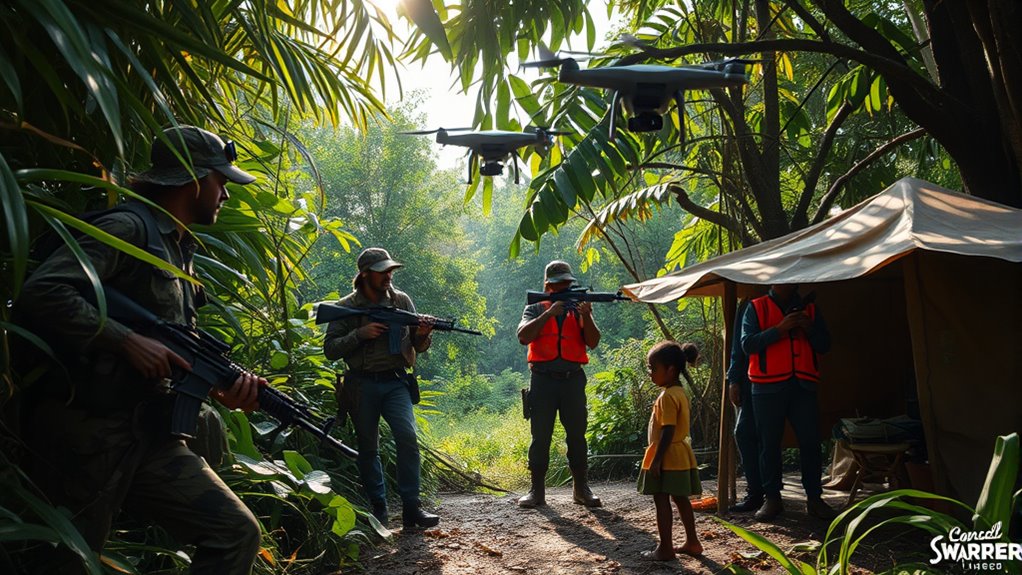
Community engagement plays a essential role in tackling wildlife trafficking at its source. When local communities understand the value of conserving species, they’re less likely to participate in illegal activities. You can support initiatives that empower communities with sustainable livelihoods, reducing the temptation to poach. Building trust is key—working directly with locals to develop solutions that benefit both people and wildlife.
Consider these approaches:
- Providing alternative income sources, like eco-tourism or sustainable farming
- Educating communities about the ecological and economic importance of wildlife
- Involving locals in monitoring and protection efforts
- Addressing cultural practices that may encourage poaching
The Impact of Scientific Monitoring and Data Collection

Advances in scientific monitoring and data collection are transforming wildlife protection efforts by providing precise, real-time insights into species populations and trafficking patterns. You can now track illegal activities more efficiently, identify hotspots, and deploy resources strategically. Data from satellite imagery, camera traps, and genetic analysis help uncover trafficking routes and understand species decline. This evidence strengthens enforcement cases and guides policy decisions. To illustrate, consider the table below:
| Monitoring Method | Key Benefit |
|---|---|
| Satellite Imagery | Detects habitat changes and illegal logging |
| Camera Traps | Tracks animal movements and poacher activity |
| Genetic Analysis | Verifies species origin and poaching links |
Emerging Strategies and Future Directions in Wildlife Protection

You can leverage digital forensics to track traffickers and uncover hidden networks more effectively. Community-based conservation efforts are gaining ground, providing sustainable alternatives to poaching. By combining these strategies, you’ll help create a more resilient and adaptive wildlife protection system.
Digital Forensics Advancements
Digital forensics has become a crucial tool in combating wildlife trafficking by enabling authorities to track and dismantle illegal networks online. You can analyze digital footprints on social media, messaging apps, and online marketplaces to identify traffickers and their operations. Advanced techniques include data mining, keyword tracking, and IP tracing, helping uncover hidden links, transaction patterns, and key players.
- Monitoring encrypted communications for trafficking clues
- Using AI to detect illegal wildlife trade listings
- Investigating digital wallets and cryptocurrency transactions
- Collaborating internationally for real-time intelligence sharing
These innovations allow you to stay ahead of traffickers who constantly adapt. By leveraging digital forensics, you can disrupt networks more effectively, gather concrete evidence, and strengthen prosecutions, making the fight against wildlife crime more targeted and impactful.
Community-Based Conservation
Community-based conservation has emerged as a promising strategy to combat wildlife trafficking by actively involving local communities in protection efforts. You play a essential role by empowering residents to protect their natural resources, creating sustainable livelihoods that reduce reliance on poaching. These programs foster local stewardship, encouraging communities to monitor, report, and prevent illegal activities. Through education and benefit-sharing, you build trust and align community interests with conservation goals. This approach helps address root causes of poaching, like poverty and lack of alternatives. You may also participate in eco-tourism, sustainable harvesting, or conservation projects that generate income while safeguarding species. As communities become guardians rather than victims, you contribute to more resilient, effective defenses against trafficking networks, ensuring long-term preservation of ecosystems and species.
Frequently Asked Questions
How Do Traffickers Exploit Legal Loopholes Across Borders?
Traffickers exploit legal loopholes by taking advantage of inconsistent regulations and enforcement across borders. They use fraudulent licenses to pass off wild-caught animals as captive-bred and ship illegal products through airports, sea cargo, and online platforms. By exploiting weak monitoring and corrupt officials, they evade detection. You can help combat this by supporting stronger international cooperation, stricter enforcement, and closing regulatory gaps to make trafficking more difficult.
What Role Do Financial Institutions Play in Combating Wildlife Crime?
You can play a vital role by urging financial institutions to implement strict anti-money laundering measures and monitor suspicious transactions linked to wildlife trade. Encourage banks to flag and report large or unusual transfers, especially those involving high-risk regions or entities. Supporting policies that restrict financial services to illegal wildlife traffickers helps cut off their funding, making it harder for traffickers to operate and expand their networks.
How Effective Are Current Anti-Corruption Laws in Wildlife Enforcement?
Current anti-corruption laws are often woefully ineffective, allowing wildlife traffickers to operate with impunity. Corruption frequently shields high-level criminals, making enforcement nearly impossible. You might think laws are strong, but in reality, they’re weakly enforced and riddled with loopholes. Without strict prosecution and enforcement, traffickers continue their devastating trade, threatening countless species with extinction. Strengthening anti-corruption measures is vital if you truly want to protect endangered wildlife.
What Are the Challenges in Tracking Online Illegal Wildlife Trade?
Tracking online illegal wildlife trade is challenging because traffickers frequently use encrypted messaging, social media, and hidden platforms to hide their activities. You’ll find them exploiting loopholes, fake identities, and fraudulent licenses to evade detection. They quickly adapt routes and methods, making it hard to trace transactions. Plus, limited resources and inconsistent regulations across countries hinder efforts, so you need advanced digital tools and international cooperation to stay ahead.
How Can Local Communities Be Incentivized to Protect Wildlife?
You can catalyze community conservation by creating compelling, community-centered incentives that inspire involvement. Offer sustainable livelihoods, like eco-tourism or alternative farming, to shift focus from poaching. Provide proper training, fair compensation, and community recognition to foster a sense of ownership and pride. Building bonds through education and engagement makes protecting wildlife a worthwhile, rewarding endeavor, transforming local lives while safeguarding species for future generations.
Conclusion
As you follow the ongoing battle between poachers and protectors, it’s clear that technology and community efforts often collide in surprising ways. Just like how a new app can expose illegal routes or a local hero steps up unexpectedly, your awareness and actions make a difference. It’s a reminder that while the fight is complex, small moments of connection—whether online or offline—can tip the scales toward a future where wildlife thrives, not just survives.