Software can be translated and still fail in another language. Every label may have an equivalent. Every sentence may be grammatically sound. Yet a legal term can be wrong, a familiar writing pattern can be broken, and a button can expand beyond the space designed for it. The words have travelled; the product has not.

Prime made for students and young adults
- Fast, free delivery for dorm and study essentials
- Prime Video and Amazon Music included
- Member-only deals
Wissen & Sprache · Gewerkton field report
The words travelled.
The product did not.
Shipping construction software in 27 languages showed why fluent translation is only the beginning: terminology, typography, interface space and evidence must survive together.
One brand is not one linguistic experience
Paragraphs, headings, buttons, statuses and compact controls each provide different amounts of context.
The difficult work sits between language and product behaviour
The final ten per cent is the real product
Machine assistance creates fast coverage. Trust is decided later—where regional meaning, visual fit and evidentiary clarity meet.
Automation needs a sceptical test
A solo founder directed coding agents using Codex and Claude; the resulting packages were checked with negative controls and mutation tests. Language work needs the same instinct: challenge the assumptions where failure carries the greatest burden.
That distinction becomes especially important in construction documentation. A vague phrase on a consumer website may be irritating. A vague phrase attached to a defect, instruction, daywork report or field acceptance can weaken the record of what happened. On site, language is not decorative. It connects people, tasks and evidence.
Gewerkton offers a useful field report from this problem. It is a voice-first construction documentation and defect management platform for global markets, born in the German market and built around 27 content languages. Its experience shows why localisation is partly a writing challenge, partly an interface challenge and partly a question of how information is structured.
It also shows why “just run it through an LLM” is an incomplete answer. A model can produce a remarkably fluent first pass. The difficult work waits in the last ten per cent, where terminology, typography, character budgets, regional meaning and the integrity of the evidence all meet.
construction software localization tools
As an affiliate, we earn on qualifying purchases.
As an affiliate, we earn on qualifying purchases.
One product does not mean one linguistic experience
Gewerkton is one brand with three product lines. Gewerkton Field is the voice-first construction site app, taking dictation into evidence, defects, daywork reports, takt and a portal. Gewerkton Studio is a browser workspace for plans and models; where no model exists, the site team creates one in the browser. Gewerkton Cloud coordinates operations, models and data between Field, Studio and third parties.
Those descriptions sound concise in English. They do not guarantee equally concise or equally precise expressions in 26 other languages. Nor does a translation system encounter only explanatory paragraphs. It must handle headings, navigation, buttons, status labels and compact interface elements, each carrying a different amount of context.
This is where translation and localisation diverge. Translation asks what a source expression means in another language. Localisation also asks whether the chosen expression belongs in that particular interface, fits the available space, follows the language’s writing conventions and communicates the intended action without ambiguity.
A fluent paragraph can tolerate expansion. A short button may not. A technical term may be correct in general prose but wrong in a construction workflow. A label can sound natural in isolation and become misleading beside a photograph, deadline or audio record. The product has to be read as a connected system rather than as a collection of strings.
The KVKK incident: fluency can conceal invention
The most revealing failures are not always obvious mistranslations. Sometimes the language looks polished enough to escape immediate suspicion. In the KVKK incident, a translator quietly invented legal terms. That is more dangerous than clumsy wording because confidence and correctness can look identical on the screen.
The lesson is not that legal material can never be translated with automated assistance. It is that fluent output must not be mistaken for verified terminology. An invented expression can resemble the sort of phrase a law might contain, particularly to a reviewer who does not work in that language. Once inserted into a reusable translation set, it may then appear consistently throughout a product. Consistency makes the error systematic; it does not make it true.
Localisation therefore needs controls that go beyond asking whether a sentence reads well. Certain terms carry a greater burden than others. Legal references, regional privacy language and terms attached to evidence need closer scrutiny because a plausible substitute is not enough. The translator’s task is constrained: preserve the actual concept rather than manufacture a locally flavoured approximation.
This is one reason the last ten per cent resists a single automated pass. An LLM can help generate alternatives, expose awkward source wording and accelerate broad coverage. But surface fluency is exactly what makes an invented legal term difficult to detect. The remaining work involves knowing which words cannot safely be improvised.
A hyphen is not a trivial detail
Malay and Indonesian revealed a different class of problem: reduplication hyphens. Here, the issue was neither legal meaning nor dramatic mistranslation. It was a writing convention small enough to be dismissed as punctuation and important enough to make the finished language feel mishandled.
These details matter because localisation is experienced cumulatively. Users do not assess only whether they can decode a sentence. They encounter hundreds of small choices: how words repeat, how compounds are presented, where punctuation belongs and whether an interface appears to understand the language it is displaying.
A system that treats the hyphen as a disposable separator can damage a valid linguistic form. A process focused only on word substitution may not even recognise the problem. The failure sits between language and engineering: the translation may contain the intended expression, while later processing or presentation handles it incorrectly.
That makes typography part of product behaviour. If language is transformed, split or constrained after translation, the final rendered result must be examined. A correct source file is not sufficient evidence that a user sees correct language.
Character budgets expose the limits of the source language
Interface design often assumes that a compact source label will remain compact. Across 27 content languages, that assumption does not survive. A translated action may require more characters. A navigation label may wrap. A phrase that fits neatly in one language may collide with another element in the next.
This is not a sign that the longer language is inefficient. It is a sign that the interface was given a character budget based on one linguistic system. Localisation exposes that hidden design decision.

The response cannot always be to choose a shorter synonym. Shorter wording may lose the distinction the interface needs, particularly where documentation and defect management are involved. A defect, an instruction and a daywork report are not interchangeable simply because one available label fits the button better.
Character budgets therefore force a negotiation between meaning and space. The language side must identify what cannot be compressed without distortion. The interface side must allow for variation. The final judgement can only be made in context, because a string list does not show wrapping, crowding or the relationship between a label and the evidence beside it.
Why the final ten per cent is the real product
At first, machine-assisted localisation can move quickly. Common navigation, explanatory copy and repeated structures create visible momentum. Then progress appears to slow. Exceptions accumulate: a legal expression that cannot be approximated, a reduplicated form whose hyphen must survive, a compact control whose translated wording no longer fits.
Calling this the last ten per cent can make it sound optional, as if the main work is already done. In practice, it is where trust is decided. The first ninety per cent demonstrates coverage. The last ten per cent determines whether the language can carry the product’s actual responsibilities.
An LLM sees patterns and produces language. It does not remove the need to define what a field means, what evidence must remain attached to an instruction, or which regional term is authoritative. Nor does it experience the interface as a crew member switching between capture and report. It can accelerate language work without becoming the final judge of legal terminology, visual fit or evidentiary clarity.
Gewerkton’s development model makes the scale of automation especially visible. A solo founder directs a fleet of coding agents using Codex and Claude. In one night, that fleet shipped 21 software packages, verified with negative controls and mutation tests. The striking point is not merely speed. It is that automated output was paired with attempts to test how the software behaves when assumptions are challenged.
Language engineering needs the same sceptical instinct. A translation should not be accepted only because the happy path looks fluent. It should be examined where it is most likely to fail: constrained interfaces, regional terminology and records whose meaning must remain clear after they move between people and languages.
Structured evidence beats prose notes
The documentation angle changes the localisation problem fundamentally. A prose note may contain all the relevant information and still make the reader hunt for it. It may mix a defect, an instruction, a deadline and an explanation in one paragraph. Translation can preserve the paragraph while leaving its operational meaning difficult to extract.
Structured evidence reduces that dependence on prose. In housing and building construction, the relevant pattern is a defect with a photo and deadline, a dictated daywork report, and a signature on the device at handover. In infrastructure and tunnels, instructions can be backed by the original audio. Each element has a role that survives beyond the sentence used to describe it.
This does not make language unimportant. It makes language more focused. Instead of asking one paragraph to carry the whole record, the system can connect the words to the relevant evidence. A photo remains a photo. A deadline remains a deadline. Original audio remains available behind an instruction. Translation helps people understand the record without silently replacing its source.
That matters for cross-border teams working across the EU, US and APAC. Each participant can work in their own language while the evidence original stays unambiguous. The goal is not to pretend that every language version is the original. It is to let multilingual access coexist with a stable underlying record.
The principle is captured by Gewerkton’s marketing line: “On site, what counts is what’s proven.” Good documentation is not simply more writing. It is information organised so that the relationship between statement and evidence remains visible.
Voice makes the source worth preserving
Gewerkton Field begins with conditions that are very different from those of a desk-based translation workflow. Site teams dictate while work is happening. The app turns that dictation into evidence, defects, daywork reports and takt information. In wind farms and renewables, teams can be distributed, crews can rotate, and offline capture is needed in dead zones.
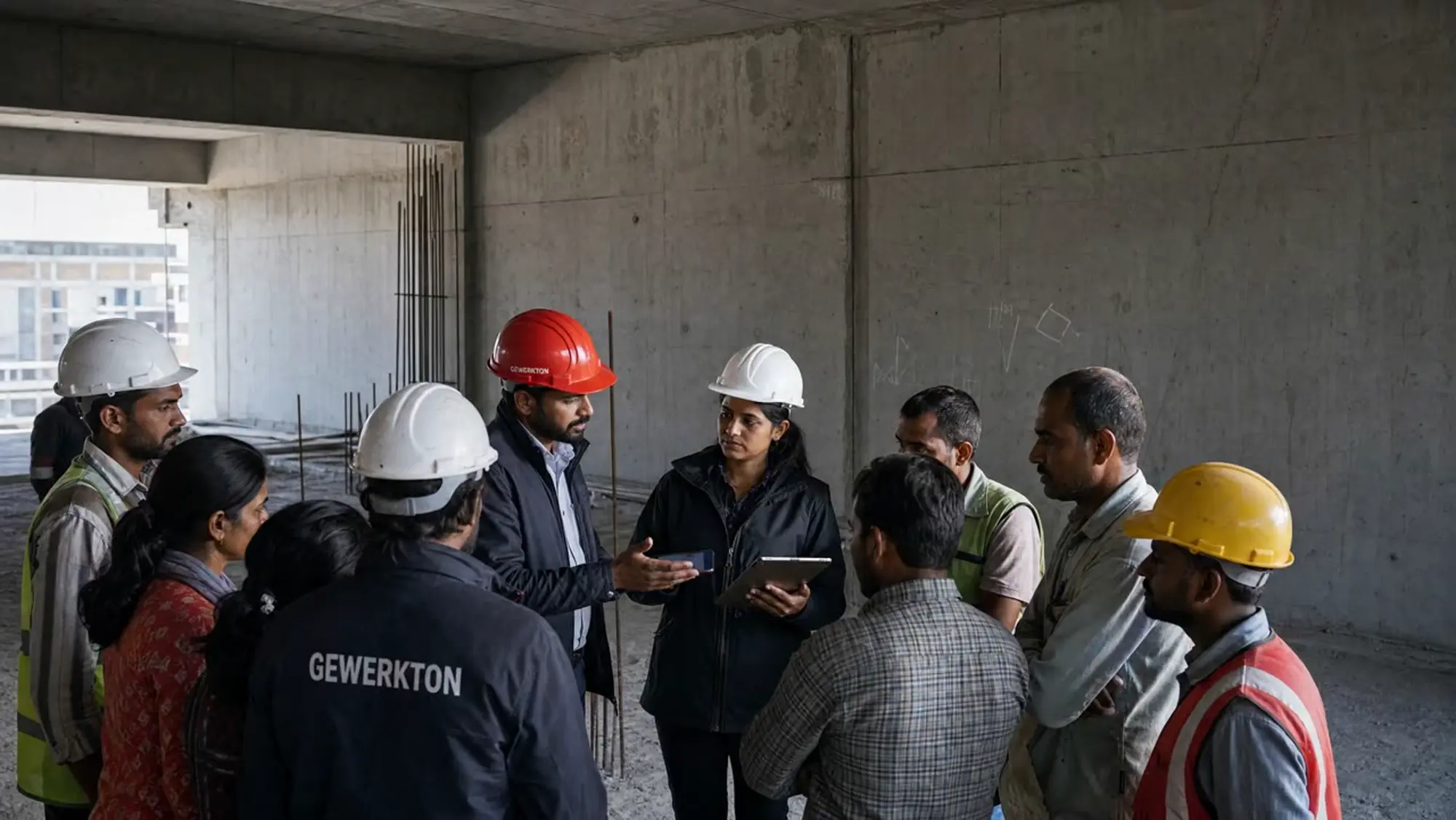
Voice-first capture recognises that the first account may arrive faster and more naturally as speech. But a multilingual system must distinguish transformation from erasure. Turning speech into a useful report is valuable; keeping the original evidence unambiguous is equally important.
The same distinction helps when meeting decisions in data centres and industrial plants become trade-sorted task lists. Structure turns discussion into work that can be followed. The translated result should support that transformation without presenting generated prose as a substitute for the source evidence.
Localisation also includes infrastructure choices
Language does not exist separately from where its processing takes place. Gewerkton supports BYO-AI across 13 AI providers, with users bringing their own keys and selecting providers by region: EU, US or Asia, including mainland China. The stated purpose is provider choice without vendor lock-in.
That regional choice is relevant for projects in Asia, including teams speaking Chinese, Korean and Vietnamese. The workflow is multilingual from capture to report, while data residency is selected by the user. More broadly, deployment can use an EU cloud or the customer’s own infrastructure.
The deepest commercial integration remains German, including GAEB, REB, XRechnung and DATEV. That history is worth stating plainly because global language coverage and regional integration are different things. Twenty-seven content languages do not imply identical commercial depth in every market.
The marketing site follows another deliberate infrastructure position: it is available in 27 languages, uses zero trackers, requires no cookie banner and has a fully egress-free architecture. Its media bank contains more than 51 self-produced clips and posters. Together, those choices make the public presentation multilingual without making translation the only measure of international readiness.
Field, Studio and Cloud share the documentation chain
The three product lines divide responsibilities without breaking the evidence flow. Field handles site capture and site-facing workflows. Gewerkton Studio provides the browser workspace for plans and models, including browser-based model creation when no model exists. Gewerkton Cloud coordinates operations and model data between Field, Studio and third parties.
This shared chain is more consequential than perfectly polished standalone prose. A translated note gains value when it remains connected to the defect, plan, model, photograph, deadline, signature or original audio it concerns. Localisation should help different readers enter that chain in their own language without blurring which item is the evidence and which text is an interpretation of it.
A beta with a clear lesson
Gewerkton is in beta now. Its public beta is planned for fall 2026. That status should frame any assessment of the product: this is an active system still approaching public beta, not a finished account of every localisation problem.
Even so, the field report is already useful. Shipping in 27 content languages reveals how quickly translation moves and how stubbornly localisation resists shortcuts. The KVKK incident shows that plausible legal language can be invented. Malay and Indonesian reduplication show that a hyphen can carry linguistic weight. Character budgets show how one language’s compactness becomes another language’s interface bug.
Above all, the work shows why construction documentation cannot rely on prose alone. Language changes as records cross borders, but structured evidence can keep their meaning anchored. Translation opens the record to more people. Localisation makes the product usable in their language. Photos, deadlines, signatures and original audio help preserve what the record is actually based on.
The first ninety per cent may make a multilingual product visible. The final ten per cent makes it credible.
Fall Picks
fall essentials
As an affiliate, we earn on qualifying purchases.